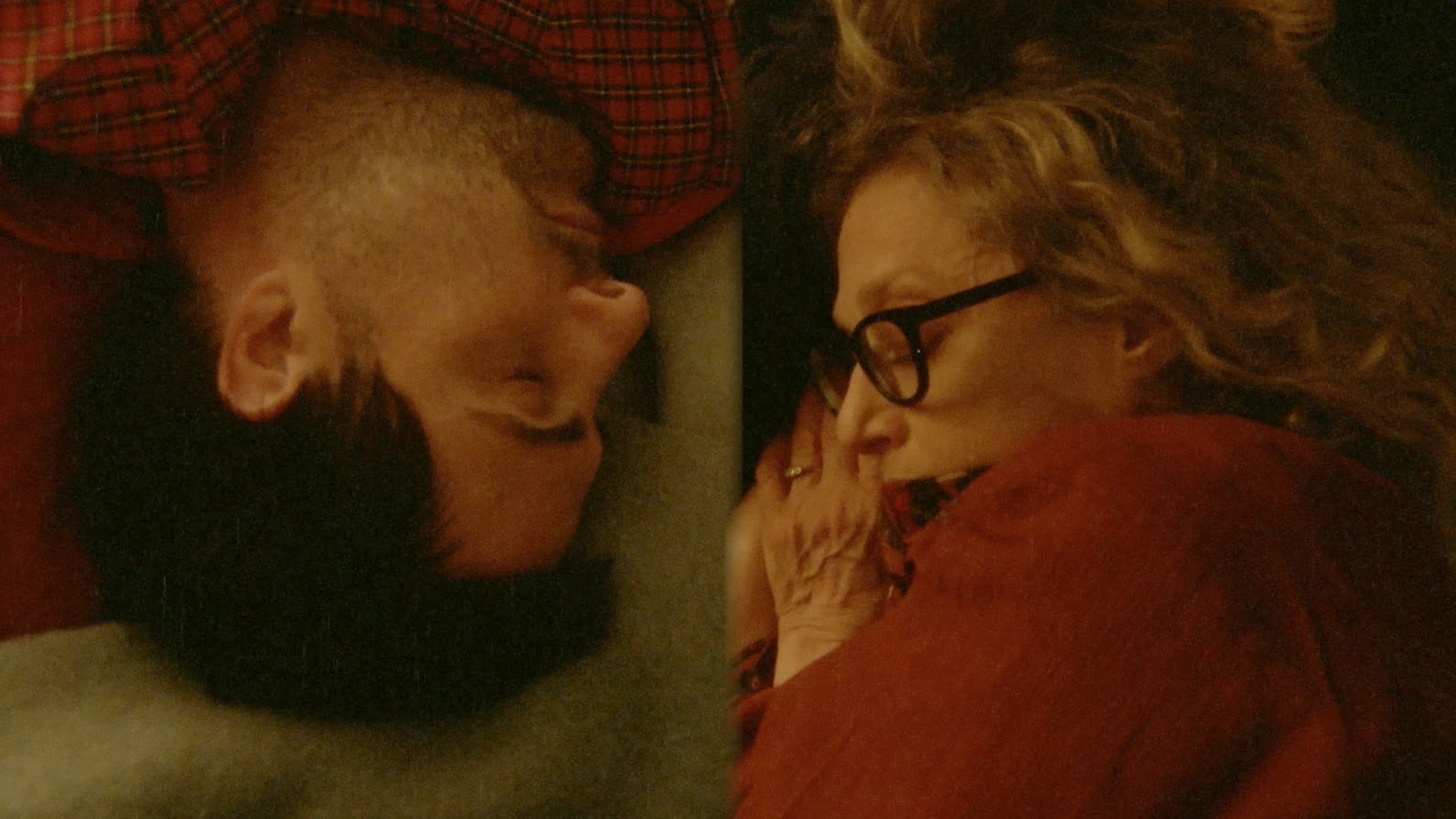
Photo caption: Mo Chara, DJ Próvai and Móglaí Bap and in KNEECAP. Courtesy of Sony Pictures Classics.
In the raucouscomedy Kneecap, a trio of Belfast slackers get busted for spraying some pro-republican graffiti, and, in the police station, resist by refusing to speak anything but the Irish language. When the frustrated anti-republican constabulary kick them loose, the guys form a hip-hop group that raps in Gaelic, with the provocative name Kneecap. Amazingly enough, this is the actual origin story of the real band Kneecap, whose members (Mo Chara, Móglaí Bap and DJ Próvai) play themselves in this film.
While Kneecap is about promoting Irish nationalism by embracing the Irish language, it has the tone of Roadrunner versus Wiley Coyote. Plenty of comic situations arise as our three rascals play a frenetic cat-and-mouse with the humorless and repressive cops. Adding a layer of complication to their new local notoriety, the father of one of the band members has faked his death to hide from both the cops and the IRA. The father is played by German-born but Irish actor Michael Fassbinder, he of the two Oscar nominations, who has somehow found himself in this goofy little movie.
You won’t see a more energetic movie this year. Kneecap is the first narrative feature for director and co-wrier Rich Peppiatt, and he is responsible for the zesty pace, even throwing animation and camera effects into his spicy movie, and he’s pulled it off with some first-time screen actors.
Kneecap is a good choice for those especially interested in Ireland, or for those in the mood for some harmless bawdy fun. Mid-movie, The Wife said “at this point, it’s gonna become predictable”, but then she was pleasantly surprised.
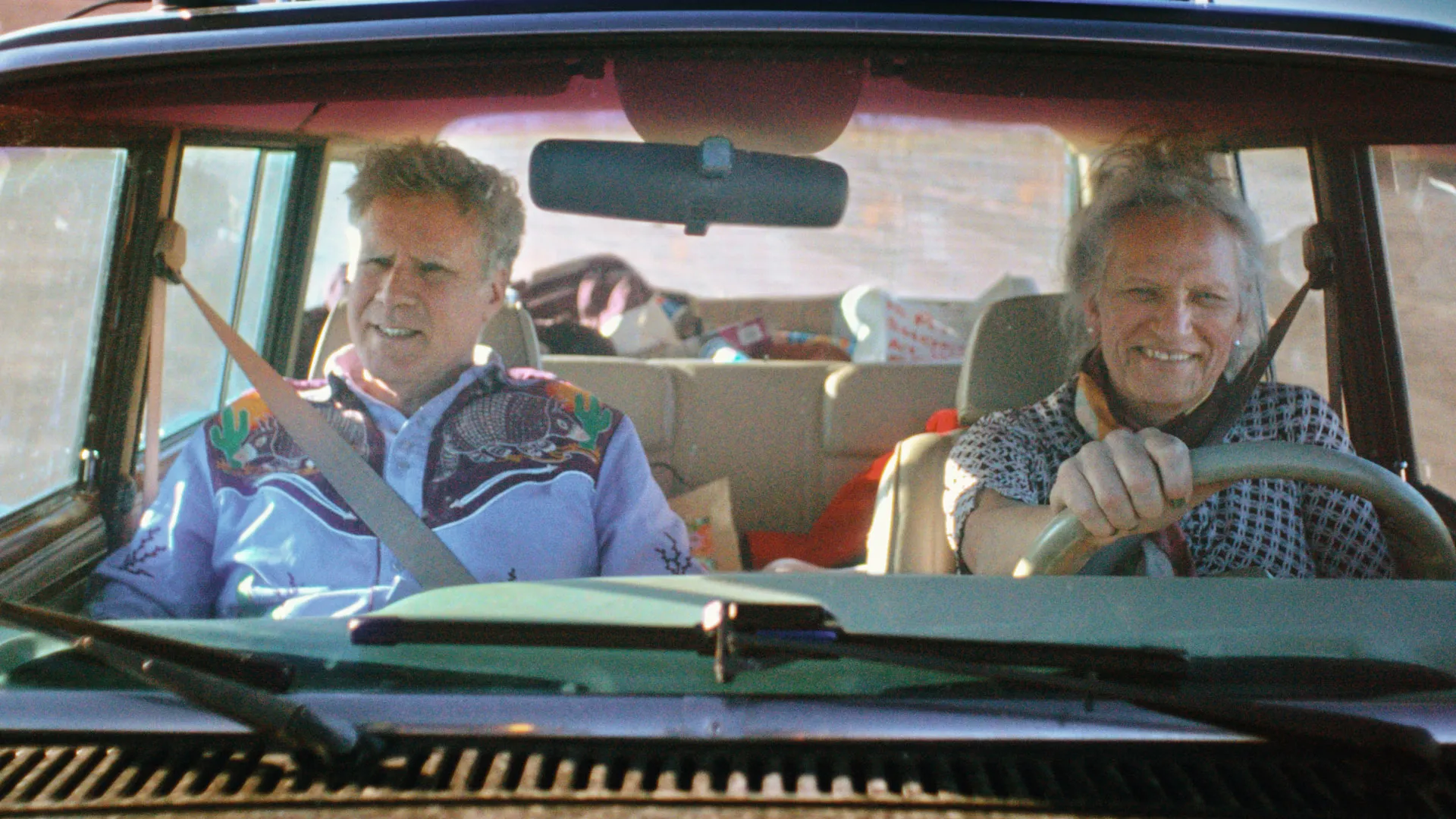
Photo caption: Will Ferrell and Harper Steele in WILL & HARPER. Courtesy of Netflix.
The Netflix doc Will & Harper features a road trip by Will Farrell and his longtime friend, former SNL writer Harper Steele, who has transitioned. Steele, who has recently transitioned, has always relished auto journeys across the back roads and small towns of America, and wonders if this pleasure is still open to her as a trans woman; Ferrell is going along for support.
The two start at Steele’s home outside New York City and end up on the beach in LA. As they stop in Indiana, Steele’s hometown in Iowa, Oklahoma and Texas, The Wife and I found ourselves cringing and holding our breaths. There are both sweet moments of acceptance and ugly moments of hostility.
The specific case of Steele and Ferrell is used to flesh out why and how one transitions, and how friends can be both curious and supportive.
Ferrell’s celebrity is a subtext here; he clearly enjoys (and maybe needs to be) recognized. Steele is cognizant of how she is treated (or even acknowledged) in or out of Ferrell’s presence.
I have not been a fan of Ferrell’s brand of comedy, but I have to commend Ferrell for his loyalty to a friend and his generosity in spending over two weeks on this cross-country road trip. Ferrell casts his vanity aside to show one episode where he badly misjudges a situation and worsens Steele’s discomfort.
Of course, Ferrell and Steele are both comedy professionals, and they are funny people, as are their SNL pals, about ten of whom show up from time to time. When Will & Harper wants to be funny, it’s funny. When it wants to be emotional, it’s genuinely emotional.
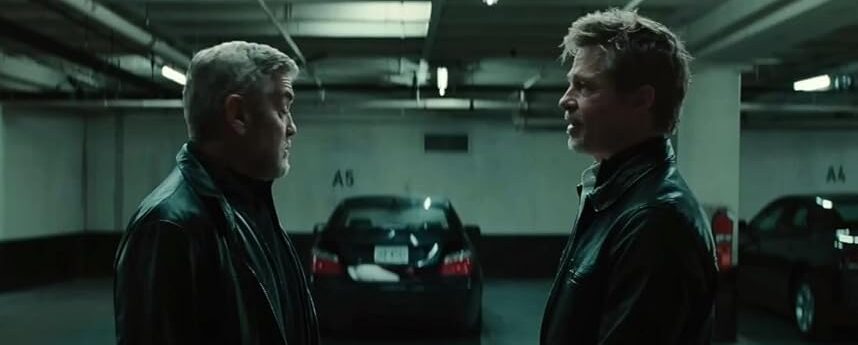
Photo caption: George Clooney and Brad Pitt in WOLFS. Courtesy of Columbia Pictures.
The crime comedy Wolfs is about the job of fixer, the guy you call when somebody has OD’d in your hotel room and you need someone to clean up the scene as if it had never happened (think Harvey Keitel’s The Wolf in Pulp Fiction). The premise of Wolfs is that TWO fixers are called to the same scene. Both are highly skilled professionals, paranoid, have big egos and are used to working alone. They are also super cool and played by George Clooney and Brad Pitt.
They bicker and posture, and, as they go about their job, circumstances make the situation more dangerous and desperate. Plenty of laughs follow, along with an excellent and imaginative nighttime chase through NYC.
Wolfs is all about the plot and the charm of its stars – it’s really just disposable entertainment. That’s not bad, because it doesn’t take itself too seriously and it’s well-crafted for what it is. It doesn’t take itself very seriously. The last two minutes is an unmistakable homage to to a very popular 1969 movie.
Some really fine actors show up in very small roles: Amy Ryan, Richard Kind and Zlatko Buric (so good in Triangle of Sadness). There’s a very funny performance by Austin Abrams as a slacker piñata in way over his head.
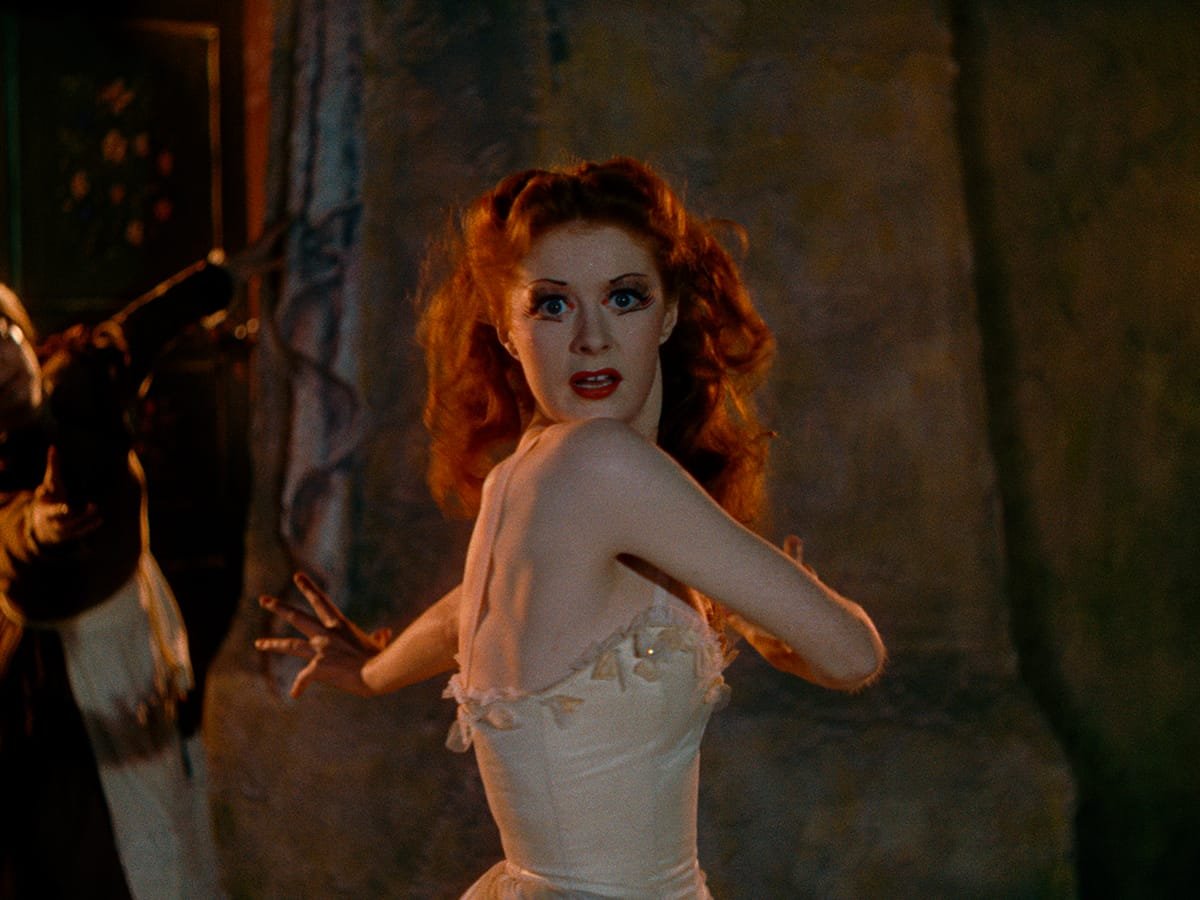
Photo caption: a scene from THE RED SHOES in MADE IN ENGLAND: THE FILMS OF POWELL AND PRESSBERGER. Courtesy of Cohen Media Group.
Martin Scorsese was immensely impacted by the work of British filmmakers Michael Powell and Emeric Pressberger, and, in his documentary Made in England: The Films of Powell and Pressberger, he explains how and why. It’s like a guest presentation in film school.
The screenwriter Pressberger wrote director Powell’s 49th Parallel, one of the very best WW II propaganda films. They found themselves to be each other’s muse. The two co-directed One of Our Airplanes Is Missing in 1942 and continued to co-direct 16 films through 1959’s Night Ambush. Their oeuvre includes several films generally acknowledged as classics of cinema: Black Narcissus, The Red Shoes, A Matter of Life and Death, and one of my personal favorites, The Life and Death of Colonel Blimp. The creative partnership wore itself out in 1959, but the two remained close friends, and were unashamed to describe their partnership as based on love.
Along the way, they routinely discarded cinematic conventions to make risky innovations:
Pausing the story in The Red Shoes to mount an original ballet in its entirety.
Using one actress to play three different roles in Colonel Blimp.
Building the drama to the pivotal duel in Colonel Blimp and then audaciously NOT showing the actual fight.
The humorous use of hunting trophies to mark the time passages in Colonel Blimp.
Using filmed music in Black Narcissus.
Evoking the set and production design of Fritz Lang’s iconic Metropolis in A Matter of Life and Death.
Switching between black-and-white and color in A Matter of Life and Death.
Creating Tales of Hoffman as a “composed film”, a marriage of cinematic imagery with operatic music.
A scene from A MATTER OF LIFE AND DEATH in MADE IN ENGLAND: THE FILMS OF POWELL AND PRESSBERGER. Courtesy of Cohen Media Group.
After his association with Pressberger, Powell made what I consider his best film, Peeping Tom, which was released in the same year as Hitchcock’s Psycho; I find Peeping Tom to be the better film, and more shocking and disturbing..
Made in England makes a passing reference to Powell’s last film, Age of Consent, but doesn’t mention that it features a voluptuous, nubile 24-year-old Helen Mirren naked.
Here’s another random thought sparked by Made in England – Anton Walbrook, who is not in the pantheon of famous actors from the Golden Age, was a really excellent actor.
Now you might NOT want to go to film class, and, in that case, this is an Eat Your Broccoli movie. But if you’re a hardcore cinephile and/or a Scorsese fan like me, this film is for you.
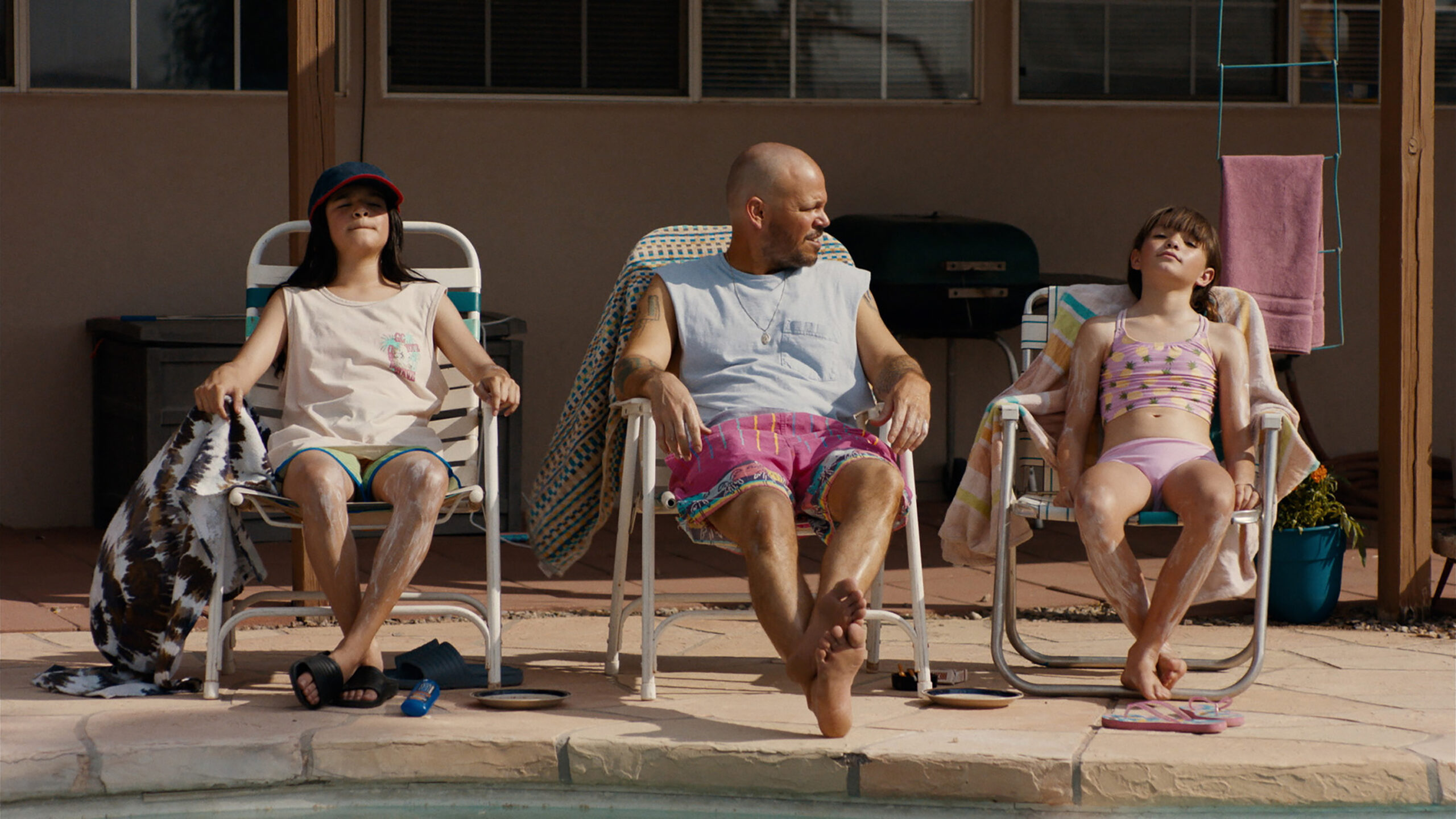
Photocaption: Rene Perez Joglar (center) in IN THE SUMMERS. Courtesy of NashFilm and Music Box Films.
In the remarkably authentic and evocative In the Summers, two sisters fly to Las Cruces, New Mexico, for annual summer visits with their divorced dad. The father, Vincente, played by Rene Perez Joglar (AKA the rapper Residente) is a spirited and talented underachiever who tries to show them a Disney Dad experience; the girls soak up the fun, but also absorb lessons about Vincente’s less reliable characteristics. Each summer, the girls return to Las Cruces with additional savvy and sponge up real world lessons from Vincente’s changing behavior.
The girls arrive expecting last year’s Vincente, but they get a new model, shaped by his changing circumstances and emotional needs, and reflecting how he sees himself. From year to year, Vincente bounces between unearned swagger to self-loathing distraction to an uneasy humility. It’s a compelling coming of age for the daughters.
Carmen (Emma Ramos), the bartender at the local pool hall, is the one consistent sounding board who can validate what the girls are experiencing with their dad.
Joglar’s performance, only his second acting role in a narrative feature and first lead, is remarkable. He is able to portray a character who is the same man at the core, but whose behavior each year is formed by the cumulative slings and arrows of his life.
The three sets of actors playing Violeta and Eva as they mature (Dreya Castillo and Luciana Eva Quinonez, Kimaya Thais and Allison Salinas, Sasha Calle and Lio Meliel) are excellent. So is Emma Ramos (New Amsterdam) as Carmen.
Writer-director Alessandra Lacorazza Samudio is able to convey so much narrative without spoon-feeding the audience. She positions the audience in the point of view of the watchful daughters, as they they to assess what is going on with their own father. She also gets fine performances out of actors with little or no movie experience. In the Summers is a triumphant debut feature for Lacorazza and marks the emergence of very promising filmmaker,
In the Summers was my favorite film at last month’s Nashville Film Festival, and it’s now in arthouse theaters.
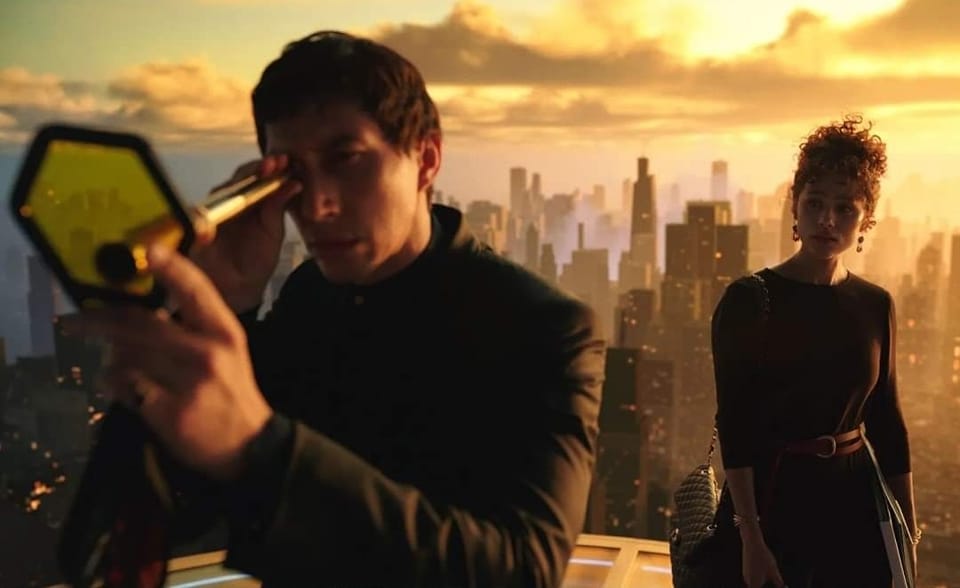
Photo caption: Adam Driver and Nathalie Emmanuel in MEGALOPOLIS. Courtesy of Lionsgate.
The epic Megalopolis is Francis Ford Coppola’s labor of love, a project he had been imagining since the 1970s. I’m glad he finally got to make the movie he wanted to make. Sadly, it’s not good.
Megalopolis is set later in this century in a New York City fictionalized as New Rome. Cesar Catilina (Adam Driver), a visionary urban designer, seeks to replace midtown Manhattan with his creation, a utopian built environment. From his aerie atop the Chrysler Building, Cesar is as unaccountable Robert Moses in The Power Broker. Cesar must overcome the resistance of the vision-impervious mayor Cicero (Giancarlo Esposito), the psychotically venal aristocrat Clodio (Shia LaBeouf) and Cesar’s own ruthlessly avaricious mistress Wow Platinum (Aubrey Plaza). Mayor Cicero’s Wild Child daughter Julia (Nathalie Emmanuel) sets out to punish Cesar for Cesar’s disrespect to her father, but she becomes fascinated by him.
Obviously, no one can imagine razing and rebuilding 100 contiguous square blocks of Manhattan without some hubris, and Cesar has plenty. Of course, he has invented a miracle building material, won a Nobel Prize and has the super power of stopping time. But his hubris makes him underestimate his enemies at his peril. Soon, Cesar and New Rome are plunged into a convulsion of betrayal and treachery. Will Cesar and his vision survive?
The visuals are astounding. New Rome is so dystopian that we yearn for the Times Square of Joe Buck, Ratso Rizzo and Travis Bickle. Ben Hur-like gladiator battles emerge, and a circus looks like Baz Luhrman’s Moulin Rouge. There’s no shortage of eye candy.
Unfortunately, there are also no shortage of movie-killing flaws. The first is the revolting pretentiousness. Each chapter is introduced with a self-important title, carved into stone, no less. Great Thinkers, from Marcus Aurelius to Ralph Waldo Emerson, are quoted, and, just in case that isn’t elevated enough, Latin is occasionally uttered. Every time poor Lawrence Fishburne speaks in voice-over, he’s proclaiming something ridiculously heavy-handed without any irony. All of these Great Thoughts are about as deep as the inside of a Hallmark greeting card.
The second major flaw is that Megalopolis is a message movie with a message that is naive and simplistic. Coppola seems to have missed the core lesson in The Power Broker, which is that the tradeoff for letting an unaccountable visionary build great things in a city, is that the result may be unjust, and that regular people are stripped of any ability to control their own lives. Everybody likes freedom, which requires the messiness and inefficiency of democracy. Coppola wants us to root for Cesar because he is vaguely high-minded, but letting Cesar have his way on everything is pretty disrespectful of Cesar’s fellow citizens.
Third, with one exception, the characters are cartoonish, like they’ve been pulled from a Batman movie. As a result, we don’t care about them. For example, there’s never been an actress better equipped to play a dangerous, sexy conniver than Aubrey Plaza; but here, Plaza only gets to act like a comic strip version of a dangerous, sexy conniver. Clodio is a silly cross between a Bond villain and Dr. Frank-N-Furter from The Rocky Horror Picture Show (and Shia LaBeouf ‘s eye makeup sometimes makes him resemble TV character actor Anthony Zerbe). Cesar himself toggles between smug and tortured with little texture.
Finally, the story is often incomprehensible.
This all makes for a wretched movie-viewing experience.
There are a few bright spots. Nathalie Emmanuel seems to be acting in a different movie than the rest of the cast, and imbues her Julia with life force, charisma and genuine feelings. Ratso Rizzo and Joe Buck themselves are back in very small parts. Dustin Hoffman sparkles as a big city fixer. Jon Voight plays a doddering financier with the dulled eyes and speaking mannerism of Donald Trump – very funny. And what about the name of Aubrey Plaza’s character – Wow Platinum? What would her stripper name be?
It pains me to pan a Coppola movie. Casablanca remains my favorite all-time movie, but The Godfather Part II is probably my #2. Godfather II, along with The Godfather, The Conversation and Apocalypse Now! are films that have impacted me deeply. That being said, as fond of Coppola as I am, and even reverential, I haven’t been enraptured by his post-1979 body of work.
In the first 20 minutes of Megalopolis, I resolved that I didn’t care about any aspect of the film and was going to walk out, but somehow stayed for the entire two hours, eighteen minutes, You don’t need to.
Photo caption: Goya Robles and Arata Iura in TOKYO COWBOY. Courtesy of Salaryman.
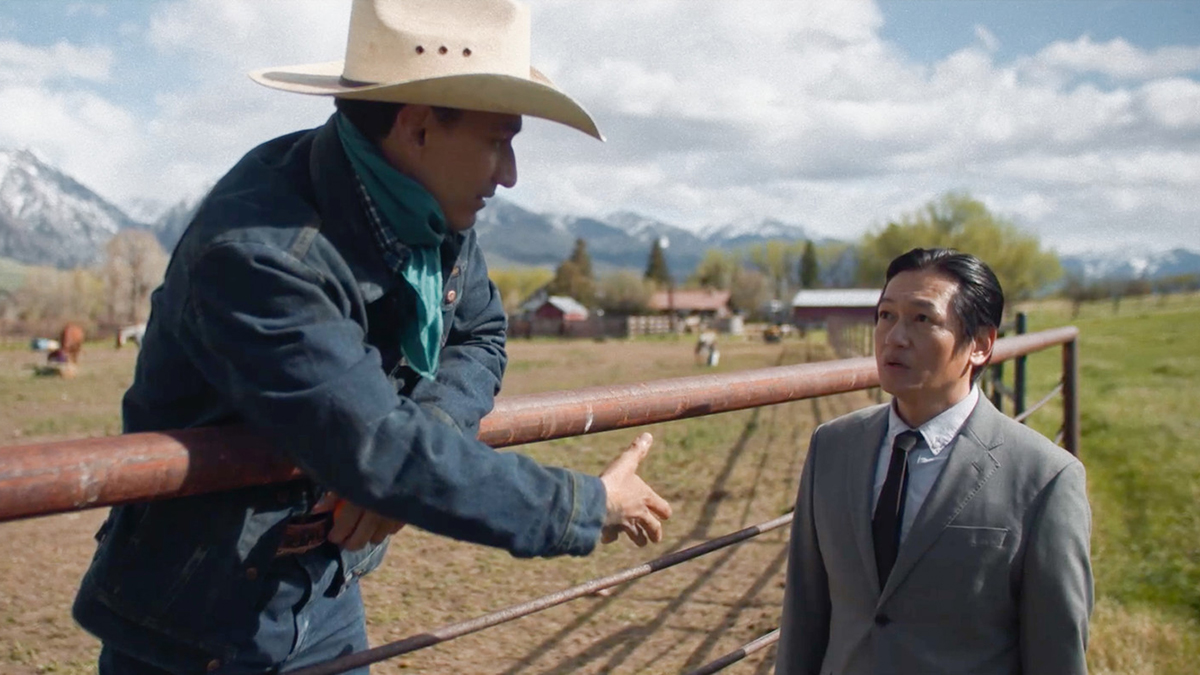
The charming dramedy Tokyo Cowboy centers on a Japanese corporate turnaround artist, Hideki (Arata Iura). Confident that he has the secret sauce to recharge any stagnant brand, he’s got a slick pitch deck (with a snapshot from his own childhood), and he’s engaged to the corporate vice-president he reports to. His company is about to liquidate a money-hemorrhaging cattle ranch in Montana, when he parachutes in for a quick fix. His Japanese beef consultant goes hilariously native, and Hideki, a smart guy, immediately sees that his idea for a quick fix was mistaken. Now unsettled and off the grid in an alien culture, Hideki recalibrates his values and his life goals.
Arata Iura’s performance is exceptional, especially since the character of Hideki is a restrained man from a very reserved culture, a cypher who is dramatically changing internally. Ayako Fujitani is very good a Hideki’s fiancé/boss Keiko. Robin Weigert (Calamity Jane in Deadwood) is excellent as the ranch manager. Jun Kunimura (222 IMDb credits) is hilarious as Hideki’s cattle expert.
Arata Iura and Ayako Fujitani in TOKYO COWBOY. Courtesy of Salaryman.
It’s the first narrative feature for director Marc Marriott, who, with cinematographer Oscar Ignacio Jiménez, creates a Big Sky setting that could reset any of us in need of self-discovery. Some directors would have ruined this story by making the fish-out-water comedy too broad or the self-discovery too self-important, but Marriott strikes the perfect tone. The screenplay was co-written by Ayako Fujitani (who plays Keiko)) and Dave Boyle.
I screened Tokyo Cowboy for the SLO Film Fest, where it won the jury award for Best Narrative Feature. Tokyo Cowboy opens on September 28 at the Lark in Larkspur and on October 25 at the Palm in San Luis Obispo.
In Nathan Silver’s comedy Between the Temples:, Jason Schwartzman plays a cantor whose wife’s death the year before has plunged him into despair; he is so paralyzed by depression, he has even lost his ability to sing. He has a chance meeting with his childhood music teacher (Carol Kane), now a retired widow.
Despite her age and his resistance, she insists on joining the bat mitzvah class he teaches at the temple. She’s a force of nature and may have enough gusto to overcome his angst. As their friendship evolves, will it bring him out of his funk?
Between the Temples is co-written by C. Mason Wells and director Nathan Silver. There are plenty of chuckles arising from Schwartzman’s character trying to neutralize his former teacher’s tsunami of will. And there are LOL moments from Madeleine Weinstein’s hilarious turn as as the rabbi’s lovelorn daughter Gabby.
Kane is excellent, and so is Dolly De Leon, who stole Triangle of Sadness, sparkles as a relentlessly determined Jewish mother. The prolific comedy writer Robert Smigel appears as the rabbi.
I screened Between the Temples for this year’s San Francisco Jewish Film Festival; Between the Temples opens in Northern California theaters this weekend.
The coming of age dramedy Didi explores that moment of maximum awkwardness and intensity for boys – the summer before entering high school. Their universe is their peers, and their desperation to be accepted and to avoid embarrassment is overwhelming. At the same time, raging testosterone seems to be crowding out the ability to think.
Didi is set at that moment (2008?) when teenagers were migrating from Myspace to Facebook. Chris Wang (Izaak Wang) lives with his older sister, their mom and his dad’s elderly mother in the Silicon Valley suburb of Fremont; the dad is away on a tech job in Taiwan. The mom (Joan Chen) has her hands full running the household by herself, and her would-be career as a fine arts painter is just not happening.
There’s a lot of immaturity in our world, but little is as obnoxious as that of a 14-year-old boy. Chris plunges ahead brashly, with a social clumsiness that is remarkable even for a young teen male. .
He is fascinated by a girl, but his best friend accurately observes that “you have zero game“. Chris also identifies what he thinks is a short cut to popularity, as a skate board filmer, but without any of the requisite preparation. He doubles down on a series of postures. One of the funniest aspects of Didi is Chris’ gift for telling pathetically naked lies that will inevitably be exposed.
Not only do Chris’ poses fail to work, he self-isolates and self-humiliates. He is going to have to learn whether he can accept who he is and is not, whether his sister is his ally instead of his antagonist, and whether his mother has something to offer besides meal preparation.
Didi features another stunning performance by Joan Chen as a mom absolutely beaten down by household drudgery, her ungrateful kids, and relentless criticism from mother-in-law. Through most of the film, the character is an emotional pinata, but Chen finishes the story with moments of searing humanity.
Didi is the first narrative feature written and directed by documentarian Sean Wang, who was nominated for an Oscar last year for his short film Nai Ni and Wai Po. Wang brings us into a teen milieu with unsurpassed authenticity.
Note: As a Bay Area native, I was confused by the Wang family home being in Fremont, but Chris starting to attending Fremont High, which is twenty miles away in Sunnyvale; that’s a dumb-down for the non-Bay Area audience. Writer-director Sean Wang himself grew up Taiwanese-American in Fremont and attended Irvington High.
Photo caption: Denzel Washington in THE LITTLE THINGS. Courtesy of Warner Bro. Pictures.
I finally caught up with caught up with the neo-noir crime procedural The Little Things on Netflix, and it’s much better than I expected. I had skipped it until now because, upon its 2021 release, it disappointed critics who were eagerly awaiting this neo-noir with Oscar-winners Denzel Washington, Rami Malek and Jared Leto. Its Metacritic rating is a middling 54. True, it’s no David Fincher or Martin Scorsese movie (or even a John Dahl movie) but, compared to the other noirish crime procedurals that you could be streaming (and I watch scores of them), it’s pretty good.
Denzel plays Joe Deacon, who is a deputy sheriff in Kern County, not an exalted position in law enforcement. We learn that Deacon used to be a crack detective in Los Angeles County, but something happened that caused him to leave that department. A Kern County departmental errand takes him back to his old stomping grounds in LA, where some old-timers greet him warmly and some warily. There’s a murder that bears resemblance to an unsolved serial killer case that still obsesses Deacon and the young up-and-coming detective Jimmy (Rami Malek) invites him to help.
The two hash through clues, augmented by Deacon’s institutional memory and his hunches. After some wrong turns, the evidence hints at a primary suspect, Albert Sparma (Jared Leto). Yes, it’s a whodunit, but the real story is about how the earlier unsolved case broke Deacon emotionally, and whether this unsolved case will do the same to Jimmy. Late in the film, there is a reveal of the moment that devastated Deacon. I loved the ending, which is about whether Deacon can find a way to save Jimmy.
Denzel Washington elevates any material and that’s the case here. Nobody does a profoundly sad and very masculine man as well as Denzel. There’s a scene where he drops by and greets his ex-wife which is wrenching, all because of the heartbreak in his eyes. Plenty of actors can portray an emotionally tortured character in a showy performance (think Nic Cage), but Denzel, in an utterly contained performance, can make us understand how a man who is doing everything to conceal his pain, is really shattered to the core.
Malek, whom I have never warmed to, is as reptilian as usual, contrasting oddly with his character’s suburban poolside family.
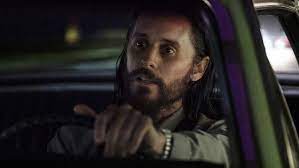
Jared Leto in THE LITTLE THINGS. Courtesy of Warner Bro. Pictures.
Leto does creepy magnificently, and his Albert Sparma has an especially twisted menace about him.
The Little Things was written and directed by John Lee Hancock, who directs better movies that others write (The Rookie, Saving Mr. Banks, The Founder) than the ones he writes (The Alamo, The Blind Side, Midnight in the Garden of Good and Evil). The Little Things is a bit too long at 2:08.
Still, Denzel’s performance and the ending make The Little Things a worthwhile watch for fans of neo-noir and of crime procedurals. The Little Things is included with Netflix and Max subscriptions and rentable from Amazon, AppleTV, VUDU and YouTube.