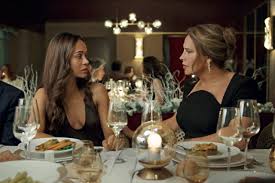
Photo caption: Zoe Saldaña and Karia Sofia Gascon in EMILIA PEREZ. Courtesy of Netflix.
The Netflix original Emilia Pérez is a sweeping musical melodrama that explores the toll of the violence on Mexico. Four women each ache for a fundamental change in their lives: one to be rewarded in money and status for her talents, one to be reunited with an old lover, one to resolve her husband’s disappearance and one to emerge in a different body. The film is very well-acted and expertly made.
Wikipedia describes Emilia Pérez as a “French musical crime comedy“, which is only accurate to a point. Its director and the author of the source novel are indeed French. The story is mostly set in Mexico, with stops in London, Lausanne, Bangkok and Tel Aviv. The dialogue is in Spanish and English. And it stars four actresses from the US, Mexico and Spain.
Zoe Saldaña, Karia Sofia Gascon, Selena Gomez and Adriana Paz shared the Best Actress award at Cannes. We see the story unfold through Saldaña’s eyes, and Gascon’s character drives the story. Gomez has a smaller, but important role, and Paz has the least to do.
The entire movie pivots around a a huge surprise early in the film, so I’m not going to spoil it by talking much about the plot. Suffice it to say that Karia Sofia Gascon’s particularly brilliant performance is uniquely challenging.
I’m not a fan of musicals generally, but the musical numbers are good and well-staged. Most arise organically from the story, which I prefer, as opposed to “and then they break out in song”, I don’t think any of the songs will become standard show tunes.
The director, Jacques Audiard, paces Emilia Pérez very well and makes the Mexican scenes especially vivid. He directed two films that ended up on my best-of-the-year lists, A Prophet and Rust and Bone.
While I admired, the filmmaking, the story, somewhere between operatic and telenovela, was a little soapy for my taste.
Photo caption: Mark Eydelshteyn and Mikey Madison in ANORA. Courtesy of NEON.
In Sean Baker’s thrilling comedy Anora, Ani is a young Brooklyn lap dancer and escort who besots an even younger Russian customer, Ivan (Mark Eydelshteyn). Ivan is the son of a billionaire Russian oligarch, and the two spend several days, and countless thousands of Ivan’s unlimited fortune, partying. Ivan even impulsively takes Ani and four of their friends to Las Vegas on a luxury spree. There, Ivan convinces Ani to marry him before they return to Ivan’s NYC mansion.
But, just as they are settling into married life, Ivan’s parents catch wind of what is, to them, an unacceptably scandalous marriage and head to New York on their private jet. In the mean time, the parents order their NYC fixer and his team to corral the young lovebirds and undo the marriage.
Ani and Ivan are mismatched, but not because of his wealth and her poverty. The most important contrast between them is that he has never had to work or fight for anything, and she has worked and fought every day for her own survival.
Giggly, giddy and ever stoned, Ivan is spoiled and extremely immature; (he acts like his maturity was stunted at 13). This is a person who has never lived a moment of responsibility, nor has even a thought of responsibility crossed his mind. He sees a green card marriage as an escape from his Russian family and (horrors!) a future career as an oligarch-in-training. That’s a fantasy. Billionaires giveth and billionaires taketh away
The fixer (Karren Karagulian), his Armenian henchman (Vache Tovmasyan) and a Russian hooligan (Yura Borisov) arrive at the mansion and all hell breaks loose. From this moment, Anora, which has been very entertaining, vaults into a rollicking, hilarious thrill ride. Ani is a woman of uncommon spirit and is immediately too much for the oligarch’s Russian-speaking crew to handle.
Ani and the goons spend the next twelve hours on a raucous and hilarious nighttime manhunt through NYC that had the audience HOWLING with laughter – and this was a 4 PM weekday arthouse audience. I haven’t been in a theater audience that laughed so hard since Barbie.
And then there’s the last two minutes or so of the film, in which director Sean Baker sharply changes the tone of Anora. The audience was filing out, asking each other What was THAT? I thought that, given what Ani had experienced in the past forty-eight hours, Ani’s reaction in the ending was profoundly truthful, and elevated the movie from one of the year’s most fun movies to one of the best.
Anora springs from the mind of writer-director Sean Baker, whose signature is using first-time actors to tell the stories of people on the margins. His best films before Anora have been his first three: Starlet, about a young San Fernando Valley woman in the porn industry and her unlikely friendship, Tangerine, about two Hollywood Boulevard transgender hookers (shot on an iPhone), and The Florida Project, about latchkey kids in a poverty motel.
Mikey Madison (center) in ANORA. Courtesy of NEON.
Ani is a force of nature, and her spirit eventually earns her kindness from an unexpected source. Mikey Madison’s performance as Ani is stunning, bringing an aching humanity and authenticity to Ani and showcasing a remarkable gift for physical comedy. Madison stars in the TV series Better Things and played a bloodthirsty Manson Girl in Once Upon a Time in Hollywood… This is her first non-teenage starring role in a feature film.
Of the most significant roles, only Madison and the actors playing Ivan and his parents and the young Russian goon, Igor, (plus the tow truck driver) have substantial screen acting experience outside Sean Baker films. In just his fourth screen role, Tovmasyan is wonderfully watchable as the movie’s human piñata.
Mikey Madison and Yura Borisov in ANORA. Courtesy of NEON.
At first Yura Borisov’s Igor seems to be only what he is paid to be – a tagalong thug. But one of the pleasures of Anora is watching Igor regard the other characters and silently judge their behavior. Borisov starred in Compartment No. 6, one my favorite films of 2022. That film won the Grand Prix, essentially the second place award, at Cannes. This year, Anora won the top award at Cannes, the Palme D’Or. Quite a run for Borisov.
How often can a raunchy comedy win the Palme D’Or and contend for the Best Picture Oscar? Sean Baker and Mikey Madison are making that happen this tear with Anora.
Here’s a film like nothing we have seen. In the unique documentary The Remarkable Life of Ibelin, a wheelchair-bound Norwegian man named Mats Steen dies young. Unable to work, he had spent his adult life consumed by the online fantasy game World of Warcraft, isolating himself from his family, friends and outside activities. His heartbroken family remembered that Mats had a blog, so they posted the news of his death on the blog in case he had any readers. To their (and the audience’s) shock, scores of emails immediately flooded in. It turns out that Mats, as his game avatar Ibelin, was a beloved member of a community, lived a rich and connected life on-line and touched many lives in several countries with his empathy and personal support.
Now, that’s plenty of a story as far as it goes, but then director Benjamin Ree takes things to a dimension I haven’t seen before. Having scored a massive archive of game-play code, Ree was able to reconstruct Mats’ life as Ibelin in the on-line game. It looks like the photo below.
THE REMARKABLE LIFE OF IBELIN. Courtesy of Netflix.
The game footage is braided with the current reflections of his friends as they recount what all of them were going through at the time. It’s a genre-busting take on the documentary form.
I couldn’t find an available photo of the non-game part of the movie to include at the top of this post. I didn’t want this photo to lead off the review because I was concerned that reader would think it was an animated movie and choose not to read about it.
As a movie studio, Netflix is IMO producing a tsunami of disposable content, all baked to formula for what people feel like watching on TV, with a heavy dose of true crime, rom coms, outlandish thrillers, etc. Much of this is watchable and some very good, but it’s mostly not very culturally nutritious. Netflix tries to mask the mediocrity of its mass content by funding a few of cinema’s best directors to make something elevated: Alfonso Cuarón (Roma), Martin Scorsese (The Irishman), Jane Campion (The Power of the Dog), Richard Linklater (Hit Man). But, I gotta give credit to Netflix for funding Ree and his entirely fresh (and decidedly non-formulaic) vision.
I must admit that I generally don’t link real human emotion to fantasy animation and gaming. However, The Remarkable Life of Ibelin is one of the most genuinely evocative, heartbreaking and sweetest movies of the year.
Ree is a young (this is only his third feature) Norwegian documentarian. I see that his The Painter and the Thief is streaming, so I think I’ll take a look at it, too.
The Remarkable Life of Ibelin is streaming on Netflix.
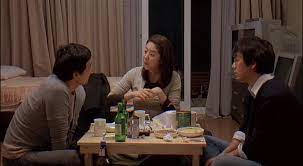
Photo caption: Ha Seong-guk, Kim Min-hee and Shin Seok-ho in IN WATER. Courtesy of Cinema Guild.
In Hong Sang-soo’s In Water, an actor-director (Shin Seok-ho) is plunging his savings into a short film that he is directing. He rents a three-bedroom house on the seaside for a week to house himself, an actress (Kim Min-hee) that he’s worked with before and a cinematographer (Ha Seong-guk) that he and the actress don’t know. The problem is that the director still doesn’t know what his film will be about.
The three walk along the shore and eat take-out food, while the director keeps delaying the shoot, stalling until his has an idea. The actress and the cinematographer, with more patience than the audience, are trying to figure out what’s going on. Finally, the director has a mundane encounter with a local that he replicates in his film, and tops it with a quietly dramatic statement about his own artistic malaise. In scenes that portray the director’s indecision, Hong Sang-soo intentionally blurs the camera (see image below) and plays tinny music.
Kim Min-hee, Ha Seong-guk and Shin Seok-ho in IN WATER. Courtesy of Cinema Guild.
Writer-director Hong Sang-soo cranks out little, intimate, clever films like Woody Allen did in his heyday and is kind of his own genre. As he demonstrates in Yourself and Yours, Claire’s Camera, Walk-up and The Woman Who Ran, Hong is a droll observer of human behavior. There’s usually a movie director character and lot of drinking and eating in his films. He checks the boxes here, with meals and snack runs and a shoju binge.
I always enjoy watching Kim Min-hee, she of the riveting performance in The Handmaiden. She’s a huge star in Korea, but she’s in an off-screen relationship with Hong Sang-soo, and she’s been showing up in his little movies.
I’ll watch any Hong-Sang-Soo movie, but I don’t think this one pays off. Even though it’s only 60 minutes long, I can only recommend In Water for hardcore Hong Sang-soo fans. I do recommend that you sample Hong Sang-soo by watching his You, Yourself and Yours, which I tagged as “Buñuel meets Seinfeld”; you can find it titled Yourself and Yours streaming on AppleTV and YouTube.
Photo caption: Ralph Fiennes (front) in CONCLAVE. Courtesy of Focus Features.
In the satisfying thriller Conclave, the pope dies and all the cardinals gather in the Vatican to elect a new pope. Cardinal Lawrence (Ralph Fiennes) has the responsibility for organizing and presiding over the election.
Cardinals may be princes of the Church, but they arrive like other business travelers; they’re towing their rolling luggage, obligingly going through the metal detector and huddling outdoors for a quick last smoke. They are put up in surprisingly spare Vatican rooms (far less adorned than a suite in a Courtyard by Marriott). The nun who is the pope’s household manager (Isabella Rossellini) imports a battalion of nuns to cook for and serve the cardinals.
Lawrence has to keep pivoting as weird things begin to happen. There’s a rumored secret report that no one can find. A noisy midnight fracas erupts in one of the cardinals’ rooms. There’s a earthquake-like rumbling noise outside. And a cardinal arrives who no one had known about, having been secretly appointed by the late pope.
Now can you call a movie with septuagenarians padding about in embroidered robes a “thriller”? You bet. Plot twists fall like dominoes, all the way up to an absolutely unpredictable gobsmack of an ending. Conclave’s screenplay was adapted from Robert Harris’ novel.
Of course, this setting is perfect for conspiracies and cover-ups. The Vatican has been mastering clandestine intrigue for over a millennium.
The story is perfectly paced by director Edward Berger, whose last film, All Quiet on the Western Front, was nominated for nine Oscars and won four. Conclave, too, is award-worthy – Berger fills the screen with stunning images: the white-mitred cardinals listening to a homily, the cardinals in their richly red robes arrayed behind tables in the Sistine Chapel, and a flock of white umbrellas being carried across a Vatican plaza.
The cast is first-rate, led by Fiennes, whom The Wife pointed out is in every scene. His Lawrence is a product of more liberal modern times, yet pragmatic about what changes are possible in the hidebound institution. Lawrence loyally carries our his duties to the Church while undergoing his own internal crisis of faith.
Isabella Rossellini’s nun is formidably fierce and tightly restrained (until she isn’t). Stanley Tucci is excellent as a respected idealogue who strains to cover up his own brittleness. John Lithgow, as one of the most ambitious cardinals, exudes oleaginous sanctimoniousness. Lucian Msamati projects the jolly confidence of a man who expects to become the first African pope. I especially admired Sergio Castellitto’s performance as a reactionary papal candidate; the character could easily have been portrayed as a cartoonish villain, but Castellitto’s unrelenting charm offensive and his gregarious energy make him a credible challenger to the others.
The newly discovered cardinal is played by Carlos Diehz in his first feature film. Diehz emanates a profound, magnetic sincerity. There is no movie here without Diehz’ quiet gravitas.
Conclave is the first big Oscar-bait movie of the 2024 Holiday season, and it will earn both popularity and prestige.
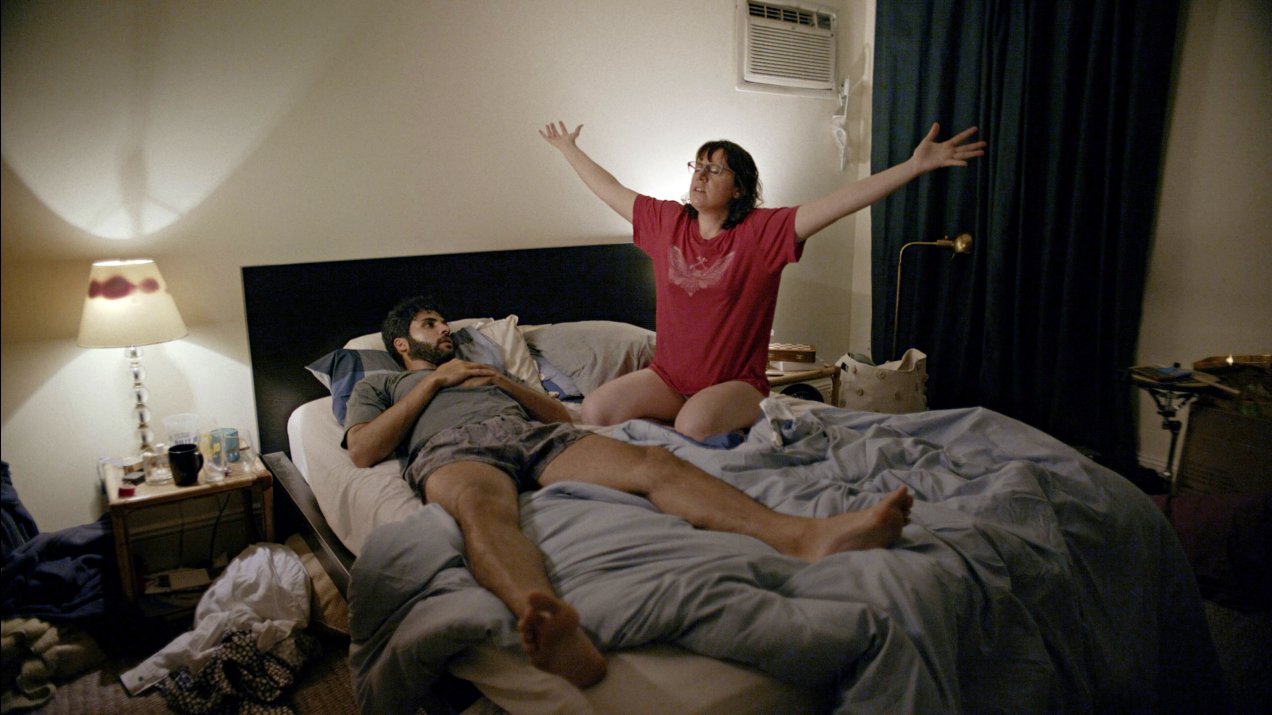
Photo caption: Babak Tafti and Joanna Arnow in THE FEELING THAT THE TIME FOR DOING SOMETHING HAS PASSED. Courtesy of Magnolia Pictures.
You won’t see a more uniquely original film than the deadpan comedy The Feeling that the Time for Doing Something Has Passed. When we meet the protagonist Ann (played by writer-director Joanna Arnow), she’s in a situation of literal dissatisfaction. Although she is particularly vulnerable in this moment, dissatisfaction seems to be the theme of her life.
Ann is smart and witty, but no one in her life SEES her. She’s so invisible to others, that her workmates award her a one year-anniversary prize, when she’s been there for three years. Her boyfriend is remarkably self-absorbed, selfish and distracted. Her parents are blissfully too far on the other side of the generational divide to relate supportively; (there’s a rollicking scene where they break into Solidarity Forever at a vacation cabin).
Ann decides to stop settling, drops her boyfriend and embarks on meeting new guys with a dating app. But her indignities, at work and on the dating trail, continue with deadpan hilarity. Will she reach a point of self-discovery?
I’ve been burying the gob smack lead, happily perverted as it is. Ann and the men she dates are into BDSM, and Ann is a submissive. When we see someone whom we think has low self esteem as sexually submissive, we may gasp at what looks like exploitation. But, we’re wrong about Ann’s self-esteem – she won’t let herself be victimized. She may be suffering the slings and arrows of life, but she is not going to see herself as a loser.
Arnow’s performance is remarkably brave and adept on several levels. Most obviously, Arnow spends much of the movie naked, and her body more resembles those of her audience members than those of most big screen leading ladies. She’s also frequently engaging in submission sex play, and all that “yes, Master” sounds silly to those not into BDSM.
The Feeling that the Time for Doing Something Has Passed is the first narrative feature that Arnow has written and directed. I can’t wait to see what she comes up with next.
I understand that this is not a movie for everyone. Some will put off by the BDSM sex play and by a woman constantly in submissive positions. But, uniquely, this is a story told from tha woman’s perspective, and I think the payoff makes the film worth sticking through any discomfort.
This a droll masterpiece of transgressive originality. After a blink-and-you’ve-missed-it theatrical run earlier this year, The Feeling that the Time for Doing Something Has Passed is streaming on Amazon, AppleTV and Hulu.
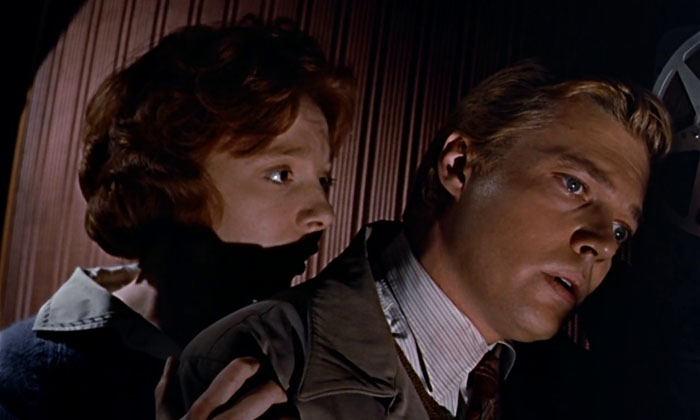
Photo caption: Anna Massey and Karlheinz Böhm in PEEPING TOM.
On October 30, Turner Classic Movies broadcasts the best-ever psycho serial killer movie. Peeping Tom was released in 1960, the same year as Psycho. The British film critics didn’t know what to make of a thriller where the protagonist was so disturbing, and they trashed Peeping Tom so badly that its great director Michael Powell (The Life and Death of Colonel Blimp, Stairway to Heaven, Black Narcissus, The Red Shoes) wasn’t able to work again in the UK. But, I think Peeping Tom is an overlooked masterpiece and is even better than its iconic counterpart Psycho.
Karlheinz Böhm plays a mild-mannered urban recluse who most people find socially awkward, but wouldn’t necessarily suspect to be a serial killer. The very innocent downstairs neighbor (Anna Massey) finds him dreamy and in need of saving – not a good choice.
Two aspects elevate Peeping Tom above the already high standards of Hitchcockian suspense. First, he’s not just a serial killer – he’s also shooting the murders as snuff films. Second, we see the killer watching home movies of his childhood – and we understand that ANYONE with his upbringing would be twisted; he’s a monster who repels us, but we understand him.
Until the last decade, Peeping Tom was unavailable, but you can find it streaming now on Amazon, AppleTV and Criterion. There’s also a superb Criterion Collection DVD with lots of extra features.
Again, TCM airs Peeping Tom on Wednesday (conveniently right after Psycho).
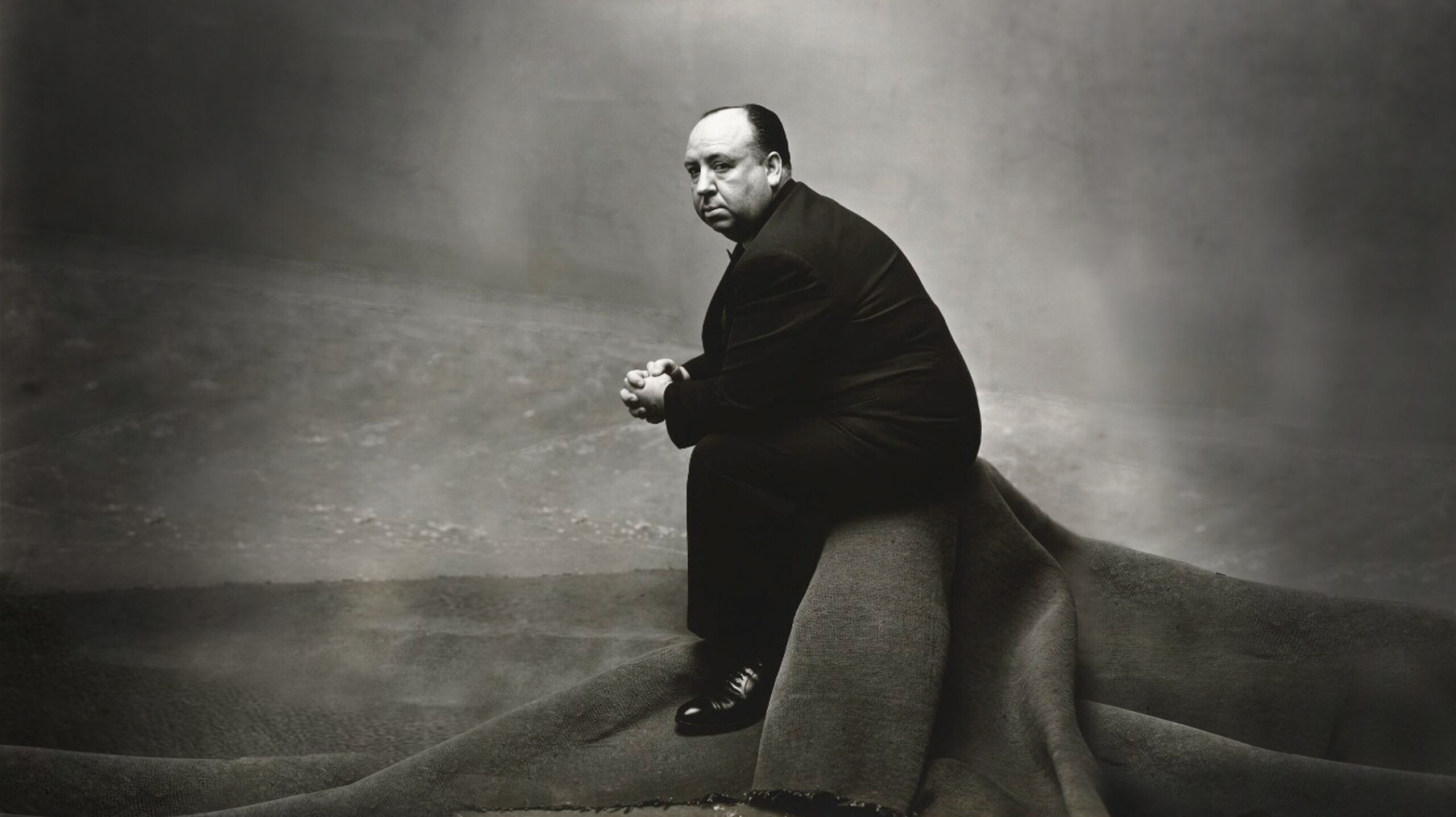
Photo caption: Alfred Hitchcock in MY NAME IS ALFRED HITCHCOCK. Courtesy of Cohen Media Group.
The clever documentary My Name Is Alfred Hitchcock celebrates the filmmaking genius of Alfred Hitchcock. Writer-director Mark Cousins uses the cheeky device of resurrecting Hitchcock to narrate the film himself; (Hitchcock is voiced by an uncredited Alistair McGowan).
This isn’t a paint-by-the-numbers, chronological biodoc. Instead, Cousins explores, one by one, signatures aspects of Hitchcock’s filmmaking. In clip after clip, Cousins shows us examples of Hitchcock’s camera placement, humor and manipulation of the audience. Above all, as a storyteller, Hitchcock delighted in the role of trickster, and Cousins embraces Hitchcock’s playfulness.
Although it isn’t a conventional film class survey, Cousins manages to touch on Hitchcock movies from his silents through his final film (Family Plot). We see Hitchcock’s deployment of Ivor Novello, Robert Donat, Joan Fontaine, Judith Anderson, Robert Cummings, Tallulah Bankhead, Joseph Cotten, Theresa Wright, Ingrid Berman, Claude Raines, Gregory Peck, Montgomery Clift, Janet Leigh and Paul Newman, not mention the iconic use of Doris Day, Kim Novak, Tippy Hedren, Cary Grant and Jimmy Stewart.
My Name Is Alfred Hitchcock opens in LA and NYC theaters this weekend.
Photo caption: Saiorse Ronan in THE OUTRUN. Courtesy of Sony Pictures Classics.
In the moving drama The Outrun, Rona (Saiorse Ronan) has escaped a difficult childhood in the harsh isolation of the Orkney Islands to achieve a Master’s in biology and a laboratory job in London. Like many of her twenty-something peers, she likes to party, and she’s also self-medicating from painful childhood issues, and the alcohol is controlling her. The drunken Rona thinks she’s having fun, but her friends and the audience cringe. She’s a falling-down, blackout drunk, and she loses her job, her romantic partner and her personal safety.
Rona recognizes that she must leave London for any chance at successful recovery, and returns to her parents’ sheep farm in the Orkneys. Her parents, while loving, aren’t able to provide an optimal recovery environment. Her father (Stephen Dillane) suffered a bipolar breakdown when Rona was a little girl, and now lives in a trailer on the farm, often incapacitated by depression or mania. Her mother (Saskia Reeves ), who lives in the farm’s cottage, responded by plunging into religion and sees everything through that lens. On Orkney, Rona has support from others in recovery and is safe from the temptations of nightclubs (there aren’t any), but she’s reminded of the childhood pain that she was self-medicating for. She moves to an even more isolated island in the Orkneys and faces herself.
This is a clear-eyed, unsparing look at alcoholism and recovery, of which relapse is a common element.
Reeves and Dillane are excellent, and Ronan will certainly be Oscar-nominated for an ever authentic and stunningly vivid performance.
The Outrun was directed by Nora Fingscheidt and adapted from the memoir by Amy Liptrot. The entire movie is good, but the final 20 seconds are perfect.
The dramatic weather of the Orkneys, raging from bleak to impressively violent, is another character in The Outrun; as turbulent as is Rona’s life, the weather rages even more.
Thanks to Saiorse Ronan, The Outrun is raw, moving and satisfying.
Photo caption: Hitoshi Omika in EVIL DOES NOT EXIST: Courtesy of Janus Films.
I was delighted when Evil Does Not Exist finally trickled on to VOD recently. I had been eager to se it because of my admiration for it’s writer-director Ryusuke Hamaguchi, whose last movie, Drive My Car, made #1 on my Best Movies of 2021. Evil Does Not Exist had also won the Silver Lion at the Venice Film Festival. Unfortunately, I didn’t like it.
This parable is set in a tiny village nestled in remote mountains (shot near Nagano, Japan), with its surrounding forest still wild and relatively untouched. Takumi (Hitoshi Omika) is the village jack-of-all-trades, and he is attuned to the natural cycles of life in the forest. A hospitality corporation has bought land outside the village and hopes to attract tourists to a newly developed glamping camp.
Takahashi (Ryûji Kosaka) is the PR guy dispatched to sell the project to the locals and preempt any political resistance from them. When Takumi raises concerns at a community meeting, Takahashi smoothly tries to deflect them. However, Takahashi privately recognizes that Takumi is right – the project’s lack of adequate septic capacity will imperil the village’s drinking water. Takahashi is the most interesting character in the fil, as he takes risks to push back internally against the company line.
In a devastating ending, Takumi, who has been stewing about the water issue, reacts to an urgent situation by taking an action that was hard for me to understand.
Evil Does Not Exist has been described as mesmerizing, and that’s how I found the extended introduction to be, but but too many scenes are way too long, especially the community meeting. I’m more patient and receptive to slow burns than most movie viewers, but, IMO, this story needed to be told more economically. Then, the ending lost me.
Now, I’m an outlier here. Besides its slew of prestigious festival awards, Evil Does Not Exist has an 83 rating on Metacritic, including raves by some of my favorite critics.
Evil Does Not Exist is streaming on Amazon, AppleTV and Criterion.