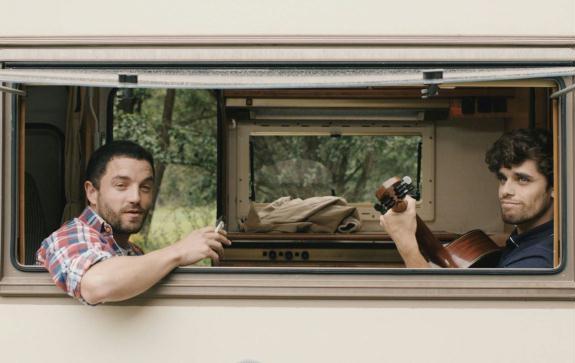
In the Belgian comedy Mobile Home, two underachievers in their late 20s, decide to move away from their parents. They move into a Fiat version of a Winnebago so they can tour the world. But their big move isn’t really that independent because they park the new home on wheels within an easy drive of their parents. The question in Mobile Home is whether either of them will catch even a whiff of adult responsibility or whether they will continue denying that it is time to get a real job.
This Belgian story is smarter than most Hollywood bromances, but nothing we haven’t seen before. A nice little festival film.
I saw Mobile Home at the San Francisco Film Society’s French Cinema Now series. The trailer is in French without subtitles.
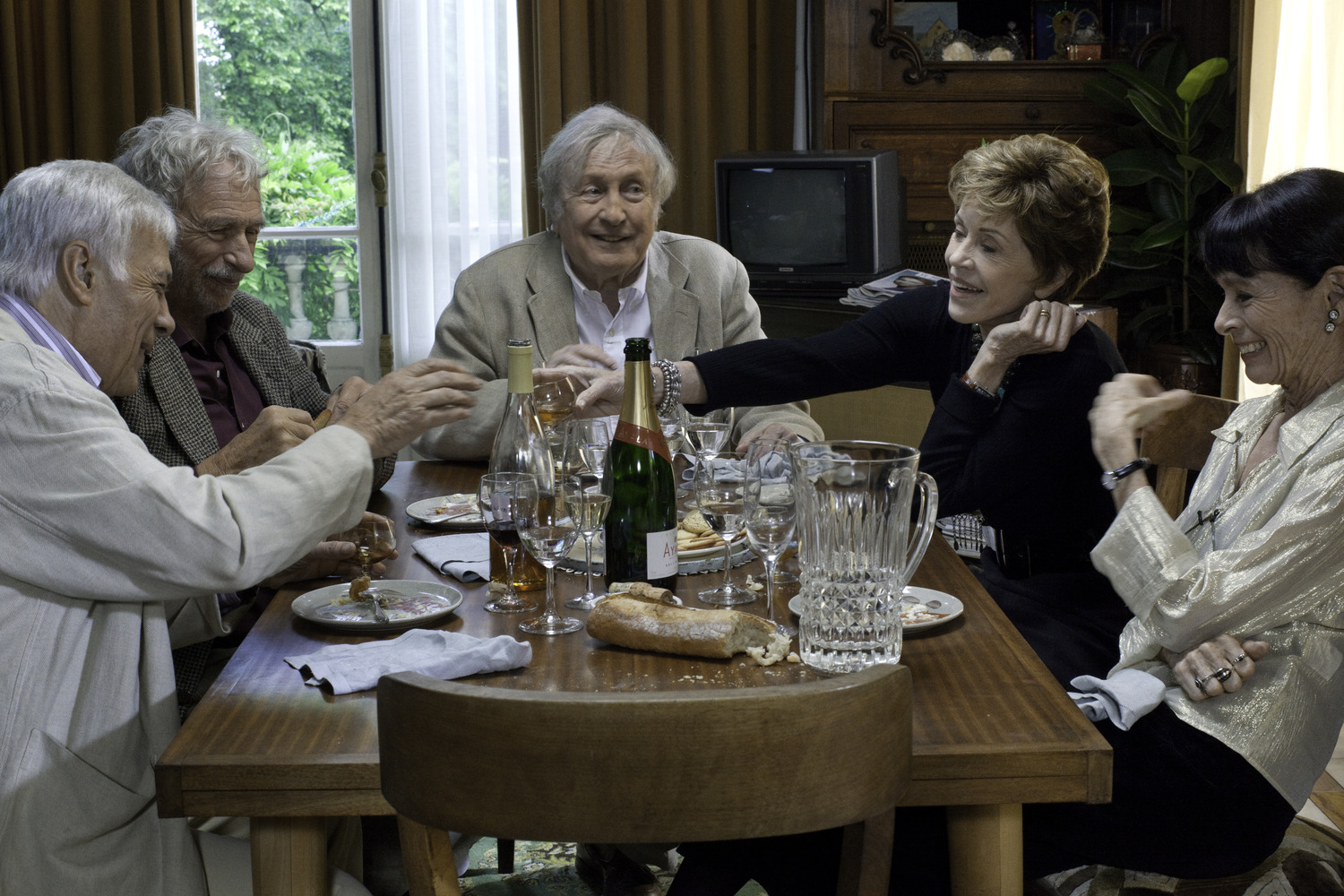
All Together (Et si on vivait tous ensemble?) is a poignant French comedy about five septuagenarian friends who decide to eschew the nursing home and live communally. They hire an anthropology grad student as a caregiver, and he changes his thesis topic to study the social and sexual behavior of the European elderly.
The comedy comes as they resist the insults of age. One elderly activist, bullhorn in hand, is dismissed as an impotent, harmless crank when the cops refuse to arrest him at a demonstration even when he hits a cop in the helmet with a bottle.
The excellent cast includes Jane Fonda (acting for the first time in fluent French in thirty years). Geraldine Chaplin, who has acted in French, Spanish, Italian and German films over the years, is impressively spry. The great French comic actor Pierre Richard (The Man with the One Brown Shoe?) is brilliant as a man terrified by his increasing loss of memory.
Although it covers similar territory as this year’s indie hit The Best Exotic Marigold Hotel (a slightly better film), they are different movies, with All Together more focused on mortality and the infirmities that come with age.
I saw All Together at the San Francisco Film Society’s French Cinema Now series. All Together is now available in the US on Video On Demand, including Amazon Instant Video.
In this indie drama, a couple navigates life while drunk. Can they stay together and flourish when she sobers up? Smashed is a remarkably realistic portrayal of the drinking life and the challenges of recovery and relapse, informed by the personal experience of co-writer Susan Burke.
The best thing about Smashed is the performance of Mary Elizabeth Winstead as the wife. Winstead realistically takes her character through the carelessness, denial, humiliation and self-degradation of drinking and the fears and determination that co-exist in her recovery. It’s a stellar performance, and I’ll be looking for Winstead in bigger roles.
Also very good are Nick Offerman as the wife’s colleague, Megan Mullally, unrecognizable as the wife’s boss, and the always delightful Octavia Spencer.
As The Wife pointed out, the amount of time that director and co-writer James Ponsoldt spent on the drinking part of the story means that lots of plot points whiz by in the final ten minutes. Still, Smashed is very watchable and benefits from the breakthrough performance by Winstead.
We usually think of sex as the culminating manifestation of lust and/or romantic love. The Sessions is an exploration of sex (first) leading to emotional intimacy.
John Hawkes plays a man in an iron lung seeking to lose his virginity to his sex surrogate (Helen Hunt). The premise may seem farfetched, but it’s based on the life of Mark O’Brien, who survived childhood polio to graduate from UC Berkeley and become a poet and journalist. The kernel of this screenplay was O’Brien’s magazine essay “On Seeing a Sex Surrogate”, and O’Brien was the subject of Jessica Yu’s Oscar-winning Breathing Lessons: The Life and Work of Mark O’Brien.
As I’ve written before, I particularly loathe “disease of the week” movies, but The Sessions is completely untainted by this maudlin genre. The credit goes to writer-director Ben Lewin, himself a polio survivor, who has made The Sessions more than a movie about sex and a disability. Lewin has embedded lots of humor, along with genuine emotions.
Hawkes and Hunt will receive Oscar nominations for the kind of performances that the Academy especially loves and rewards. Hawkes spends the entire movie horizontal on a gurney with his spine contorted by a device the filmmakers labeled “the Torture Ball”. Equally courageously, Hunt is often naked (really, really naked), frankly leading the couple through simulated sexual acts.
But don’t be put off by the showy aspects of the performances, which are authentic and riveting. Hawkes, who is best known for his scary and creepy roles in Winter’s Bone and Martha Marcy May Marlene, embodies a witty man who has overcome more than most, but who fears the depths of his own vulnerabilities. Likewise, Hunt goes very deep to express emotions that take her by surprise.
Beyond Hawkes and Hunt, The Sessions is uniformly well-acted. I especially enjoyed the performances of William H. Macy as a goofily sympathetic Berkeley parish priest, Moon Bloodgood as a poker-faced but playful caregiver and Ming Lo as an amusingly dense hotel clerk.
Lewin, Hawkes and Hunt have combined to make an uncommonly evocative, funny and thoughtful film. The Sessions was an audience fave at the Sundance and Toronto film fests. (Plus it’s a great date movie.)
Ethel is a fine HBO documentary on the life of Ethel Kennedy, Robert F. Kennedy’s widow. The filmmaker is Ethel’s daughter Rory, her 11th child, born six months after RFK’s assassination. Rory Kennedy had the advantage of access to a trove of photos and home movies, along with on-camera interviews with her mother and her siblings. The result is an affectionate and insightful portrait of Ethel, with the view of RFK’s career by his own family. We are surprised to learn that Ethel was the most competitive member of the family. We also learn of her impish liveliness, such as dropping “Get a new Director” into the FBI’s basement suggestion box. Ethel is an interesting woman who has lived an extraordinary life. Anyone interested in 20th Century American history should see Ethel.
Ethel debuted last week and is being rebroadcast on HBO.
Here’s a treat – Paul Williams Still Alive, an affecting documentary about the songwriter, omnipresent in the 70s, but not now. Because Paul Williams’ life story follows the arc of every episode of VH1’s Behind the Music (hits the show biz big time, does too many drugs, career crashes and burns), this film could have been trite. Instead, it’s fresh and appealing, chiefly because filmmaker Stephen Kessler is such an unabashed fan boy who glories in following Williams around, uncovering tidbits like Williams love of eating squid.
The documentary’s other cornerstone is that Paul Williams himself – now twenty years sober – is a very appealing guy. Williams doesn’t dwell on the time when he was rich, famous and unhappy. He has an edge, and doesn’t suffer fools, but he lives in the moment and it’s fun to see a guy now so content in his skin.
Paul Williams Still Alive is available now on Video On Demand, including Amazon Instant Video.
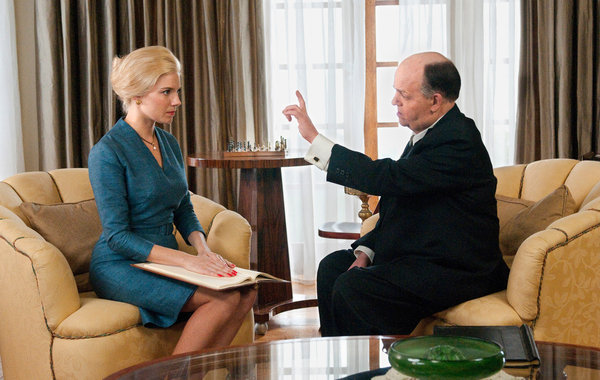
HBO’s The Girl is the story of a beautiful young woman being sexually harassed by the much older and very unattractive male boss who is responsible for her career success. In this case, the woman is Tippi Hedren, the boss is Alfred Hitchcock, and they’re making The Birds and Marnie. Unfortunately, the movie just grinds along as Hitchcock becomes more twisted and Hedren becomes more wearily traumatized. The story is based on a book by Donald Spoto, whose version of Hitchcock is not shared by other film historians.
The Girl wastes some excellent acting. Toby Jones and Sienna Miller are good as Hitchcock and Hedren. As Hitchcock’s wife and secretary, Imelda Staunton (Vera Drake) and Penelope Wilton (Downton Abbey, Best Exotic Marigold Hotel) are splendid. The Girl, which is just a dreary movie-watching experience, is now playing on HBO.
Set in 1969 Florida, The Paperboy is a coming of age film nestled within a deliciously pulpy crime drama. The story is centered around an overlooked younger son (talented up-and-comer Zac Efron) who is thrilled when his older brother (Matthew McConaughey) returns to their swampy backwater after making it in the big time of Miami. The older brother is an investigative reporter who seeks the truth about a sensational death row case.
The strength of the film is in the supporting characters. David Oyelowo plays the older brother’s cynical and self-absorbed partner. John Cusack’s death row inmate is utterly animalistic, a real departure for Cusack. Nicole Kidman plays the convict’s pen pal fiance; the younger brother falls for her, but she’s apparently screwing everyone except him.
But the surprise performance in The Paperboy is by recording artist Macy Gray, who plays the family domestic. With complete authenticity, Gray is playful, hurt, dignified, angry, funny, tough, cagy and vulnerable and, as the narrator, she keeps the movie together. It’s a really superb performance, and I look forward to seeing Gray in more high profile parts.
This is director Lee Daniels’ follow up to his heart rending Precious. Once again, his character driven story-telling is first rate. The Paperboy is dark, violent, sexy and gripping with vivid characters.
Watch for Kidman’s particularly alarming treatment for jellyfish stings.
Ben Affleck directs and stars in Argo, unquestionably the best Hollywood movie of the year so far. In this true story from the Iran Hostage Crisis, a down-on-his-luck spy rescues six Americans hiding in the Canadian Ambassador’s Tehran home by pretending to make a cheesy Hollywood sci fi movie. The scenes in Tehran and Washington are pure thriller, leavened by the very funny Hollywood thread.
It’s a gripping story. Setting up the audacious plan is only the beginning. It must be sold to risk averse government officials. And it must be sold to the “house guests”, who clearly understand how risky it is. The diplomats must learn their cover identities as Canadian filmmakers well enough to withstand interrogation. And the team must be shuttled past layer upon layer of suspicious, trigger happy and completely unpredictable revolutionaries. Helluva story, well told.
Thanks to director Affleck, editor William Goldberg and cinematographer Rodrigo Prieto, Argo is brilliantly photographed and constructed.It is economical story-telling at its best, with each shot revealing critical information – the lethal chaos in the streets of Tehran, the paralyzing fear of the house guests, the determination of Affleck’s operative.
It’s a deep cast. John Goodman and Alan Arkin are hilarious as the movie industry guys. Scoot McNairy and Christopher Denham are especially good as house guests. Farshad Farahat is compelling as the commander of the final revolutionary checkpoint. The rest of the cast is equally superb: Bryan Cranston, Philip Baker Hall, Richard Kind, Michael Parks, Clea DuVall, Adam Arkin, Chris Messina and Victor Garber. Watch for a bit role played by 80s horror maven Adrienne Barbeau.
This could have been jingoistic, but Affleck starts the movie with an animated historical primer to remind (or teach) the audience about why the Iranians were so angry. And he generously included another American perspective during the end credits. Much more nuance than the standard Hollywood movie – good for Affleck!
Upon leaving the theater, The Wife asked the revelatory question: “How come it wasn’t as good as its parts?”. True, Seven Psychopaths is well-acted by a very deep team of my favorite actors and is embedded with belly laughs, but, as a whole, it’s just not that satisfying.
Colin Farrell plays an alcoholic writer struggling to get past the title of his new screenplay. He expertly plays the straight man against an assortment of raging oddballs. Sam Rockwell is brilliant as the writer’s not-a-good-influence friend who, underneath a shiftless exterior, is profoundly psychopathic. Christopher Walken hits another home run as a dignified eccentric. And Woody Harrelson plays a pedal-to-the-metal raging psycho crime boss as only he can.
The supporting cast includes the immortal Harry Dean Stanton, Abbie Cornish, Gabourey Sidibe (Precious), Michael Pitt (The Dreamers, Boardwalk Empire), Michael Stuhlbarg (A Serious Man), Olga Kuylenko and the always reliable Zeljko Ivanek. The best performances are by Tom Waits (as a bunny-petting retired serial killer) and Linda Bright Clay (as Walken’s tough-as-nails wife).
But the story isn’t tight enough. Writer-director Martin McDonagh (In Bruges) (who doesn’t admire Quentin Tarantino) here only delivers Tarantino Lite. Instead, I recommend McDonagh’s brilliant In Bruges (and The Guard which McDonagh produced). For those who like dark, dark comedy with lots of violence, Seven Psychopaths is entertaining. For everyone else, nothing special.