Quartet, an ensemble geezer comedy, is really an excuse for four brilliant actors (Maggie Smith, Billy Connolly, Tom Courtenay, Pauline Collins) to show their chops. It’s set in a retirement home for retired musicians. The residents are preparing for an annual benefit performance, and the long-estranged ex-wife of a resident is moving in.
The most interesting character is the one played by Pauline Collins – a vivacious woman who may have always been ditzy and now has very little short-term memory. In 1996, Collins won a Tony and was nominated for an Oscar for the title role in Shirley Valentine.
Tom Courtenay plays a man still devastated by a bad breakup decades before. There’s a wonderful scene in which he explains opera to a class of working class teens by comparing it to rap. Courtenay is best known for The Loneliness of the Long Distance Runner (1962), Dr. Zhivago (1965), The Dresser (1983), but was excellent more recently in the overlooked Last Orders (2001).
Maggie Smith and Billy Connolly are very good in familiar roles. The irrepressible Connolly is very funny as a particularly randy old gentleman. Smith’s character is in her sweet spot – not unlike the sharp-edged but increasingly vulnerable gals she played in Gosford Park, Downton Abbey and The Best Exotic Marigold Hotel. The actors playing the other residents are delightful, including a passel of opera stars from the 70s and 80s, Sinatra’s European trumpet player and more.
This is the first movie directed by Dustin Hoffman, and he did an able job. He takes advantage of the beautiful pastoral location, paces the film well and, as one would expect, enables the actors to turn in very fine performances. Quartet is just a lark, but not a bad way to spend an hour and a half.
The pretty good horror movie Mama, with Jessica Chastain, can send chills down your spine without any slashing or splattering. It’s the story of two orphaned little girls who have survived in the forest for four years. When they are rescued, they are feral creatures who scurry about on four legs. They are sheltered at first in a research institute, and then in their uncle’s home. It turns out that, unbeknownst to the adult characters, the sisters were “parented” in the forest by a being who comes along with them.
Jessica Chastain brings an unexpectedly rich characterization to this genre film. She plays the uncle’s girlfriend, the tattooed bass player in a rock band, who didn’t sign up to parent two deeply troubled kids. She is apologetically non-maternal, but forced by circumstance to co-parent and then to single parent the girls. Ultimately, she has a face-off with a very jealous and very scary competitor.
The entire cast is excellent, especially Megan Charpentier as the older daughter and Daniel Kash as the ambitious scientist. Nikolaj Coster-Waldau, the scary bad guy in Headhunters, plays softer as both the girls’ decompensating dad and their compassionate uncle.
I’m generally not a fan of horror films and I especially loathe the gorefests that currently dominate the genre. But the Mama delivers the scares the old-fashioned way, with inventive characters, a sense of foreboding and a creepy and dangerous villain.
If you’re lucky, you get old. When you get old, you eventually get infirm and then you die. I generally do not focus on this grim truth, but no one can argue it isn’t part of the human condition, and director Michael Haneke explores it with his film Amour.
We meet a delightful elderly couple played by French film icons Jean-Louis Trintignant and Emmanuelle Riva. They live a comfortable and independent life, engaged in culture and current events, until she suffers a stroke. He steps up to become her sensible and compassionate caregiver. However, the decline of her health brings humiliating dependence is for her and frustration and weariness for him. It finally becomes unbearable for both of them (and for the audience).
Amour is heartbreaking, made so by its utter authenticity. I have been plunged by circumstance into the caregiving role at times, and I recognized every moment of fear, frustration, resentment and exhaustion that the husband experiences.
I tend to despise Haneke because he is a sadistic filmmaker. I hated his critically praised The White Ribbon because the audience has to sit through 144 minutes of child abuse for the underwhelming payoff that parents of Germany’s Nazi generation were mean to them. In Funny Games, where a gang of sadistic psychos invade a home, Haneke toys with the audience’s expectation that the victimized family will be rescued in a thriller or avenged – but they are simply slaughtered. However, he doesn’t manufacture cruelty in Amour, the cruelty is in the truth of the subject.
Haneke’s brilliant skill in framing a scene, his patience in letting a scene develop in real-time and his severe, unsparing style are well-suited to Amour’s story. He is able to explore his story of love, illness and death with complete authenticity. That, and the amazing performances by Trintignant and Riva, make the film worthwhile. That being said, it is a painful and not enjoyable viewing experience.
Amour is an undeniably excellent film. Whether you want to watch it is a different story.
An uncommon collection of acting talent (Sean Penn, Ryan Gosling, Nick Nolte, Josh Brolin, Emma Stone, Anthony Mackie, Giovanni Ribisi) sinks with Gangster Squad, a mob movie based on Mickey Cohn’s 1949 sojourn in LA. Because director Reuben Fleischer recently made Zombieland, which I loved for its original approach to zombie movies. Unfortunately, there is not one original minute in Gangster Squad. If you enjoy movie violence, avoid Gangster Squad and see Django Unchained a second time.
Sean Penn plays Mickey Cohn – or maybe he’s playing Joe Pesci’s character in Goodfellas. What made Pesci’s volatile character so menacing (and unforgettable) was that you never knew when he would irrationally erupt and do something unthinkably horrible. But Penn’s character is totally predictable – he always does the worst thing imaginable so there’s no menace; it’s like watching Michael Vick train dogs – just gruesome.
Gangster Squad was slated for a September 7, 2012, release, but it contained a scene of a mass shooting inside a movie theater; the Aurora, Colorado, tragedy made the distributor skittish, so another scene was shot to replace it, delaying the release for four months.
Promised Land is an engaging drama about the exploitation of natural gas in rural America – until the corny ending. Matt Damon and Frances McDormand play a team of corporate road warriors who persuade farmers to lease their land for the fracking. Based on the experience of his own hometown, the Damon character believes that the American rural way of life has become an unsustainable myth, that small farming communities are doomed without the cash from natural gas. He believes that he is suckering them into their own salvation.
It’s an “issue movie”of the kind that I often dislike. My day job is in public policy, and I see more nuance and tradeoffs than usually make it into these movies, which are often too “black hat/white hat” for my taste. Promised Land doesn’t fall into that trap because Damon’s character and because the locals are not uniformly saintly. Most of the struggling farmers can’t sign their leases fast enough. Ken Strunk plays an elected official right out of Mark Twain’s Hadleyburg. Lucas Black plays a guy who is a puddle of bad choices waiting to be made. Scoot McNairy (Argo) plays an inarticulate man of firm principles; he’s right, but he doesn’t know why.
Director Gus Van Sant (Good Will Hunting, Elephant, Paranoid Park, Milk) creates a rural community that is completely authentic without using clichés. Damon is outstanding. McDormand, John Krasinski, a frisky Rosemarie DeWitt (Rachel Getting Married, Your Sister’s Sister) and Hal Holbrook are all reliably excellent.
Unfortunately, after navigating through the conflicting values, difficult tradeoffs and shades of gray that are found in real life, the movie takes the easy way out – an improbable ending that is happy for all. Too bad – a little cynicism would have gone a long way here.
Not Fade Away is a pleasant enough coming of age story by The Sopranos creator David Chase and rocker Steven Van Zandt. It centers around the life of a 16-year-old’s garage band from 1963 through 1966. As you would expect from Chase, the movie absolutely nails the look and feel of each year of the dynamic period – a treat for Boomers. The protagonist’s generation gap with his father (James Gandolfini) climaxes in a poignant encounter in which the dad reveals a secret to his son – the only way he can find to forge a bond. Van Zandt wrote songs for the band, along with a hilarious advertising jingle for a medical supply company. But, other than that, it’s a fairly unremarkable film.
Rust and Bone is an intelligent drama about a complicated woman and an uncomplicated man. She (Marion Cotillard) takes pride and enjoyment from her high profile job and lives with a boyfriend, but she is dissatisfied. A shocking and disabling accident turns her dissatisfaction into despair.
He (Matthias Schoenaerts of Bullhead) is amiable, carnal and matter-of-fact. He wouldn’t recognize a plan or a deep thought if it smacked him on the temple. For him, stress can lead to violent outbursts, which are especially scary because he is a downscale prizefighter.
The two people form a bond, and therein lies the drama. They engage each other in differing paces at different depths, often doing the same thing for separate reasons.
Director Jacques Audiard (A Prophet) makes excellent choices throughout, especially with very effective moments of silence and near-silence, which work to emphasize dramatic events more effectively than would swelling strings.
There are also non-stock secondary characters. One is the boxer’s shady friend whose eyes never meet another’s gaze, yet dart about, never missing anything. Another is the boxer’s sister who stands for a French working class struggling with the increasingly multinational economy.
Key plot plots may sound corny in isolation, but everything in this movie works well together. It’s an intelligent, solid and worthwhile drama.
A controversy has erupted relating to Zero Dark Thirty and its depiction of torture used by American intelligence forces in the War On Terror. Critics of the movie assert that 1) the movie incorrectly shows that interrogations under torture helped track down Bin Laden and/or 2) the movie favors this application of torture. Astoundingly, much of the criticism came before the release of the film and from people who had not seen it.
It is historical fact that, during the George W. Bush administration, American intelligence forces used “harsh interrogation techniques” on detainees, some of which (including waterboarding) constitute torture. It is also well-established that torture is not an effective means of interrogation. You can check with last month’s report by the Senate Intelligence committee (reported here) and these intelligence experts interviewed on NPR (and also here).
In my view, the torture used in these interrogations violated US and international law. I also take the word of interrogation experts that torture is not effective because it does not produce reliable intelligence. To end the torture, subjects will eventually say anything that they think that the interrogator wants to hear – whether true or timely or useful or not. These experts say that more useful information is gained – without torture – by using skilled non-coercive interrogation techniques.
[SPOILER ALERT – the next few paragraphs contain key plot points. If you haven’t seen the movie, you can skip to the last paragraph for my conclusion.]
So does Zero Dark Thirty incorrectly show that interrogations under torture helped track down Bin Laden? The first hour of Zero Dark Thirty depicts the first years of the War On Terror, including several instances of interrogation with torture (which undeniably happened). In the movie, one of the pieces of information secured through such an interrogation is a nickname for one of Bin Laden’s couriers – but this tidbit does not pay off. But years go by without anyone capitalizing (or even verifying this lead). Most of the intelligence agents even believe information from another detainee that the courier is dead. In fact, years elapse and new leads come and go after the torture of detainees has ended.
Only in the ninth year of the man hunt, do the intelligence agents begin to close in by combining an overlooked tip on the courier’s family name, wiretapping the courier’s mother’s home phone, triangulating his cell phone calls (my favorite scenes in Zero Dark Thirty), putting a tail on the courier and satellite and drone surveillance of the compound. Even with this, only the Jessica Chastain character rates more than a 60% probability on Bin Laden’s location. All of this happens long after Zero Dark Thirty has shown the last of the torture – and after showing presidential candidate Obama pledging to end the practice when elected President.
Now, of course, non-critical thinkers in the audience may see torture at the beginning and the successful raid on Bin Laden at the end, and incorrectly connect the dots but, in my opinion the filmmakers cannot be held responsible for the lazy thinkers in the audience. I conclude that Zero Dark Thirty does not show that the use of torture helped to locate Bin Laden.
And does Zero Dark Thirty favor the use of torture? The torture scenes are realistic, and they are uncomfortable for the audience; they are not gratuitous. In contrast, in the Dirty Harry movies, the audience roots for Harry when he shoots the bad guy in the kneecap to get information. In Zero Dark Thirty, the filmmakers do not frame the scenes so the audience gets a kick out of the torture – even though the folks being tortured are the most despicable people on earth. I have no problem with the filmmakers showing the use of torture – it did happen and it illustrates that, in the 9/11 aftermath, the American government would go to any means to get the terrorists. Just because the filmmakers show stomach-turning torture does not mean that they endorse it. I conclude that Zero Dark Thirty does not favor the use of torture.
Finally, I am very disappointed that many commentators and political leaders that I generally agree with jumped into the fray before they saw Zero Dark Thirty. These are the same folks who, along with me, would not hesitate to ridicule the criticism of a film (e.g., The Last Temptation of Christ) by right wingers who hadn’t seen it. In this case, their criticism of Zero Dark Thirty was both unfounded and unfair.
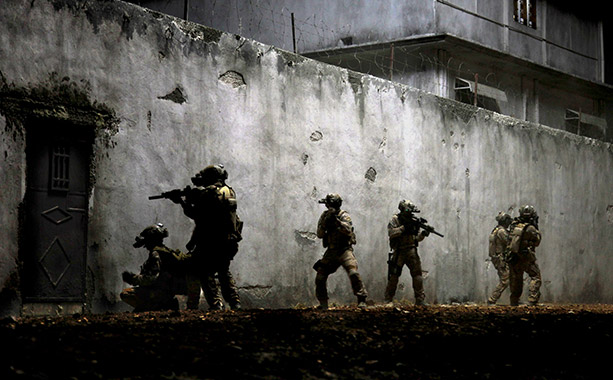
Zero Dark Thirty is director Kathryn Bigelow’s inspired telling of the hunt for Bin Laden. Bigelow, who won the directorial Oscar for The Hurt Locker, once again demonstrates an uncommon ability to enthrall. She chose to tell the story of the frustrating, wearying and dangerous ten-year man hunt, not just the exciting raid in Abbottabad.
We should all be grateful that this movie was made with Bigelow’s directorial choices. She is content to invest half of her screen time on false leads and wasted efforts – and makes them utterly gripping. She neither lingers on the violence nor shies away from it. In a scene where a CIA operative is looking for a man talking on a cell phone, the camera pulls back to reveal that he is on a chaotic Pakistani street with hundreds of men on cell phones – perfectly conveying the needle-in-a-haystack aspect of the search. As the Navy Seal team returns from the successful raid, the music is deeply thoughtful and reflective, not the triumphalist anthem that many directors would have used.
Zero Dark Thirty contains realistic and non-gratuitous depictions of war, terrorism and torture. The movie is, to my sensibilities, not too uncomfortable for most viewers. (Tomorrow I will comment on the torture controversy surrounding this movie.)
Jessica Chastain brilliantly plays the CIA analyst who doggedly and passionately pursues an unlikely lead that finally pays off after a ten-year grind. I’ve already rhapsodized several times about Chastain’s sudden emergence as perhaps our best current screen actress. She is profoundly gifted and can do anything. Let’s just say that, as good as Zero Dark Thirty is, she carries it.
The rest of the fine cast includes Jason Clarke (Lawless), Joel Edgerton (Animal Kingdom), Jennifer Ehle (The Ides of March, The King’s Speech), Kyle Chandler (Friday Night Lights), Fares Fares (Safe House), Jeremy Strong (The Guard), Mark Duplass and James Gandolfini.
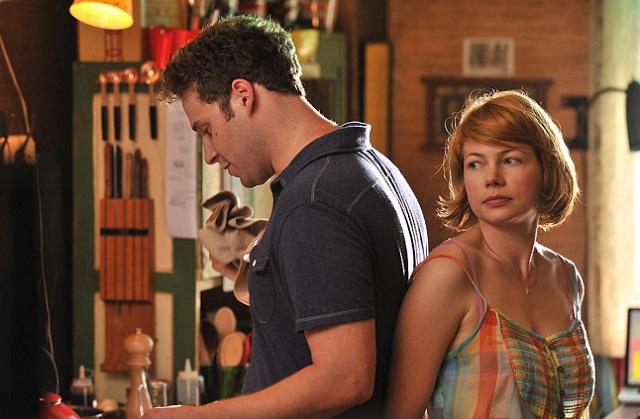
Seth Rogen and Michele Williams in TAKE THIS WALTZ
What are 2012’s most overlooked films? Take This Waltz, Elena and Once Upon a Time in Anatolia are on some Top Ten lists, including mine, but they still haven’t gotten the buzz that they deserve. These are three of the very best films of the year. I wish that more women, especially, would experience writer-director Sarah Polley’s work and Michele Williams’ performance in Take This Waltz. Anatolia is admittedly not for everyone, but I think that future film historians may rate it as a masterpiece.
The thriller Deadfall was solid, but got lost among the big Holiday movies. And the brilliantly original satire King Kelly, which I saw on VOD, wasn’t released in any theaters that I know of.