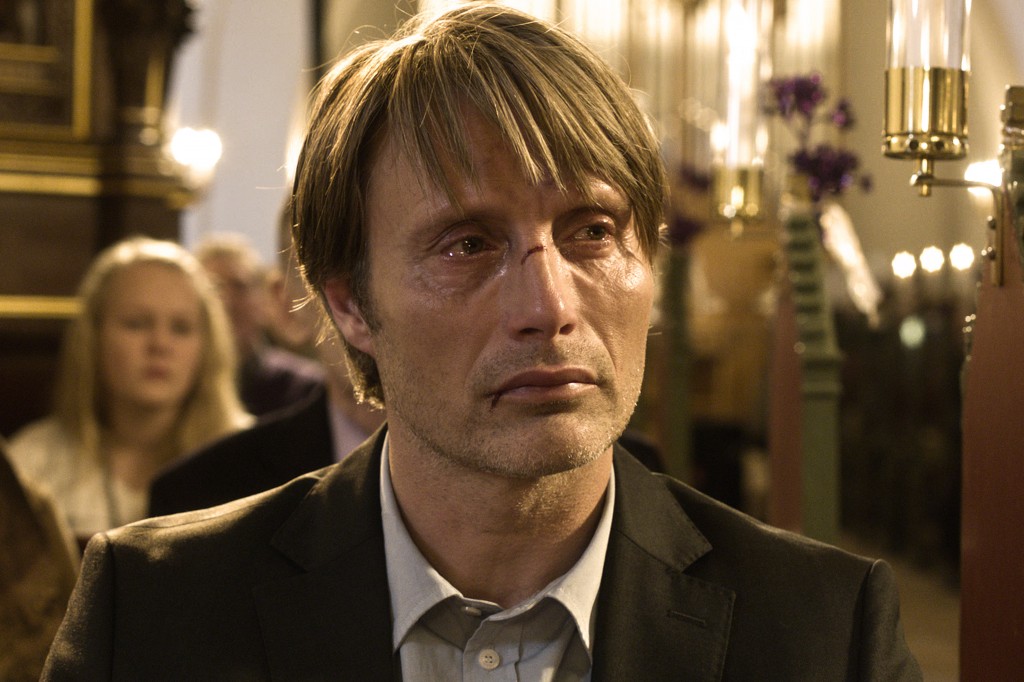
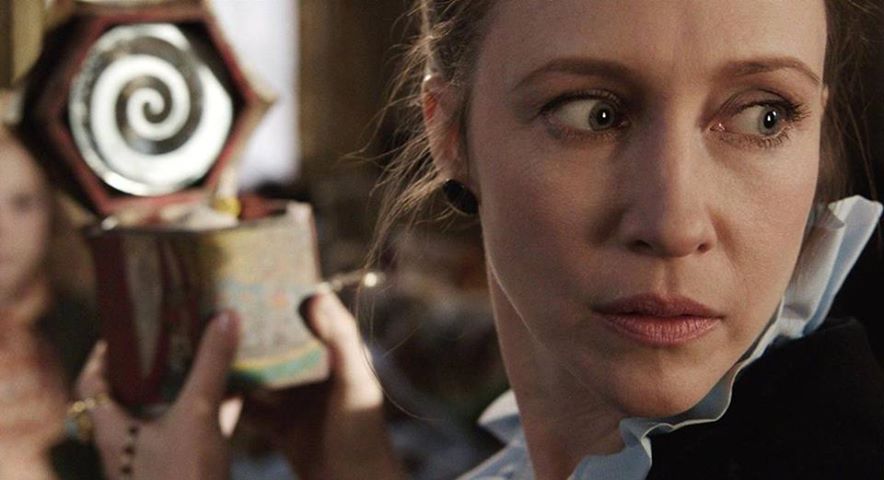
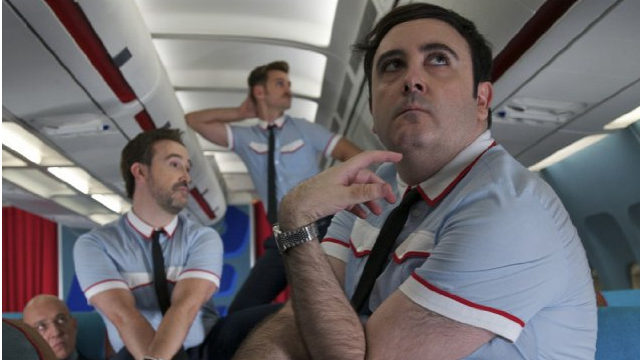
Marion Dougherty (left) and some of her discoveries in CASTING BY
Every serious movie fan should see the fine HBO documentary Casting By, which reveals the importance of the casting department, chiefly by focusing on the pioneering work of New York casting director Marion Dougherty and her Hollywood counterpart Lynn Stalmaster.
In the hey day of the Studio System, studios would simply typecast actors plucked from their list of contract players, But Dougherty, casting for the early TV dramas shot in New York, picked the most promising stage actors and cast them AGAINST type. When the Studio System collapsed in the early 1960s, Dougherty and Stalmaster were able to bring this approach to the movies, especially for former TV directors like Sidney Lumet and George Roy Hill and young up-and-comers like Martin Scorsese.
It’s really difficult to imagine American cinema from the past 50 years without Al Pacino, Dustin Hoffman, Gene Hackman and Robert Duvall – and Dougherty is the person who cast them for their breakout credits. Not to mention James Dean, Jack Lemmon, Warren Beatty, Rod Steiger, Jon Voight, Christopher Walken, Glenn Close, Martin Sheen and Diane Lane. And she pushed for Danny Glover to be cast in his Lethal Weapon role, originally written for a white detective.
Stalmaster’s story is just as compelling, including his advocacy for then unknown John Travolta and his casting of the very odd kid in Deliverance.
Casting By also takes on the turf war with the remarkably ungenerous Directors Guild, which results in grudging credits and no Oscars for casting directors.
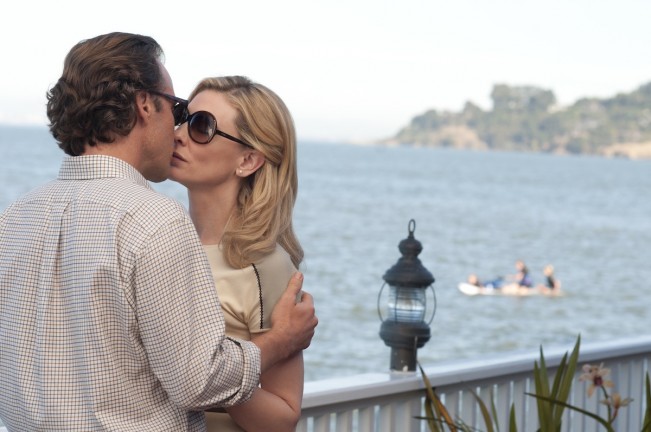
Peter Skarsgaard and Cate Blanchett in BLUE JASMINE
Woody Allen’s Blue Jasmine is a remarkably profound portrait of a woman seemingly ruined by circumstance and trying desperately to cling to who she thought she was. In a stunning performance, Cate Blanchett plays Jasmine, a New York socialite whose billionaire swindler of a hubby has lost his freedom and his fortune to the FBI. Jasmine’s identity has been based on the privilege derived from her money, her marriage and her social station – and all of that is suddenly gone. Flat broke and reeling from the shock of it all, she seeks refuge with her working class San Francisco sister.
Despite her desperate situation, Jasmine arrives still brimming with deluded entitlement, Woody having calculated an undeniable resemblance to Blanche Dubois in A Streetcar Named Desire. But Blue Jasmine is more accessible than the great play Streetcar because it’s so damn funny. Jasmine’s pretensions are as pathetic as Blanche’s, but it’s very, very funny when her top shelf expectations collide with her current reality.
Cate Blanchett will certainly be nominated for an Oscar for this role. Blanchett is able to play a woman who is suffering a real and fundamental breakdown through a series of comic episodes. She flawlessly reveals Jasmine’s personality cocktail of charm, denial, shock, desperation and sense of authority.
I know that a lot of folks are put off by the creepiness of Woody’s real life marriage, but he has written a great female lead role for Blanchett, and he’s directed actresses to four Oscars in the past, as outlined in this recent New York Times article.
In my favorite scene, Jasmine faces her young nephews across a diner’s booth in a diner. They ask her questions with childish directness and inappropriateness. Her answers are candid from her point of view, but nonetheless astoundingly deluded – and just as inappropriate. The scene is deeply insightful and hilarious.
Who and what has brought Jasmine to her knees? Certainly she has been victimized by her amoral sleazeball of a husband, but she vigorously refuses to consider taking any responsibility herself. Can she be forced to look within? And is she strong enough to face what she would see?
Sally Hawkins is equally perfect as Jasmine’s good-hearted sister Ginger, a woman who doesn’t expect much from life and still gets disappointed. Andrew Dice Clay, of all people, is excellent as Ginger’s ex, a lug who rises to a moment of epic truth-telling. Louis C.K. brings just the right awkward earnestness to the apparently decent guy who takes a hankering to the long-suffering Ginger. Alec Baldwin nails the role of Jasmine’s husband, a man whose continual superficial charm almost masks his cold predatory eyes, and it’s a tribute to Baldwin’s skill that he makes such a natural performance seem so effortless.
Playing a primarily comic character, Bobby Cannavale delivers a lot of sweaty energy, but with too much scenery chewing. The great actors Peter Skarsgaard and Michael Stuhlbarg do what they can with far less textured characters.
The Wife thought Blue Jasmine dragged in places, and she was distracted by some components that didn’t ring true about the San Francisco setting – two key working class characters with Tri-State Guido accents and a Sunday afternoon cocktail party where the men wear neckties; she’s dead right on both points, but they didn’t bother me.
Blue Jasmine may not rise to the level of Allen’s Midnight in Paris, Annie Hall, Manhattan, Hannah and Her Sisters and Husbands and Wives, but it’s a pretty good film with a superlative, unforgettable performance.
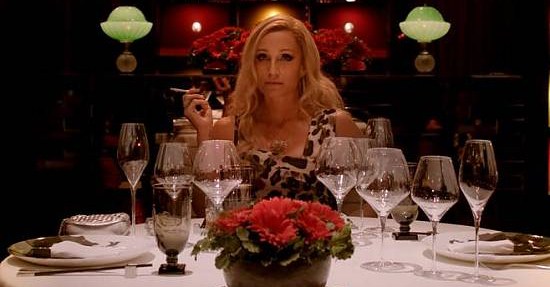
I can say only three good things about Only God Forgives. First, it’s not painfully bad, but laughably bad. Second, the great Kristin Scott Thomas is on-screen for 10-15 minutes in an outlandishly campy role. Third, this week presents the rare opportunity to see the best of cinema (The Hunt) and the worst (Only God Forgives) in a perverse double feature.
After combining on the thrilling Drive, director Nicholas Winding Refn and Ryan Gosling return with Only God Forgives, a hyper-violent revenge tale. I loved Drive, with Winding Refn’s vivid colors and taut pacing, its shocking violence and Gosling’s evocative performance. Only God Forgives reprises the garish palette, but fails on the other aspects.
Gosling’s character, a pro kick-boxer and the henpecked son of a female crime lord, has little so personality that he could have played by Keanu Reeves. The exploitative violence doesn’t have the shock value of Drive’s. But, most unforgivably, the pacing drags. Winding Refn tries to deliver gravity by inserting pregnant pauses between virtually each shot. Typically, one character looks off camera, and there’s a pause and a dramatic musical chord; then another character looks back, with another pause and another chord. Look Pause Chord Look Pause Chord Look Pause Chord ad nauseam.
Kristin Scott Thomas plays Gosling’s evil mom and gets to utter this unforgettable line: “How many cocks can you entertain in that cute little cumdumster of yours?”.
Playing the cop villain, Thai actor Vithaya Pansringarm walks deliberately – very deliberately – around Bangkok and is very good at moving his eyes without moving his head. Oddly, after mutilating yet another person with his hidden sword, he enthralls a roomful of uniformed cops by crooning a karaoke ballad.
Highly anticipated (because of Drive), Only God Forgives got trashed by critics at Cannes and been reviled upon its US release. Only After Earth, The Lone Ranger and Pacific Rim may keep it out of the bottom spot as the year’s worst major release.
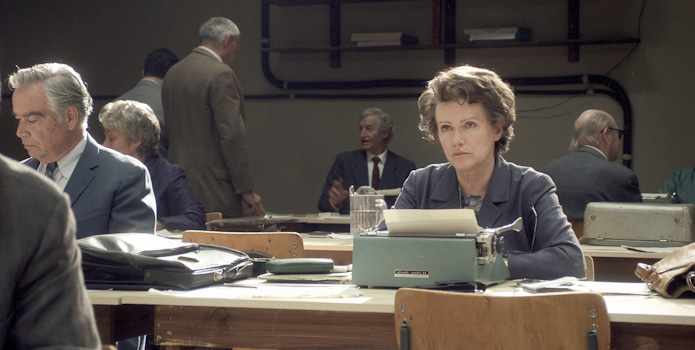
Hannah Arendt is a movie about an intellectual argument that has since been resolved in favor of the title character. Hannah Arendt was a noted political theorist and a leading thinker on totalitarianism. In 1961, The New Yorker assigned Arendt (a German Jew who herself avoided the Holocaust by fleeing to the US) to cover the trail of Nazi war criminal Adolf Eichmann. Instead of finding Eichmann to be personally monstrous, she saw him as a bureaucratic functionary who failed to think through the monstrous consequences of ordinary tasks; he took pride in successfully loading people on to a train without taking responsibility for sending them to their extermination. Arendt made Eichmann the poster boy for she coined as “the banality of evil”.
While the banality of evil is is a concept generally accepted today, it caused a furor at the time from those who could not accept that a human catastrophe of the magnitude of the Holocaust could have been enabled by ordinary humans. Hannah Arendt is the story of that controversy. Unfortunately, it’s difficult to make a compelling movie about a quibble between intellectuals – and even more challenging when the argument itself has been stale for 40 years.
Arendt had achieved academic status in the 1950s that was remarkable for a woman of the time. She was also arrogant and tone deaf to political correctness, which helped her step into the controversy.
Arendt is ably played by Barbara Sokowa. Janice McTeer (Tumbleweeds, Albert Nobbs) gets a much flashier role as Arendt’s loyal friend, the feisty writer Mary McCarthy, and McTeer’s performance is by far the most watchable piece of the movie.
For a much more visceral exploration of the banality of evil, I recommend Blind Spot: Hitler’s Secretary, described in my 5 Essential Holocaust Films.
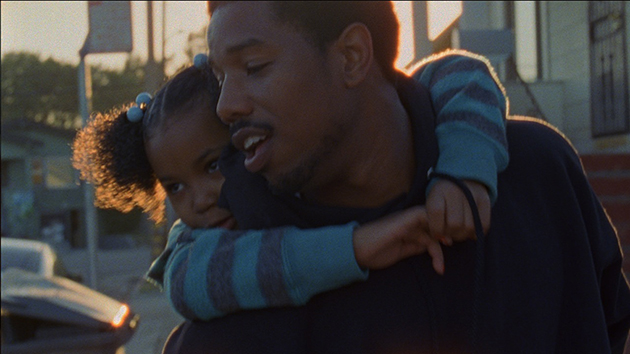
The emotionally powerful Fruitvale Station explores the humanity behind the news. If, as I do, you live in the San Francisco Bay Area, you know what happened to Oscar Grant. Returning to the East Bay after 2008 New Year’s Eve revelries in San Francisco, the unarmed 22-year-old was handcuffed and lying on his stomach when he was mortally wounded by a transit cop’s gunshot. Oscar Grant was African-American. The transit cop was white. Multiple cell phone videos of the incident went viral on New Year’s Day. Fruitvale Station opens with one of those shaky videos.
But the beauty and strength of this impressive film is that Fruitvale Station is not about the incident and its political fallout – it’s about the people involved, in their workaday and familial roles to which all of us can relate. It follows the fictionalized life of Oscar Grant as he lives out what he doesn’t know is his last day.
Writer-director Ryan Coogler’s Oscar Grant is a complete and textured character. Oscar is a charming guy, a loving father and the fun dad/uncle who children love roughhousing with. He’s remarkably unreliable as a boyfriend, son and employee. He’s done a stretch in San Quentin, and he’s got a temper. He’s capable of random acts of kindness. He’s a complete package of decency, fecklessness, irresponsibility and possibilities. Would he have turned his life around if he hadn’t been at Fruitvale Station that night? We’ll never know. And that’s the tragedy laid bare by Fruitvale Station.
Although it’s a tragedy with some heartbreaking moments, Fruitvale Station isn’t a downer – it’s too full of humanity for that. Neither is it a political screed; Coogler lets the facts speak for themselves and the audience to draw its conclusions.
The acting is first-rate, especially Michael B. Jordan as Oscar, Melonie Diaz as his girlfriend and the great Octavia Spencer as his mom. Equally, important, the supporting cast is just as authentic.
It’s a stunning debut feature for 27-year-old filmmaker Ryan Coogler, from whom much is now expected. (Coogler is also an African-American from the East Bay who is roughly the same age as Oscar Grant.)
Fruitvale Station was justifiably honored at both the Sundance and Cannes film festivals. It’s one of the best movies of 2013.
In the Danish drama The Hunt (Jagten), Mads Mikkelsen plays a man whose life is ruined by a false claim of child sexual abuse. You’ll recognize Mikkelsen, a big star in Europe, from After the Wedding and the 2006 Casino Royale (he was the villain with the bleeding eye). He won the 2012 Cannes Best Actor award for this performance.
The story is terrifyingly plausible. The protagonist, Lucas, is getting his bearings after a job change and a divorce. He lives in a small Danish town where everyone knows everyone else, next door to his best friend. The best friend drinks too much and his wife is a little high-strung, but Lucas embraces them for who they are. He’s a regular guy who hunts and drinks with his buddies and is adored by the kids at the kindergarten where he works. He’s not a saint – his ex-wife can get him to fly off the handle with little effort.
A little girl hears a sexual reference at home that she does not understand (and no one in the story could ever find out how she heard it). When she innocently repeats it at school, the staff is alarmed and starts to investigate. Except for one mistake by the school principal, everyone in the story acts reasonably. One step in the process builds upon another until the town’s parents become so understandably upset that a public hysteria ensues.
Director Thomas Vinterburg had previously created the underappreciated Celebration (Festen).The Hunt is gripping – we’re on the edges of our seats as the investigation snowballs and Lucas is put at risk of losing everything – his reputation, his job, his child, his friends, his liberty and even his life. Can Lucas be cleared, and, if he is, how scarred will he be? The Hunt is a superbly crafted film with a magnificent performance by Mikkelsen.
The satisfying shocker The Conjuring begins in a familiar way. In 1971, a couple (Ron Livingston and Lili Taylor) moves into an old, isolated farmhouse with their five daughters. The youngest kid finds a creepy old music box, the dog refuses to come inside the house, all the clocks stop at 3:07 AM, the house is always chilly and there’s a boarded-up cellar. If you’ve ever seen a scary movie, you know that THIS HOUSE IS HAUNTED. Soon, the family desperately seeks the help of husband and wife ghostbusters (Vera Farmiga and Patrick Wilson).
Interestingly, the story is based on a real occurrence. The real ghost experts soon afterward took on the notorious house in Amityville, Long Island.
What makes The Conjuring work so well? First, the performances of Vera Farmiga and Lili Taylor elevate the material. Each is gifted with the capacity to mix passion, inner strength and fragility.
Director James Wan superbly paces the action, letting our sense of dread build and build until we jump in our seats. He uses a handheld (but not jumpy) camera to provide cool angles and a point of view that helps us relate to the characters.
And there is no gore. There are a few scary images, but The Conjuring relies on good, old-fashioned surprises and our discomfort with the occult to supply the fright.
The Cheshire Murders, another in HBO’s fine summer documentary series, takes us beyond the familiar police procedural. This is not a whodunit – we immediately know what happened and who committed the crimes. Three murders were committed in a home invasion, and the two perpetrators were caught red-handed – their guilt confirmed by confessions and DNA and other forensic evidence.
Instead, as The Cheshire Murders peels back the onion, we hear about the crime’s impact on a quiet Connecticut suburb and on the families of the victims and the perpetrators. We trace the unanswered questions on the police response. We follow the life journeys of the murderers which culminate in this horrific crime. We see how the case affected the political debate over capital punishment in Connecticut, and test our own views on capital punishment with the facts of a heinous crime, certain guilt and monstrous offenders.
The Cheshire Murders is all the more effective because the filmmakers refused to sensationalize the case. The facts, speaking for themselves, are compelling enough.
The Cheshire Murders is currently playing on HBO. Note: Some of the victims of this wanton, senseless and disgusting crime were children; although there are no grisly images, the facts of the case are disturbing.
I’m So Excited is a silly romp from Spanish director Pedro Almodovar. After mastering intense dramas (Talk to Her, Bad Education and Broken Embraces), Almodovar returns to his early success (Women on the Verge of a Nervous Breakdown) with this over-the-top sex comedy.
When the landing gear malfunctions on a flight from Madrid to Mexico City, the flight crew prepares for an emergency landing in Spain by dosing the coach passengers with a muscle relaxant. The pilots, flight stewards and business class passengers self-medicate their nerves with lots of drugs and have a lot of sex with each other. The all-gay stewards perform a hilariously choreographed lip sync to the Pointer Sisters’ I’m So Excited. The sex and drugs have less shock value than in Almodovar’s comedies of the 1980s and early 1990s. It’s all just good dirty fun.
The cast includes veterans of many Almodovar films, including Javier Cámara of Talk to Her and Bad Education, obviously enjoying himself here with an uncharacteristically daffy performance.
In the appealing coming of age story The Way, Way Back, a betrodden teen (Liam James) gains confidence when mentored at his summer job by a lowlife (Sam Rockwell). The kid’s mom (Toni Collette) has been rocked by a divorce (hubby found a young thing), and has rediscovered some self esteem in the attentions of a creep (Steve Carrell). Now the kid, his mom, her insufferable boyfriend and the boyfriend’s bratty daughter are off to his summer home on the Atlantic shore. The kid finds a job at a cheesy local water park, and funny stuff happens.
In depicting the ways that parents make their teen kids miserable, The Way, Way Back is spot on. I’m not talking about the uncool cluelessness that makes all teens embarrassed about the even most perfect parents. The Way, Way Back focuses on children from broken marriages who are made to feel unvalued or whose weaknesses are picked at or whose parents become too involved with their own issues. Indeed all the kids in The Way, Way Back come from divorced families. Even one childless marriage (Rob Corddry from Warm Bodies and Amanda Peet) is very imperfect.
Collette’s performance nails the desperation of a woman, once abandoned, for a relationship that will meet at least some of her needs. Alison Janney is hilarious as the neighboring divorcee who is embracing her alcoholism. The rest of the cast, including Maya Rudolph, is good, too. Give credit to Carrell for taking on a very unsympathetic role, something not every bankable star will do.
It may not be a Must See, but The Way, Way Back is sweet, perceptive and pretty funny.