InCaptain Phillips, Tom Hanks stars as the real-life ship captain hijacked by Somali pirates and rescued by American commandos in 2009. The real-life Phillips survived his terrifying ordeal with guts and smarts, and Hanks and director Paul Greengrass bring the story alive. Greengrass is an old hand at movies with urgency and tension: Bloody Sunday, two movies in the Bourne franchise and an Oscar nomination for United 93.
Another key is that Captain Phillips was shot on the high seas on an actual container ship, an actual lifeboat and a skiff just like the real pirates use. As a result, it’s amazingly real when the pirates clamber up the side of the massive ship while both vessels roll in the waves and when the seamen and pirates play hide-and-go-seek below decks in the dark.
That being said, the movie wouldn’t work without Tom Hanks, who is unsurpassed at playing an Everyman thrust into a perilous situation. Hanks is our generation’s Jimmy Stewart, and I can see Hanks playing Stewart’s roles in Rear Window, Vertigo, Anatomy of a Murder and The Man Who Shot Liberty Valance.
Most of the pirates are standard types, but the lead pirate is a much more textured character, superbly played by Barkad Abdi, hitherto a Somali-American limo driver from Minneapolis. The depth in Abdi’s performance is also essential to the film’s success. The cast also features character actor Michael Chernus, so good in Higher Ground and Men in Black 3, as the #2 on the ship.
All in all, Captain Phillips is a flawless true story thriller.
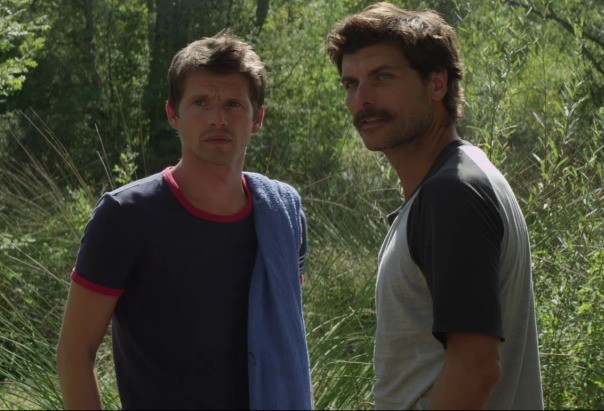
The Year & the Vineyard is an interesting, funny, original movie, shot without a budget. It was written, directed and edited by Spanish director Jonathan Cenzual Burley. The story is set in a small village in the beautiful countryside of Spain in 2012. It begins when a strong macho Italian, who is a fighter for the International Brigade, literally falls through a hole in the sky and lands in a vineyard. He believes he is fighting the Spanish Civil war in 1937. The local priest, who is very funny, flamboyant and a little odd, is convinced the Italian is either an angel or a saint, and, after a thorough examination, concludes that neither is correct.
The Italian stays at the home of a very shy teacher and the 2 men become friends. The teacher is in love with a local girl and the priest and the fighter encourage him to sing to her to minimize his nerves, so that he can actually declare his love to her through song. The scene reminded me of Romeo and Juliet when Romeo declares his love to Juliet when she is standing on a balcony.
The Italian sees a picture of his lover from 1937 in a history book and notices that she is also fighting in the war. His sole desire is to be reconnected with her back in 1937, and so the men try to figure out how he fell out of the sky in the first place. Finally, by throwing stones up in the air close to where he fell, they finally realize that there is a hole in the sky that he is able to climb over to go back to 1937. He does this with the help of a ladder and his friends.
What struck me about the director is his absolute passion and belief in what he is doing. His Grandfather fought in the civil war and played a small role in the movie. In addition, filming took place where Burley spent his summers as a child, so his personal connection was apparent. You could see how hard he worked to put this piece together. It took him about a year to make the whole film from start to finish without a budget. His actors are not well-known, but I was impressed with their ability. He finally finished the movie on Sunday, days before the world premiere at the Mill Valley Film Festival, and I was lucky enough to attend and see him introduce it to the audience. It was exciting to see how dedicated Jonathan Burley is to his work.
The Year & the Vineyard was funny and cute and, even though the start was slow, I really enjoyed the whole production. The audience was clearly engaged, and being present and hearing the answers to our questions, you can see that this man is committed to his art.
Our Marin correspondent Zeke Ortiz represented us at this year’s Mill Valley Film Festival.
Critics love the artsyMuseum Hours (it has a Metacritic rating of 83), in which a Canadian woman visits Vienna and meets a museum guard; I found it intellectually interesting but not emotionally compelling. The museum guard sits behind a velvet rope all day watching visitors peruse the oil paintings; he passes his time with mental games, like counting the eggs depicted in the paintings or imagining the museum patrons without their clothes. The woman’s last surviving relative, a cousin whom she has not seen in years, has become comatose and she feels obligated to visit her.
We piece together the essence of the characters from nuggets in the screenplay. The man managed unsuccessful rock bans in his youth, is gay, lost his partner along the way and now isolates himself by spending his free time on the Internet. The woman, who gets by with a series of part-time, dead-end jobs, is also socially isolated. They strike up a platonic friendship.
Here’s the interesting part – director Jem Cohen has filled the film with visually arresting shots of the bleak parts of Vienna, sometimes in direct juxtaposition with the artworks in the museum, allowing us to contemplate composition, subject and colors. In the middle of the film, a docent engages a tour group in a provocative discussion of Breugel.
That’s all fine, but it doesn’t make for much entertainment. There’s not much story, and the characters, while interesting, are not in themselves enough to carry the 107 minutes. Museum Hours is a worthy choice, but not a Must See, for art film devotees.
In the dark comedy The Family, the family of an American mafioso has been relocated to Europe under the witness protection program. However, they are so violent that they keep blowing their cover and have to move again. Here, they have just failed to fit themselves in to the sunny French Riviera and have been moved again to chilly Normandy.
The recurring joke in The Family is that these people escalate almost every human interaction into severe violence and that all the family members are highly skilled. The mafioso is played by Robert De Niro, his wife by Michelle Pfeiffer, and both very ably deliver the deadpan comedy. But the best performances (in the best written roles) are by Dianna Agron (Quinn in Glee) and John D’Leo as the couple’s teenagers. Tommy Lee Jones is also VERY briefly in the movie, as are Vincent Pastore and Dominic Chianese of The Sopranos.
Luc Besson (The Professional, District B13), the French director who celebrates American action movies, gets to make an American action comedy set in France. I enjoyed The Family much more than I thought I would because I expected another lame culture clash comedy and instead got a darker comedy. Still, it is what it is – a broad comedy – but a competent one.
Niels Arestrup (A Prophet, War Horse) stars as the owner of French wine estate who places impossible expectations on his son, with lethal results. The poor son has gotten a degree in winemaking, has worked his ass off on his father’s estate for years and has even married well – but it’s just not enough for his old man. The father’s interactions with the son range from dismissive to deeply cruel.
The father’s best friend is his longtime estate manager, whose health is faltering. The son is the natural choice for a successor, but the owner openly prefers the son’s boyhood friend, the son of the manager. The first half of You Will Be My Son focuses on the estate owner’s nastiness toward his son, which smolders throughout the film. But then the relationship between the sons turns from old buddies to that of the usurper and the usurped. And, finally, things come down to the decades-long relationship between the two old men.
Deep into the movie, we learn something about the father that colors his view of his son. And then, there’s a startling development that makes for a thrilling and operatic ending.
Here’s the first MUST SEE of the fall movie season. The compelling and affecting Short Term 12 is set in a foster care facility unit named Short Term 12; since the kids can live there for years, it seems pretty long-term to me. These are kids who have suffered abuse and neglect and who act out with disruptive and dangerous behaviors. Runaways, assaults and suicide attempts are commonplace, and some of the kids thrive on creating drama.
The gifted lead counselor on the unit is Grace (Brie Larson), who isn’t much older than the kids. She’s kind of a Troubled Kid Whisperer who, in each impossible situation, knows exactly what to do to defuse or comfort or protect. But while she is in total command of her volatile and fragile charges, she is profoundly troubled herself. She and her boyfriend Mason (John Gallagher Jr.), who also works on the unit, are themselves survivors and former foster youth. Mason seems to have resolved his issues, but Grace’s demons lurk just under her skin.
In Short Term 12’s taut 96 minutes, we watch Grace navigate through crisis after crisis until she must face her own. We share many of the most powerful moments in 2013 cinema, particularly one kid’s unexpectedly painful insightful and sensitive rap, another kid’s authoring a wrenching children’s story and Grace’s own outburst of ferocity to protect a kid from a parent.
Brie Larson’s performance as Grace is being widely and justifiably described as star-making, and I think she deserves an Oscar nomination. I noticed her performances in much smaller roles in Rampart and The Spectacular Now , and I’m really looking forward to the launch of a major career. Think Jennifer Lawrence.
John Gallagher Jr. must be a superb actor, because nobody in real life can be as appealing and sympathetic as his characters in Margaret, Newsroom and Short Term 12. I’ll watch any movie with Gallagher in it, and he’s almost good enough to help me stomach Newsroom.
In his debut feature, writer-director Destin Cretton has hit a home run with one of the year’s best dramas. Some might find the hopeful ending too pat, but I say So What – I have met many former foster youth who have transcended horrific childhoods to become exemplary adults.
In the brilliant drama Mud, two Arkansas boys venture onto a river island and discover a man named Mud (Michael McConaughey) hiding from the authorities. Ellis (Tye Sheridan of The Tree of Life) is a hopeless romantic, consumed by an ideal view of love. His more hard-eyed buddy Neckbone (Jacob Lofland) is on the outlook for cool stuff. Both are ready for the excitement of a secret adventure.
Mud is another triumph for writer-director Jeff Nichols (Shotgun Stories, Take Shelter). The story has aspects of a boyhood adventure and of an escape thriller which hook the audience. But Mud is, at its heart, a coming of age story in which Ellis (primarily) gets a big dose of realism about love and human constancy. Neckbone doesn’t have many illusions about human nature. His parents aren’t in the picture, and he lives with his wacky uncle Galen (Michael Shannon) in a trailer. Neckbone has a knack for immediately getting to the core of situation by bargaining an errand for a pistol or asking “Didja feel her titties?”. A step down from Neckbone’s trailer lifestyle, Ellis lives on a floating shack tied to the riverbank. His parents are together, but, it seems, not for long. Somehow, Ellis believes in an ideal and forever love.
There are many relationships for Ellis to observe: his parents’ troubled journey, the sacrifices Mud makes for his lover (Reese Witherspoon), the mysterious bond between Mud and another houseboat dweller (Sam Shepherd), a rich man’s (Joe Don Baker) own obsession with his sons, his partnership with Neckbone and Ellis’ own first foray into dating. It’s all a bigger mouthful than Ellis was expecting.
The two kid actors are great. So are McConaughey, Shepherd, Witherspoon, Baker and Nichol’s favorite actor, Shannon. Mud primarily succeeds because Nichols has created compelling characters and woven a top-rate story, both gripping and thoughtful.
Mud is one of the best movies of 2013. Mud is available on DVD from Netflix and streaming from Amazon, iTunes, Vudu, GooglePlay, YouTube and other VOD outlets.
In a twist on the usual romantic comedy plot, I Give It a Year starts out with the perfect wedding, and then traces the couple’s (Rafe Spall and Rose Byrne) adventurous first year of marriage. They have married after a brief infatuation, and it turns out that they aren’t a great fit. It becomes rapidly apparent that she is more well suited with her new client (Simon Baker), and his true soul mate is his ex-girlfriend (Anna Faris).
Of course, this is a romantic comedy, so be prepared for some silliness and some implausibility. But I give it credit for an original story, and it’s mostly entertaining, with some moments of hilarity. Anna Faris is brilliant in her character’s earnest but futile attempt to master the acrobatics required in a three-way sexual encounter. And it’s very funny when the young groom realizes that the honeymoon photos that the bride is showing her parents includes some naughty bits.
I especially enjoyed the fine dramatic actress Olivia Colman (Tyrannosaur, Broadchurch, The Iron Lady) playing broadly against type as the worst imaginable marriage counselor (she interrupts a session to take a call on her cell phone and scream abuse at her husband). As in the very best comedy, Colman plays it absolutely straight as she, in turn, violates every professional precept.
Filmmaker Matthew Cooke’s documentary How to Make Money Selling Drugs is a dispassionate critique of the Drug War. Using the How To format as an attention grabber, Cooke presents the job opportunities in illegal drug commerce as rational economic decisions How much money can you make as a street dealer? As a drug smuggler or kingpin? What is the risk that you will need to defend your product inventory from a violent robbery? What are the risks that you will be incarcerated? How do those risks change if you are African-American?
The talking heads are former industry insiders, ranging from former street dealer 50 Cent to big league smuggler Brian O’Dea and notorious LA druglord Freeway Rick.
How to Make Money Selling Drugs is effective because Cooke generally strips away the value judgements and lets the audience draw its own conclusions, balancing out the risks and rewards. The final risk presented, that of addiction, is particularly sobering. (How to Make Money strays from this approach just once, with a Woody Harrelson diatribe.) I expect that most viewers will conclude that 1) drug dealing is not a great long-term career path; and 2) the Drug War has not been effective in reducing drug abuse or illegal commerce.
How to Make Money Selling Drugs is available streaming from Amazon, iTunes and Vudu.
The skeleton of the story inAin’t Them Bodies Saints is simple – a Texas prison escapee goes looking for his wife and kid. But that capsule understates the totality of Ain’t Them Bodies Saints, an atmospheric romantic drama that is superbly written, directed, acted and scored.
Every filmmaker should watch the first ten minutes of Ain’t Them Bodies Saints for its extremely economic story-telling, which lets the audience piece together the setting and the cores of the characters without obvious exposition. Bob and Ruth are young lovers, and Ruth is pregnant. They are involved in a crime, for which Bob goes to prison before their child is born. When the daughter is four, he escapes from prison and everyone – Ruth, Bob’s old crime partners, the community and the cops – know that he’s headed back to Ruth. Both the cops and the criminals are awaiting – the story follows the path to the inevitable conflict.
The characters are unforgettable. Bob, played with ferocity by Casey Affleck (Gone Baby Gone and The Assassination of Jesse James blah blah), has an obsession to reunite with Ruth and the daughter he has never seen. He has framed this quest as his moral obligation to take care of his family – but, of course, they would be better off without him and the trouble he will bring. He’s not really capable of nobility, but he doesn’t know that.
Ruth has a profound passion for Bob, and she owes him for taking the fall for her. But, despite her loyalty, she is entirely realistic about the consequences of his return. We see Ruth’s steely determination and wilfulness in yet another searing performance by Rooney Mara (The Social Network, The Girl with the Dragon Tattoo).
The complexity of the secondary characters contribute to the compelling story. With an unsettling mixture of decency and creepiness, the local cop (Ben Foster, equally good in The Messenger and Rampart) becomes very attentive to Ruth and her daughter. He had been wounded at Bob and Ruth’s capture, seems to be genuinely interested in the welfare of the little daughter and also clearly has a thing for Ruth.
Ruth has also been helped by a fatherly gentleman storekeeper (Keith Carradine), whom we later learn is the local crime lord. His actions seem rooted in all the right values, but, given his criminality, how benevolent can he really be? As a leading man, Carradine had an impressive run in the 70s where he starred in Robert Altman’s Nashville, Ridley Scott’s The Duellists and Louis Malle’s Pretty Baby, all within three years. Now with 128 screen credits, Carradine’s performance here perfectly strikes every note.
Ain’t Them Bodies Saints looks beautiful – much like a Terence Malick film without all the confusion and boring parts. I also liked Daniel Hart’s atmospheric but unobtrusive music.
Ain’t Them Bodies Saints is completely absorbing – and that doesn’t happen by accident. This is writer-director David Lowery’s first feature with a theatrical release. Who is this guy? Lowery edited two recent indies that I criticized for other reasons, Upstream Color and Sun Don’t Shine, but in which his editing was remarkable. It’s clear from Ain’t Them Bodies Saints that Lowery is a major talent.
So there you have it – a gripping story with brilliant performances by Rooney, Affleck, Carradine and Ben Foster in the debut of a promising filmmaker.
What does the title mean? I have no idea. And I hope that Lowery lets someone else name his next exceptional movie.