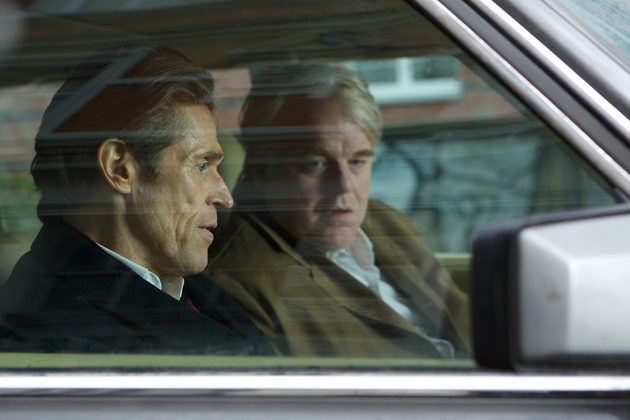
My DVD/Stream of the week – perfect for binge-viewing on the holiday weekend – is the eight one-hour episodes of HBO’s True Detective. It’s a dark tale of two mismatched detectives – each tormented by his own demons – obsessed by a whodunit in contemporary back bayou Lousiana. Woody Harrelson is very good – but Matthew McConaughey’s performance may have been the best on TV this year.
The two detectives are shown pursuing a case together in 1995 and then being interviewed separately about it in 2012. In the 2012 scenes, McConaughey sits at a table, his eyes dead but occasionally flashing, behind a coffee mug and an increasing lineup of empty beer cans. He chain smokes and stares down his interrogators – doing very little with frightening intensity. McConaughey has recently delivered brilliant performances in excellent movies (Mud, Bernie, The Paperboy, Killer Joe, The Wolf of Wall Street, Dallas Buyers Club) – and this may be his best. McConaughey is reason enough to watch True Detective.
True Detective is available on DVD from Netflix and streaming from HBO GO.
The advocacy documentary Citizen Koch exposes the terrible effects of the US Supreme Court’s Citizens United decision, which allows the right-wing billionaire Koch brothers to anonymously spend unlimited treasure to promote political candidates, measures and legislation that I (The Movie Gourmet) abhor. Filmmakers Carl Deal and Tia Lessin, who have worked with Michael Moore, share Moore’s use of documentary to persuade by observation: here are the facts that will lead you to agree with us.
The very best aspect of Citizen Koch is the core story of Governor Scott Walker’s assault on public employees and their unions in Wisconsin. Citizen Koch meticulously connects the dots between the Koch Brothers’ strategy of degrading the Democratic Party’s strength by weakening public employee unions and Walker’s machinations. It’s a conspiracy in plain sight. Citizen Koch is at its best when this thread is told from the perspective of a few Wisconsin public employees – who are themselves Republicans.
Unfortunately, what could have been a superb film on the political conflict in Wisconsin gets flabby and diluted with threads about Citizens United and Charles and David Koch. The worst part is a fourth thread about Buddy Roemer, a sleazy opportunist who has changed political parties three times but is held up as some sort of beacon of good government; it’s outrageously naive and potentially discredits the rest of the film.
And here’s a little controversy that is illustrative of the Koch Brothers political power. PBS was going to air Citizen Koch on its documentary series POV, but chickened out because David Koch sits on the board of PBS’ NYC affiliate WNET and is a huge contributor to PBS products like Nova.
Erich Bergen, John Lloyd Young, Vincent Piazza and Michael Lomenda in JERSEY BOYS
Jersey Boys, while not great cinema, is definitely a fun time at the movies. We might have expected great cinema because this is Clint Eastwood’s version of the Broadway musical, itself a show biz bio of Frankie Valli and the Four Seasons. The acting is a little uneven, the female parts are underwritten and some parts drag. But what Jersey Boys does offer – the Four Season’s evocative pop hits, a couple charismatic performances and a dash of Christopher Walken – is worth the trip to the theater.
The story’s arc is a familiar one – after paying their dues with years of bottom-scraping gigs, a bunch of nobodies achieve overnight fame and wealth and then destruct. Three things are a little different about these guys. First, the core of the group is mobbed up (and you can see how the real Frankie Valli could later play a mobster so well in The Sopranos). Second, their catalyst is the pop music-writing genius Bob Gaudio, a suburban teen who joins the hardscrabble threesome from a tough neighborhood and serves them their hits: Sherry, Big Girls Don’t Cry, Walk Like a Man, Rag Doll, Dawn (Go Away) and Can’t Take My Eyes Off You. Finally, the cause of the group’s downfall is neither external (e.g., crooked business manager or evil record company) nor pervasive substance abuse.
Eastwood tells the story in four segments – each from the perspective of one of the guys – and this works pretty well. He gets a big boost from the performances of Vincent Piazza as the cocky group leader, Erich Bergen as the creative mastermind Gaudio and Mike Doyle as their flamboyant producer. John Lloyd Young reprises his Broadway role as the group’s big star, lead singer Frankie Valli. Young can do Valli’s very distinctive voice, but has a very limited emotional range. And it turns out that Valli, because he’s a pretty square guy, has the least interesting story of the group. When Valli does have relationship angst, the story gets bogged down. Michael Lomenda plays the fourth guy and get to ask the plaintive question, “What if you’re Ringo?”
Jersey Boys also contains yet another delightful turn by Christopher Walken, this time as the Four Seasons’ mobster mentor. Walken himself started out as a chorus boy, and it’s fun to see him holding his own in the grand musical finale. And remember the young and dreamy Christopher Walken belting out The Four Seasons’s Can’t Take My Eyes Off You in The Deer Hunter’s great bar scene? It’s near the beginning of this trailer.
Man, I was really looking forward to the violent Aussie thriller The Rover, because its co-writer/director David Michôd had written and directed one of my recent favorites: Animal Kingdom. Unfortunately, although The Rover delivers the dark violence of Animal Kingdom, it really just doesn’t have enough story.
That story is set “10 years after The Collapse”, in an Australian outback where the social order has completely broken down. No manufactured goods seem to available except for gasoline, which fuels the armed thugs who cruise through the severely bleak landscape preying on what locals remain fortified in their homes and on each other. A perpetually angry and sweaty loner (Guy Pearce) has his car stolen by a gang of robbers, and sets off after them. He soon picks up the injured, half-witted brother of one of the gang (Robert Pattinson of the Twilight movies), who had been left to die at a robbery gone bad. Driving and violence ensues.
By the end of the story co-written by Michôd and the actor Joel Edgerton, we learn why Pearce’s character is so angry and why he wants his car back. But those answers just aren’t enough of a payoff to justify the ride.
I gotta mention the eccentric performance by Pattinson, adorned with some really bad teeth and, for some reason, effecting a West Virginia hillbilly accent. It’s been a long, long time since I’ve seen an actor employ more tics – so many that Pattinson often looks like he is doing a Joe Cocker impression. The rest of the cast, especially Pearce and Gillian Jones, are uniformly excellent.
Skip The Rover and watch Animal Kingdom again instead.
Nicholas D. Wrathall’s documentary Gore Vidal: The United States of Amnesia is an affectionate portrait of the famously prickly novelist. Vidal, himself an American blue blood, delighted in the harshest criticism of American society, culture and politics. In the film, he observes “When I want to know what the United States is up to, I look into my own black heart.”
Vidal practically invented snark. Most of all, he seemed to relish the role of provocateur, publicly spewing out outrageous (and oft factually unreliable) statements. There has never been a more entertaining TV talk show guest. In Gore Vidal: The United States of Amnesia, we see many of the famous talk show moments – including the 1968 NBC debate when he baited the ubercool William F. Buckley into calling him a queer; that was a pricelessly typical moment, where Vidal playfully PRETENDED to take himself very seriously in labeling Buckley “crypto-Nazi”, causing Buckley – who really WAS taking himself seriously – to erupt.
Wrathall’s film benefits from his access to Vidal himself, facilitated by Vidal’s nephew, the director Burr Steers (who co-produced and appears). So there are glimpses into less well-known aspects of Vidal’s life, including his longtime partner and his love of living in Italy.
Say what you must, Vidal was both absorbing and ever-amusing, which makes Gore Vidal: The United States of Amnesia an intelligent diversion.
Ranging from wry to hilarious, the German dark comedy A Coffee in Berlin hits every note perfectly. Opening tomorrow, it’s the debut feature for writer-director Jan Ole Gerster, a talented filmmaker we’ll be hearing from again.
Jan Ole Gerster
We see a slacker moving from encounter to encounter in a series of vignettes. Gerster has created a warm-hearted but lost character who needs to connect with others – but sabotages his every opportunity. He has no apparent long term goals, and even his short term goal of getting some coffee is frustrated.
As the main character (Tom Schilling) wanders through contemporary Berlin, A Coffee in Berlin demonstrates an outstanding sense of place, especially in a dawn montage near the end of the film. The soundtrack is also excellent – the understated music complements each scene remarkably well.
I saw A Coffee in Berlin (then titled Oh Boy) at Cinequest 2013 and singled it out as one of the three most wholly original films in the festival and as one of my favorite movie-going experiences of the year. A Coffee in Berlin was snagged for the festival by Cinequest’s film scout extraordinaire Charlie Cockey.
In the taut 76 minutes of Caesar Must Die, convicts in an Italian maximum security prison put on a performance of Shakespeare’s Julius Caesar. Every year, there’s a drama laboratory at this prison. It turns out that Julius Caesar is a perfect choice.
Julius Caesar is, most of all, a play about high stakes. And high stakes, where a decision can result in life or death or power or failure or freedom or incarceration, is something these guys profoundly understand – and have time to reflect upon. During rehearsal, one actor snaps at the director, “I’ve been in here for 20 tears, and you’re telling me not to waste time?”. When Cassius states that he has wagered his life on the outcome of one battle and lost, the line is more powerful because we know the actor playing Cassius is himself a lifer.
When the prisoners audition, we learn that their sentences range from 14 years to “life meaning life”. Most of them are naturalistic and very effective actors. The guy who plays Caesar is especially powerful in his acting and reacting.
The Julius Caesar story unfolds in black-and-white as the prisoners rehearse and then play the early scenes in the contemporary prison setting. Segments from the performance itself – about 15 minutes – are filmed in color.
It all works very well as a very successful Shakespeare movie – and as a prison movie, too. Caesar Must Die is available on DVD from Netflix and streaming on Netflix Instant, Amazon, iTunes, Vudu and Hulu.
We Are the Best! is about Swedish thirteen-year-old girls in 1986 – and the most important descriptor here is “thirteen-year-old”. It’s perhaps the age where friendship is most important. It’s the age when the needle flips back and forth between moroseness and exuberance. When you feel like your peers despise you, when you’re skittish about your own body, you’re exploring feelings about the opposite gender and you are certain that your parents are the most embarrassing on the planet – you really need someone on your own team to check in with.
In We Are the Best!, we have two girls with punk hair who are NOT the popular kids in school. Trying to stake out some personal dignity, they find themselves claiming to be a punk band, despite not owning or knowing how to play any musical instruments. They reach out to the other social outcast at their school, a serious practicing Christian who plays classical guitar, and she soon sports a punk haircut, too. Together, they test the bonds of friendship and navigate the adventures that all thirteen-year-olds encounter. As it explores the value of teen friendship, We are the Best! is funny, poignant and charming.
“Of course you are” is what The Wife says when I answer one of her questions with something like, “I’m watching the Icelandic penis documentary”. Indeed, the documentary The Final Member is about the curator of the Icelandic Phallological Museum. He has collected and displays sample penises from every mammalian species from hamster to sperm whale. THAT’S NOT THE WEIRD PART.
The museum still lacks a sample from Homo Sapiens. It’s the curator’s quest – and the men vying to contribute their own organs – that is central to The Final Member. Like the
Errol Morris films Days of Heaven (pet cemetery) and Tabloid (Mormon missionary, cloning dogs), it’s not that the OBJECT of obsession is so funny – it’s the obsession itself. It’s that the documentary presents people who are SO OBSESSED and SO EARNEST about the topic. Of course, it is pretty funny when guys are each striving to put their penises on museum display.
In fact, the lengths to which one guy is willing to go for penis fame and fortune is astounding and, for male viewers, wince-inducing. I’m working on a list of Jawdropping Documentaries, and – believe me – The Final Member is gonna make that list. I recommend The Final Member for its 75 minutes of “he said WHAT?” LOL moments.
BTW that’s one-third of a sperm whale penis in the image at the top of this post. (And the very last shot in The Final Member is a very wry filmmaking joke, too.)
The Final Member is now streaming on Amazon and iTunes.
The Canadian comedy The Grand Seduction is the funniest movie of the year so far. It’s a MUST SEE.
Brendan Gleeson (In Bruges, The Guard, The General, Braveheart) and Gordon Pinsent (Away from Her) play isolated Canadians try to snooker a young doctor (Taylor Kitsch of Friday Night Lights) into settling in their podunk village. They enlist the entire hamlet in an absurdly elaborate and risky ruse, and the result is a satisfying knee-slapper that reminds me of Waking Ned Devine with random acts of cricket.
The Grand Seduction opened this year’s Cinequest on an especially uproarious note. The audience, including me and The Wife, rollicked with laugh after laugh. Like Ned Devine, I think that The Grand Seduction can become a long-running imported art house hit like The Best Exotic Marigold Hotel or The Full Monty.