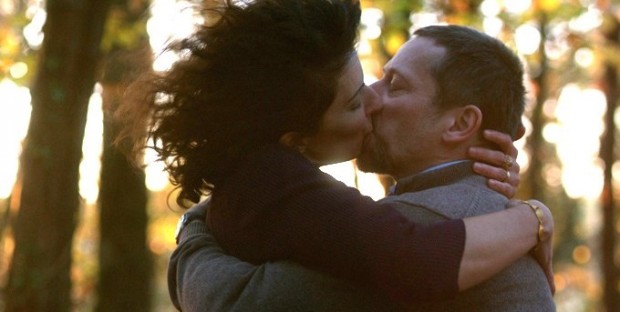
Here’s an underrated 2014 romance that most of us didn’t get to see in theaters: The Face of Love.
Annette Bening plays a woman whose husband suddenly dies, and she is plunged into an immediate and harsh sense of loss. She goes on with her life and then is surprised to meet a man who is attracted to her. They begin to date and fast develop a serious bond. Here’s the kicker – the new boyfriend looks EXACTLY like her late husband (both are played by Ed Harris). You know that eventually he is going to find out, and that eventually her kids and friends are going to find out, and that people are going to think this is very weird. Those characters – and the audience – will wonder whether she is in love with this new man – in love with the image of her husband.
As one would expect, Bening and Harris both give compelling performances. The scene where the new guy asks her out on a date is especially fun. The Face of Love is a worthwhile watch.
The Face of Love is available on DVD from Netflix and streaming from Amazon, iTunes, YouTube, Google Play and Xbox Video.
The term “dramedy” has never been more apt – The Skeleton Twins is a serious exploration of two complex and textured characters with depression, and yet most of the movie is very, very funny. Bill Hader and Kristen Wiig play adult twins who haven’t spoken in ten years; they share a troubled upbringing, bitingly wicked and often morbid humor and serious melancholy. Their blues manifest in different, but serious ways. Brought together when the sister invites the brother to move in with her and her husband, past memories are evoked, each calls the other on their bullshit and everyone’s serene routine is overturned.
The two stars are excellent – and this is Hader’s best film work so far. His monologue about how far he’s come since high school is heart-breaking.
There is lots to like about The Skeleton Twins:
perhaps Luke Wilson’s best performance as the ever-decent and upbeat husband, hopelessly out of his depth with his troubled spouse;
a hilarious Wilson monologue about “land mines”, which will make everyone who has been either a boyfriend or a husband fall out of his seat laughing;
a sparkling turn by Joanna Gleason as the twins’ insufferably self-absorbed New Agey mother;
watching Wiig finally outshine Hader in lip-syncing to Starship’s execrable power ballad “Nothing’s Gonna Stop Us Now”. (BTW, on YouTube, you can find Starship’s original video for “Nothing’s Gonna Stop Us Now” – Mickey Thomas at his most insincere and Grace Slick in 80s Big Hair – YIKES.)
So the film works overall, but I was left a little short on the mental health aspect (see, if you want, under SPOILER ALERT below). Nevertheless, I recommend The Skeleton Twins for its intelligence, honesty and humor.
[SPOILER ALERT: The main characters are both clinically depressed. I didn’t buy the ending where – without any medication or talk therapy – the two seemed to trending hopefully because they have embraced honesty and the support of each other. Now The Wife, who is a trained therapist, DID buy the ending, saying that the movie didn’t show them to be OK, just doing well with each other’s support. The critical consensus seems to be with her.]
Terry Gilliam directed The Zero Theorem, which tells you that it’s going to be visually arresting and Way Out There. Former Monty Python member Gilliam wrote and directed Brazil, The Adventures of Baron Von Munchausen and The Imaginarium of Dr. Parnassus – all much better movies than The Zero Theorem (which he did not write).
The Zero Theorem takes place in a dystopian future world where the powers that be completely control everything that they need for the economy (what you do, how continually you work and how little you get paid), but allow individual freedom to consume crappy consumer goods and follow phony religions. Those that are too troubled to be productive are left to fend for themselves on the filthy streets, free of public services. It’s the realization of Antonin Scalia’s world view.
Christoph Waltz plays a poor workaday Everyman who just wants some time off to look after his deteriorating health. He’s literally a wage slave to a malevolent character named Management. A professional numbers cruncher, Waltz is attacking a very fundamental mathematical discovery. And that’s the whole movie – as he hacks away on his keyboard, he is battered and abused by The System, cajoled by an obnoxious middle manager (David Thewlis – very funny) and distracted by a sexually available temptress.
For what it’s worth, Waltz is pretty good as the protagonist, a perpetual victim. Matt Damon and Tilda Swinton show up in brief parts. Melanie Thierry, a very beautiful actress of limited range (see The Princess of Montpensier), plays the hottie.
All in all, it’s just not Far Out enough and the story – stretched to feature length – is tedious. You’re better off watching one of Gilliam’s good films, or Lost in La Mancha, the documentary on his snake-bitten attempt to make a movie out of Don Quixote.
The Zero Theorem releases tomorrow in theaters, but is already streaming on Amazon, iTunes, YouTube, Google Play and Xbox Video, among others, including your cable/satellite On Demand.
Want to see the prototype for Orange Is the New Black? On September 6, Turner Classic Movies airs the 1950 Caged. Eleanor Parker (who died last year) played the naive young woman plunged into a harsh women’s prison filled with hard-bitten fellow prisoners and compassion-free guards. Parker was nominated for an acting Oscar, but her performance pales next to that of Hope Emerson, whose electric portrayal of a hulking guard also got an Oscar nod. Caged also features the fine character actresses Thelma Moorhead, Jane Darwell (Ma Joad in The Grapes of Wrath) and Ellen Corby (Grandma Walton here as a young woman). Sixty-four years later, Caged might still be the best women’s prison movie ever.
The smart and hilarious The Trip to Italy showcases the improvisational wit of Steve Coogan and Rob Brydon, along with some serious tourism/foodie porn. As in The Trip, the two British comics are sent off on a hedonistic road trip to review spectacular restaurants – this time in Italy’s most stunningly beautiful destinations. Along the way, they needle each other and virtually any occurrence can trigger a very funny riff. As in The Trip, they compete for the funniest Michael Caine impression; but this time, their funniest impression is of a harried Assistant Director trying to give notes to the mask-wearing Tom Hardy in The Dark Knight Rises.
And – if you enjoy travel and fine dining – the restaurant scenes are unsurpassed.
In the almost satisfying romantic drama Love Is Strange, Alfred Molina and John Lithgow play New York City men who, 39 years into their relationship, marry and then are separated by circumstance. By far the best part of Love Is Strange is that Molina and Lithgow develop unique characters, credible and truthful, neither a stereotype in any way. It’s a pleasure to watch these guys, and their embrace on a rainy night is shattering. Another good part: they have a teen nephew, and there’s some truth in the movie’s depiction of the difficulties of being a teenager and raising a teenager.
Unfortunately, Molina’s and Lithgow’s talents are left high and dry by co-writers Ira Sachs (who directed) and Mauricio Zaharias. The set-up to split up the couple’s living arrangements is contrived and unrealistic. Several plot points range from random to confusing (why do some characters steal some library books?), and some fade out without any resolution. Sachs also makes some directorial missteps. There’s a concert scene in which we are jarred with closeups of four or five non-characters (and, I think, non-actors) that really can’t be explained unless these are vanity shots of the movie’s investors. And a climactic shot of a character crying in a stairwell goes on one count, two counts, then twenty counts too long.
Love Is Strange is not a bad movie – and it does contain the splendid performances by Molina and Litgow – but it sure ain’t a Must See.
Opening tomorrow, The One I Loveis one of the year’s most original stories – a romance, dark comedy and sci-fi fable rolled into one successful movie. Mark Duplass and Elisabeth Moss play a couple in that place in their relationship where quirks have become annoying instead of endearing, some trust issues have emerged and the two are just generally misfiring. Their couples therapist recommends a weekend at an idyllic, isolated vacation cottage, which also has a second (presumably unoccupied) guest house. The beautiful setting is enhanced by a bottle of wine and a reefer, and the desired rekindling of romance and intimacy occurs. So everything goes as we would expect for this first nine minutes of the movie, and then – WOW – a major plot development that involves the guest house.
As soon as one of the characters explicitly references TV’s The Twilight Zone, the story becomes what would have been a perfect episode in that Rod Steiger series. Screenwriter Justin Lader pulls off a What’s Gonna Happen Next? story that has its moments of creepy thriller and madcap comedy. But, at its heart, the story explores these questions: what is it about our partners that keeps us in or drives us out of a relationship? How do we stay in love with someone who has changed from who we fell in love with? Or who hasn’t become the person we had projected? The One I Love is only 91 minutes, so the tension and the thoughtfulness can slowly build while keeping us on the edges of our seats.
Moss and Duplass are simply remarkable here – these are two great performances.
MINOR SPOILER ALERT: Both Duplass and Moss play other characters in this movie – and they excel at creating subtle differences in the characters that are revealing, thought-provoking and scary.
Eva Green in the poster for FRANK MILLER’S SIN CITY: A DAME TO KILL FOR
Wow, was this ever a disappointment. I loved the first Sin City from co-directors Richard Rodriguez and Frank Miller (the graphic novelist). And I’m in Sin City’s prime target audience because I love noir sensibility, hard-boiled dialogue and stylized violence in my movies. But Frank Miller’s Sin City: A Dame to Kill For is just not engaging.
None of the three story threads is particularly thrilling. The dialogue is so consistently lurid that it’s just overblown. Powers Boothe – always a wonderful villain – snarls his menacing smile so often that we expect him to grow mustaches and twirl them. The movie violence is of the splatter variety, and the bloodbath unleashed by Rosario Dawson and Jamie Chung is just silly. The ultra-sympathetic Denis Haybert is miscast as a monstrous superthug. Jessica Alba does a convincing job as a stripper but not as an alcoholic.
The whole thing is a stunning waste of a fantastic cast, including Boothe, Haybert, Mickey Rourke, Joseph Gordon-Levitt, Josh Brolin, Ray Liotta, Juno Temple and Christopher Meloni. In particular, Meloni and Liotta are not given much to do. Temple shines as usual as a mistress-for-hire, and Christopher Lloyd sparkles as a particularly unsanitary surgeon.
One remarkable thing – Eva Green (whose character is The Dame to Kill For) plays much of the movie in full frontal (and back and side view) nudity; I can’t remember seeing the body of a major female star displayed so clinically. Now she looks really good naked, but the sheer screen time of her nudity is unusual. Of course all the women in the movie are objectified – and other than Green’s malevolent and slutty femme fatale, Alba’s stripper, and Temple’s mistress, the female characters are all prostitutes.
If you like noir, then the film looks great: almost all black-and-white except for, occasionally, cherry red cars and vivid lipstick, hair and dresses on the women. The best I can say about Sin City: A Dame to Kill For is that it’s nasty, brutish and 102 minutes short.
On August 27, Turner Classic Movies has the gripping film noir whodunit D.O.A., which opens with a man walking into a police station to report HIS OWN MURDER. The man (Edmond O’Brien) finds out that he has been dosed with a poison for which there is no antidote – and that he has only a few days to live. He desperately races the clock to find out who has murdered him and why – all in a taut 83 minutes. Much of D.O.A. was shot on location in San Francisco and Los Angeles, and one SF scene has one of the first cinematic glimpses into Beat culture. The little known director Rudolph Maté gave the film a great look, which shouldn’t be a surprise because Maté had been Oscar-nominated five times as a cinematographer. The next year, he followed D.O.A. with another solid noir, Union Station, with William Holden and Barry Fitzgerald.
(This 1950 version with Edmond O’Brien is the one you want to see; avoid the 1988 remake with Dennis Quaid and Meg Ryan.)
The superbly written drama Calvary opens with a startling line, which kicks off the unsettling premise. Brendan Gleeson (In Bruges, The Guard, The Grand Seduction) plays a very good man who is an Irish priest, Father James. In the confessional, a man tells him that – in one week – he will kill Father James. Having been molested by a priest (now dead), the man will make his statement against the Church: “There’s no point in killing a bad priest. I’m going to kill you because you’re innocent.”
Who is the man? (Father James figures it out before the audience does.) Will the execution really happen? Will Father James take steps to protect himself? Tension builds as the days count down.
The character of Father James is wonderfully crafted. Having come to the priesthood in midlife, after being married and having a secular career, he is seasoned and unburdened by high expectations of human nature – and has a wicked sense of humor. Yet he is moral in the best sense and profoundly compassionate. And Gleeson – always excellent – nails the role. It’s one of the finest leading performances of the year.
We know that the killer comes from a very limited pool of villagers and would-be parishioners, played by Chris O’Dowd, Dylan Moran, Aidan Gillen, M. Emmet Walsh, Isaach de Bankole and Orla O’Rourke. Their feelings for Father James range from fondness to indifference. Their attitudes toward the Church, on the other hand, range from indifference to hostility. (Moran is the best – playing a man grappling with his unhappiness, despite enjoying a fortune built by exploiting others. )
None of these characters is a stereotype. It’s a quirky bunch – but not CUTE quirky. There’s a lot of buried rage in this village – and dry humor, too. Referring to his wife, one casually says, “I think she’s bipolar, or lactose intolerant, one of the two”.
But it’s not the the villagers that Father James must deal with. He gets a visit from his occasionally suicidal adult daughter (Kelly Reilly, who is ALWAYS good); he loves and welcomes her, but she often contributes more stress. He doesn’t love his roommate, an idiotically shallow priest David Wilmot (the thug in The Guard who hilariously couldn’t figure out if he was a psychopath or a sociopath). Then there’s a seriously twisted imprisoned killer (the star’s son Domnhall Gleeson), a foreign tourist numbed by a sudden tragedy (Marie-Josee Croze) and a scheming bishop (David McSavage).
Writer-director John Michael McDonagh (The Guard) gets the credit for populating his screenplay with enough unique and original characters for an entire film festival, let alone one movie. After The Guard and Calvary, I can’t wait to see his next movie.
As one should ascertain from its title, Calvary ain’t a feel-good movie. It plumbs some pretty dark territory. But as we follow Brendan Gleeson’s extraordinary performance as a good man navigating a grimly urgent situation, it is mesmerizing.