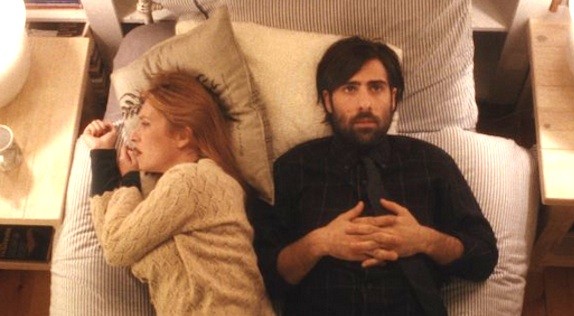
Elisabeth Moss and Jason Schwartzman in LISTEN UP PHILIP
The dark indie comedy Listen Up Philip features perhaps the most self-involved character in cinema (and that’s really saying something). The young novelist Philip Lewis Friedman (Jason Schwartzman) believes that his writing talent entitles him to simmer in permanent rage and to crap on every one in his path. To the credit of writer-director Alex Ross Perry, this supremely unsympathetic character is very fun to watch. (And, unlike in most mumblecore movies, Philips’s self-absorption is not accepted as an aspect of normal life, but treated as appallingly aberrant and cruel.)
Philip is living with his photographer girlfriend (Elisabeth Moss), whose career is beginning to eclipse his. It’s pretty clear that their home will soon be tossed on Philip’s trail of relationship carnage.
Just when Philip might have to face the natural consequences of his behavior, he meets the WORST POSSIBLE mentor – an older famous novelist (Jonathan Pryce). The older guy, who has his own collection of relationship wreckage, is ready to enable, nurture and magnify all of Philip’s worst tendencies.
Perry cleverly moves the story’s focus from one character to another and adds a hilarious voiceover narration that parodies the tone of many modern American novels. Be sure to watch for the faux book covers during the final credits.
Listen Up Philip is smart and funny, but plenty dark. It’s available streaming on Amazon, iTunes, Vudu, YouTube and Google Play.
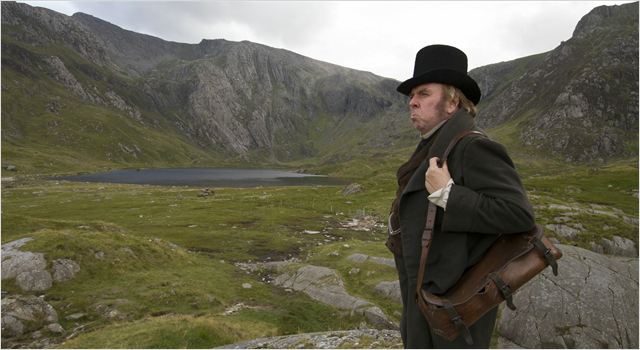
Mr. Turner, Mike Leigh’s biopic of the 19th Century British landscape painter J.M.W. Turner, is visually gorgeous, is centered on a career-topping performance by Timothy Spall as the title character, and is just too damn long.
It kills me to say that, because I’m a huge admirer of Leigh’s films, especially Secrets & Lies and Another Year;. But it’s 150 minutes long, and there’s only 120 minutes of compelling story in there. I took a party of several seasoned art house film goers to a screening at the Mill Valley Film Festival, and EVERYONE agreed that Mr. Turner dragged.
That’s too bad, because it wastes a stunning performance by Leigh regular Timothy Spall. Turner was driven by his artistic passions, distracted by his carnal appetites and didn’t invest much energy in getting along with most people. Spall uses a palette of grunts, not as a gimmick, but as a means to reveal what this guy – otherwise trying to be so contained – was thinking or feeling. (So heartbreaking in Secrets & Lies, Spall is most recognizable as Peter Pettigrew/Wormtail in the Harry Potter movies.)
As in any Leigh film, all the acting is excellent, but Dorothy Atkinson turns in an especially noteworthy and vanity-free performance as Turner’s long suffering maid.
The real Turner was a groundbreaking genius in his use of light. Leigh’s greatest achievement in Mr. Turner is visual – evey exterior shot looks like it could have been painted by Turner. It’s a remarkable visual achievement.
Alas, the stunning photography and two great performances weren’t enough to keep my mind from wandering.
Now here’s an amazing true story: those ubiquitous but creepy images of waifs with exaggerated eyes were created by painter Margaret Keane, but the credit for them – and income from them – were taken by her con man husband Walter Keane. In the entertaining Big Eyes, the couple is played by Amy Adams and Christoph Waltz.
Adams’ performance is perfectly tuned, so we can understand how Margaret could be charmed and bullied into such a disadvantageous situation. Waltz does a good job in the first two-thirds of the movie, when he depicts Walter’s charm and chutzpah; but his performance in the final third of the movie seems very broad. Big Eyes also features especially fun supporting turns by Danny Huston and Terence Stamp.
Big Eyes does a good job of illustrating the overt sexism of the pre-Women’s Lib 1950s. And the serious issue of domination and control in a relationship lurks in the background. But Big Eyes has been distilled down to a simplistic Good Gal/Bad Guy story.
Denizens of the San Francisco Bay Area will enjoy the familiar Bay Area locations, especially the recreation of North Beach in the Beat Era and Woodside in the Sunset Magazine 1960s.
Bottom line: Big Eyes is a satisfying audience-pleaser, but not a movie I’ll be thinking about tomorrow.
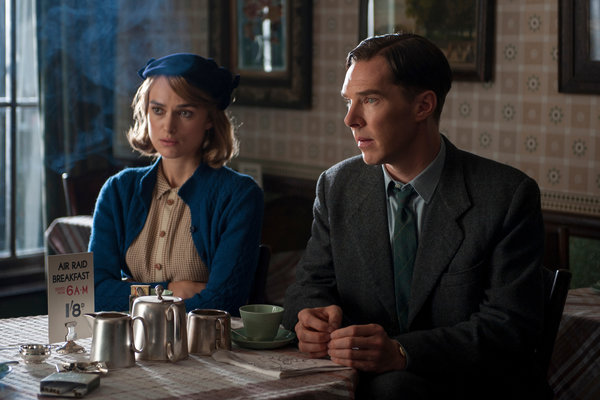
Keira Knightly and Benedict Cumberbatch in THE IMITATION GAME
So – here’s a pretty good true story: the guy who invented the computer and played a key role in defeating the Nazis was hounded for his homosexuality. And The Imitation Gametells that story very well and is a pretty good movie. Benedict Cumberbatch is excellent as Alan Turing, the mathematical genius who was able to create a proto-computer that could break the codes of the German Enigma cipher machine. To make his character even more interesting, Turing had appalling, almost Asberger-like personal skills and needed to conceal his sexual preference. Cumberbatch nails the role, and will reap an Oscar nomination for his efforts.
It’s a top-to-bottom excellent English cast. Keira Knightley is especially good as Joan Clarke, the real life female codebreaker who overcame sexism and who became, briefly, Turing’s fiance.
Based on the popular memoir by Cheryl Strayed, Wild is the story of how Strayed dealt with her own emotional collapse. Suffering emotionally from the death of her mother, among other issues, Strayed (Reese Witherspoon) had become a red-hot mess, playing around with heroin and destructive serial sex and, in the process, dooming her marriage to a solid guy (Tomas Sadoski from The Newsroom). To cleanse herself from her demons, Strayed embarked on a solitary thousand mile hike along the Pacific Crest Trail.
Hiking the Pacific Coast Trail is a mighty quest – both an ordeal and an achievement. But walking it alone as a woman – that’s a whole different deal. The camera is on Reese Witherspoon in every scene, and she carries the movie with her performance – both as Cheryl implodes in the flashbacks and as she overcomes her fears and inexperience on her hike. It’s been eight years since Witherspoon won the Oscar for Walk the Line. Recently, she’s been reinventing her career with high quality fare like Mud,Devil’s Knot, Wild and the upcoming Inherent Vice. Her work in Wild is top rate.
Laura Dern’s performance may be even better than Witherspoon’s. She plays Strayed’s mom, a woman who has been dealt a shit sandwich every day of her life, but who relentlessly insists on appreciating life’s small pleasures. It’s a compelling and heartbreaking performance.
Now I have done some back country hiking and I know what it’s like to walk for 15 miles in a day. It can be pretty damn monotonous. But not this movie. Writer Nick Hornby (High Fidelity, About a Boy) and director Jean-Marc Vallée do a fine job in presenting the scope of a thousand mile journey by pulling out the most compelling components – the moments that illustrate the impressiveness of the feat and the depths of Strayed’s emotional damage and healing.
It’s pretty fine piece of filmmaking overall, and I’m going to start looking for the work of Jean-Marc Vallée. As he did in Dallas Buyers Club, here he tees up extraordinary performances while avoiding what could have become trite and sentimental audience manipulation. Watching Witherspoon and Dern in Wild is a good use of anyone’s time.
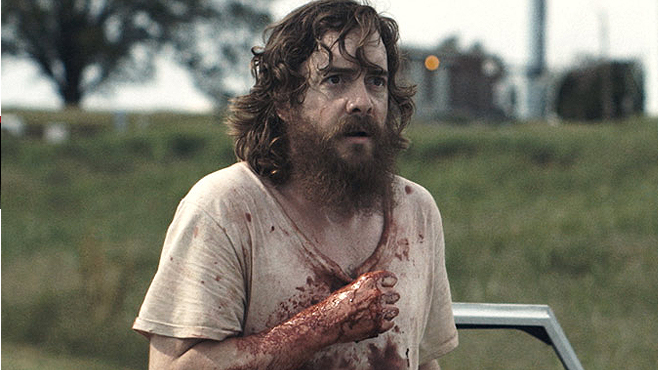
Here’s an entirely fresh take on the revenge thriller. Blue Ruin, an audience favorite on the festival circuit in 2013, didn’t get a theatrical release, and I would have missed it entirely but for a suggestion from my friend Jose.
As the film opens, we are following a homeless man and observing his survival tactics; once we’re hooked, we learn that a traumatic incident led to his homelessness. Then we watch him methodically prepare for an entirely different mission. There is very little dialogue in the first 30 minutes. And then we have 60 minutes of lethal cat-and-mouse, with intense suspense about which of the characters will survive and how. As a thriller, this is first class.
What makes Blue Ruin so fresh is the lead character, who has been shattered by a tragedy in his life – and who isn’t at all confident about his ability to redress it. This ain’t a Charles Bronson or Liam Neeson type hunter-of-bad-guys. Instead, our hero is as scared and fragile as most of us would be if we were being hunted for our lives – and so we relate to him.
Macon Blair is superb as the protagonist. He’s entirely believable both as a damaged down-and-outer and as a man-on-a-mission. Man, I hope Blair gets cast in more movies – he’s just great here.
Devin Ratray, one of the execrable, buffoonish cousins in Nebraska, is very good in an entirely different role here – a slacker scarred by his war experiences who nevertheless remains very skilled.
Blue Ruin was written and directed by Jeremy Saulnier. He is responsible for the wholly original lead character and the intense pace of the film, along with the meticulously economical storytelling; the exposition never relies on even one extra word of dialogue.
Blue Ruin is available on DVD from Netflix and streaming from Netflix Instant, Amazon Instant, iTunes, Vudu, Google Play, YouTube and Xbox Video.
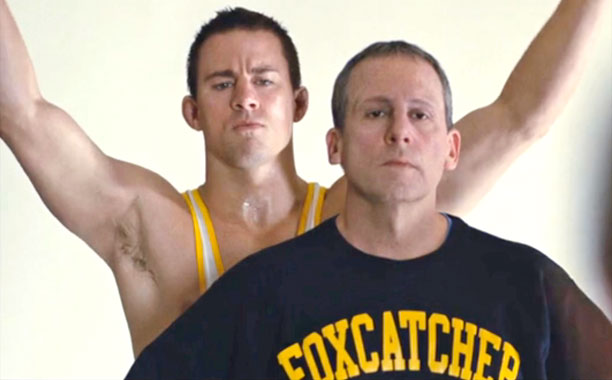
It may be set in the macho world of Olympic wrestling, but the docudrama Foxcatcher is really a relationship movie. The relationship triangle is between Olympic gold medal winning brothers Mark and Dave Schultz and the billionaire wrestling enthusiast John E. du Pont. Mark is uncomplicated and naive and seduced by du Pont’s offer to get him out of his older, more worldly, brother’s shadow. But du Pont turns out to be one sick puppy, with tragic results.
And the character of John E. du Pont, as brilliantly revealed by Steve Carell, is what makes this story so fascinating. He’s a zillionaire who is passionate about a relatively low profile Olympic sport and wants to sponsor US wrestlers – that’s all within the normal band of rich guy behavior. But he also fancies himself a coach, a Vince Lombardi-like Leader of Men, and his wealth enables him to act out his pathetic fantasies. It’s pretty clear that he’s driven by the worst mommie issues since Norman Bates in Psycho. (Vanessa Redgrave, in a brilliantly understated performance, plays his perpetually disapproving mother.)
Carell wear a prosthetic nose to resemble the real du Pont (just perform a Google image search for “John E du Pont” to see the real thing). But Carell knocks this role out of the park with his eyes – cluelessly confident, then raging when denied what he wants, then searching for a glimmer of maternal approval. Carell deserves – and I’m sure will secure – a Best Actor Oscar nomination. The guy can do more than comedy, that’s for sure.
All three of the main actors are getting Oscar buzz. Mark Ruffalo, is exceptional as Dave Schultz. Two of his scenes are extraordinary. In one, he is listening to Mark’s big plans and we can tell he thinks it’s too good to be true, but he doesn’t want to rain on his brother’s parade. In the other, he is being prompted to say something that disgusts him in du Pont’s vanity documentary. The story is centered on Channing Tatum as Mark Schultz. I generally like Tatum, and he’s OK here, but I couldn’t get past his device of jutting out Mark’s chin to capture the dumb jock look.
Foxcatcher is directed by Bennett Miller, whose two other films were Capote and Moneyball. He lets us understand Mark Schultz by watching him in his daily routine. He lets us understand John E. du Pont by contrasting his empty, blathering coachspeak with his posing as someone accomplished in his own right. Bennett keeps the camera right on his characters and stays out of the way, especially with his effectively spare soundtrack. It all works very well.
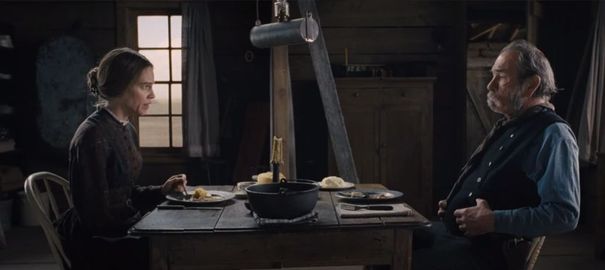
Tommy Lee Jones co-wrote, directs and stars in the dark Western (I love Westerns!) The Homesman. Hilary Swank plays a single woman in bleak frontier Nebraska who volunteers to take three madwomen to respite, a hard five weeks wagon ride to the east in civilized Iowa. She conscripts an irascible reprobate (Tommy Lee Jones) to help her. About Jones’ character, A.O. Scott of the New York Times wrote “It’s as if Yosemite Sam had turned up in the pages of a Willa Cather novel.” As in any odyssey or road trip story, they face obstacles that make it an adventure – and, in a Western, we expect those to include harsh natural conditions, hostile Indians and bad gunmen.
Like Clint Eastwood’s Unforgiven, The Homesman doesn’t romanticize the Wild West. The three passengers have suffered mental breakdowns. Each of them has clung to sanity through almost the unbearable hardships of frontier life, and then has been broken by a distinct trauma.
The Homesman has been labeled a “feminist Western”, and this is accurate. Swank’s character is independent, industrious and earnest and responsible to a fault. She’s a great catch for any guy post-1900, but her very independence repels any hope for male companionship in the mid-19th Century Old West, where the local yokels travel all the way Back East for women that are suitably submissive. As to the three broken passengers, really bad things have happened to the women, and the fact that they’ve been isolated with patriarchal and, in some cases abusive, men, has made it that much more unbearable.
Jones directs with a steady hand, and as in his exemplary Three Burials of Melquiades Estrada, proves to have a special gift with a western setting and in getting good performances. Here, he and Swank are just as good as we would expect, which is pretty damn good. The cast is dotted by the likes of John Lithgow and even Meryl Streep, but the standout, most memorable performances are the supporting turns by Tim Blake Nelson, James Spader and Hailee Steinfeld.
Unless you’re on a date or looking for an escapist lark, The Homesman is a fine movie on all counts; but be prepared for unrelenting grimness in this starkly, dark tale.
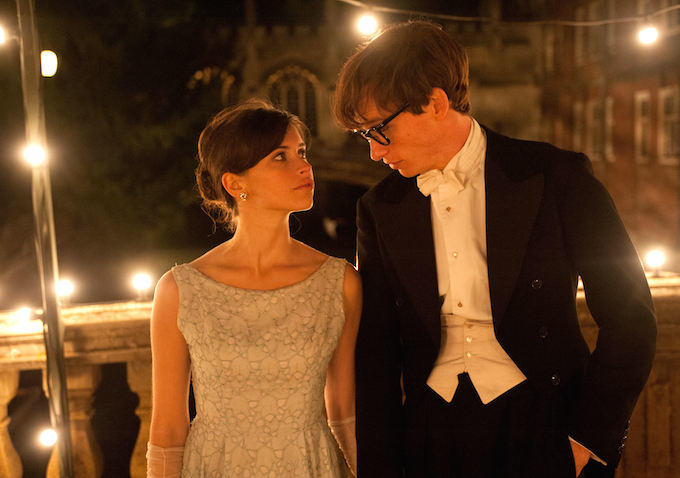
The Theory of Everything is based on the book by the woman who married Stephen Hawking – and this is important. While the story of Stephen Hawking – a generational genius who becomes physically disabled but continues his groundbreaking work – is pretty amazing, the story of the two of them facing this journey together brings more depth and texture to the tale. And, since everybody is somewhat familiar with the arc of Stephen Hawking’s career, the added focus on Jane Hawking brings some unpredictability to the plot.
The role of Stephen is one that many actors would kill for, and Eddie Redmayne delivers an exceptionally good performance. You may remember Redmayne’s solid turn in a good movie, My Week with Marilyn, and that he was one of the few highlights in the otherwise dreadful Les Miserables.
Felicity Jones’s performance as Jane stands up to Redmayne’s. She masks her profound inner strength with adorability. She was very good in Like Crazy, a romance that I really liked, although NONE of my readers did.
It’s worth mentioning that The Theory of Everything was directed by James Marsh, because he’s on a helluva storytelling run: the acclaimed documentaries Man on a Wire and Project Nim and last year’s overlooked thrillerShadow Dancer.
All told, The Theory of Everything has a compelling story with two fine performances, which adds up to a satisfying moviegoing experience.
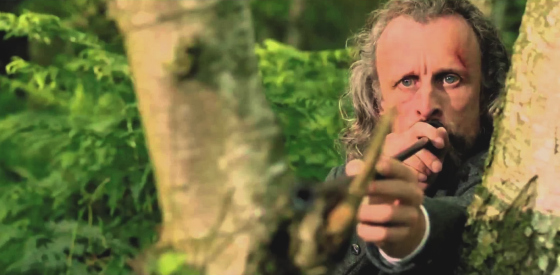
Technically, the Dutch thriller Borgman is a horror film, but it’s horror for adults, without the gore and with lots of wit. The shock doesn’t come from monsters unexpectedly lurching out of nowhere. The entertainment comes from the OMG moments of the “don’t ask the weird guy into your house!” and “don’t let the sinister guys watch your kids!” variety.
The setting is the architecturally striking and well-tended home of an affluent Dutch family and their Danish nanny. The husband is an aggro corporate schemer who is a real scumbag – selfish, racist and chauvinistic, with the capacity for a violent rage. His wife Marina is repressed and neurotic. But they are highly functional until a homeless guy, Camiel Borgman, happens by and circumstances compel them to put him up. Borgman feels entitled to more and more outrageous impositions – and soon it’s apparent that he’s even more sinister than he is obnoxious.
What if Charles Manson wasn’t a drug addled hoodlum and instead used his deranged charisma with remarkable skill? Borgman leads a crew of normal looking but murderous henchmen, who operate with the ruthless efficiency of Navy Seals. (Watch for the scar near the younger woman’s shoulder-blade.) Vaguely gifted with mind control, he can apparently create dreams by squatting naked gargoyle-like above Marina while she slumbers with her husband. There is violence aplenty, but it tends to come through a bonk on the head or some poison in a glass.
Dark comedy stems from the matter-of-factness of the murders and body disposal (as in tossing corpses into a lake and then diving in for a relaxing swim). Every once in a while, there’s a hilariously sinister moment, like the supremely random appearance of some whippets that seem more like hellhounds.
The acting is uniformly excellent, including the kids, but Jan Bijvoet as Borgman and Hadewych Minis as Marina are stellar.
Some questions are never answered (who are those three guys at the beginning and why are they hunting the homeless guys?). Is this a cult or aliens or what? The audience needs to accept some ambiguity. But the overall story arc is clear – no good is going to come of these people once they meet Camiel Borgman and his friends.
There is a subtext here: is this family so bourgeois that it deserves its fate? Fortunately, this subtext isn’t as in-your-face as in some recent self-loathing Eurocrap like Happy Days or Finsterworld, so it’s not at all off-putting. But Borgman can be enjoyed without going there at all.
Borgman is superbly written and directed by Alex van Warmerdam, a 62-year-old Dutch actor with only a handful of writing and directing credits.
I don’t often recommend a horror movie, but I’m all in on Borgman. Take it from me – you haven’t seen this movie before, and it’s endlessly entertaining. Borgman is available on DVD from Netflix and streaming from Amazon, iTunes, Vudu, YouTube, Google Play and Xbox Video.