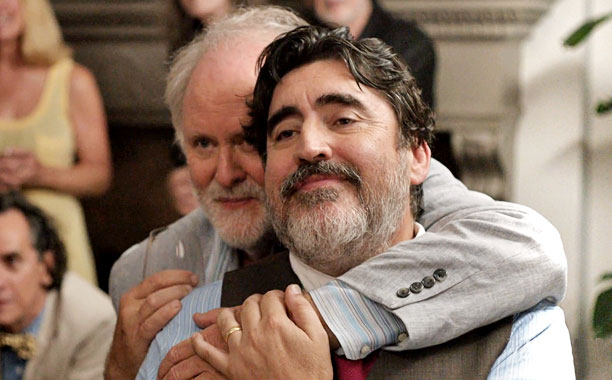
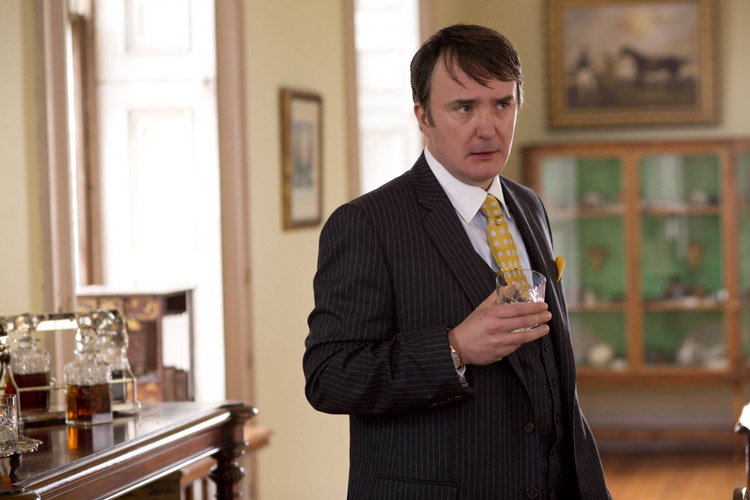
In the almost satisfying romantic drama Love Is Strange, Alfred Molina and John Lithgow play New York City men who, 39 years into their relationship, marry and then are separated by circumstance. By far the best part of Love Is Strange is that Molina and Lithgow develop unique characters, credible and truthful, neither a stereotype in any way. It’s a pleasure to watch these guys, and their embrace on a rainy night is shattering. Another good part: they have a teen nephew, and there’s some truth in the movie’s depiction of the difficulties of being a teenager and raising a teenager.
Unfortunately, Molina’s and Lithgow’s talents are left high and dry by co-writers Ira Sachs (who directed) and Mauricio Zaharias. The set-up to split up the couple’s living arrangements is contrived and unrealistic. Several plot points range from random to confusing (why do some characters steal some library books?), and some fade out without any resolution. Sachs also makes some directorial missteps. There’s a concert scene in which we are jarred with closeups of four or five non-characters (and, I think, non-actors) that really can’t be explained unless these are vanity shots of the movie’s investors. And a climactic shot of a character crying in a stairwell goes on one count, two counts, then twenty counts too long.
Love Is Strange is not a bad movie – and it does contain the splendid performances by Molina and Litgow – but it sure ain’t a Must See.
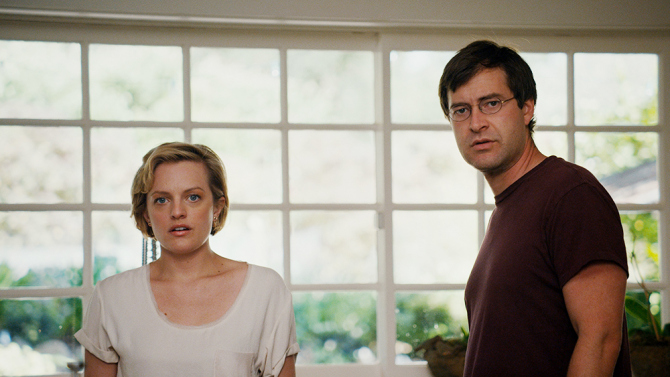
Opening tomorrow, The One I Loveis one of the year’s most original stories – a romance, dark comedy and sci-fi fable rolled into one successful movie. Mark Duplass and Elisabeth Moss play a couple in that place in their relationship where quirks have become annoying instead of endearing, some trust issues have emerged and the two are just generally misfiring. Their couples therapist recommends a weekend at an idyllic, isolated vacation cottage, which also has a second (presumably unoccupied) guest house. The beautiful setting is enhanced by a bottle of wine and a reefer, and the desired rekindling of romance and intimacy occurs. So everything goes as we would expect for this first nine minutes of the movie, and then – WOW – a major plot development that involves the guest house.
As soon as one of the characters explicitly references TV’s The Twilight Zone, the story becomes what would have been a perfect episode in that Rod Steiger series. Screenwriter Justin Lader pulls off a What’s Gonna Happen Next? story that has its moments of creepy thriller and madcap comedy. But, at its heart, the story explores these questions: what is it about our partners that keeps us in or drives us out of a relationship? How do we stay in love with someone who has changed from who we fell in love with? Or who hasn’t become the person we had projected? The One I Love is only 91 minutes, so the tension and the thoughtfulness can slowly build while keeping us on the edges of our seats.
Moss and Duplass are simply remarkable here – these are two great performances.
MINOR SPOILER ALERT: Both Duplass and Moss play other characters in this movie – and they excel at creating subtle differences in the characters that are revealing, thought-provoking and scary.
Eva Green in the poster for FRANK MILLER’S SIN CITY: A DAME TO KILL FOR
Wow, was this ever a disappointment. I loved the first Sin City from co-directors Richard Rodriguez and Frank Miller (the graphic novelist). And I’m in Sin City’s prime target audience because I love noir sensibility, hard-boiled dialogue and stylized violence in my movies. But Frank Miller’s Sin City: A Dame to Kill For is just not engaging.
None of the three story threads is particularly thrilling. The dialogue is so consistently lurid that it’s just overblown. Powers Boothe – always a wonderful villain – snarls his menacing smile so often that we expect him to grow mustaches and twirl them. The movie violence is of the splatter variety, and the bloodbath unleashed by Rosario Dawson and Jamie Chung is just silly. The ultra-sympathetic Denis Haybert is miscast as a monstrous superthug. Jessica Alba does a convincing job as a stripper but not as an alcoholic.
The whole thing is a stunning waste of a fantastic cast, including Boothe, Haybert, Mickey Rourke, Joseph Gordon-Levitt, Josh Brolin, Ray Liotta, Juno Temple and Christopher Meloni. In particular, Meloni and Liotta are not given much to do. Temple shines as usual as a mistress-for-hire, and Christopher Lloyd sparkles as a particularly unsanitary surgeon.
One remarkable thing – Eva Green (whose character is The Dame to Kill For) plays much of the movie in full frontal (and back and side view) nudity; I can’t remember seeing the body of a major female star displayed so clinically. Now she looks really good naked, but the sheer screen time of her nudity is unusual. Of course all the women in the movie are objectified – and other than Green’s malevolent and slutty femme fatale, Alba’s stripper, and Temple’s mistress, the female characters are all prostitutes.
If you like noir, then the film looks great: almost all black-and-white except for, occasionally, cherry red cars and vivid lipstick, hair and dresses on the women. The best I can say about Sin City: A Dame to Kill For is that it’s nasty, brutish and 102 minutes short.
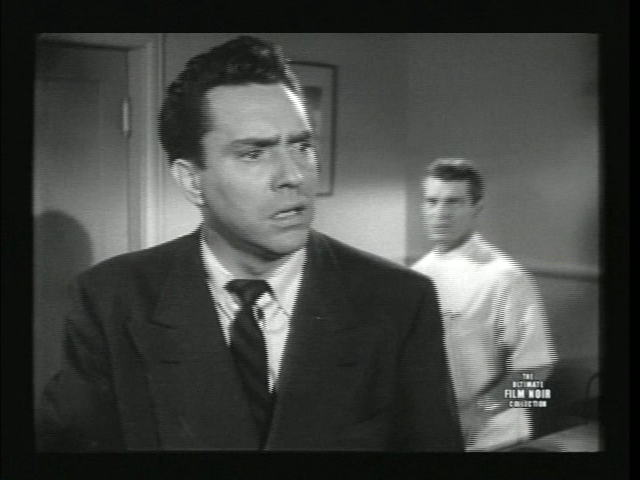
On August 27, Turner Classic Movies has the gripping film noir whodunit D.O.A., which opens with a man walking into a police station to report HIS OWN MURDER. The man (Edmond O’Brien) finds out that he has been dosed with a poison for which there is no antidote – and that he has only a few days to live. He desperately races the clock to find out who has murdered him and why – all in a taut 83 minutes. Much of D.O.A. was shot on location in San Francisco and Los Angeles, and one SF scene has one of the first cinematic glimpses into Beat culture. The little known director Rudolph Maté gave the film a great look, which shouldn’t be a surprise because Maté had been Oscar-nominated five times as a cinematographer. The next year, he followed D.O.A. with another solid noir, Union Station, with William Holden and Barry Fitzgerald.
(This 1950 version with Edmond O’Brien is the one you want to see; avoid the 1988 remake with Dennis Quaid and Meg Ryan.)
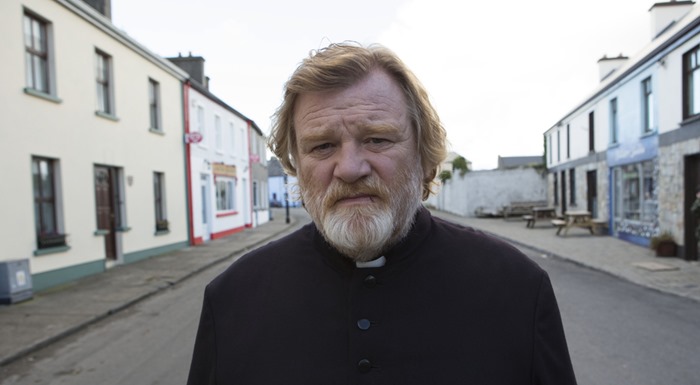
The superbly written drama Calvary opens with a startling line, which kicks off the unsettling premise. Brendan Gleeson (In Bruges, The Guard, The Grand Seduction) plays a very good man who is an Irish priest, Father James. In the confessional, a man tells him that – in one week – he will kill Father James. Having been molested by a priest (now dead), the man will make his statement against the Church: “There’s no point in killing a bad priest. I’m going to kill you because you’re innocent.”
Who is the man? (Father James figures it out before the audience does.) Will the execution really happen? Will Father James take steps to protect himself? Tension builds as the days count down.
The character of Father James is wonderfully crafted. Having come to the priesthood in midlife, after being married and having a secular career, he is seasoned and unburdened by high expectations of human nature – and has a wicked sense of humor. Yet he is moral in the best sense and profoundly compassionate. And Gleeson – always excellent – nails the role. It’s one of the finest leading performances of the year.
We know that the killer comes from a very limited pool of villagers and would-be parishioners, played by Chris O’Dowd, Dylan Moran, Aidan Gillen, M. Emmet Walsh, Isaach de Bankole and Orla O’Rourke. Their feelings for Father James range from fondness to indifference. Their attitudes toward the Church, on the other hand, range from indifference to hostility. (Moran is the best – playing a man grappling with his unhappiness, despite enjoying a fortune built by exploiting others. )
None of these characters is a stereotype. It’s a quirky bunch – but not CUTE quirky. There’s a lot of buried rage in this village – and dry humor, too. Referring to his wife, one casually says, “I think she’s bipolar, or lactose intolerant, one of the two”.
But it’s not the the villagers that Father James must deal with. He gets a visit from his occasionally suicidal adult daughter (Kelly Reilly, who is ALWAYS good); he loves and welcomes her, but she often contributes more stress. He doesn’t love his roommate, an idiotically shallow priest David Wilmot (the thug in The Guard who hilariously couldn’t figure out if he was a psychopath or a sociopath). Then there’s a seriously twisted imprisoned killer (the star’s son Domnhall Gleeson), a foreign tourist numbed by a sudden tragedy (Marie-Josee Croze) and a scheming bishop (David McSavage).
Writer-director John Michael McDonagh (The Guard) gets the credit for populating his screenplay with enough unique and original characters for an entire film festival, let alone one movie. After The Guard and Calvary, I can’t wait to see his next movie.
As one should ascertain from its title, Calvary ain’t a feel-good movie. It plumbs some pretty dark territory. But as we follow Brendan Gleeson’s extraordinary performance as a good man navigating a grimly urgent situation, it is mesmerizing.
Alive Inside is one of the most emotionally powerful documentaries that I’ve EVER seen. Seemingly miraculously, Alzheimer’s patients are transformed by music. The music doesn’t cure Alzheimer’s, but it pulls the patients out of isolation, helps them relate to other people and brings them joy.
Alive Inside tells the story of a solitary guy, Dan Cohen, and his tiny non-profit Music & Memory, which distributes iPods to Alzheimer’s patients. Michael Rossato-Bennett filmed Cohen’s work to prepare a video for Music & Memory. That original six-and-a-half minute video went viral. Rossato-Bennett realized that he had the beginnings of a movie, and, several years later, Alive Inside is the result.
Alive Inside won an Audience Award at Sundance, and I think that Alive Inside will be one of the two favorites for the Academy Award for Best Documentary Feature. It’s already on my list of Best Movies of 2014 – So Far.
All that aside, it’s a riveting film – and an example of the power of cinema. It’s impossible not to be moved when people essentially recover their humanity. And when you leave the theater, you’ll likely be thinking about making sure that your kids have your playlist.
Emma Stone and Colin Firth in MAGIC IN THE MOONLIGHT
Woody Allen’s annual movie is the disappointing romantic comedy of manners Magic in the Moonlight. Set in the late 1920s, a master magician (Colin Firth) goes to the South of France to unmask a phony psychic (Emma Stone). Things do not go as he had been expecting.
There’s plenty of witty banter, especially between Stone and Firth. Both do well in their parts, and they both look fabulous in the period dress. There’s also a really wonderful (as in Oscar-worthy) performance by Eileen Atkins as the magician’s life-seasoned aunt. The superb actress Jacki Weaver isn’t given anything to do except to beam some batty and vacant smiles. The rest of the cast is not as deep as in other Woody Allen movies.
But the movie never reels you in emotionally, and it’s only about as entertaining as one of those British sitcoms playing on your local PBS station. Albeit VERY briefly, I dozed off. Two scenes in particular are extended several moments too long, apparently just to accommodate more repartee. And the empiricism vs spiritualism debate seems shallow, contrived and stale when compared to that in the recent sci-fi romance I Origins.
It’s not unwatchable Woody like The Curse of the Jade Scorpion. But it’s not really good Woody, either. So, if you MUST have a dose of Woody this summer, watch one of Woody’s masterpieces: Annie Hall, Manhattan, Hannah and Her Sisters, Crimes and Misdemeanors and Midnight in Paris. Or better yet, go seeBoyhood or A Most Wanted Man or – beginning on Friday – Calvary or Alive Inside.
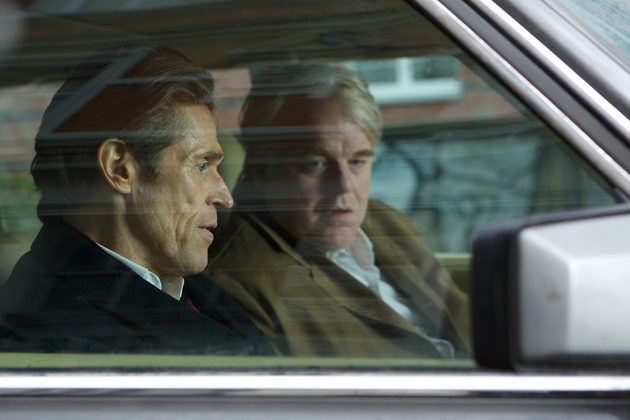
Willem Dafoe and Philip Seymour Hoffman in A MOST WANTED MAN
Espionage thrillers adapted from John le Carré novels, like A Most Wanted Man, are so good because le Carré, himself a former British intelligence operative, understand that intelligence services, riddled with bureaucratic jealousies and careerist rivalries, are not monoliths. His very human spies spend as much energy fighting each other as they do fighting the enemy. As a result, le Carré’s stories are more complex and character-driven than a standard “good-guys-hunt-down-a-terrorist” thriller plot.
That’s also the case with A Most Wanted Man, with which le Carré moves from the Cold War to the War of Terror. Philip Seymour Hoffman plays Günther, the leader of a German anti-terrorism unit in Hamburg. He must track down a possible Chechen terrorist while parrying off other German security forces, the CIA (Robin Wright), a shady banker (Willem Dafoe) and a do-gooder human rights attorney (Rachel McAdams). It’s the classic le Carré three-dimensional-chess-against-the-clock, and it works as an engrossing thriller.
But the A Most Wanted Man’s biggest asset is a searing performance by the late great Philip Seymour Hoffman. Günther is a canny and determined guy who needs to outsmart everyone else and manipulate forces beyond his control – and Hoffman nails it. His final scene is a spectacular explosion of emotion. (So soon after Hoffman’s death, it’s impossible to watch him here, with a huge belly and with his character chain-smoking and swilling whiskey, and not think of his final relapse into his ultimately fatal addiction; for this reason, A Most Wanted Man may be even more effective after a few years have passed.)
That being said, Robin Wright’s role as a duplicitous, shark-like CIA officer is under-written and doesn’t let her show her acting chops like House of Cards. Dafoe and McAdams are good in their roles. I was distracted by Grigoriy Dobrygin’s performance as the Chechen, which looked like bad Jeremy Davies without the twitches. The fine German actress Nina Hoss (Barbara) plays Hoffman’s assistant, and I hope we start to see her in more English language roles.
But the bottom line is that A Most Wanted Man is, overall, a satisfying thriller, and Philip Seymour Hoffman’s performance is reason enough to catch it in the theaters. (BTW le Carré’s screen masterpiece is the 1979 series Tinker, Tailor, Soldier, Spy, which is available on DVD from Netflix.)
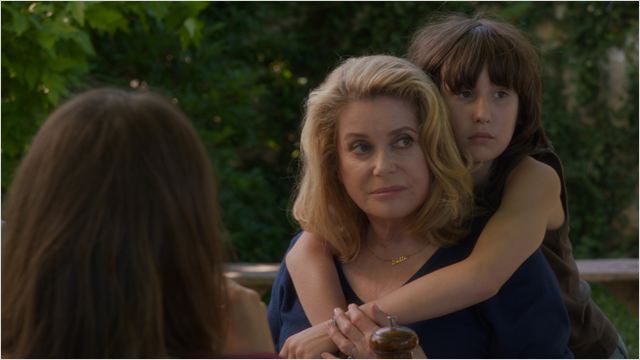
The extraordinary Catherine Deneuve goes on an escapist road trip in the satisfying French drama On My Way. She plays a woman chained to the stress of running a failing restaurant and caregiving for her mother. Her marriage was scarred by infidelity (both ways) and her life has been one of relationship carnage. After she suffers a personal betrayal, she needs to get away and abruptly leaves the restaurant mid-service, embarking on a random road trip through the French countryside – made even more random because she is geographically disabled. After a series of misadventures, she ends up taking the 11-year grandson (who doesn’t remember meeting her) to his other grandfather (whom she hasn’t met because she refused to attend her daughter’s wedding). She suffers many an indignity along the way, but rediscovers her happiness in an unexpected niche.
On My Way is directed and insightfully co-written by Emmanuelle Bercot, who acted in Polisse, one of my Best Movies of 2012.
Deneuve, once the world’s most beautiful woman, has a pretty solid claim on being the world’s most beautiful 70-year-old. She’s also a good sport, willing to take a part that explicitly references the passing of her youthful beauty at several story points.
On My Way is available on DVD from Netflix and streaming from Netflix Instant, streaming on Amazon Instant, iTunes, Vudu, YouTube, Google Play and Xbox Video.
[SPOILER ALERT: Here are examples of the references to the aging of her looks. Her age-approximate boyfriend dumps her for a 25-year old. The 30ish guy who picks her up tells her that he was imagining her as she was young during sex. She resists – until forced by circumstance – to attend the reunion of beauty queens. ]
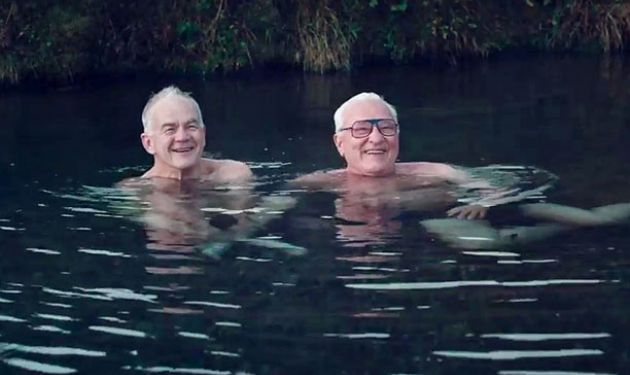
Here’s a really fun movie. Land Ho! features a vibrant and irascible geezer who conscripts an old friend into a rowdy road trip to – of all random places – Iceland. It’s a showcase for Earl Lynn Nelson, who essentially plays himself in the movie. Nelson is a 72-year-old Kentucky doctor who is a force of nature and has possibly an even dirtier mind than The Movie Gourmet’s. He is a friend of the 29-year-old writer director Martha Stephens who was INSPIRED to see the possibilities in sending him off on an adventure and filming the results. His friend (and ex-brother-in-law) is played by an actor, Paul Eenhoorn.
It all works. Nelson – an unapologetic hedonist – is funnier than hell, and Eenhorn stays right with him as the more reserved and sometimes aggrieved buddy. Land Ho! is a string of LOL moments, whether Nelson is providing politically incorrect fashion advice to young women or unsolicited marital advice to a honeymooning couple or pulling out a joint and proclaiming “It’s time for some doobiefication”.
This is a geezer comedy that doesn’t make the geezers cute. Nelson may be a piece of work, but there’s nothing in Land Ho! that isn’t genuine.
I just have two knocks on the movie. It’s only 95 minutes long, but it would be crisper at about 87. And, as The Wife pointed out, there’s really no need for the huge jarring subtitles to let us know precisely where these guys are in Iceland.
Nevertheless, it’s worth a watch. The audience at Sundance loved this movie, and I think Land Ho! is a hoot-and-a-half.