Julianne Moore will win this year’s Best Actress Oscar for her portrayal of a professor faced with the early onset of Alzheimer’s in the otherwise pedestrian disease drama Still Alice. Moore’s character is a brainiac who is by nature a hyper-achiever, so the disease strips away both her memories and the identity that she has striven to mold for herself. Of course, once she receives the diagnosis, she harnesses both her brainpower and drive to prepare herself and her family for the eventualities. It’s a breathtakingly brilliant performance, with never a false note, as we see the professor slipping from the occasional memory lapse to the ravages of dementia.
The movie’s strongest scenes are those when she is floundering with the as yet undiagnosed affliction and when she tells her family about her diagnosis, with a particularly wrenching implication for her kids. Disease movies present a challenge for any filmmaker – how can the grimness of an irreversible and progressive illness be leavened by moments of redemption and humor so it’s not too painful to watch? And here, Still Alice falls short – the redemptive moments, most particularly a corny speech before Alzheimer’s advocates, just seem phony and manipulative. And the story walks right up to the edge of a better ending and then steps away.
The supporting cast, including Kristen Stewart, are all okay (although Alec Baldwin seems a bit checked out). All in all, there’s not much else here. But Julianne Moore might be enough.
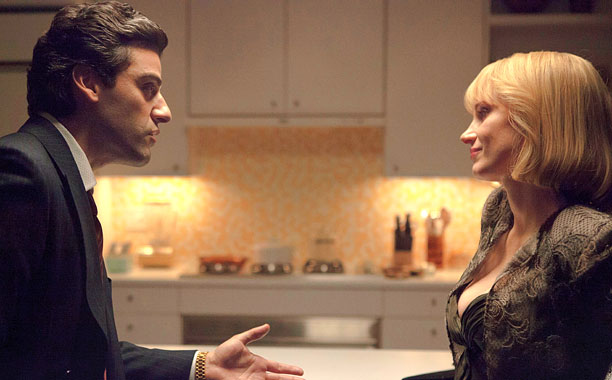
Oscar Isaac and Jessica Chastain in A MOST VIOLENT YEAR
In the brooding drama A Most Violent Year, a businessman (Oscar Isaac) risks everything on a big deal and must fight against time to save it as competitors, criminals and an ambitious prosecutor all try to rip it from his grasp. The guy is principled and a bit of a Boy Scout, and he handicaps himself by refusing to get dirty – even though he trades in a rough-and-tumble (and generally corrupt) industry. Fortunately, his wife and business partner Jessica Chastain is the daughter of a mobster and his in-house lawyer (Albert Brooks) is an unapologetic crook.
Two things work really well in A Most Violent Year. The first is the exceptional evocation of time and place. We are taken back to New York City in 1981, when it had all the trappings of a failed state, including a breakdown in the rule of law. As the movie takes us between weed-overgrown industrial locations, we drift into the dingy and the sinister.
The second triumph is the acting. Of course, Chastain is always wonderful, even if she is a little underused here; her character is delightfully tougher and more realistic than her hubbie. David Oyelowo is very good as the cynical prosecutor who becomes mournfully sympathetic to the naive protagonist. Albert Brooks, Peter Gerety (superb as the bartender in the otherwise dreadful God’s Pocket) and Jerry Adler (Hesh in The Sopranos) bring a spark to their smaller parts. Isaac (Inside Llewyn Davis, The Two Faces of January) adds smoldering intensity, but he’s overshadowed by the ensemble.
The splashiest performance is by Elyes Gabel as an immigrant trying to leverage a truck driving job into the American Dream who finds himself plunged by circumstance into increasingly desperate straits. Gabel perfectly modulates his performance as a guy who starts out modestly hopeful, then becomes traumatized and just hangs on to a semblance of emotional balance, and finally, his future unhinged by rotten luck, implodes.
However, I was underwhelmed by the story. Even though there’s a ticking clock element and a whodunit, it’s just not gripping enough to take this drama into psychological thriller territory. And there are some distracting holes in the plot (see Spoiler Alert below if you must). This is a disappointment after writer-director J.C. Chandor’s excellent first two films, Margin Call and All Is Lost.
While not a Must See, A Most Violent Year is still a successful drama, adorned by another flawless turn by Jessica Chastain.
SPOILER ALERT: [If the truck hijackers are really “working for themselves” and not one of Abel’s competitors, then they should only be stealing oil – so who is prowling around Abel’s house with a gun and who is attacking his sales force? And who makes a real estate purchase with hundreds of thousands of dollars in cash and lets the seller leave with BOTH the money and the only copy of the signed contract – twice?]
My DVD/Stream of the Weeks is a fine first feature with a GREAT title for a contemporary noir thriller: Bad Turn Worse. It’s set in a nowheresville Texas cotton gin town. Three childhood friends have just graduated from high school, and two are looking to escape to college – Bobby (Jeremy Allen White) and Sue (MacKenzie Davis). Not sharing a speck of Bobby’s and Sue’s intellectual curiosity, Sue’s longtime boyfriend B.J. (Logan Huffman) doesn’t want them to go; B.J. is dreamy and testosterone-filled, but bone-headed and weak-willed, with a gift for making impulsive, destructive choices. Bobby is sweet on Sue, and she is starting to be repelled by B.J.’s immaturity and selfishness. Sure enough, B.J. does something which entangles them all in a lethal jam.
Pretty soon there’s a double cross within a double cross, with a love triangle overlay. Nobody can trust anybody else, and somebody is gonna have to die…
The young leads are good, but two veteran TV actors sparkle in supporting turns. Mark Pellegrino plays a ruthless and crazy-scary villain that no one should cross. Jon Gries (Uncle Rico in Napoleon Dynamite) is hilariously deadpan as the corrupt Sheriff who tries to connect the dots for Bobby with metaphors – and Bobby’s dots just aren’t connecting.
Bad Turn Worse’s noir sensibility comes from 1) the amoral attitude that sometimes you gotta break the law and 2) the expectation that there can’t be a happy ending with all this treachery in play.
Bad Turn Worse is written by Dutch Southern and is the directorial debut of Simon and Zeke Hawkins. These guys have definitely proven that they can pull off a solid thriller. Bad Turn Worse is available streaming from Amazon Instant, iTunes, Vudu, YouTube, Google Play and Xbox Video.
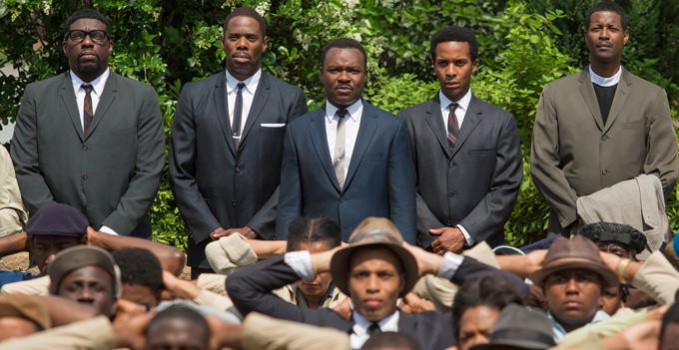
David Oyelowo as Martin Luther King Jr. (center back) in SELMA
It’s been a while since I’ve seen as stirring a movie as Selma, Director Ava DuVernay’s retelling of the Selma, Alabama, Civil Rights marches in 1965 – one of the most heroic episodes in a saga known for heroism.
It’s an important story. Although the marches came on the heels of a racist atrocity, instead of just vomiting rage, Martin Luther King (David Oyelowo) and his fellow civil rights leaders had a specific strategic goal in mind. Their planned civil rights march from Selma to Montgomery was designed to trigger the passage of yet-to-be-drafted legislation, the Voting Rights Act of 1965. They knew that there would be risks to all and sacrifices by many – both martyrs to the cause and victims of terrorism. Those sacrifices were real and are depicted in the movie. As the civil rights leaders navigate the reefs of local Jim Crow rule and murderous racist terrorism, Selma’s story is compelling minute-to-minute.
King himself must bear the burden of responsibility of a leader sending his charges out to possibly sacrifice their lives. All the time, he is receiving threats to his safety and that of his family, dealing with blackmail and character assassination and going through a rough patch in his marriage to Coretta Scott King (Carmen Ejogo).
But Selma, like history, is not a One Man Show. King doesn’t just dictate the path for his Southern Christian Leadership Council (SCLC). He has to work with his colleagues in the SCLC and reach out to build a coalition with the local African-American community and other national organizations, chiefly the Student Non-violent Coordinating Committee (SNCC). King is not just another noble face. He’s got to show a canny craftiness as a study in negotiating, a guy who knows when to hold ’em and knows when to fold ’em.
Here’s something else that Selma does extraordinarily well. I’m a history buff who understands that – to relate a historical narrative in 90-120 minutes – filmmakers must compress historical events and compound characters. However, Selma allows us to glimpse the broad canvas by seeing other important figures of the Civil Rights movement – Andrew Young, Ralph Abernathy, Hosea Williams, John Lewis, James Forman, Diane Nash, James Bevel, James Orange and even Malcom X and Bayard Rustin. There are also the white martyrs James Reeb and Viola Liuzzo. And New York Times reporter Roy Reed is there, representing the handful of national newsmen who brought the civil rights struggle into the homes of non-Southern America. As villains, we have not just George Wallace (Tim Roth) but Al Mingo and Sheriff Jim Clark.
And what about the controversial depiction of President Lyndon Johnson (Tom Wilkinson)? The short answer is that Selma’s treatment of LBJ is sometimes factually inaccurate and definitely wrong in tone. I am going to discuss this more fully in another post, probably on Wednesday. But the bottom line is this – see the movie anyway. At its core, the movie is about what happened in Selma and within the leadership of the Civil Rights movement – it generally gets that right.
After seeing Selma, I reflected on the media landscape in 1965 – where every home in America watched the TV news from either CBS, NBC or ABC. The repugnant spectacle of the white mob beating the peaceful demonstrators came into every American living room, including mine. We Americans all saw the same thing. But in today’s media environment, a huge fraction of the country gets it news from Fox News, which would likely twist and minimize the very facts that mobilized a nation in 1965 – and another huge fraction would be watching non-news content and miss the controversy all together.
But my most sobering reflection upon leaving the theater was this – right now the Republican Congress and the majority of the US Supreme Court are trying their hardest to emasculate the very Voting Rights Act that was the culmination of the campaign in the movie Selma.
In a uniformly well-acted movie, David Oyelowo deserves special praise for his portrayal of MLK. Oprah Winfrey and veteran character actor Henry G. Sanders are the best of the rest. On a personal note, I relished seeing one of my faves Wendell Pierce (Treme and The Wire) and also up-and-comer Tessa Thompson of Dear White People.
Selma is inspirational, kids should see it and families should discuss it. It’s just outside the Top Ten of my Best Movies of 2014.
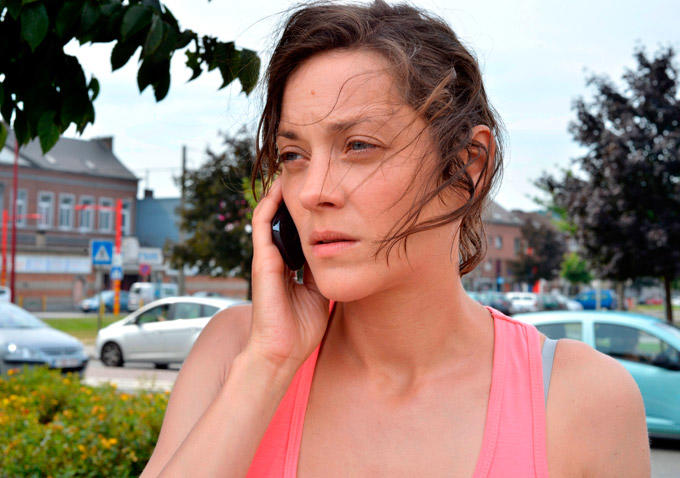
In the Belgian drama Two Days, One Night, a factory worker (Oscar winner Marion Cotillard) finds out on Friday afternoon that she will be laid off unless she can convince nine of her sixteen co-workers to sacrifice their bonuses. She must make her case to each of them before a vote on Monday morning. It’s a substantial bonus, and every one of her colleagues really needs it; their spouses are expecting it, too, and many have decided how they are going to spend it. The vote is going to be close, the stakes for each family is high and the tension builds.
Our protagonist is anything but plucky. She needs to be coaxed and prodded by her husband and a militant co-worker. She is buoyed enough by an early victory to keep going, but she’s constantly on the verge of giving up.
She hasn’t been been well, which also complicates things. Because the filmmakers wait until midway to explicitly reveal her illness, I’m being careful not to spoil it here. But the precise illness is important because it affects both her own stamina and the confidence of her co-workers about how well she would contribute to the workplace.
Two Days, One Night is the latest from two of my favorites writer-director filmmakers, the brothers Jean-Pierre and Luc Dardennes. They specialize in contemporary dramas of the Belgian working class. Their The Kid with a Bike was #1 on my Best Movies of 2012. And I think that their 2002 The Son (Le Fils) was pretty much a masterpiece, too. The Dardennes’ hand held (but NOT shaky) cameras intrude right on top of the characters, bringing an urgency and immediacy to every scene. Hyper realism contributes to the verisimilitude and thereby builds more power into the stories; here, a tense conversation in the doorway to an apartment building get interrupted by someone walking in – just as it would be in real life.
At its core, Two Days, One Night explores the limits of emotional endurance. What does she need to rebound form her malaise – the adrelin surge of battle? Or the power from getting to make her own choice?
[Anyone who has visited France or Belgium will recognize the remarkable politeness of the characters – observing all the formalities of greeting, shaking hands and saying thanks and goodbye even in the most awkward and emotionally charged encounters.]
Two Days, One Night is a fine film, just outside the Top Ten on my Best Movies of 2014. Unsurprisingly, Cotillard’s glammed-down performance is brilliant. It’s a compelling story as we walk her tightrope of desperation, heading toward redemption. Two Days, One Night opens widely in the San Francisco Bay Area tomorrow.
In Clint Eastwood’s real-life story American Sniper, Bradley Cooper plays Chris Kyle, the most effective sniper in US military history. A Navy Seal in the Iraq War, Kyle signed up for a soul-sucking four tours. American Sniper is about how he survived those searing war experiences and how he did/did not cope with the emotional legacy of those experiences back in the USA.
Nobody should have to see and endure what Kyle (and tens of thousands of his comrades) did. Kyle was that recognizable American male who refused to admit that his experience could be taking an emotional toll. As a result, he’s constantly on the verge of being blown up in the war scenes and on the verge of imploding in the scenes back home. Sometimes there’s more danger in the domestic scenes than in the war action scenes.
The war scenes are convincing, brutal and adrenalin-packed. The final battle scene is one of the most harrowing I’ve ever seen in a movie. While Kyle’s unit is under siege, we can see what his headquarters is seeing on the high tech satellite view – and it looks increasingly hopeless. When the situation is at it most desperate, a sand storm hits, and suddenly we’re immersed into the fog (sand?) of war, trying to tell who is who and what is happening.
And here’s an observation on violence in Eastwood movies. Clint used to trade in good old fashioned movie violence as he shot ’em up in westerns, war action films and the Dirty Harry series. But beginning with Unforgiven, all of Eastwood’s films have featured only the most realistic violence. With Unforgiven, a toggle switched inside Clint, and he must have determined to use violence only for STORYTELLING and never for ENTERTAINMENT. This is the case with American Sniper.
This may be Bradley Cooper’s finest performance. He is perfect as the Everyman hero surviving battle, but clinging on by his fingernails in peacetime. It’s a finely modulated performance without a shred of PTSD cliche. The other actors (including Sienna Miller as the wife) are just fine, but their roles are relatively underwritten.
American Sniper is a very strong movie, compelling and thoughtful. It just makes the Top Ten on my Best Movies of 2014.
In the light but smart comedy Goodbye to All That, a guy (Paul Schneider) is slobberknocked when his wife demands a divorce. Trying to right himself, he takes on post-divorce co-parenting and modern-age dating. Amusing episodes ensue.
Our hero encounters a slew of well-acted female characters who provide him with a menu of challenges; the cast includes Amy Sedaris, Melanie Lynskey, Heather Graham and Ashley Hinshaw. There’s a particularly hilarious scene with his wife’s steadfastly partisan therapist (Celia Weston).
But the funniest role is played by Anna Camp (Pitch Perfect, Caitlin D’arcy in The Good Wife and Gwen in The Mindy Project) – a bipolar nymphomaniac evangelical Christian. I still chuckle when I think of “I’m Debbie Spangler!”
This is the directorial debut of Angus McLachlan, the writer of the delicious Junebug. It’s not as good as Junebug, but it has the same sharp observation of human foibles. Goodbye to All That is available streaming on Amazon Instant, iTunes, YouTube, Google Play and Xbox Video.
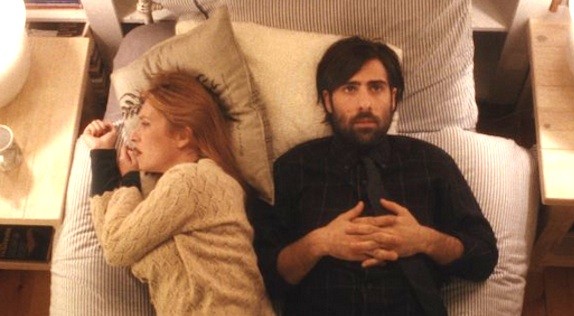
Elisabeth Moss and Jason Schwartzman in LISTEN UP PHILIP
The dark indie comedy Listen Up Philip features perhaps the most self-involved character in cinema (and that’s really saying something). The young novelist Philip Lewis Friedman (Jason Schwartzman) believes that his writing talent entitles him to simmer in permanent rage and to crap on every one in his path. To the credit of writer-director Alex Ross Perry, this supremely unsympathetic character is very fun to watch. (And, unlike in most mumblecore movies, Philips’s self-absorption is not accepted as an aspect of normal life, but treated as appallingly aberrant and cruel.)
Philip is living with his photographer girlfriend (Elisabeth Moss), whose career is beginning to eclipse his. It’s pretty clear that their home will soon be tossed on Philip’s trail of relationship carnage.
Just when Philip might have to face the natural consequences of his behavior, he meets the WORST POSSIBLE mentor – an older famous novelist (Jonathan Pryce). The older guy, who has his own collection of relationship wreckage, is ready to enable, nurture and magnify all of Philip’s worst tendencies.
Perry cleverly moves the story’s focus from one character to another and adds a hilarious voiceover narration that parodies the tone of many modern American novels. Be sure to watch for the faux book covers during the final credits.
Listen Up Philip is smart and funny, but plenty dark. It’s available streaming on Amazon, iTunes, Vudu, YouTube and Google Play.
Mr. Turner, Mike Leigh’s biopic of the 19th Century British landscape painter J.M.W. Turner, is visually gorgeous, is centered on a career-topping performance by Timothy Spall as the title character, and is just too damn long.
It kills me to say that, because I’m a huge admirer of Leigh’s films, especially Secrets & Lies and Another Year;. But it’s 150 minutes long, and there’s only 120 minutes of compelling story in there. I took a party of several seasoned art house film goers to a screening at the Mill Valley Film Festival, and EVERYONE agreed that Mr. Turner dragged.
That’s too bad, because it wastes a stunning performance by Leigh regular Timothy Spall. Turner was driven by his artistic passions, distracted by his carnal appetites and didn’t invest much energy in getting along with most people. Spall uses a palette of grunts, not as a gimmick, but as a means to reveal what this guy – otherwise trying to be so contained – was thinking or feeling. (So heartbreaking in Secrets & Lies, Spall is most recognizable as Peter Pettigrew/Wormtail in the Harry Potter movies.)
As in any Leigh film, all the acting is excellent, but Dorothy Atkinson turns in an especially noteworthy and vanity-free performance as Turner’s long suffering maid.
The real Turner was a groundbreaking genius in his use of light. Leigh’s greatest achievement in Mr. Turner is visual – evey exterior shot looks like it could have been painted by Turner. It’s a remarkable visual achievement.
Alas, the stunning photography and two great performances weren’t enough to keep my mind from wandering.
Now here’s an amazing true story: those ubiquitous but creepy images of waifs with exaggerated eyes were created by painter Margaret Keane, but the credit for them – and income from them – were taken by her con man husband Walter Keane. In the entertaining Big Eyes, the couple is played by Amy Adams and Christoph Waltz.
Adams’ performance is perfectly tuned, so we can understand how Margaret could be charmed and bullied into such a disadvantageous situation. Waltz does a good job in the first two-thirds of the movie, when he depicts Walter’s charm and chutzpah; but his performance in the final third of the movie seems very broad. Big Eyes also features especially fun supporting turns by Danny Huston and Terence Stamp.
Big Eyes does a good job of illustrating the overt sexism of the pre-Women’s Lib 1950s. And the serious issue of domination and control in a relationship lurks in the background. But Big Eyes has been distilled down to a simplistic Good Gal/Bad Guy story.
Denizens of the San Francisco Bay Area will enjoy the familiar Bay Area locations, especially the recreation of North Beach in the Beat Era and Woodside in the Sunset Magazine 1960s.
Bottom line: Big Eyes is a satisfying audience-pleaser, but not a movie I’ll be thinking about tomorrow.