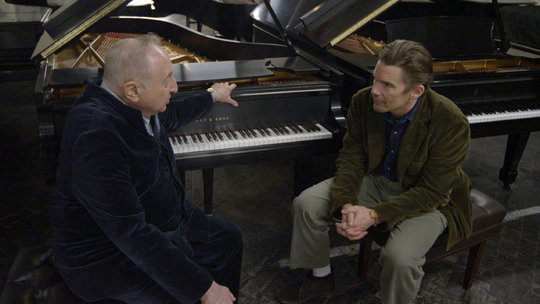
Seymour Bernstein and Ethan Hawke in SEYMOUR: AN INTRODUCTION
As Seymour: An Introduction opens, we see an elderly man giving piano lessons to VERY talented pianists. His gentle instructions address tiny details in the performances that we in the audience can’t notice – such as how deeply to press the piano key. Each of his tips is constructive and easy to understand As exacting as his corrections are, his overall demeanor never fluctuates from entirely supportive. This extraordinary teacher is the concert pianist Seymour Bernstein.
Bernstein long ago abandoned a career in the spotlight. We’re meeting Bernstein only because the actor Ethan Hawke met him by chance and benefited from his life advice. Hawke directed this film.
Thank you, Ethan. It’s a deep privilege to meet this gifted and kind man, and spend an hour-an-a-half watching him treat others as he does. When the Wife and I caught a screening, no one left the theater until the end credits were completed.
Slow West, which I saw at Cinequest, is out on VOD today, ahead of a theatrical release in mid-May. I suggest that you skip it.
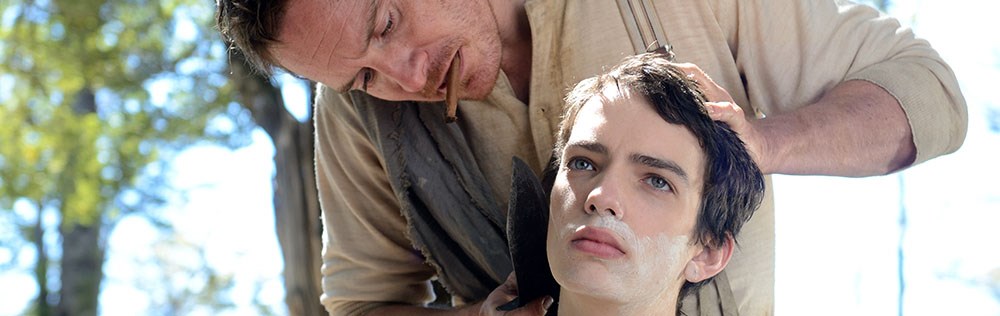
I love Westerns, but Slow West just didn’t work for me. It’s a film of some ambition, and it won an award at Sundance, but the movie kept sliding in and out of self-consciousness, and I could never settle in to the story.
Kodi Smitt-McGee plays a sixteen-year-old Scot completely unsuited for survival in the Old West. Nonetheless, he is devoted to a young woman and he launches a determined quest to track her down. He soon picks up a veteran Westerner (Michael Fassbender) who can guide and guard him. The two, of course, have a series of adventures along the way.
There’s some appealingly dark and droll humor in Slow West (quite a few good laughs, actually). The problem is that Slow West can’t figure out whether it should have the tone of a straight Western (Unforgiven, The Homesman) or wink at the audience (Little Big Man). Accordingly, some of the period details are so wrong that they distracted me from the story. For example, in an otherwise very funny scene with arrows and a clothesline, the Indians look like tiny, skinny Asians. Smitt-McGee employs a Scots accent in every fifth line. And Fassbender sounds like he just stepped out of a time machine from 2015.
Slow West was filmed in New Zealand, so there are grand vistas that kind of look like the American West, but then kinda don’t. This DID work for me, because it contributed an almost subconscious edge to heighten some scenes.
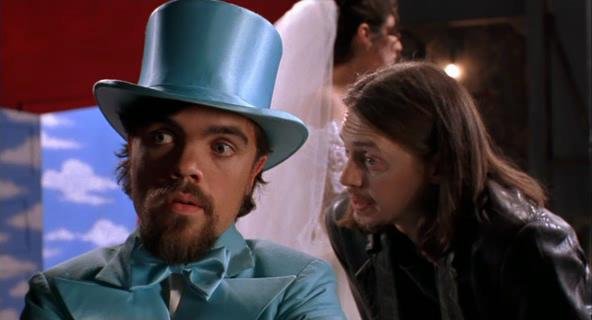
Peter Dinklage and Steve Buscemi in LIVING IN OBLIVION
The hilarious 1995 comedy Living in Oblivion follows a grossly under-resourced indie movie director (Steve Buscemi), who must somehow finish his low-budge/no-budget art film despite being surrounded by zanies. He’s got a neurotic female lead (Catherine Keener), a preening and slumming A-list star named Chad Palomino (James Le Gros) and an elderly actress who can’t remember her lines (Rica Martens). His stubborn and sullen cinematographer (Dermot Mulroney) is bedding the First Assistant Director (Danielle von Zerneck), who has an agenda of her own. With this outfit, everything that CAN go wrong…
Living in Oblivion is filled with lines like “I can’t act. I can just do shower scenes in Richard Gere movies for the rest of my life!” and “Hey! That’s my eye patch and I don’t want anyone else wearing it. It’s insanitary.”
But the pièce de résistance is the feature debut of Peter Dinklage, 8 years before his breakout role in The Station Agent and 16 years before becoming a star in Game of Thrones. He plays an tiny actor with a gargantuan chip on his shoulder: “Why does my character have to be a dwarf?” and “I don’t even have dreams with dwarves in them. The only place I’ve seen dwarves in dreams is in stupid movies like this!”.
Director Tom Dicillo, having been Jim Jarmusch’s cinematographer, was no stranger to indie filmmaking. After Living in Oblivion, Danielle von Zerneck moved on to a producing career.
Living in Oblivion is available on DVD from Netflix and streaming from Amazon Instant, iTunes, Vudu, YouTube and Xbox Video.
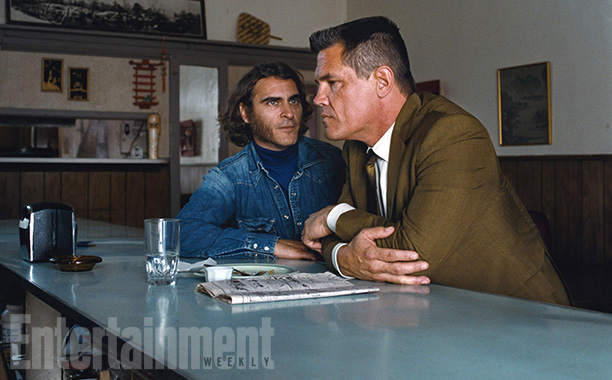
Adapted by Paul Thomas Anderson from a Thomas Pynchon novel, Inherent Vice is a funny and confused amble through pot-besotted 1970 Los Angeles. Joaquin Phoenix plays a bottom-feeding private eye who is contacted by an old girlfriend and, of course, finds himself knocked out and implicated in a murder. Thus begins a plot so convoluted that it makes The Big Sleep look as linear as a Bud Light commercial.
We meet a wide array of characters with names like Dr. Buddy Tubes, Japonica Fenway and Puck Beaverton. We hear sly wit along with seeing low brow sight gags (nose-picking. etc.). There are funny lines, as when Phoenix’s pothead detective is described as “You smell like a patchouli fart”. Perhaps the funniest moment is when our addled hero writes himself a note in block letters: “NOT HALLUCINATING”.
Owen Wilson, Reese Witherspoon, Benicio Del Toro, Eric Roberts, Jeannie Berlin, Jena Malone, Maya Rudolph and Martin Short all pop up in Inherent Vice, and Joaquin Phoenix is as good as one would expect. The most memorable performances, though are by Josh Brolin and Katharine Waterston. Brolin is hilarious as a flat-topped hardass cop. Waterston plays the former girlfriend, Inherent Vice’s female lead, and she pretty much captivates every scene that she’s in. Musician Joanna Newsom, who also plays a minor character, narrates very effectively.
Paul Thomas Anderson (Hard Eight, Boogie Nights, Punch-Drunk Love, The Master) is a brilliant filmmaker, and Inherent Vice gets the time and place just right, with an especially evocative color palette.
It’s mildly entertaining all the way through, but never compelling. And all the way through is two hours and twenty-eight minutes – not really a slog, but you’re never on the edge of your seat. And you’re certainly not going to think about it tomorrow.
I finally got around to watching Inherent Vice on DirecTV PPV. It’s also streaming on Amazon Instant Video, iTunes, Vudu, YouTube, Google Play, Xbox Video and Flixster.
The title character in Kumiko, The Treasure Hunter (Rinko Kikuchi – Oscar nominated for Babel) flies from Japan to Minnesota on a quest to unearth the suitcase of loot that Steve Buscemi hid in the snow in the movie Fargo. Because she doesn’t speak English or have any money, navigating the frigid 200+ miles from the Minneapolis Airport to Fargo, South Dakota makes for a fish-out-of-water comedy, albeit a tiresome one-joke comedy.
We meet our heroine living a solitary life of utter dissatisfaction in Tokyo, where she spits in every cup of her boss’ tea. At night, she watches and re-watches a scratchy VHS tape of Fargo. As we watch her increasingly bizarre actions, it becomes clear that she is starkers. The absurdist humor in Kumiko comes from the completely deadpan depiction of the bizarre. It’s all very droll, with many genuinely funny moments, but it finally becomes tedious. And I didn’t buy the glimpse of magical realism at the ending.
Here’s something I liked about Kumiko – the director and co-writer David Zellner also plays the role of the rural deputy sheriff – and he’s really great at capturing the essence of a well-meaning man driven to help, but utterly unequipped to do so.
So, how funny, really, is mental illness? Having seen it up close in my own life, I don’t seek it as necessarily cute or quirky. This woman is raving mad, but she’s been able to remain (barely) functional with a highly regimented life in her own culture. When she plunges herself into an alien world, she inevitably decompensates. I am able to enjoy mental health humor (and I aspire to be the farthest thing from a scold on the subject), but just watching someone flail around within their disability isn’t entertaining for me.
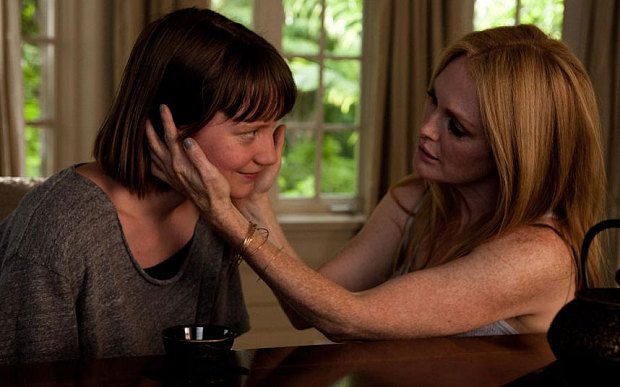
David Cronenberg’s Maps to the Stars is funny, dark and disturbing, but is ultimately unsatisfying. The disturbing part shouldn’t surprise us, Cronenberg having been responsible for the exploding heads in Scanners, the auto accident sexual fetishes of Crash (1996) and the nightmarish druggy hallucinations of Naked Lunch. But Cronenberg’s most recent A History of Violence and Eastern Promises have been very accessible, albeit with striking violence. Maps to the Stars lures us in with a brutally witty show biz satire, and then clubs us with the most twisted family violence.
John Cusack and Olivia Williams play a rich Hollywood couple who had unknowingly committed their unique form of Original Sin, which has resulted in two damaged and dangerous kids. Julianne Moore plays a needy and neurotic movie star grappling with middle age and her own family heritage. These are people who take astonishing privilege for granted and treat their minions in contempt. They react to the most even the most horrific tragedies by assessing how it will affect a book tour. Cusack’s faux-shaman-to-the-stars ponders fixing the worst possible PR disaster by going “on Oprah and pulling a Lance Armstrong”.
What makes this such a nasty show biz satire, is that the eveil doesn’t just come from the Hollywood suits. Here, the talent and the creatives are just as biz-oriented – always focused on box office, their fees, and cut throat competition for the next career-enhancing and remunerative gig. There is very smart humor and lines like, “You know, for a disfigured schizophrenic, you’ve got the town pretty wired”.
Brilliant as always, Julianne Moore is a very good sport here (even with a fart gag). The most memorable performances are by the very underutilized Olivia Williams (The Ghost Writer, Hyde Park on Hudson) – always teetering with desperation just under the surface – and Evan Bird, a monstrous teen star who isn’t to blame for how he is. Cusack and Mia Wasikowska are also very good. I just can’t figure out the appeal of Robert Pattinson, who is in this move to be a love interest, and doesn’t add anything special.
Although there’s a lot to enjoy about Maps to the Stars, it just doesn’t pay off. There’s very disturbing violence, some involving children, and sending up Hollywood foibles with the level of sickness in these characters, just isn’t worth it.
Maps to the Stars, after a blink-and-you-missed-it theatrical release, is available streaming on Amazon Instant Video, iTunes, Vudu, YouTube, Google Play and Xbox Video.
Let me start by saying that I’m apparently not the audience for the romance 5 to 7; I didn’t like it, but my female companions all enjoyed it.
A struggling Manhattan writer in his late twenties meets a ravishingly beautiful married Frenchwoman who is ten years older. As we all know, the French are more open-minded about sex than are Americans. She invites him to conduct a discreet affair – discreet because the romance is restricted to the two hours between 5 PM and 7 PM, the hours that she is not with her family. He is played by Anton Yelchin (Chekov in most recent Star Trek , Like Crazy). She is played by the stunning French actress Bérénice Marlohe (Skyfall).
And here’s the problem – the woman is rich and privileged and she’s played by Bérénice Marlohe. This character can have any man she wants (Marlohe even could snare James Bond himself in Skyfall.) Why is she interested in this callow loser? We just can’t connect the dots.
I blame writer-director Victor Levin (creator of Mad About You and one of the team behind Mad Men) for writing that is contrived – at a higher level than network sitcoms, for sure, but still contrived. 5 to 7 does has its moments. When the young guys finds himself at an intimidating dinner party at his lover’s apartment, he finds that the other guests are Julian Bond (!), famous maestro and an iconic chef – the real guys in celebrity cameos. And New Yorker editor David Remnick plays himself in another cameo – all very witty. Glenn Close and Frank Langella show up mid-movie as his parents, and hilarity ensues for ten minutes or so. But then Yelchin’s loser man-boy comes back on-screen, and I just couldn’t suspend disbelief.
There’s a suitably sentimental ending. I suspect that there’s a gender divide on this movie. Women seem to enjoy it, while men seem to be disgusted by it.
[SPOILER ALERT: In the epilogue, the two main characters run into each other years later with their families. His new wife doesn’t have a clue that her hubby had been involved with this woman. In real life, no way THAT happens.]
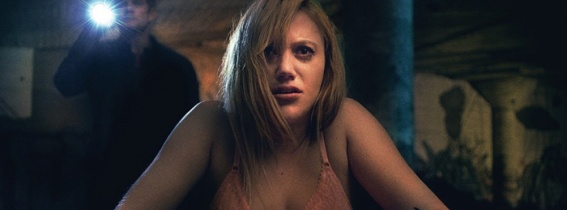
The Movie Gourmet doesn’t watch many horror movies, but I really liked the inventive, scary and non-gory It Follows. 19-year-old Jay (Maika Monroe) has sex with a guy who then tells her that he has passed on to her a kind of supernatural infection – a monster will follow her and kill her if she doesn’t pass it on to someone else. The monster shambles along at zombie speed and takes the form of a different human being each time. It’s terrifying – there’s a constant sense of dread and a convulsive shock every time It appears.
Writer-director David Robert Mitchell has created a very scary horror film with an excellent soundtrack and a minimum of makeup, special effects and hardly any blood. It’s even more frightening that she’s being stalked by something that usually looks normal.
Before the screening, I had to sit through several trailers from the horror genre. There was NOTHING in those trailers that I hadn’t seen before in The Shining, The Exorcist or a multitude of less elevated films. I have to note the contrast with It Follows, which is definitely something that you haven’t seen before.
The very talented actress Maika Monroe is almost always on-screen and she proves that she can carry a movie. I first noticed her in At Any Price , where she played the son ‘s girlfriend. That role was especially well-written – beginning as a simple teen from a broken family looking for some fun, her journey takes several surprising turn – and Monroe’s performance was memorable. Until fairly recently, Monroe was pursuing a professional career in freestyle kite surfing.
All the acting is good in It Follows, but Keir Gilchrist is especially good at portraying the ACHING sexual frustration of a teenage boy.
It Follows has a wonderful sense of place. It is set and was shot in the Detroit suburbs, the rural lakefront and the decaying inner city. The extraordinary High Lift Building in Detroit’s Water Works Park serves as the exterior for the climactic set piece.
But the key to It Follows is its originality – without expensive f/x or disgusting gore – it’s likely the best horror movie of the year.
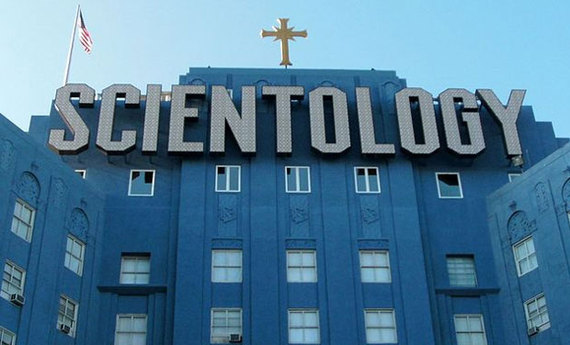
HBO is airing Going Clear: The Prison of Belief, documentarian Alex Gibney’s devastating expose of Scientology. The indictment of Scientology as dangerous cult is stunning. Gibney is sunshining an amazingly rich reservoir of source material: we hear from several former Scientologists, including the former chief spokesperson, the former top deputy to the Chairman of the Board, along with former believer director Paul Haggis and the John Travolta’s original Scientology handler.
Gibney begins by tracing the journey of Scientology’s founder, L. Ron Hubbard and reviewing the organization’s history. Now I knew about the science fiction writer Hubbard, his book Dianetics and even the E-meter. But I sure didn’t know about the Sea Org with its billion-year employment contracts, the Scientology Navy and the bizarro theology with invisible Thetans, volcanos and H-bombs. Nor had I seen the North Korea-style cult-of-personality spectacles featuring Chairman of the Board David McCavige. And I hadn’t heard about the church’s opposition to same-sex marriage.
Then come the really scary stuff. We hear from former Scientology officials who testify that they have been incarcerated in the Rehabilitation Project Force – a concentration camp on a top floor of the Scientology’s Los Angeles HQ and in what is essentially a prison camp in Florida to “re-educate” suspected heretics and backsliders. And there is testimony about the prisoners being separated from their children, who are shunted off to Cadet Org. One official offers personal testimony of his assignment to break up Nicole Kidman’s marriage to Tom Cruise and to alienate her children from her. It’s horrifying stuff. And it’s a riveting viewing experience.
Alex Gibney is one our very, very best documentarians. He won an Oscar for Taxi to the Dark Side, and he made the superb Casino Jack: The United States of Money, Enron: The Smartest Guys in the Room, Client 9: The Rise and Fall of Elliot Spitzer and Mea Maxima Culpa: Silence in the House of God. (He can’t seem to pass up a really long movie title – but Going Clear etc., came from a book title.)
If you’re asking “How can smart, able people fall into this stuff?”, then I recommend finding a film that I reviewed at Cinequest 2015 – The Center. Upon its release, The Center should become the perfect narrative fiction companion to Going Clear.
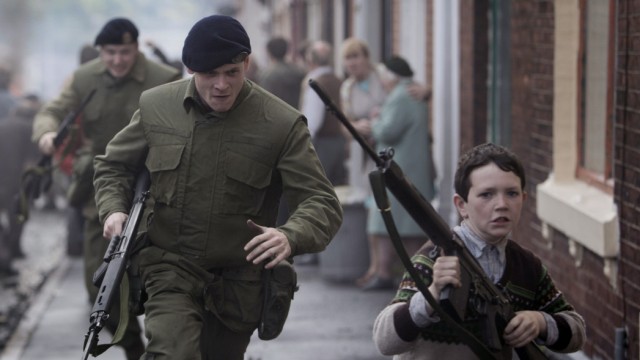
The title of the harrowing thriller ’71refers to the tumultuous year 1971 in Northern Ireland’s Troubles. An ill-prepared unit of British soldiers gets their first taste of action in Belfast, and the rookie Private Gary Hook (Jack O’Connell) gets inadvertently left behind in hostile territory. Private Hook races around an unfamiliar and dangerous city at night. He is being hunted by his own regular troops, a shadowy and sketchy military intelligence unit, the regular IRA, the hotheaded Provisional IRA and Ulster paramilitaries – all with their own conflicting agendas. Any civilian who helps him will be at direct and lethal risk from the partisans.
In their feature debuts, director Jann Demange and cinematographer Tat Ratcliffe take us on a Wild Ride, with just a couple of chances for the audience to catch its collective breath. Importantly, the way Private Hook gets left behind amid the escalating chaos is very believable. Then there’s an exhilarating footrace through the alleys and over brick walls. Every encounter with another person is fraught with tension. Finally, there’s a long and thrilling climactic set piece in a Belfast apartment block.
O’Connell is in 90% of the shots and carries it off very well. All of the acting in ’71 is excellent. Corey McKinley is special as the toughest and most confident ten-year-old you’ll ever meet. Barry Keoghan takes the impassive stone face to a new level. And I always enjoy David Wilmot (so hilarious in The Guard).
I thank the casting and the direction for making it easy for us to tell all of these pale, ginger characters apart. To the credit of writer Gregory Burke, the beginning of the film economically sets up Private Hook as having the fitness and stamina to survive what befalls him throughout the night.
With all the different sides playing each other, the action (and the action is compelling) is set in an especially treacherous version of three-dimensional chess. Some of the double- and triple-crossing at the end is breathtaking. But what ’71 does best is putting the thrill in a thriller – keeping the audience on the edge of our seats for all 99 minutes.