IN THE HAND OF DANTE: the heist and the impenetrable

Photo caption: Oscar Isaac in IN THE HAND OF DANTE. Courtesy of Netflix.

In the Hand of Dante is director and co-writer Julian Schnabel’s film adaptation of the Nick Tosches novel; I haven’t read the book, but it’s likely one of those impossible-to-make-into-a-movie novels – and it’s got to be better than this film.

The movie braids together two parallel stories – one that begins in 21st century New York and the other set in early 14th century Italy. The modern story is in back-and-white; the period story is in color.

The modern story follows the arc of a heist film. Oscar Isaac plays a fictionalized Nick Tosches, a contemporary writer who is enthralled with the work and life of the pre-Rennaisance Florentine poet Dante Alighieri. The movie Tosches knows that an original manuscript written by Dante himself would be invaluable on the antiquities market and thinks he knows where a previously unknown specimen exists. A criminal kingpin (John Malkovich), with his vile enforcer (Gerard Butler) and weaselly sidekick (Louis Cancelmi), bankrolls two heists – one to steal the Dante original and a second to swipe contemporaneous works that can be used to authenticate the Dante work.
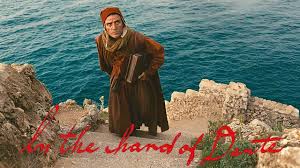
Oscar Isaac in IN THE HAND OF DANTE. Courtesy of Netflix.

The period piece takes us to the early 1300s and the life of Dante himself (also played by Oscar Isaac). Butler and Cancelmi also play medieval figures. Gal Gadot plays Dante’s wife – not his idealized muse – in the period piece and Tosches’ fantasy love in the modern story. Most of the Dante story centers around the politics of Florence and the papacy, with a bizarre piece with Martin Scorsese, under a massive tangle of white long hair and beard, as a sage who guides Dante’s thinking.

The heist story is procedural and features the off couple pairing of the intellectual Tosches and the sadistic philistine hitman (Butler). This is the most accessible thread of the film, and there’s really nothing exceptional about it except for the profound indecency of the hitman. The modern story tries to mirror the themes of artistic freedom and obsessive love of the Dante story, and even throws in 9/11. On the whole, everything except the heist story is impenetrable.

None of this is the fault of the cast, which is uniformly good – except for the artificial-seeming chemistry between Isaac and Gadot. It’s always great to see Louis Cancelmi, and Duke Nicholson is exceptional as the hitman’s first terrorized and degraded victim. Besides Scorsese, Al Pacino, Jason Momoa and the iconic Franco Nero show up in cameos.

Julian Schnabel is one of the great contemporary painters, and branched into filmmaking with the arthouse hit Basquiat in 1994. This is only Schnabel’s sixth narrative feature in thirty-two years, including the wonderful The Diving Bell and the Butterfly. Schnabel is a gifted artist in every medium, but In the Hand of Dante is a rare misfire.

At the outset, there’s a scene involving the boy Tosches being guided past a traumatic experience by his uncle Carmine, played by Al Pacino – and Pacino is magnificent. It’s by far the best-acted and most compelling scene in In The Hand of Dante. Unfortunately, another two hours and twenty minutes follow.

In the Hand of Dante is streaming on Netflix.
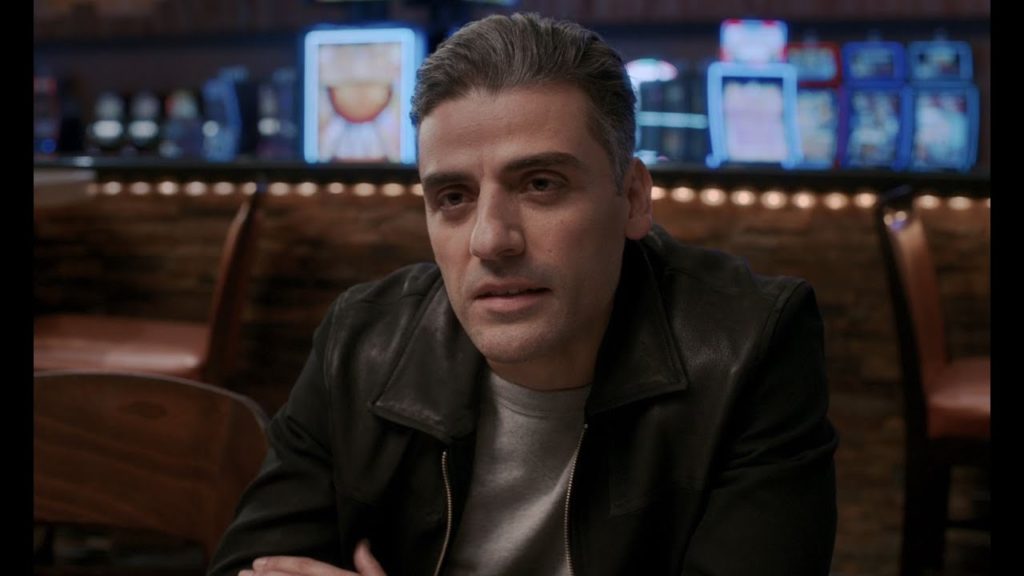
THE CARD COUNTER: a loner, his code and his past

Photo caption: Oscar Isaac in THE CARD COUNTER. Photo courtesy of Focus Features / ©2021 Focus Features, LLC

Oscar Isaac stars in Card Counter, Paul Schrader’s dark portrait of a highly disciplined loner who lives by a code but can’t submerge his past. Isaac’s character, improbably named William Tell, is a professional gambler, who lives in an endless string of motels and casinos.

The first thing we learn about William Tell is his rigid sense of self-discipline – in an OCD display of entering a new motel room and covering each piece of furniture in twine-bound sheets. This is an expert who can win free money at casinos, but resists winning too much, so he doesn’t get kicked out. He prefers anonymity to acclaim. More than anything, William Tell invests in keeping his head down.

It turns out that Tell has been traumatized by things he did as an army guard at Abu Ghraib – and the consequences. It’s no surprised that yet another solitary, emotionally damaged character has sprung from the dark mind of Paul Schrader (Taxi Driver, First Reformed).

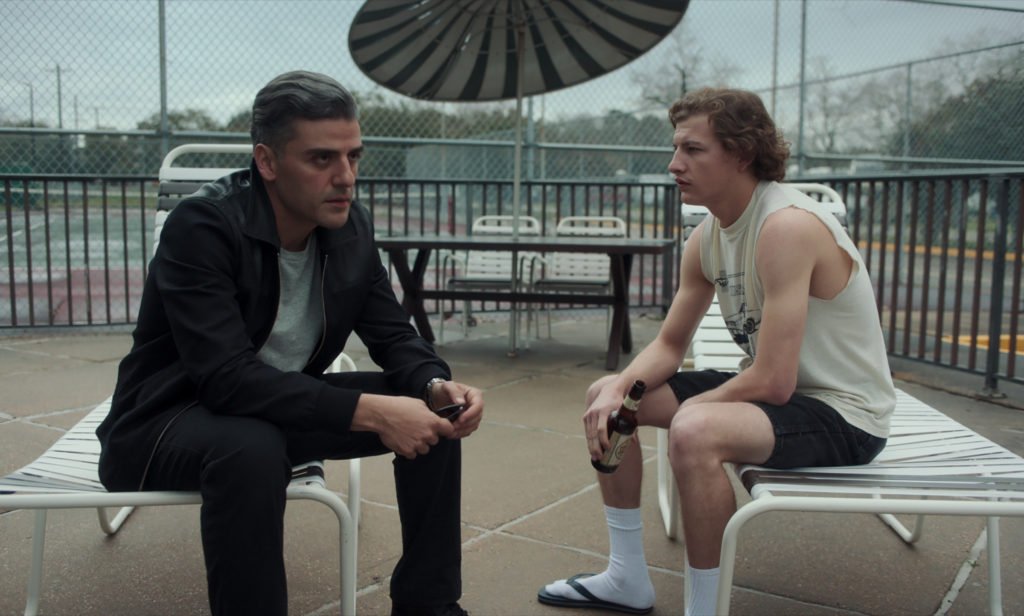
Oscar Isaac and Tye Sheridan in THE CARD COUNTER. Photo courtesy of Focus Features / ©2021 Focus Features, LLC

Above all, Tell is a man with a code. He meets a young man (Tye Sheridan), also haunted by the aftereffect of Abu Ghraib, who is consumed by a revenge fantasy. Although Tell avoids social entanglements, he is compelled to save the kid from himself.

Although most of The Card Counter takes place in casinos, it’s really not gambling movie. There is some card play and some gaming procedure. This is a character-driven story – and it’s not about who wins or how much. Schrader playfully hints at a big poker showdown, but it’s a red herring.

The role of this intense and obsessive man is perfect for Oscar Isaac and his piercing gaze. I usually don’t warm to Isaac, although he has been proficient in some films that I love: Ex Machina, The Two Faces of January. Maybe I don’t see a sense of humor in there? Anyway, he is stellar here.

Tye Sheridan is excellent as the young man bent on revenge. Tiffany Haddish plays a woman who runs a stable of professional gamblers and lives off her emotional intelligence; it’s a delight every time she is on-screen. The great Willem Dafoe appears in a brief but pivotal role.

I haven’t ever seen a movie character like William Tell, which makes The Card Counter an excellent watch.

A MOST VIOLENT YEAR: brooding, well-acted but underwhelming

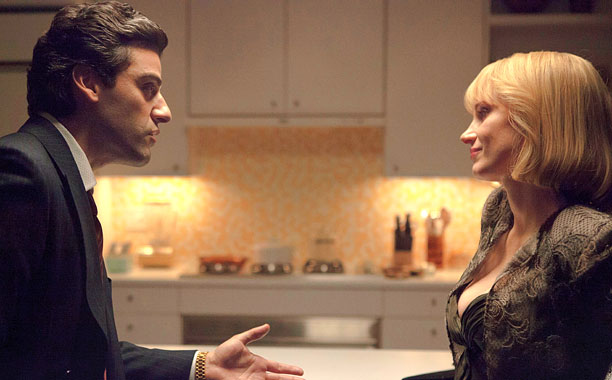
Oscar Isaac and Jessica Chastain in A MOST VIOLENT YEAR

In the brooding drama A Most Violent Year, a businessman (Oscar Isaac) risks everything on a big deal and must fight against time to save it as competitors, criminals and an ambitious prosecutor all try to rip it from his grasp.  The guy is principled and a bit of a Boy Scout, and he handicaps himself by refusing to get dirty – even though he trades in a rough-and-tumble (and generally corrupt) industry.  Fortunately, his wife and business partner Jessica Chastain is the daughter of a mobster and his in-house lawyer (Albert Brooks) is an unapologetic crook.

Two things work really well in A Most Violent Year.  The first is the exceptional evocation of time and place.  We are taken back to New York City in 1981, when it had all the trappings of a failed state, including a breakdown in the rule of law.  As the movie takes us between weed-overgrown industrial locations, we drift into the dingy and the sinister.

The second triumph is the acting.  Of course, Chastain is always wonderful, even if she is a little underused here; her character is delightfully tougher and more realistic than her hubbie.  David Oyelowo is very good as the cynical prosecutor who becomes mournfully sympathetic to the naive protagonist. Albert Brooks, Peter Gerety (superb as the bartender in the otherwise dreadful God’s Pocket) and Jerry Adler (Hesh in The Sopranos) bring a spark to their smaller parts.  Isaac (Inside Llewyn Davis, The Two Faces of January) adds smoldering intensity, but he’s overshadowed by the ensemble.

The splashiest performance is by Elyes Gabel as an immigrant trying to leverage a truck driving job into the American Dream who finds himself plunged by circumstance into increasingly desperate straits.  Gabel perfectly modulates his performance as a guy who starts out modestly hopeful, then becomes traumatized and just hangs on to a semblance of emotional balance, and finally, his future unhinged by rotten luck, implodes.

However, I was underwhelmed by the story.  Even though there’s a ticking clock element and a whodunit, it’s just not gripping enough to take this drama into psychological thriller territory.  And there are some distracting holes in the plot (see Spoiler Alert below if you must).  This is a disappointment after writer-director J.C. Chandor’s excellent first two films, Margin Call and All Is Lost.

While not a Must See, A Most Violent Year is still a successful drama, adorned by another flawless turn by Jessica Chastain.

SPOILER ALERT: [If the truck hijackers are really “working for themselves” and not one of Abel’s competitors, then they should only be stealing oil – so who is prowling around Abel’s house with a gun and who is attacking his sales force?   And who makes a real estate purchase with hundreds of thousands of dollars in cash and lets the seller leave with BOTH the money and the only copy of the signed contract – twice?]

Drive: noir action in vivid LA

Drive is a movie that you haven’t seen before – a stylishly violent noir tale unfolding on a brilliantly filmed canvas.

Ryan Gosling stars as a stunt driver by day, criminal getaway driver by night.  He hardly talks and doesn’t emote.  Indeed, his character is listed in the credits as “Driver” and sometimes referred to in the dialogue as “The Kid”.  He is motivated only by his pursuit of adrenaline rushes and the opportunity to do something good for a vulnerable mom (Carey Mulligan).  Indeed, Gosling is superb.

But the real star of Drive is its Danish writer-director,  Nicolas Winding Refn.  The film has a noir plot but Refn eschews the shadowy black and white of traditional noir for especially vivid scenes of Los Angeles.  For example, early in the film, Gosling enters a convenience store and the screen is filled with the garish colors of junk food packaging.  It’s one of the most artfully lit and photographed scenes in the last year.

Drive abounds in nice touches. While being hunted by the cops, Gosling’s driver is listening to both the police scanner and a radio broadcast of the Lakers game; unexpectedly, it turns out that there is an essential reason that he’s listening to the Lakers.

This movie contains some extreme violence – violence that is intentionally extreme for its effect.

The cast is excellent, with especially memorable turns by Albert Brooks, Bryan Cranston (Breaking Bad) and Oscar Isaac.

(I admired Refn’s 2008 Bronson, the story of a Britain’s “most dangerous convict” who parlayed a seven-year sentence into 34 years (30 of them in solitary) by repeatedly taking hostages and beating up the SWAT teams that rescue them.   Roger Ebert called Bronson “92 minutes of rage”.)