Ah, those nutty Czechs. Here, we think we’re watching a political spoof. Then, a third of the way in, Lost in Munich becomes a mockumentary on the “making of” the movie we thought we were watching. The joke is on us and on the incompetent and unlucky fillmmaker characters and on the Czechs themselves.
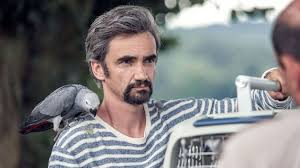
There’s a particular dry deadpan in some Czech cinema, and the best example may be a Cinequest film from two years ago, Polski Film. The Czechs are happy to make fun of themselves and their European neighbors (in this case the French). The movie-within-a-movie centers on Czech hard feelings from French Prime Minister Edoaurd Daladier selling out the Czechs in the 1938 Munich Agreement with Hitler. A dim French diplomat tries to smooth things over by bringing Daladier’s 80-year-old pet parrot, but the parrot turns out to be counterproductively politically incorrect, the parrot is parrotnapped, and the comic absurdity of Lost in Munich goes on from there.
Lost in Munich is pretty successful when it mocks the making of a snake-bitten movie where everything that CAN go wrong…You’ll probably like this movie if you have a taste for absurdist cinema. Lost in Munich plays Cinequest again on March 11 and 12.
The Canadian psychological thriller Lost Solacetakes a highly original premise and turns it into a pedal-to-the-metal thriller. It’s an astonishingly successful debut for director and co-writer Chris Scheuerman.
Co-writer Andrew Jenkins stars as the psychopath Spence, whose life is devoted to exploiting women, stealing their stuff and emotionally devastating them to boot. Spence is remarkably skilled and seems unstoppable until he unwisely ingests a recreational drug – he starts suffering hallucinatory episodes that are intensely emotional. Here’s the brilliantly original core of Lost Solace – having the occasional fit of feelings and empathy really gets in the way of being a coolly cruel psychopath.
Spence targets the emotionally fragile rich girl Azaria (Melissa Roxburgh). Melissa is burdened both by the care for her violently psychotic brother Jory (Charlie Kerr) and by years of verbal evisceration by her prick of a father, Chuck (Michael Kopsa). Able to peg Spence as a scumbag, Jory offers Spence a share of his inheritance to kill Chuck. It’s a plan hatched by a psychotic – what could possibly go wrong? Add an ambitious physician (Leah Gibson) who is eager to cash in on a cure for psychopathy, and we’re off to the races.
Scheuerman is an economical story-teller who lets the audience connect the dots. Spence doesn’t even speak until well into the movie. But Scheuerman spins a great tale, and as he reveals his characters, we see that Chuck may be every bit as fiendish as Spence and that Betty the doctor, may be just as greedy. There’s plenty that can unravel Spence’s Perfect Crime, and that’s what keeps us on the edges of our seats.
Andrew Jenkins is completely believable as both the supremely confident Spence and, later, as the Spence determined to steel his way through his unexpected confusion. The rest of the cast is exceptional, too, especially Kopsa and Gibson.
So far my personal favorite at Cinequest 2016, Lost Solace will have its World Premiere on Friday, March 4, and screen again on March 6 and 10.
Restlessness, thy name is Woman. The absorbing and character-driven autobiographical drama Heaven’s Floor begins with photographer Julia (Clea Duvall) finishing a shoot, but then being reluctant to go home. Now Julia has built herself a comfortable West LA life – career, marriage, kid, friends, house. What is she missing?
Julia feeds her wanderlust by impulsively joining an arctic adventure led by Jack, a charming reprobate. This isn’t fair to Julia’s husband Ed, but he dutifully covers for her on the home front. The trip to the Canadian Arctic becomes more nightmare than adventure, and Julia is marooned in a small Inuit village where she meets an orphaned girl. Both Julia’s compassion and her impulsivity kick into high gear, and we are off on a journey that will indelibly change several lives.
Note that Heaven’s Floor is autobiographical. Indeed, what seem like the most improbable and extreme plot points in Heaven’s Floor really happened to writer-director Lori Stoll. Stoll’s real life background as a photographer also informed the film’s cinematography – and the scenes in the Arctic are particularly impressive.
There’s plenty of exciting, true life adventure in Heaven’s Floor. But, at its core, it is an evocatively crafted character study of Julia – her restlessness, impulsivity, compassion and emotional needs. Heaven’s Floor takes on a quest that may – or may not – satisfy those needs and complete the already complicated Julia.
Although it’s anything but a showy role, the part of Julia’s husband Ed is also remarkably written. Movies are not often kind to characters who resist someone’s “following their heart”, no matter how impractical or whatever the consequences to others. Yet Stoll’s depiction of the husband Ed is very sympathetic, as someone reacting with understandable resistance to impulsive, unilateral and life-changing commitments.
Clea DuVall has a knack for making small parts in good movies (21 Grams, Zodiac, Argo) memorable. Here, she gets her chance at a leading role and her Julia keeps us on the edge of our seats; we care about her, but have no idea what she’s going to jump into next. Toby Huss is very, very good as Julie’s loving but aggrieved husband Ed. Veteran Irish actor Timothy V. Murphy sparkles as the huckster adventurer Jack who could sell the proverbial ice to Eskimos.
Heaven’s Floor is one of the 129 Cinequest films directed by a woman. Heaven’s Floor’s World Premiere is at 6:45 PM on Friday, March 4 at Cinequest with more screenings on March 6 and 11.
Coming on Friday: an interview with Heaven’s Floor writer/director Lori Stoll.
The most masterful filmmaking achievement at Cinequest 2016 might just be the Chilean drama The Memory of Water by Matias Bize. The Memory of Water is an exploration of grief, its process and its impact. After all, the individuals who make up couples grieve in different ways and at different paces.
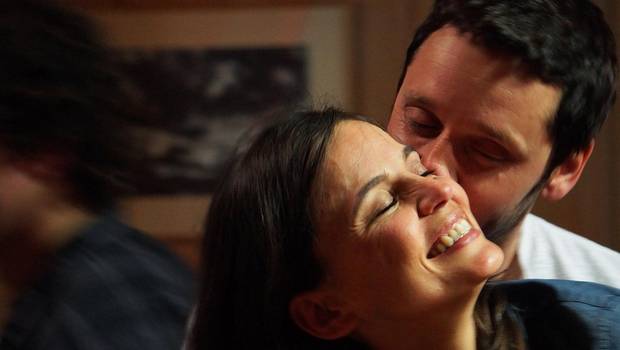
We meet a couple (Benjamin Vicuña and Elena Anaya) who has recently experienced a tragedy. He is undertaking an everyday task. She is (literally) revisiting the tragedy. Director Bize brilliantly takes us to the wall in the home where parents record the height of their growing kid – the camera scans up the marks for 2, 2/12, 3, 3 1/2 and then stops after 4. We understand.
The husband is extremely sensitive and tries his best to comfort her. It’s not enough. She tells him that he needs to cry just once. The movie is his journey to being able to cry that one time.
We see him at work, faced with something that reminds him of the tragedy, She is a medical translator and, in the most heartrending scene, must maintain her poise to get through a task that no one should be asked to perform. There’s an explosive sex scene, beautifully shot in red light, that’s all about the release of passion in an encounter that is itself passionless and meaningless.
And we see water. Water that evokes tragic memory. And water in a different form that brings joyful memory. And, finally, water in a scene of closure.
The Memory of Water explores the same ground as Rabbit Hole, the excellent Nicole Kidman/Aaron Eckhardt film based on David Lindsay-Abaire’s Pulitzer- and Tony-winning play. But The Memory of Water is better cinema.
The 35-year-old Bize (The Life of Fish) is a major filmmaking talent. The Memory of Water is a Must See at this year’s Cinequest and screens on March 2, 10 and 12.
The documentary The Promised Band is about a group of Israeli and Palestinian women seeking to fight through the cultural, legal, political, military and security barriers between them (by forming a girl band). It effectively brings the audience into the Israel-Palestine border situation and the isolating effects on both Israelis and Palestinians.
Israel’s solution to the security situation has created a world in which Israelis and Palestinians do not interact and get to know each other personally. The American filmmaker Jen Heck has friends on both sides, and sought to connect them personally – which is not easy. In fact, it is illegal and dangerous for Israelis to visit parts of the West Bank that are designated as Area A (under complete Palestinian control). And it’s downright impossible for Palestinian residents of Area A to enter Israel. The women decide to form a band, with the hope that a performance in Israel can legally justify a visit by the Palestinian women.
Is this extremely naive? Indeed, Heck herself and one of her Israeli friends seem pretty clueless about the risks…at first. But other Israeli women had been in Palestine while serving in the Israeli Defense Forces, and the Palestinian women live with the harsh realities every day.
The most compelling subject of the documentary is the main Palestinian character, the charismatic Lina. Lina is a rock star, and a little imbalance is created when she is matched with the other subjects of the documentary. Lina is clearly repressed by both Israeli occupation and her own conservative culture, but she doesn’t grouse about the latter to her Israeli friends.
The Promised Band is a successful exploration of the effects of mutual isolation, as well as a wistful personal study of the women (and a man) who come and go from the band. Along the way, it provides a very explicit snapshot of the barriers to travel and social integration. The Promised Band is one of the 129 woman-directed films at this year’s Cinequest.
The Promised Band’s World premiere will be on March 4 at Cinequest, with additional screenings on March 6 and 12.
The Hungarian drama Fever at Dawnis a little movie with an epic romance. Set just after the liberation of the Nazi concentration camps, Hungarian invalids who survived the camps have been sent to convalesce in hospital camps in Sweden. A young patient, Miklos, gets a dire diagnosis and determines to find love once more before he dies. A half century before internet dating, he concocts a scheme to get himself in front of every sick Hungarian woman in Sweden. When he meets his potential soulmate Lili, a moral question rises to the surface – should he share his diagnosis?
Some Holocaust survivors experienced ambivalence about the Jewish identity that led to yellow stars on their clothes and, essentially, targets on their backs. This ambivalence becomes a significant thread of Fever at Dawn and is addressed more explicitly than usual for a Holocaust (or post-Holocaust) movies.
Don’t read too much about this movie before seeing it. There’s an unexpected nugget at the end.
Fever at Dawn’s US Premiere will be on March 2 at Cinequest, with additional Cinequest screenings on March 3, 7 and 9.
Ever notice how people who watch a lot of Fox News or listen to talk radio become bitter angry and, most telling, fact-resistant? In the documentary The Brainwashing of My Dad, filmmaker Jan Senko as she explores how right-wing media impacts the mood and personality of its consumers as well as their political outlook. Senko uses her own father Frank as a case study.
We see Frank Senko become continually mad and, well, mean. And we hear testimony about many, many others with the identical experience. Experts explain the existence of a biological addiction to anger.
Senko traces the history of right-wing media from the mid-1960s, with the contributions of Lewis Powell, Richard Nixon, Rush Limbaugh, Roger Ailes and Rupert Murdoch. Senko even gets right-wing wordsmith Frank Luntz on camera to explain the power of buzz words. If you don’t know this story (Hillary was right about the “vast, right-wing conspiracy”) , Senko spins the tale very comprehensively. If you do know the material (and my day job is in politics), it is methodical.
This topic is usually Senko’s focus on mood and personality is original and The Brainwashing of My Dad contributes an important addition to the conversation. One last thing about the brainwashing of Senko’s dad – it may not be irreversible…
The U.S. Premiere of The Brainwashing of My Dad will be March 5 at Cinequest, with additional screening on March 6 and 9.
Contemporary Russian cinema has been pretty dark and cynical lately (Leviathan and Elena), for example), focusing on the profound and persistent corruption in that society. Having said that, the comedy Orleans is dark by even Russian standards.
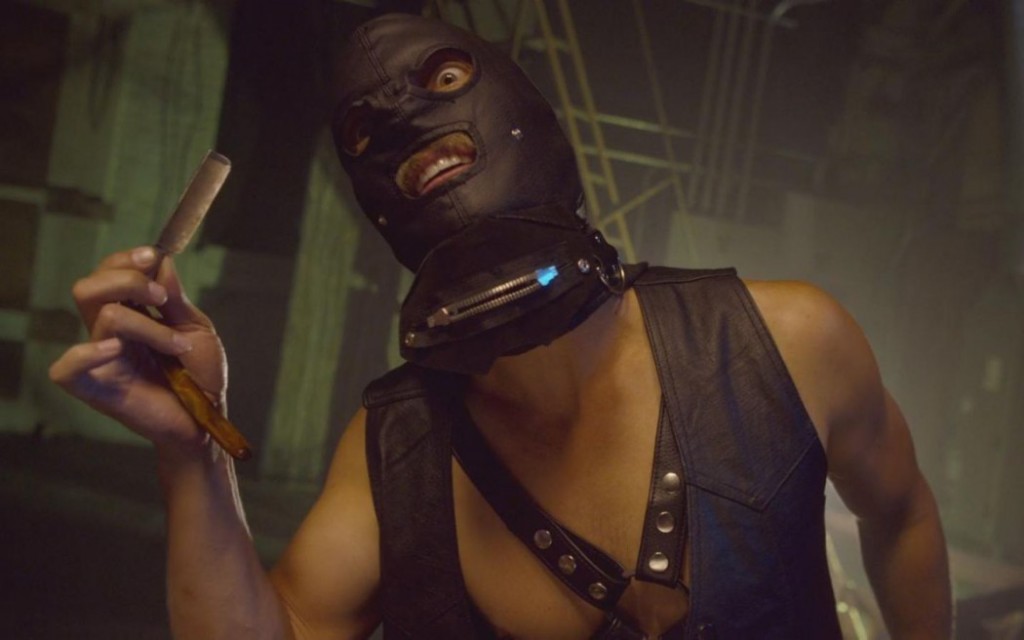
We meet a rogue doctor in a small town, a guy who relishes a matter-of-fact everyday depravity. He and a local hairdresser are living in a world that is morally bleak enough, when magical realism intrudes in a very bad way – an invincible stranger with evil powers visits town. They all even go to the circus – it’s kind of Fellini meets Tracy Letts meets Rob Zombie. There’s even one of the most cringeworthy eye procedures since Un Chien Andalou.
Orleans is a trippy movie. Settle in, but don’t think that you’ll remain comfortable for long. North American Premiere at Cinequest on March 2, 3 and 4.
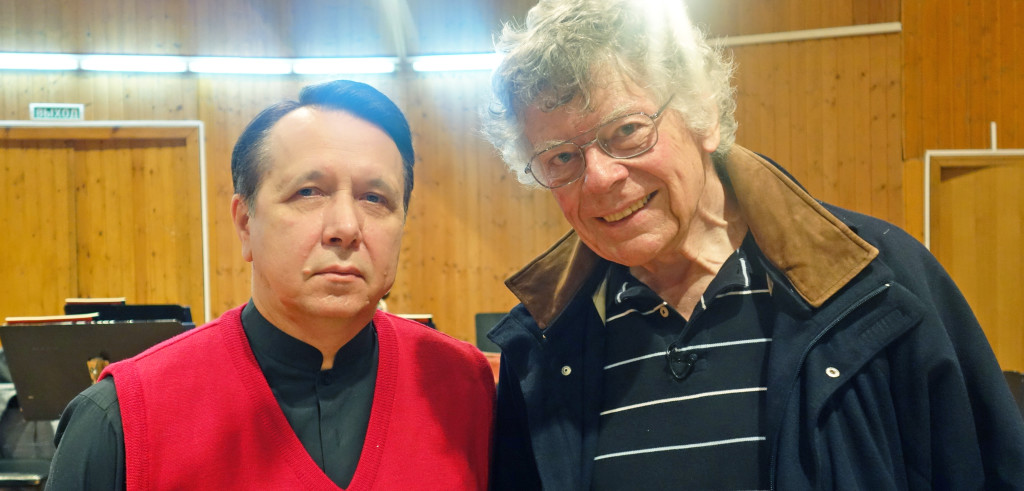
San Francisco billionaire Gordon Getty was born into great wealth, so he was never going to be a Regular Guy. And few aspire to become composers of classical music, as Getty has. He is profiled in the documentary Gordon Getty: There Will Be Music.
Getty sees himself as more 19th Century than 20th (tellingly, not even mentioning the 21st). It’s an apt description of someone who bases musical compositions on the works of Poe and Dickinson. Affable and genuine,Getty is easy to spend time with. We get a fun glimpse into the Getty family history – and learn that Gordon was already out of college when he read that his dad was the richest American. “I knew he was rich, but…”
Getty is conscious that his uberwealth brings major advantages to his vocation as well as detracting from his credibility. Naively, he thinks that they balance out. But one thing is or sure – Getty is no dilettante. He is a serious composer, who has devoted himself to his craft.
The most interesting aspects of Gordon Getty: There Will Be Music are Getty’s music and the insight into his process as a composer. Getty’s passion in pronounced, but it’s a quiet passion. The pace of the film reflects its subject and his music, which is not pulsating. Classical music fans will enjoy this film than those who are not.
The shamelessly low brow comedy A Beginners Guide to Snuff features a very dim pair of would-be actors who seek to win a horror movie contest by simulating a snuff film. What could possibly go wrong? To get the most realistic performance out of their leading lady, they decide to kidnap her and pretend that they’re going to torture her to death on film. Their choice of that leading lady (played by Bree Williamson) brings some very unexpected consequences.
Most of the humor in Beginners Guide comes from the dumb and dumber filmmakers and spoof on low-budget horror cinema. But Williamson’s electric performance, like a shot of adrenaline, animates and elevates the movie whenever she is on-screen. Her character is so many tiers above the two boobs that she remains in charge even when chained to a table. On top of that, she has some unanticipated skills and characteristics…
A Beginners Guide to Snuff ends with a particularly inspired trailer for the movie-within-the-movie. If you’re looking for broad and dark comedy with a sparkling performance by an actress, this is your movie. World Premiere at Cinequest on March 4, 6 and 11.