Stream of the Week: VICTORIA – a thrill ride filmed in one shot

VICTORIA
VICTORIA

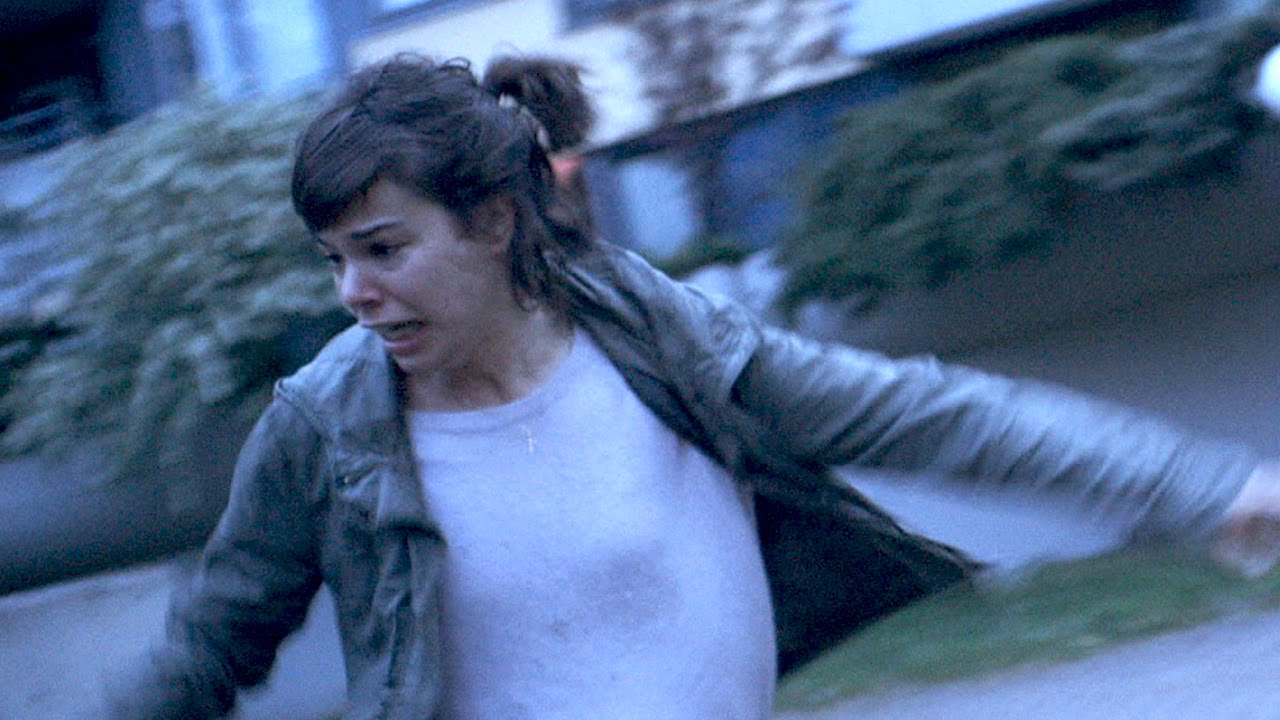
Victoria is worth watching as a thriller, but it has become notorious for a pretty important aspect of its filmmaking – the entire movie was filmed in a SINGLE SHOT.  Its tagline is One girl. One city. One night. One take. (Actually, the successful take was on the third try.)  Rope and Birdman are famously filmed to LOOK like they are one shot. But all of Victoria really IS just one shot.

That would be noteworthy enough if Victoria were a drawing-room story like Rope, but it is amazing for a story that zips between interior and exterior locations, runs from nighttime through daybreak and includes chase scenes through the streets of Berlin.  It’s a stunning achievement for director Sebastian Shipper.

After a career disappointment, young Spanish woman (Laia Costa) has moved to Germany – where she knows no one – and has taken a service job while she licks her wounds.  Out for a beer after work, she meets a bunch of drunk German guys.  Partying with them leads to an entanglement with one of those low-level criminal enterprises that just isn’t going to turn out well.  Things get life-or-death serious, and the characters are soon on the run for their lives.

The German characters don’t speak Spanish and the Spanish girl doesn’t speak German, so they speak to each other in broken English; the only English subtitles are when the German guys are talking to each other in German about the girl in her presence.

Costa is on-screen for the entire movie, and she’s very, very good.  She nails the character, somebody who is basically good but who can impulsively make the wrong choice, too.  Anyone who sees her as a mere adornment underestimates her at his own risk.  She is full of moxie and is damn practical.

Frederick Lau is especially good as the guy who connects most personally with the girl. Franz Rogoski is also outstanding as the guy whose troubled past catches up to him and devours his friends, too.

Anyone who has watched a film noir will find Victoria’s ending is disappointingly predictable.  Otherwise, this would have been one of the top ten films of 2015.

But Victoria is still a gripping 138-minute thrill ride.  Director and co-writer Shipper acted in Run, Lola, Run which had previously set the standard for movie freneticism.  Make sure that you watch it in one uninterrupted sitting.  Victoria is available to stream from Amazon Video, iTunes, YouTube and Google Play.
HIGH-RISE: the villain is an oligarchy

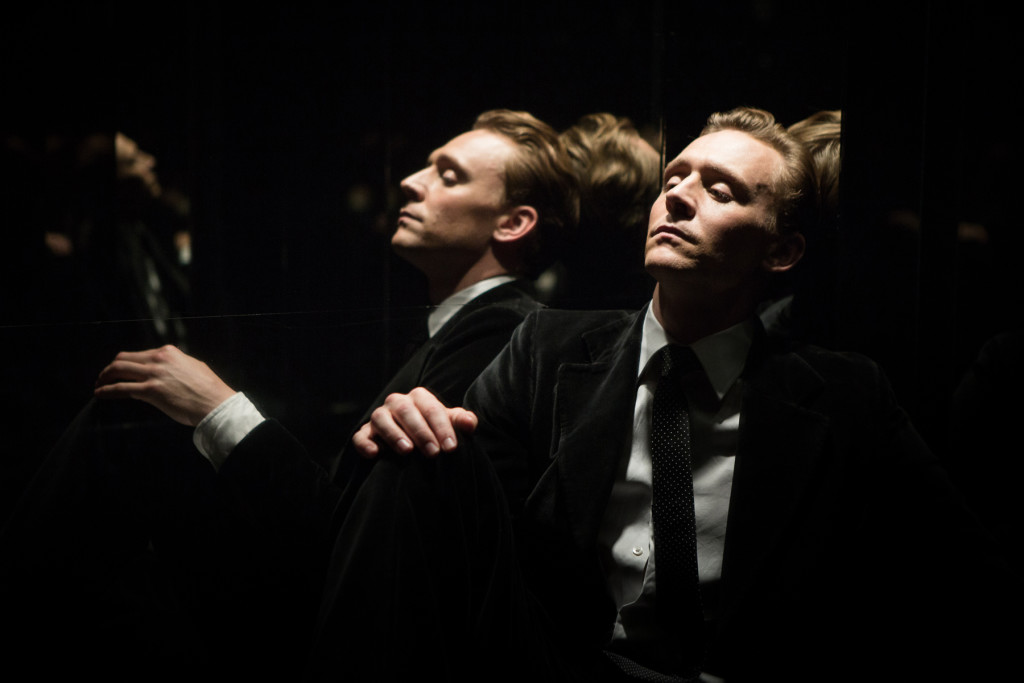
Tom Hiddleston in HIGH-RISE. Photo courtesy of the San Francisco Film Society.

The dystopian sci-fi satire High-Rise, adapted from a J.G. Ballard novel, makes a droll and cynical comment on our species.  Taking place in the near future, the very wealthy live on the top floors of a self-contained high-rise, just above the middle class.  Human greed and jealousy creates scarcity for the residents – not Third World-type scarcity, but scarcity of amenities like swimming pool access and power brownouts.  Class competition erupts and a morbid descent into murderous chaos ensues.  We plunge into this complacent, and then hellish, world from the perspective of a young middle class striver (Tom Hiddleston).

The designer of the complex of high-rises (Jeremy Irons) lives in a luxurious penthouse with a staggeringly pastoral garden.  The character’s name is Royal, but he’s not the ruler.  (We actually come to wish that he were benignly in charge.)  And despite his trappings, Royal is not the omnipotent Bond-type villain.   The villain turns out instead to be an oligarchy of the One Percent, along with the darkest aspects of every character’s humanness.

Tom Hiddleston is fine, and the rest of the cast is solid.   The two standouts are Jeremy Irons as Royal and Sienna Miller, dressed in Carnaby Street retro, as a deliciously voracious man-hunter.  The wonderful Elisabeth Moss is wasted in a role where she just doesn’t have much to do.

I saw High-Rise at the 59th San Francisco International Film Festival (SFIFF). It opens in Bay Area theaters tomorrow.

GREEN ROOM: blood and suspense

Imogen Poots in GREEN ROOM

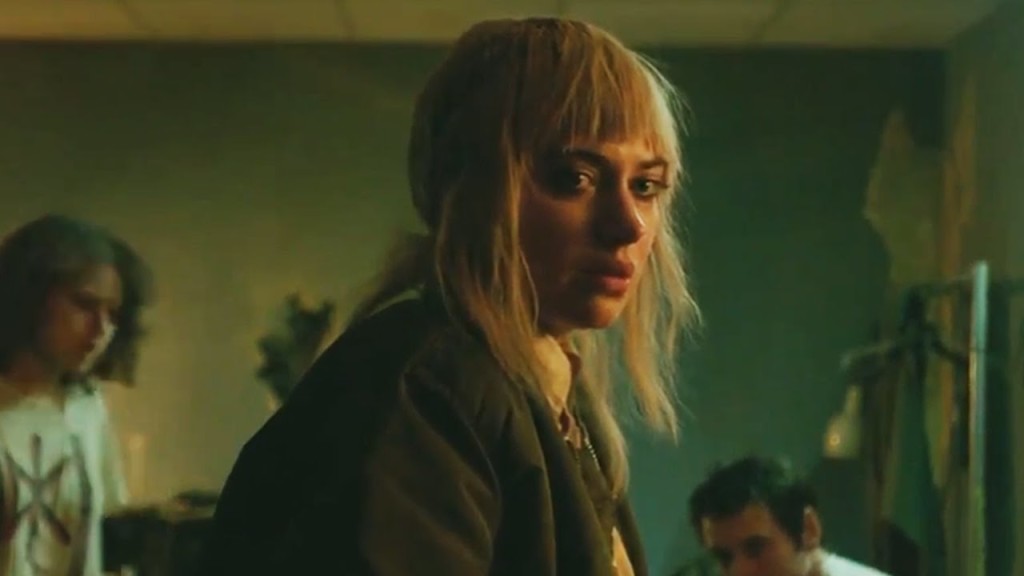
The bloody thriller Green Room is a fresh and satisfying, well, bloody thriller. A vagabond rock band (Anton Yelchin, Alia Shawkat and a couple of others) finds themselves playing a gig at a remote white nationalist compound in the woodsy Northwest. Inadvertently, they witness a murder and the chief skinhead (Patrick Stewart!) needs to eliminate all the witnesses. The band members and a local girl (Imogen Poots) are trapped in a room with just one way out, as the skinheads send in waves of machete- and shotgun-wielding thugs and vicious pit bulls. Who will survive and how?

Director Jeremy Saulnier proves again that he’s the rising master of the genre movie.  Saulnier’s writing and directorial debut was 2014’s Blue Ruin, an entirely fresh take on the revenge thriller. An audience favorite on the festival circuit in 2013, Blue Ruin didn’t get a theatrical release, and I would have missed it entirely but for a suggestion from my friend Jose.   In Blue Ruin, Saulnier was responsible for the wholly original lead character and the intense pace of the film, along with the meticulously economical storytelling; the exposition never relies on even one extra word of dialogue.  Blue Ruin is available on DVD from Netflix and streaming from Netflix Instant, Amazon Instant, iTunes, Vudu, Google Play, YouTube and Xbox Video.

In his superb leading performance in Blue Ruin, Macon Blair was believable both as a damaged down-and-outer and as a man-on-a-mission.  In Green Room, Blair plays Gabe, the put-upon middle manager  of Patrick Stewart’s  compound.  Blair is just so interesting an actor.  Here, he brings an unusual humanity  to his role as a henchman.

The actor who drives the story, however, is Imogen Poots.  Her character is very practical – realistic enough to see that the situation is hopeless.  At first, she is numbed by the murder of her friend.  But when she finally decides that she is going to survive – watch out!  Since 2012, Poots has becoming a preferred indie leading lady with Greetings from Tim Buckley, A Late Quartet , The Look of Love, A Country Called Home, Green Room and her most complex role so far in the upcoming Frank & Lola.   Here in Green Room, she’s a force of nature.

Once again, Saulnier delivers a very fresh and original genre movie.  The total effect is very intense and very violent.   If you’re okay with some gory violence, then Green Room is a thrill ride worth taking.

Stream of the Week: THE BRAINWASHING OF MY DAD

THE BRAINWASHING OF MY DAD

Ever notice how people who watch a lot of Fox News or listen to talk radio become bitter, angry and, most telling, fact-resistant? In the documentary The Brainwashing of My Dad, filmmaker Jan Senko as she explores how right-wing media impacts the mood and personality of its consumers as well as their political outlook. Senko uses her own father Frank as a case study.

We see Frank Senko become continually mad and, well, mean. And we hear testimony about many, many others with the identical experience. Experts explain the existence of a biological addiction to anger.

Senko traces the history of right-wing media from the mid-1960s, with the contributions of Lewis Powell, Richard Nixon, Rush Limbaugh, Roger Ailes and Rupert Murdoch. Senko even gets right-wing wordsmith Frank Luntz on camera to explain the power of buzz words. If you don’t know this story (Hillary was right about the “vast, right-wing conspiracy”) , Senko spins the tale very comprehensively. If you do know the material (and my day job is in politics), it is methodical.

This topic is usually explored for its impact on political opinion. Senko’s focus on mood and personality is original and The Brainwashing of My Dad contributes an important addition to the conversation. One last thing about the brainwashing of Senko’s dad – it may not be irreversible…

I first reviewed The Brainwashing of My Dad for its U.S. Premiere at Cinequest 2016. The Brainwashing of My Dad is available streaming on Amazon Video, Vudu, YouTube and Google Play.

Stream of the Week: GRANDMA – worth seeing for ten minutes of Sam Elliott

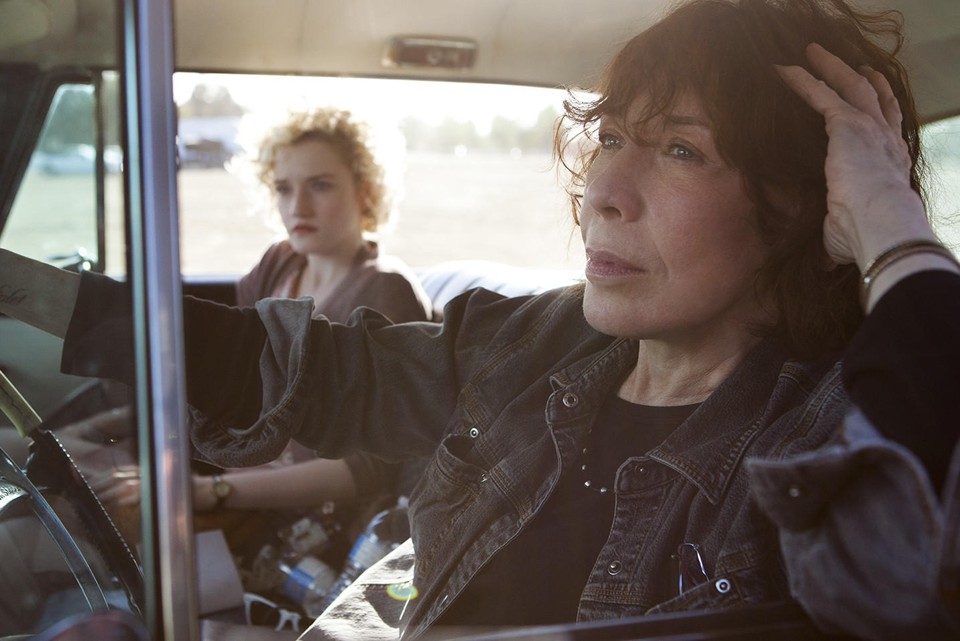
Julia Garner and Lily Tomlin in GRANDMA

I don’t throw around the term “genius” loosely, but Lily Tomlin’s imagination and comic timing really merits the term.  It’s always a pleasure to watch her work and the Tomlin vehicle Grandma, although minor Tomlin, is worthwhile.  Tomlin plays a crusty retiree whose high school-age granddaughter (Julia Garner) shows up at her door with an urgent need that she doesn’t want to tell her mother (Marcia Gay Harden) about.  They go on an adventurous quest for a solution – all in suburban LA.

Grandma is not a great movie, but it’s much more than a curmudgeonly geezer movie. Writer-director Paul Weitz, who co-wrote and co-directed About a Boy,  gives Tomlin a vivid character to play, and there are some excellent performances for Tomlin to interact with.  Judy Greer is brilliant as Tomlin’s recent lover.  And this is the final performance for one of my favorites, the late Elizabeth Peña (Down and Out in Beverly Hills, Lone Star).

The biggest surprise in Grandma is Sam Elliott, who is ALWAYS good, but I’ve never seen him explode in as searing a performance as this.  It’s remarkable, and Elliott steals the movie.

Grandma is available to stream from Amazon Video, iTunes, Vudu, YouTube and Google Play.

DOUGH: light, fluffy and empty

DOUGH
DOUGH

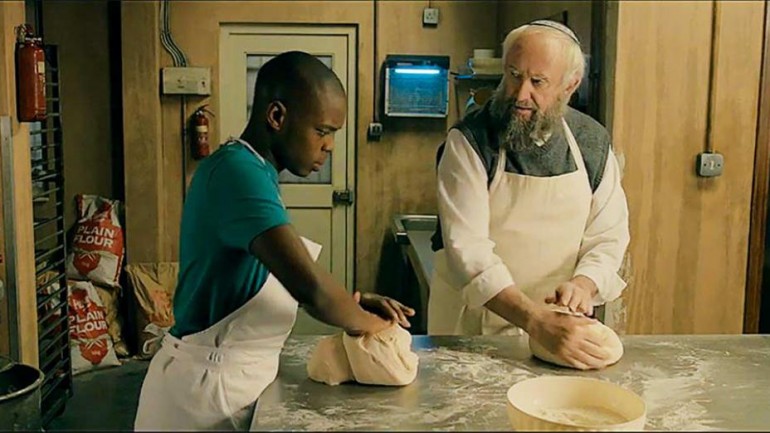
The British comedy Dough treads the familiar territory of the mismatched buddy movie, specifically the Old Guy/Young Guy type.  Dough is distinguished from the rest of the genre by a culture clash element and the eminent actor Jonathan Pryce.  The story is set in contemporary London and the Old Guy is an Orthodox Jewish bakeshop owner (Pryce) and the Young Guy is a Muslim African refugee drug dealer (Jerome Holder).

The main characters are thrown together uncomfortably in the bakeshop, which is inexorably dying until Young Guy accidentally launches a new product line when he drops marijuana into the dough.  Suddenly business begins to boom, and all would be well but for two villains, a reptilian business rival and a scary skinhead drug lord.

Jonathan Pryce and Holder act as well as they can with this material, as does the sprightly Pauline Collins (Shirley Valentine).  But you’ve seen every one of Dough’s plot developments in a movie before.  The villains and the physical comedy are WAY too broad.  Overall, Dough is better than the average sitcom on broadcast TV, but pretty banal.

Light, fluffy and empty, Dough is the Twinkie of movies. I don’t choose to eat Twinkies myself, but I understand that sometimes you might want one.

THE CROSS OF THE MOMENT: the bleakness of the “Or Else”

THE CROSS OF THE MOMENT

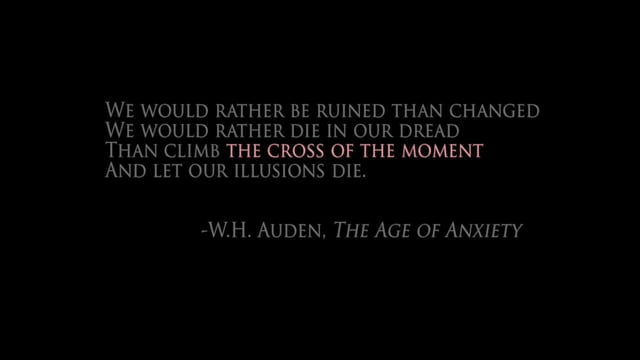
There’s no slick TED Talk or cool graphics in the compelling and sometimes chilling documentary The Cross of the Moment.  In that way, it’s exactly the film that An Inconvenient Truth was trying NOT to be.  But The Cross of the Moment is actually the more ambitious film because it’s not trying to convince us that global warming exists or is caused by humans – it’s helping us understand the bleakness of the “or else” if we don’t stall or reverse climate change.

Indeed, we hear from talking heads (really, really smart talking heads).  Director Jacob Freydont-Attie has selected scientists who are as able as the great scientific popularizers like Carl Sagan and James Burke.  It’s stripped down, undiluted science from scientists – but ever lively.  As a result, we in the audience are able to connect the dots ourselves.  We are in Deep Shit.  And capitalism itself may keep us from digging our way out.

The International Film Festival of North Hollywood (IFFNOHO) will present the world premiere of The Cross of the Moment on Sunday, May 1.

PROJECTIONS OF AMERICA: propaganda, American-style

PROJECTIONS OF AMERICA
PROJECTIONS OF AMERICA.  Photo courtesy of PBS International.

Peter Miller’s documentary Projections of America reveals the story of American-made World War II propaganda films, designed to reassure the soon-to-be-occupied Europeans.  “Propaganda” is a sinister word, and the surprise in Projections of America is how indirect, subtle and superficially benign the filmmakers were.  The goal of the films was to make the liberating Americans seem not so scary, even though they were bombing Europe and then showing up heavily armed en masse and speaking only English.

The government tapped Hollywood screenwriter Robert Riskin (It Happened One Night, Mr. Deeds Goes to Town) to make a series of movies, and Projections of America is also very much Riskin’s story.  We even see Riskin’s  family home movies and hear directly from his children (whose mother was the actress Fay Wray).

We are used to government propaganda being bombastic, obvious and heavy handed, which these films are not.  Riskin’s team made slice-of-American-life films to showcase workaday America through the daily experiences of Americans – with their implicit American values shining through.

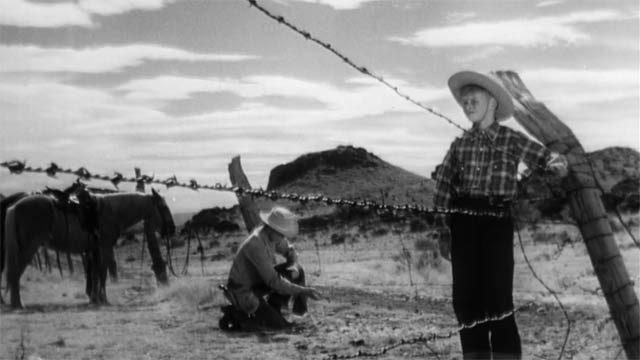
One film, Swedes in America, hosted by Ingrid Bergman, showed just one tile in the American mosaic, but the everyday lives of Swedish-Americans resonated with other European ethnicities, who could imagine themselves comfortable in American society.  Another movie focused on a popular American immigrant from Italy, Arturo Toscanini.  And still another film brought a boy from bombed-out Britain to the American West to show him the real-life cowboy experience firsthand (how cool that must have been!).

The most popular movie in the series was Autobiography of a Jeep, which tracked every step of a Jeep’s journey from its American assembly plant to its use in wartime Europe – with the Jeep’s internal dialogue as the film’s narration.

The movies, of course, show a favorable and idealized, but not completely phony, view of America.  Certainly, the films did not dwell on problems of American society, such as racial segregation.  One movie depicts a small town receiving European refugees at first with distrust, but finally with acceptance.  The overall impact of the movies was to depict America and Americans as free, boisterous and alive with possibilities.  That, at its core,  was not untruthful.

Projections of America is narrated by John Lithgow.

The International Film Festival of North Hollywood (IFFNOHO) will host Projections of America’s LA premiere on Saturday, April 30.   Autobiography of a Jeep is also playing separately at IFFNOHO.

GAZELLE: THE LOVE ISSUE

GAZELLE: THE LOVE ISSUE

I challenge anyone to watch the first one minute of the absorbing documentary Gazelle: The Love Issue without wanting to see more of Gazelle Paulo and his art.  Gazelle’s art defies easy description – an unusual combination of fashion and performance art.  He dresses, models, takes photos of others and has turned his photo blog (FreakChic.com) into the magazine Gazelle.  In Gazelle: The Love Issue, director Cesar Terranova gives us the unvarnished Gazelle, with glimpses of the most personal aspects of his life and relationships.

Gazelle creates striking clothes and makeup that project ideas and feelings.   Descriptions like “drag queen” or Gazelle’s own understated “dressing up to go out” are totally inadequate and misleading.  Whether it’s funny or disturbing, this stuff is real art, more avant-garde than campy.  And as art must be to be good, Gazelle’s is ever evocative.

Spending 94 minutes with Paulo is pretty easy because he’s so gentle and humble despite his flamboyant, even exhibitionistic, behavior.  He’s an island of genuine kindness in a sea of snark and bitchiness.

The International Film Festival of North Hollywood (IFFNOHO) is showcasing the LA premiere of Gazelle: The Love Issue as the festival’s opening night film on Thursday, April 28, and it’s a sure-fire crowd-pleaser.

FIVE NIGHTS IN MAINE: a grieving fish out of water

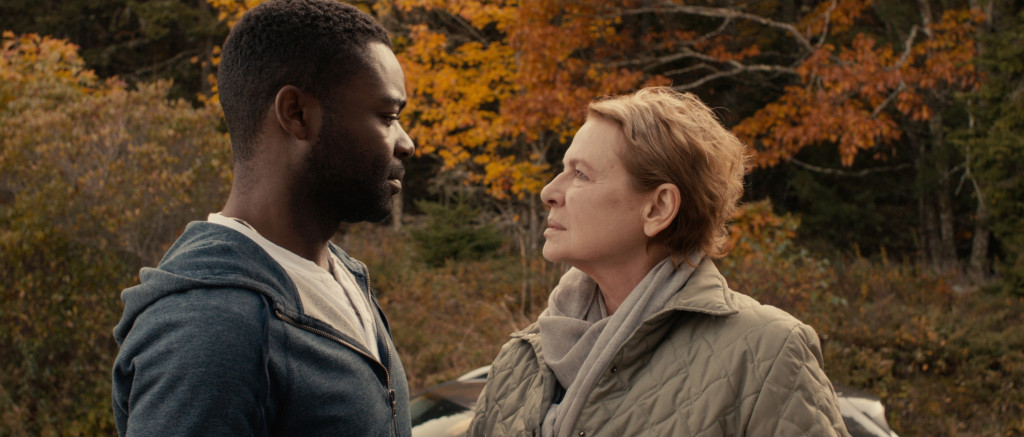
David Oyelowo and Dianne Wiest in Maris Curran's FIVE NIGHTS IN MAINE, playing at the 59th San Francisco International Film Festival, April 21st - May 5th, 2016.
David Oyelowo and Dianne Wiest in  FIVE NIGHTS IN MAINE. Photo courtesy of San Francisco Film Society

An Atlanta man (David Oyeowlo) suddenly loses his wife to an auto accident and is completely shattered by the depth and the jarring abruptness of his loss.  Pushed by his sister out of his paralysis, he drives up to Maine to visit his wife’s mother (Dianne Wiest).  She is a person who is generally harsh, judgemental and irritating at all times, but is more so now that her own health is failing.  His experience becomes the antithesis of the comfort and support that one would expect.  As she probes and spars with him, the two are each driven to their own catharsis.  The end of Five Nights in Maine also comes abruptly, leaving us to reflect on the lessons learned by the leading characters and how their grief is resolved.

Five Nights in Maine uses a handheld camera and LOTS of close=ups.  This was a conscious choice by first-time writer-director Maris Curran, who sought a “closing in” effect because “grief is claustrophobic”.

Dianne Wiest’s performance is an awards-worthy tour de force.  Flashing fiery looks and shooting piercing remarks from an invariably rigid posture, she commands our attention every moment that she is on-screen.  As we would expect, Oyewolo is outstanding, especially in the early scenes where he collapses into shock.  Rosie Perez, not as sassy, but every bit as appealing as usual, is rock solid in the supporting role as the mother’s nurse.  As the sister, Tenoyah Parris (Chi-Raq, Dear White People, Mad Men)  gives yet another flawless performance.

I saw Five Nights in Maine at the 59th San Francisco International Film Festival (SFIFF), where Director Maris Curran, producer Carly Hugo and actor David Oyelowo appeared at the screening. Curran said she was motivated to write a story about as her own marriage was falling apart; when the ground was pulled out from under her, she created a protagonist in that situation.

Aiming for a sensual look to an emotional film, Curran was able to snare Tunisian cinematographer Sofian El Fani, fresh from his exquisite work in from Blue Is the Warmest Color, for his first American film. Budgeted for a 19-day shoot,the crew finished in only 18.

Oyewolo, happily married for 18 years, found exploring the territory of losing his wife to be very uncomfortable. for him. Five Nights in Maine was shot right after Selma, so his exhaustion from Selma helped him find this “hollowed-out” character. Oyewolo sees Five Nights in Maine as a fish out of water story – not just geographically but emotionally (a man not used to or prepared for grief). Oyewolo prefers women directors “wants to be part of stories that are emotionally challenging”.

Fortunately, Curran leavens this dark-themed story with bits of sharp humor. It’s an emotionally affecting and authentic movie.  The U.S. theatrical release of Five Nights in Maine is expected in  late summer or early fall 2016.