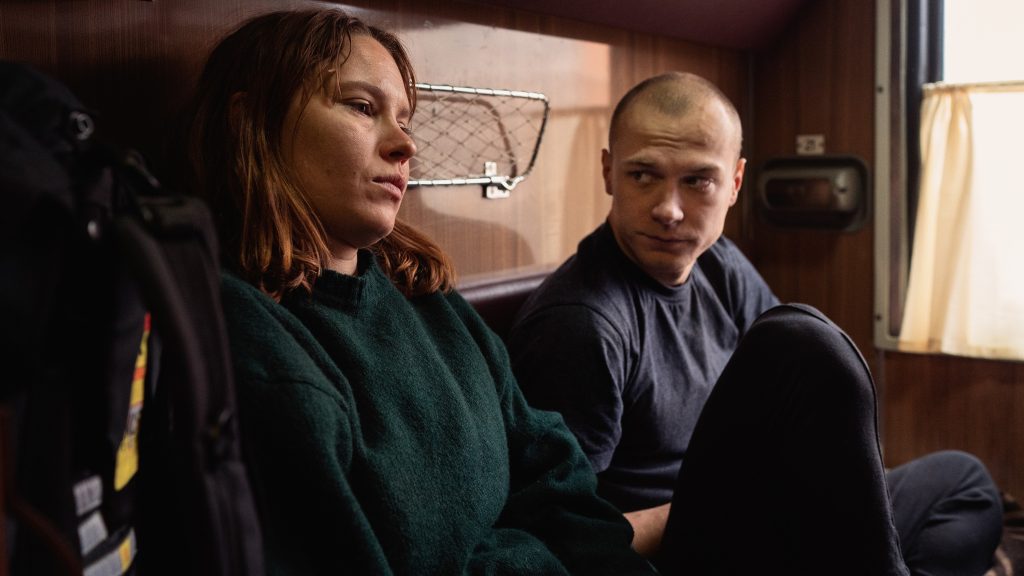
In the gripping drama Styx, Rieke (Susanne Wolff) is a woman who intends to pilot her sailboat on a solo voyage from Europe to Ascension Island off the coast of Africa. That’s one woman, all alone on her boat for 3,000 miles of open ocean.
Oozing matter of fact confidence, Rieke seems well-equipped for the adventure. She is fit, highly skilled, an experienced sailor and provisioned up with top quality gear and supplies. Rieke’s day job is as an emergency physician, and we see that no crisis situation seems to faze her.
In the first part of Styx, we think we’re watching a survival tale – woman against nature. But when a dramatic storm hits, we’re afraid for her but she’s not.
After the storm, she faces the first situation that she can’t handle on her own – one of life-and-death that has been spawned by a humanitarian crisis bigger than any individual. Frustratingly, she knows exactly what must be done, but she can’t do it herself; instead, she must rely on civilized nations behaving according to expected norms. But are those expected norms available to everyone? And will everyone act as they should?
Rieke’s persona is based on acting to solve every problem. But here, there are no good choices.
This is a German film about a German character, but almost all the dialogue is in English, the international language of navigation.
The second feature for director Wolfgang Fischer, Styx has won film festival awards, including at the Berlin International Film Festival. Styx can be streamed from Amazon, AppleTV and Vudu.
The Sniper is an unfortunately prescient film noir that tracks the loner Edward Miller (Arthur Franz), whose misogyny drives him to murder a series of San Francisco women in what seem like random shootings.
From the beginning, it’s very clear that 1) every encounter with a woman pushes Miller’s buttons, and 2) he is trying to control a compulsion to shoot them.
When ER doctor treating him for a burn asks, “Can I ask you a question? Were you ever in a mental institution?”, Miller replies, “Only when I was in prison – in the psycho ward.” Uh oh.
Understandable public hysteria triggers a manhunt, led by a seasoned detective lieutenant (Adolphe Menjou) and his snarky assistant (Gerald Mohr), a guy who is never witty but thinks he is. The embattled police chief is played by Frank Faylen (cabbie Ernie in It’s a Wonderful Life). The cops don’t understand who they are looking for or how to track him down.
If The Sniper is any indication, the SFPD’s police methods of communications, investigation and crowd control were very primitive in 1952.
A police psychologist (Richard Kiley) educates the cops about the killer’s profile, and they finally close in. The weakest part of The Sniper is a talky “message picture” segment where the psychologist tries to convince some civic dinosaurs that the mentally ill need treatment to keep them from killing the rest of us. It’s as lame as the Simon Oakland epilogue lecture in Psycho.
It’s notable that The Sniper was released in 1952, before “active shooter” was a thing. This was 14 years before the Texas Tower shootings and 16 years before Peter Bogdanovich’s similarly-themed fictional narrative Targets. The Zodiac Killer, a real life anonymous serial killer who communicated directly with the police, first struck 16 years after The Sniper (and also terrorized the Bay Area).
The Sniper is also an early exploration of misogynistic attitudes and violence. Even the casual remarks from the folks on the street illustrate unconsciously sexist attitudes on gender.
Arthur Franz in THE SNIPER
The Sniper depends on the performance by Arthur Franz, and he is excellent. Of course, he gets to play full psycho, but he is best when he is observing women and silently registering disgust and repulsion. With his countenance otherwise placid, the look in Franz’s eyes changes at the instant that he is triggered into antipathy; you can see him thinking Bitch! Slut! This performance is Franz’s career topper.
I had a vague recollection of Franz, but couldn’t place his other screen work, which was primarily in amiable supporting roles. Franz was the young corporal who narrates The Sands of Iwo Jima, a young ship’s officer in The Caine Mutiny and had a supporting turn in the fine Fritz Lang/Dana Andrews noir Beyond a Reasonable Doubt. But most of his 152 screen credits came in 1950s and 1960s television, including five guest appearances in Perry Mason.
Marie Windsor and Arthur Franz n THE SNIPER
The most dazzling performance in The Sniper is Marie Windsor’s as one of Miller’s laundry delivery customers, the singer in a bar. Windsor is at her most charismatic; her sexy charm, however, is exactly what rubs Miller the wrong way.
Menjou is solid, but these are not Mohr’s or Faylen’s best performances. Jay Novello sparkles in a very small role as the tavern owner who employs Marie Windsor’s songstress.
Arthur Franz in THE SNIPER
The Sniper is directed by the accomplished Edward Dmytryk (Murder My Sweet, Crossfire, The Hidden Room, The Caine Mutiny). Dmytryk elevates the tension with dramatic shots from the sniper’s and victim’s points of view. Dmytryk even gets a lttle showy when Miller shoots someone and the fatal bullet breaks the glass on her publicity poster.
The San Francisco locations are superbly detailed in the blog ReelSF, an essential for Bay Area cinephiles. (However, the boardwalk carnival was shot in Southern California, not at San Francisco’s Playland-at-the-Beach.)
The Sniper is very hard to find. It is not available to stream, and I needed to buy the French DVD. The Sniper is scheduled to screen at the 2022 Noir City film festival.
Marjorie Lord and William Gargan in THE ARGYLE SECRETS
The Argyle Secrets is a fast-paced 63-minute espresso noir, a race to find a politically explosive Macguffin. That Macguffin is the Argyle Album, a list of those Americans playing footsy with the Nazis, just in case Hitler might win the war. This list has obvious value, both as a news media exposé and as blackmail leverage. value.
The Argyle Secrets starts out with voice-over exposition, flashes of the characters to come, and some rapid voice-over exposition from our protagonist, the investigative reporter Harry Mitchell (William Gargan).
Mitchell has the opportunity to meet a visiting national columnist (George Anderson), who tells him about the existence of, but not the content of the Argyle Album. When the columnist suddenly dies amid suspicious circumstances, Mitchell comes under suspicion and goes on the run to solve the case and prove his innocence. Of course, he also wants the Big Scoop for his own newspaper.
George Anderson and William Gargan in THE ARGYLE SECRETS
But Harry Mitchell is not alone in his pursuit of the Argyle Album. Just like in that Macguffin classic The Maltese Falcon, he is racing devious characters with multiple aliases. In pursuit of the Argyle Album themselves, they’re now in pursuit of Harry. There’s even a fat man in a white suit (Jack Reitzen).
The fat man is a solo operator, but there’s also a gang with an accented leader (John Banner, 20 years before his Sgt. Schultz in Hogan’s Heroes) and sunglasses-wearing muscle (Mickey Simpson) – and they’re willing to use a blowtorch on Harry. Plus a shifty fence (Peter Brocco).
There’s also the alluring Marla (Marjorie Lord), a sexy femme fatale who may or may not be loyal to the gang. Fondling Harry’s lapels, she puts on her best Brigid O’Shaughnessy and coos, “You think I’m really rotten, don’t you? I am. I really am.”
The plot transpires over 24 hours. Who will find the Argyle Album? Is Marla playing Harry? Will Harry survive?
William Gargan in THE ARGYLE SECRETS
William Gargan carries the story as Harry. Gargan made a career of playing fictional detectives – Barrie Craig for four years in the popular radio series Barrie Craig, Confidential Investigator, then Ellery Queen in three movies and Martin Kane in 51 television episodes.
Marjorie Lord in THE ARGYLE SECRETS
Marjorie Lord, who considered herself primarily a stage actress, did massive amounts of television, especially 227 episodes playing Danny Thomas’s wife in The Danny Thomas Show (plus another 24 episodes as the same character in in Make Room for Granddaddy).
However, Lord is right at home playing a movie femme fatale in The Argyle Secrets, exuding sexuality and unashamed self-interest.
The Argyle Secrets was written and directed by Cy Endfield, then a 34-year-old Orson Welles protege, in what he called his first film as an auteur. Blacklisted in the US, Endfield went on to direct the fine 1957 British noirHell Drivers and the 1964 hit Zulu.
The Argyle Secrets has been newly restored by the the Film Noir Foundation. The world premiere 35mm restoration of The Argyle Secrets will be at the 2022 Noir City film festival.
The Argyle Secrets is very hard to find and is not available to stream; I expect that a Film Noir Foundation DVD will become available.
Marjorie Lord and William Gargan in THE ARGYLE SECRETS
Photo caption: Denzel Washington in THE TRAGEDY OF MACBETH. Photo courtesy of A24.
Joel Cohen’s The Tragedy of Macbeth with Denzel Washington and Frances McDormand is now streaming on AppleTV. I’ll be writing about it next week.
REMEMBRANCES
Sidney Poitier in THE HEAT OF THE NIGHT
Sidney Poitier was an actor whose great intelligence, charisma and intensity, which combined into a righteous power. He was the first black A-list movie star and a man who changed things forever by insisting on playing empowered, non-degraded roles. Revisit the moment in In the Heat of the Night when his detective informs Carroll O’Connor’s redneck lawman, “They call me Mister Tibbs“. He wasn’t just an iconic actor, either – he was a also an accomplished director and a bona fide civil rights leader.
Licorice Pizza: This entertaining coming of age story has a lot going for it – the originality of an age mismatch, two fresh and interesting lead actors and a 1973 time capsule of the San Fernando Valley. A little too much length and an odd segment with Bradley Cooper as Jon Peters keep this from being among the best films of the year.
ON VIDEO
The Heist of the Century: This delightful crime tale from Argentina, tells a story that would be unbelievable – except it all really happened. HBO Max, Amazon, Vudu, YouTube.
Light from Light: This indie gem ingeniously embeds three portraits of personal awakening into what looks like a familiar haunted house movie. Amazon, AppleTV.
Don’t Look Up: Wickedly funny. Filmmaker Adam McKay (The Big Short) and a host of movie stars hit the bullseye as they target a corrupt political establishment, a soulless media and a gullible, lazy-minded public. Netflix.
Lamb: This dark, cautionary fable of karma is a brilliant and unsettling debut by writer-director Valdimar Jóhannsson. Amazon, AppleTV, Vudu, YouTube and redbox.
More 2021 movies on video:
The Hand of God: Filmmaker Paolo Sorrentino’s own coming of age story – and a time capsule of 1986 Naples. Netflix.
Being the Ricardos: a tepid slice of a really good story. Amazon (included with Prime).
On January 18, Turner Classic Movies airs The Friends of Eddie Coyle, a neo-noir triumph for Robert Mitchum. Mitchum plays a world-weary, low-level hood being squeezed between Boston’s Irish Mob and law enforcement. Double crosses abound. Sandwiched between his turns in The Candidate and Young Frankenstein, Peter Boyle delivers one of his best – and sleaziest – performances. For more details, see the The Friends of Eddie Coyle page in my Overlooked Neo-noir.
Photo caption: Cooper Hoffman and Alana Haim in LICORICE PIZZA. Courtesy of MGM.
The entertaining coming of age story Licorice Pizza has a lot going for it – the originality of an age mismatch, two fresh and interesting lead actors and a 1973 time capsule of the San Fernando Valley. A little too much length and an odd segment with Bradley Cooper as Jon Peters keep this from being among the best films of the year.
Gary (Cooper Hoffman) is a successful child actor who, at fifteen, is aging out of his marketability; nevertheless, he has stashed his earnings and can’t pass up the chance to build a business mini-empire, whether in waterbeds or pinball machines. Gary is a bundle of showbiz charm and ambition, and he is always “on”.
Gary’s ambition contrasts with the 24-year-old Alana (Alana Haim), who is drifting through deadend jobs. Amused, and then intrigued, by Gary’s chutzpah, she starts driving him around (he’s too young for a driver’s license) and becomes entangled in his schemes, intermittently questioning why “I’m hanging out with Gary and his 15-year-old friends“.
Alana is open to experiences, and flirts with a more age-appropriate actor pal of Gary’s, enjoys meeting much older celebrity in a Ventura Blvd showbiz bar, and moons after a young politician. Still there’s Gary – will he become her friend – or her soulmate?
Licorice Pizza is the creation of accomplished writer-director Paul Thomas Anderson (Hard Eight, Boogie Nights, Magnolia, Punch-Drunk Love, There Will Be Blood, The Master, Inherent Vice). The vibe of Licorice Pizza is so specific to the period and place that I was surprised to learn that Anderson, who did grow up in the San Fernando Valley, was only three years old in 1973.
Alana Haim and Cooper Hoffman in LICORICE PIZZA. Courtesy of MGM.
Licorice Pizza is entirely a character-driven story and its most successful moments rest on the performances of newcomers Haim and Hoffman. Haim excels at portraying Alana’s moxie. Gary is a force of nature, and Hoffman captures his knack for ever acting as the adult hustler, except when his teenage emotional immaturity peeks out.
Cooper Hoffman is the son of Anderson’s frequent collaborator Philip Seymour Hoffman. Philip Seymour Hoffman had an early-career minor part in Hard Eight, broke through with his supporting performance in Boogie Nights, and starred or co-starred in Magnolia, Punch-Drunk Love and The Master.
Alana Haim is a musician in the sister band Haim. Here’s the pretty cool, 3:57 one-shot video of their pop hit Want You Back and a live festival cover of the Peter Green Fleetwood Mac’s Oh Well. Paul Thomas Anderson has directed nine of Haim’s videos (but not that Want You Back video that I just linked). Haim’s real life parents and sisters play her family in Licorice Pizza.
Sean Penn, showing a sense of humor for the first time since Fast Times at Ridgemont High, is very good as a veteran Hollywood celebrity, as is Tom Waits as his drinking buddy.
Indie filmmaker Benny Safdie is excellent as the non-fictional elected official Joel Wachs. (I essentially grew up in campaign offices like the ones perfectly re-created in Licorice Pizza (and the one in Taxi Driver where Cybill Shepherd volunteered).
In one disjointed segment, an over-the-top Bradley Cooper sends up the by-all-counts-scumbag Jon Peters, who washes over Gary and Alana with a tsunami of self-absorbed outrageousness. The tone of the Jon Peters scenes just doesn’t mesh with the rest of the movie and only serves to jar the audience out of the story.
I was expecting Licorice Pizza to be among the very best films of the year, so I was a little disappointed. I still enjoyed it overall, but it failed to engage The Wife, who thought that the oft-repeated motif of characters running didn’t work.
Gary would be 63 today, and Alana 72. I’m pretty sure that they’re not together as a couple, but that they have lived very interesting lives.
Marin Ireland and Jim Gaffigan in LIGHT FROM LIGHT
Writer-director Paul Harrill’s indie gem Light from Light ingeniously embeds three portraits of personal awakening into what looks like a familiar haunted house movie.
Single mom Sheila (Marin Ireland) has been a paranormal investigator (a ghost hunter), but she isn’t sure that she even believes in ghosts; she had taken up this pursuit because her most recent ex was a true believer. A clergyman asks for her help with a widower that he is counseling; the man (Jim Gaffigan) has experienced some odd happenings and wonders if his dead wife is haunting the house. And so we think we’re off on a thrill ride of chills and jump scares…
Instead, the phenomena that Light from Light explores are down-to-earth: the impacts of absence and loneliness.
Scarred by one too many failed relationships, Sheila is closed down. She’s working a dead-end job behind a rental car counter, doing her best to raise her sensitive teen son and not doing much else; she has isolated herself in her routine. Her son mirrors his mom – a girl is sweet on him, but he’s afraid to have a relationship with her lest it bring him the heartbreak that his mom has experienced. The widower is both immersed in grief and mulling over something about his wife that complicates his feelings.
The plot is about looking for the ghost, but the movie is really about these three people and whether they can self-liberate from their social paralysis and engage with others.
Light from Light is centered around an astonishing performance by Marin Ireland (Hell or High Water, Sneaky Pete and Tony-nominated for reasons to be pretty). Elisabeth Moss is a producer, and she suggested Marin Ireland for the role of Sheila.
The well-known comedian Jim Gaffigan (who also had a serious supporting turn in Chappaquiddick) has impressive screen-acting chops. The grief of Gaffigan’s character does not look “dramatic”; it’s all the more powerful for being matter of fact. Harrill wrote the part with Jim Gaffigan in mind after listening to him on NPR’s Fresh Air, and learning that Gaffigan had almost lost his wife to cancer and understood facing this loss.
This is the second feature for Harrill. Besides successfully subverting a genre, he makes effective use of a quiet, restrained, spare soundtrack. Set and shot in Knoxville, Tennessee and the Great Smoky Mountains, Light from Light excels in bringing us into a very specific time and place.
Light from Light can be streamed from Amazon and AppleTV.
Guillermo Francella and Diego Peretti in THE HEIST OF THE CENTURY. Photo courtesy of Mill Valley Film Festival.
The Heist of the Century, a delightful crime tale from Argentina, tells a story that would be unbelievable – except it all really happened.
Most improbably, one of the masterminds is Fernando (Diego Peretti), a dope-smoking, new agey martial arts instructor. He has an idea for One Big Score – a bank robbery that will take hours, during daylight, in the middle of the city, and is certain to mobilize the entire police force. Fernando enlists a highly disciplined, professional criminal Luis Mario (Guillermo Francella); initially skeptical of and resistant to both Fernando and the job, Luis Mario joins Fernando in planning and assembling a team.
The planning is meticulous, including unexpected elements like studying the SWAT Team manual on hostage negotiations and attending acting class. Three of their solutions to defeating the bank’s security demonstrate undeniable genius.
The heist itself, with the seconds ticking and the bank surrounded by an army of police, is thrilling. The thieves have a formidable opponent in the police negotiator Sileo (an excellent Luis Luque); he is a wise and solid pro surrounded by lesser minds – and he doesn’t appreciate being made to look like Wiley Coyote.
However, what looks like a triumph might come to ruin – because of the most human of foibles. The ending is amazing.
The Heist of the Century is the true story of the 2006 Banco Rio robbery in Acassuso, Argentina, a seaside suburb of Buenos Aires. Fernando Araujo, the original mastermind, is credited as one of the screenwriters.
The Heist of the Century is directed by Ariel Winograd, who emphasizes the contrasting personalities of Fernando and Luis Mario and creates a perfect balance between the humor and the thrills. Winograd spices the soundtrack with music ranging from The Kinks, spaghetti westerns to Motown and opens with a cheesy James Bondesque tune.
Guillermo Francella, who plays Luis Mario, played Ricardo Darin’s drunk assistant in The Secrets of Their Eyes. In this movie, Francella’s real life daughter Ana plays Mario Luis’ daughter Lu.
I screened The Heist of the Century for the Mill Valley Film Festival in October 2020. Now you can stream it from HBO Max, Amazon, Vudu and YouTube.
Peter Bogdanovich with Jesse Hawthorne Ficks at the Roxie in 2019
Peter Bogdanovich will rightly be remembered as the writer-director of at least one undisputed masterpiece, The Last Picture Show. He also directed some near-masterpieces and some infamous flops. But he was also a popularizer of film history and an unsurpassed raconteur. The NYT could appropriately describe his life and career as “a Hollywood drama”.
From childhood, Bogdanovich was a movie fan, who made himself into a film historian before most folks even knew that was a thing. His interviews with John Ford, Orson Welles and Alfred Hitchcock were important documents of film history and helped Americans appreciate own own auteurs. He bookended his own career with auteur documentaries. In 1971, he made Directed by John Ford. In 2018, his The Great Buster celebrated an even greater genius than Bogdanovich (who didn’t get a redemptive final act like Bogdanovich’s).
As a very young man, Bogdanovich became an actor, and he always seemed to be performing. Here is a guy who interviewed Welles, Hitchcock and Ford, and he likely imagined himself being interviewed someday. When he got the chance to spin tales, he gloried in it.
An unashamed name-dropper, Bogdanovich was the master of the colorful Hollywood anecdote (including some he may have embellished). He got to tell his own story in the first season of the Turner Classic Movies podcast The Plot Thickens, which I highly recommend.
He relished his Hollywood rise without appreciating that a fall was possible. Bogdanovich’s ego led to some miscalculations in business decisions so staggering that they have made some of his films “lost films”, unable to be seen for decades.
The reason that Woody Allen, who also made films for adult audiences, could direct 57 films is that his sister, Letty Aronson, produced the last 33 of them; they lined up financing for modest budgets and stuck to them; Peter Bogdanovich (and Orson Welles) let grandiosity overpower discipline, which meant living with the consequences of self-indulgence and the taking of big risks.
One of my own greatest moviegoing experiences was sitting next to Bogdanovich (yes, in the immediately adjacent seat) during a rare screening of They All Laughed. Another was being in the audience when the Roxie Theater screened The Last Picture Show (and the hard-to-find Saint Jack – with Bogdanovich in attendance for two Q&A sessions.
Ben Johnson in THE LAST PICTURE SHOW
Four Bogdanovich films are among my all-time favorites:
The Last Picture Show: It’s a movie about kids that is best appreciated by grown-ups, especially grown-ups with some mileage on them. When I saw The Last Picture Show at San Jose’s domed Century Theaters in 1971, I was the same age as the main characters, and I was especially interested in their sexual escapades. It’s a remarkable thing to watch a coming of age story about 18-year-olds when you are 18 and then again forty years later when you know stuff. Nominated for eight Oscars, it won two.
What’s Up, Doc?: The EXTENDED closing chase scene is among the very funniest in movie history – right up there with the best of Buster Keaton; Streisand and O’Neal lead an ever-growing cavalcade of pursuers through the hills of San Francisco, at one point crashing the Chinese New Year’s Day parade. Bogdanovich’s hero Howard Hawks, the master of the screwball comedy, would have been proud.
Saint Jack: This cynical neo-noir set in Vietnam-era Singapore benefited from great performances by Ben Gazzara and Denholm Elliott, and the only movie appearance by Monika Subramaniam. Bogdanovich shot the film guerilla-style, pretending to the local authorities that he was following a more politically acceptable script. After years of being very hard to find, Saint Jack is finally available to stream.
They All Laughed: This film elevates the entire rom com genre. The middleaged romance between Ben Gazzara and Audrey Hepburn is exquisitely wistful and authentic. John Ritter leads an endearingly funny supporting cast with Patti Hansen, Blaine Novak, Dorothy Stratton and Colleen Camp. Ritter’s comedic performance is itself a masterpiece – right up there with the best of Chaplin, Keaton and Cary Grant. They All Laughed remains an essentially lost film, although you can find the DVD.
Ben Gazarra and Audrey Hepburn in THEY ALL LAUGHED
Other fine Bogdanovich films include Paper Moon, Mask and The Cat’s Meow.
Peter Bogdanovich and John Huston in Orson Welles’ THE OTHER SIDE OF THE WIND
During his heyday in the 1970s, he acted (playing essentially himself) in the Orson Welles masterpiece The Other Side of the Wind, released in 2018. Late in his life, he became well-known to fans of The Sopranos by playing Tony Soprano’s psychiatrist’s psychiatrist.
Cinema was better – and more colorful – because of Peter Bogdanovich. I’ll miss him.
Photo caption: Peter Bogdanovich in THE SOPRANOS. Courtesy of HBO.
Drive My Car: director and co-writer Ryûsuke Hamaguchi’s engrossing masterpiece about dealing with loss – and it’s the best movie of 2021. Layered with character-driven stories that could each justify their own movie, this is a mesmerizing film that builds into an exhilarating catharsis.
Nightmare Alley: enough burning ambition for a thousand carnies.
Belfast: a child’s point if view is universal. If you have heartstrings, they are gonna get pulled.
C’mon C’mon: In Mike Mills’ charming and authentic film, Joaquin Phoenix plays a well-intentioned, emotionally intelligent guy who gets an immersion course in parenting.
House of Gucci: Lady Gaga and Adam Driver shine in this modern tale of Shakespearean family treachery.
Benedetta: Paul Verhoeven’s entertaining parable of belief and class, wrapped in scandal and sacrilege.
ON VIDEO
The Real Charlie Chaplin: This biodoc seeks to reveal Charlie Chaplin’s childhood in poverty, his manipulation of very young wives and his blacklisting, but not his filmmaking. Showtime.
Photo caption: Jennifer Lawrence and Leonardo DiCaprio in DON’T LOOK BACK. Courtesy of Netflix.
Don’t Look Up: Wickedly funny. Filmmaker Adam McKay (The Big Short) and a host of movie stars hit the bullseye as they target a corrupt political establishment, a soulless media and a gullible, lazy-minded public. Netflix.
Lamb: This dark, cautionary fable of karma is a brilliant and unsettling debut by writer-director Valdimar Jóhannsson. Amazon, AppleTV, Vudu, YouTube and redbox.
More 2021 movies on video:
The Hand of God: Filmmaker Paolo Sorrentino’s own coming of age story – and a time capsule of 1986 Naples. Netflix.
Being the Ricardos: a tepid slice of a really good story. Amazon (included with Prime).
Yesterday, I wrote about George Wallace, coming up on January 12 on Turner Classic Movies, with its brilliant performance by Gary Sinise. George Wallace is not available to stream and is rarely broadcast, so set your DVR.
On January 12, Turner Classic Movies brings us George Wallace, with its brilliant performance by Gary Sinise. Sinise captures the character of the driven, morally flexible Alabama Governor, whose political opportunism took him to personify the defense of racial segregation in America. His wild personal journey included presidential campaigns, becoming paralyzed by an assassination attempt, and mellowing in a redemption-seeking epilogue.
Originally a 1997 TV miniseries, this three-hour work was based on the fine Marshall Frady biography and was directed by the legendary John Frankenheimer (The Manchurian Candidate, Seven Days in May).
Mare Winningham plays Wallace’s first wife Lurleen, who succeeded him as Alabama’s Governor, and Angelina Joie plays his second wife Cornelia. Sinise, Winningham and Frankenheimer all won Primetime Emmys.
George Wallace is not available to stream and is rarely broadcast, so set your DVR.