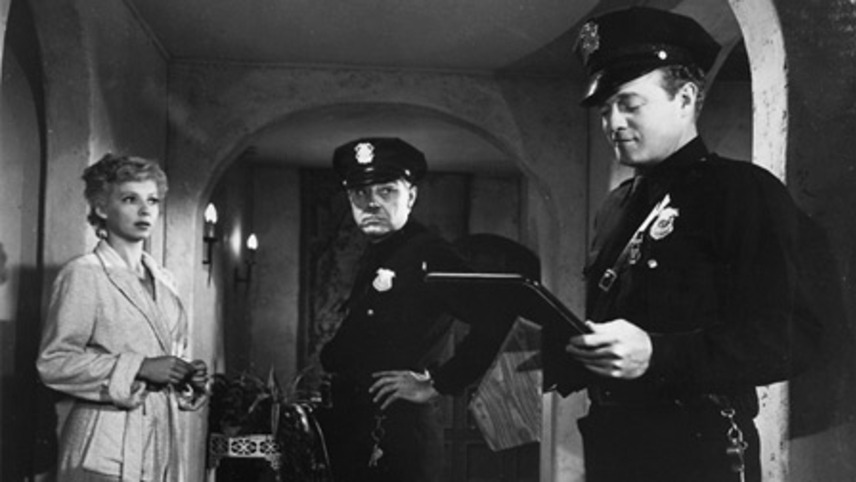
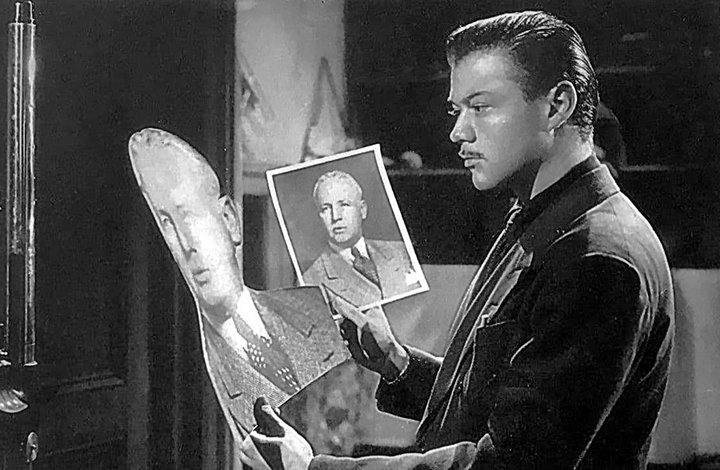
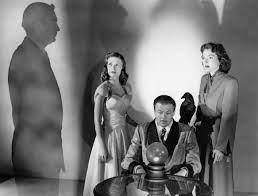
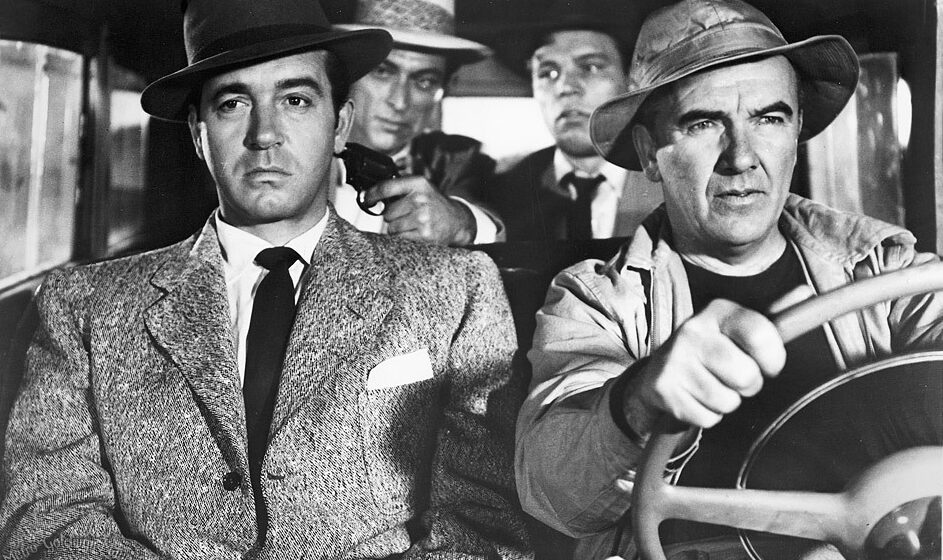
Evelyn Keyes (left) and Van Heflin (right) in THE PROWLER
On October 29, Turner Classic Movies brings us the 1951 film noirThe Prowler stars the usually sympathetic good guy Van Heflin as the twisted bad guy. Heflin is a beat cop responding to a call – a woman has reported a prowler outside her house. By the time Heflin and his partner arrive, the prowler is long gone, but Heflin is lusting after the comely woman (Evelyn Keyes), who is home alone every night because her husband works as an all-night DJ. Under the ruse of making sure that the prowler has vamoosed, Heflin returns and overcoming her reticence, seduces her. As befits a film noir, once he finds out about the husband’s insurance policy, sleeping with the guy’s wife just isn’t enough anymore.
It’s a strong screenplay, penned by the blacklisted screenwriter Dalton Trumbo (who also provides the voice of the DJ). The Prowler is one of my Overlooked Noir.
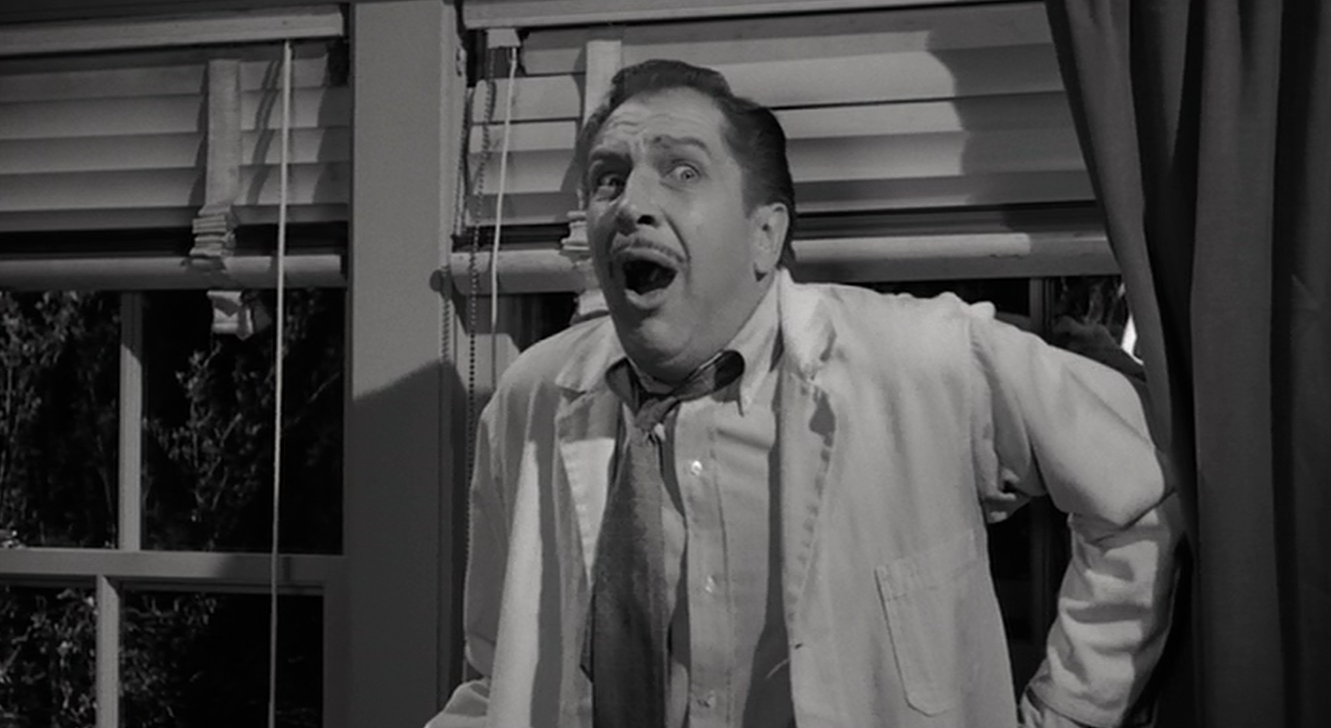
On late Friday night, Turner Classic Movies is bringing us a campy Vincent Price horror classic from 1959, The Tingler. It has a scary premise – a parasite embedding itself in people’s spine and feeding on them – unaware until they feel a tingle AND THEN IT MAY BE TOO LATE! When finally revealed, the grown parasite is VERY scary-looking. Conveniently, the infested can weaken the parasite by screaming. Horror schlockmeister William Castle reportedly installed buzzers in the backs of some theater seats, so some audience members would get an actual tingle in the spine at the scariest moments. In the trailer below, Castle preps his audiences to scream if they feel a tingle. It’s a cult classic.
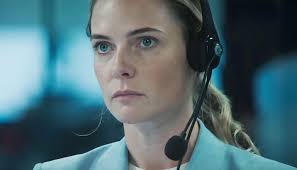
Photo caption: Rebecca Ferguson in A HOUSE OF DYNAMITE. Courtesy of Netflix.
In Kathryn Bigelow’s thoughtful nail-biter A House of Dynamite, a ballistic missile armed with a nuclear warhead is on its way to annihilate an American city. American military and national security officials have only minutes to act. That’s a terrifying scenario, and Bigelow knows that portraying it in exacting, realistic detail is very, very scary. She also forces the audience to undertake an intellectual exercise, thinking through What would I do?
All of us Americans – and all the Russian people – understand that if Russia were to launch a nuclear strike on the US, that the US would then automatically retaliate and destroy the military and economic capacity of Russia, along with most of its residents. And vice-versa. In that case, all the decision-makers know the procedures to implement, already carefully thought out in advance.
But what happens if we don’t know WHO has fired a nuclear warhead at us? That very central ambiguity would make decisions very much NOT automatic.
Most of us know that the US President is shadowed by a military officer carrying a briefcase (“the football”) that contains the codes authorizing nuclear warfare. Some of us know that select officials would be evacuated to nuke-proof bunkers. And that, in the event our top 36 leaders are wiped out at once, there’s a 37th person designated to take command. Here, Bigelow takes us inside to show us what all this would actually look like.
Most of the national security chain of command is highly trained to dal with the situations that the rest of see only as vague contingencies. These folks know exactly what their responsibilities are and what to do. Of course, they are human, and they recognize the consequences of the actions that they are trained to take and the impacts those situations will have on their loved ones. I’m talking here about the National Security staff in the situation room, the top military commanders, the folks tasked with launching defensive missiles from their silos and that young guy carrying “the football”,
But the President and Defense Secretary (try for a moment to forget the current occupants of those offices), press aides and others in the government probably don’t have that background, and must deal with a broadband of topics. With just an orientation briefing when they took office, they would essentially be thinking all this through for the first time, like the rest of us.
Bigelow also reminds us that a crisis may occur when we’re on vacation, running late to work, at some forgettable photo op, or when our spouse is taking the feverish kid to the doctor. Civil War re-enactments have their value, but juxtaposed with an impending nuclear holocaust… Time waits for no one, as they say.
Idris Elba in A HOUSE OF DYNAMITE. Courtesy of Netflix.
Idris Elba and Jared Harris are superb as the President and Defense Secretary, plunged into a crisis they would never, never have chosen to address. As the national security and military pros, Rebecca Ferguson, Jason Clarke, Tracey Letts and Anthony Ramos are similarly excellent.
We see so many national security thrillers with ridiculously implausible plots (The Diplomat and Hostage are recent examples) that it’s both welcome and bracing to see a screenplay so realistic. Bigelow gets everything right, down to how female decision-makers in DC wear comfy shoes to the office and change into dress shoes after passing though the metal detector.
I love movies that tell their stories in real time. Here, the key part of the story is only seven minutes long, so Bigelow tells it again and again from the perspective of different characters.
Along with being the first woman to win the Best Director Oscar, Kathryn Bigelow (K-19: The Widowmaker, The Hurt Locker, Zero Dark Thirty) may be our greatest national security filmmaker ever. A House of Dynamite is thoughtful, chilling and one of the Best Movies of 2025 – So Far.
A House of Dynamite is in theaters and begins streaming on Netflix this Friday. The immersive experience of a movie theater was great for A House of Dynamite; if you’re streaming it at home on Netflix at home, turn off the lights in the room, crank up the volume on the TV and silence the notifications on your phone.
Photo caption: Albrecht Schuch in PEACOCK. Courtesy of Oscilloscope Laboratories.
In the droll and absurd comedy Peacock, Matthias (Albrecht Schuch of All Quiet on the Western Front) works in a most unusual companion service; he gets paid for jobs like masquerading as a client’s fictional partner. Matthias has so perfected being a chameleon that he has lost all sense of himself. This disquiets his wife and colleagues, and, when the vengeful ex-husband of a client terrorizes him, Mattias’ world starts to unravel.
Albrecht Schuch in PEACOCK. Courtesy of Oscilloscope Laboratories.
If you like Ruben Ostland’s work (Force Majeure, The Square, Triangle of Sadness), you’ll like Peacock. In fact, there’s a scene in Peacock that borrows A LOT from the chimp impersonator scene in The Square.
Austrian director Bernhard Wenger won a prize at Venice, where Peacock was also nominated for Best Film in the Critic’s Week.
I screened Peacock for NashFilm. It’s being shown at six Laemmle theaters in LA this Wednesday.
Photo caption: Frank Dillane in URCHIN. Courtesy of 1-2 Special.
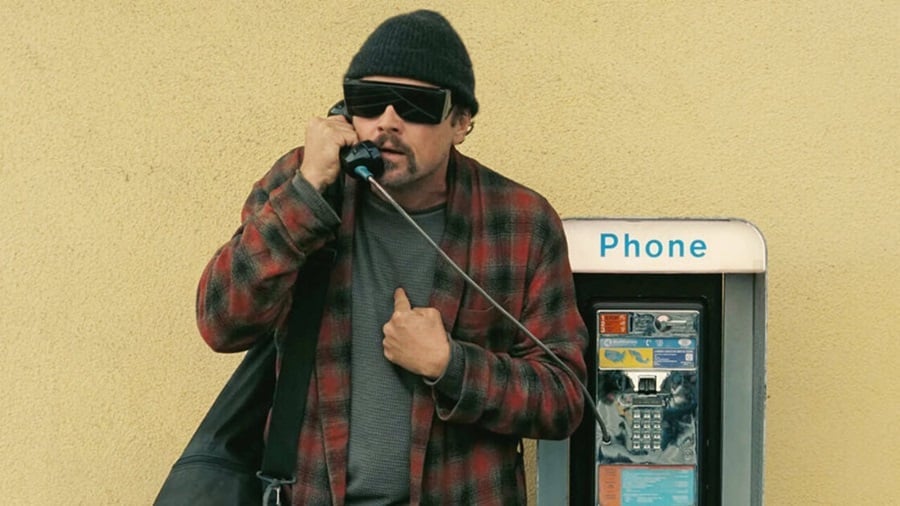
In Urchin, the first film written and directed by actor Harris Dickinson, Mike (Frank Dillane) is a homeless British addict who gets jailed for a strong-arm robbery. Released on paroled with eight months of sobriety, Mike gets placed into a free apartment and a job with a very understanding boss, and he starts to forge healthy friendship with workmates.
The problem is that Mike thinks that society owes him. I’m not trying to get all Twelve-Steppy, but nobody is going to recover from addiction without accountability and gratitude, which Mike does not. Sure enough, Mike is frustrated by a normal minor responsibility and … Urchin is basically an exercise of waiting for Mike to blow it.
Critics have been falling over themselves in praising Dickinson’s film and Dillane’s performance. Indeed, Dillane is extraordinarily convincing in his portrayal of a street addict; unfortunately, he doesn’t succeed in getting us to care about Mike.
With the exception of a couple unnecessary and distracting moments of magical realism, Dickinson directs very ably. A la Mike Leigh (very high praise), he brings us right into the gritty world of panhandling, street drug sales, the police station booking room and menial workplaces. (Mike Leigh never needed magical realism and could keep us engaged in a bleak story.)
But Dickinson is a better director than a writer. The audience never develops a stake in Mike’s predictable demise, which leaves Urchin as an Eat Your Broccoli movie.
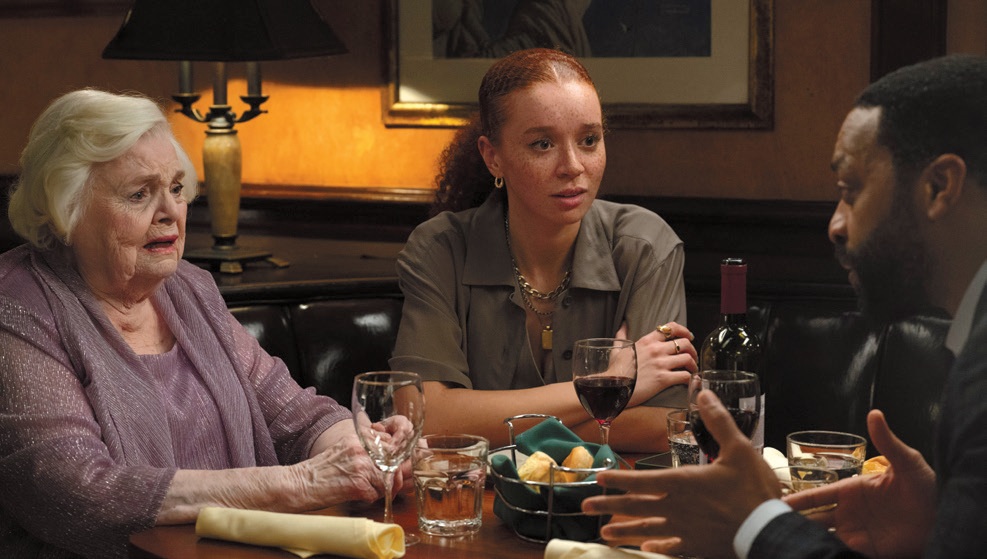
Photo caption: June Squibb, Erin Kellyman and Chiwetel Ejiofor in ELEANOR THE GREAT. Courtesy of Sony Pictures Classics.
This week on The Movie Gourmet – a new review of the astonishingly over-the-top One Battle After Another and a remembrance of an iconic actress. Don’t miss this week’s TV pick (below).
REMEMBRANCE
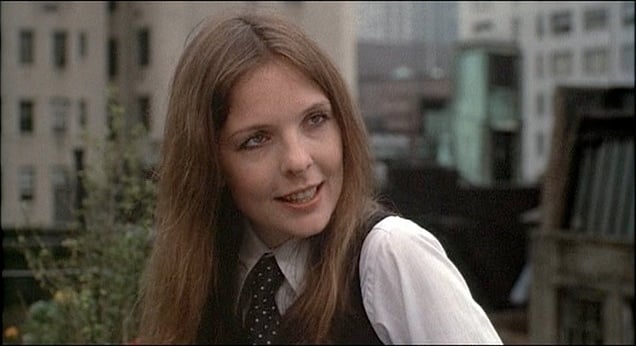
Diane Keaton in ANNIE HALL
The beloved Diane Keaton earned her status as a cinema icon with unforgettable performances in three of the 50 Greatest Movies of All Time. She won her Oscar her completely idiosyncratic portrayal of the title character in Annie Hall, my choice as the best romantic comedy ever. In The Godfather, her Kay Adams book ended the story of Michael Corleone, first accepting his “That’s my family, Kay, It’s not me.” and then ending the movie with the door to Michael literally closing in her face. The most searing moment in The Godfather Part II was Kay’s ferocity in telling Michael about a miscarriage that wasn’t. 72 more movies and three more Oscar nominations filled out Keaton’s 54-year screen career, but those three performances were indelible. A further note – my best pal in LA occasionally ran into Keaton around town, and she liked to dress like Annie Hall in real life.
CURRENT MOVIES
Eleanor the Great: grief, an appalling lie, redemption. In theaters.
To Kill a Wolf: mysteries revealed. Amazon, AppleTV, Fandango.
ON TV
Turhan Bey and Lynn Bari in THE SPIRITUALIST.
Here’s a rarity – on October 18, Turner Classic Movies brings us The Spiritualist (also The Amazing Mr. X), a 1948 B-picture that I hadn’t heard of until I saw it at last year’s Noir City in Oakland. It’s only 78 minutes long, and it’s a lot of fun. A cunning phony psychic (Turhan Bey) has convinced a wealthy widow that he can communicate with the dead, and she’s moved him into her mansion. Her world-wise daughter (Cathy O’Donnell) isn’t buying his act. But, while he is a con artist, he’s a really, really skilled one, and he pulls off illusion after illusion to keep the gullible widow believing – it’s like watching a magic show. The Spiritualist was shot by John Alton, one of the two greatest film noir cinematographers, and he makes the mansion extra spooky and the tricks extra sinister.
This was a rare leading role for Turhan Bey, and he makes a very charismatic charlatan, oozing suave charm and faux authority. Bey, an Austrian with a Turkish father and a Jewish Czechoslovakian mother, knocked around Hollywood playing exotic characters and never getting the lead in an A-picture. He has a very interesting Wikipedia page.
Cathy O’Donnell, Turhan Bey and Lynn Bari in THE SPIRITUALIST.
Photo caption: Leonardo DiCaprio in ONE BATTLE AFTER ANOTHER. Courtesy of Warner Bros.
It’s been a while since I’ve seen a movie so over-the-top as Paul Thomas Anderson’s broad satire One Battle After Another. It’s sometimes hilarious, sometimes thrilling and always outrageous.
Leonardo DiCaprio stars as Bob, the tinkering bomb-maker in French 75, a group of far-left revolutionaries led by Perfidia (Teyana Taylor), charismatic and oversexed and too in love with her own badass flamboyance. Sure enough, once they piss off the nation’s repressive law enforcement establishment, French 75 is destined to go the way of the Weather Underground and the Symbionese Liberation Army. In a shock-and-awe campaign led by Colonel Stephen J. Lockjaw (Sean Penn), the revolutionaries are all neutralized or driven underground. Bob is able to get away and hide out under a new identity with Perfidia’s newborn daughter Willa.
The story resumes sixteen years later, with Bob and Willa living in a Northern California forest cabin. Bob is still a stoner underachiever, but he’s a devoted dad, and Willa (Chase Infiniti) has blossomed into a young woman of uncommon intelligence and curiosity. Suddenly, Lockjaw leads a military assault team to capture them, and the two are off on a two-hour race for their lives. When they become separated, Bob, despite his sparse hero skills, tenaciously tries to find her. Why has Lockjaw reappeared after sixteen years? He has his reasons, which I won’t spoil.
Paul Thomas Anderson, whose best movies are Boogie Nights and There Will Be Blood, has a body of work that ranges from the super-serious (The Master) to the silly (Inherent Vice). But his movies are always character-driven and always centered in empathy – we understand what makes his characters tick. In this case, he celebrates the resilience of his protagonists.
What I haven’t seen before from Anderson are the violent attacks and white-knuckle chases that we see in more conventional Hollywood thrillers. Anderson delivers here, with a movie that’s chock-filled with exciting set pieces. The final chase on an up-and-down road called the Texas Dip outside Borrego Springs, California, is spectacular. Is this a political satire embedded in a thriller, or the other way around?
And about that broad satire – principal photography took place in the first seven months of 2024, before Trump’s election and before his second-term weaponization of ICE and attempt to inflict martial law upon American cities. It’s chilling that reality is now mirroring what Anderson, as he was writing the screenplay, must have thought was far-fetched.
From the get-go, Anderson paints the government forces as fascist and white supremacist. But he skewers the wacko far-left as well. One of the scenes with the revolutionaries is as funny as the Liberation Front/Splinter scene in Monty Python’s Life of Brian.
Leonardo DiCaprio is a huge movie star who can carry a romantic drama (Titanic) or an action adventure (The Revenant) and, hell, play Jay Gatsby or Romeo. Here, his Bob shambles along, often terrified and klutzy, and none too strategic. It’s to DiCaprio’s credit that he turned down what became the righteous Jesse Plemons role in Killers of the Flower Moon to play a dumbass. And, again in One Battle After Another, he is racing for survival, always seemingly one step too slowly. It’s a fantastic, anti-Tom Cruise performance.
Sean Penn in ONE BATTLE AFTER ANOTHER. Courtesy of Warner Bros.
Penn’s Lockjaw is the most demented military character in the movies since Brigadier General Jack D. Ripper (Sterling Hayden) in Dr. Strangelove. As perverse and perverted as he is, you have to acknowledge his epic relentlessness. Penn is able to humanize the awful Lockjaw with his vulnerabilities – sexual and social-climbing yearnings that control him.
Chase Infiniti, in her first feature film, gives us a Willa with the latent ferocity of her mom, but with more grounding, discipline and self-awareness. More of Chase Inifiniti, please.
Chase Infiniti in ONE BATTLE AFTER ANOTHER. Courtesy of Warner Bros.
Teyana Taylor dominates the first chapter of One Battle After Another, with Perfidia’s stunning charisma and power. Benicio Del Toro and Regina King are excellent as two of Bob’s rescuers. Eric Schweig, an actor I’ve admired since The Last of the Mohicans (1992), shows up in a small but key role.
One Battle After Another has a Metacritic rating of 95. Although I’ve been singing its praises here, I initially found it a little too long for something so bombastic. Since then, I’ve thought about it more, and have placed it higher on my list of the Best Movies of 2025. Anyway, it’s so well-crafted and unusually outrageous that it’s a Must See.
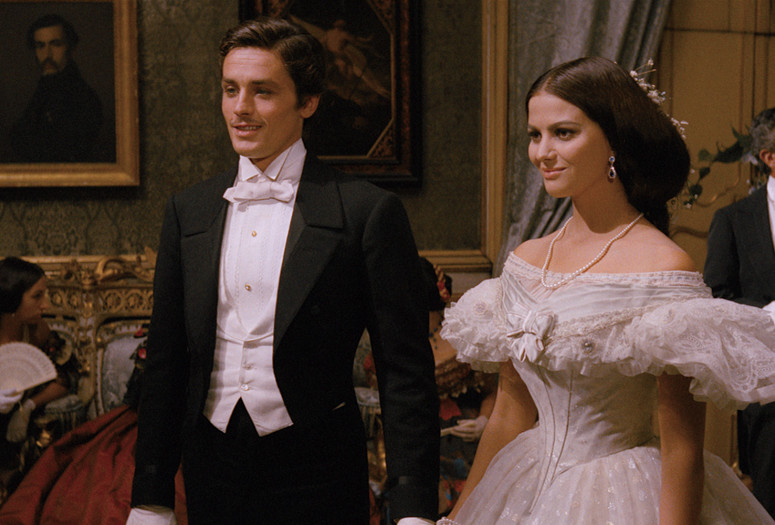
Claudia Cardinale was first noticed in the Italian comedy Big Deal on Madonna Street and had a key role in Fellini’s 8 1/2, one of the greatest movies ever. Popularly seen as a voluptuous bombshell in the 1960s, she worked in 128 films through 2022. The scene in which she is re-introduced to the local nobleman (Burt Lancaster) as a nubile adult in The Leopard is one of the most stunning entrances in cinema.
Indie writer-director Henry Jaglom was known internationally among cinephiles for his artsy, individualistic, women-centered films like Eating and Venice/Venice. I attended an in-person Jaglom presentation of his film Hollywood Dreams.
CURRENT MOVIES
Eleanor the Great: grief, an appalling lie, redemption. In theaters.
To Kill a Wolf: mysteries revealed. Amazon, AppleTV, Fandango.
ON TV
John Payne, Lee Van Cleef, Nevile Brand and Preston Foster in KANSAS CITY CONFIDENTIAL
On October 11, TCM is presenting a triple-header of important film noir:
Kansas City Confidential: A criminal mastermind hides his identity from his own squad of indelible goons (Lee Van Cleef, Neville Brand, Jack Elam) as they pull off a heist and frame a poor flower delivery driver (John Payne). To solve the crime and clear himself, the driver has to head to Mexico, where more plot twists await.
The Manchurian Candidate: For a ticking bomb thriller, you really can’t top John Frankenhimer’s 1962 original. Laurence Harvey plays a victim of Commie brainwashing who has become a robotic, remote-controlled assassin. Can he be stopped in time?The Manchurian Candidate tops off a set of brilliant Frank Sinatra performances (before his directors couldn’t restrain him from mugging): From Here to Eternity, Suddenly!, The Man with a Golden Arm. Harvey, Sinatra and Janet Leigh are all good, but this is really Angela Lansbury’s movie. Not only is her character promoting the political career of her bombastic Joe McCarthy-like husband, but she is a Communist agent intent on the Communist takeover of the US government. And she is pulling the strings to direct the assassin – her own son! Lansbury’s character makes my list of Worst Movie Mothers.
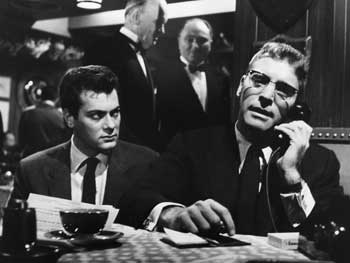
Sweet Smell of Success: This film proves that you don’t need a murder to qualify as a film noir as long as there’s enough blackmail, police corruption and brutality, sexual harassment, criminal frames and red-baiting. In his best-ever performance, Tony Curtis plays a press agent who must suck up to a powerful, cruel and capricious columnist (Burt Lancaster).
Tony Curtis and Burt Lancaster in SWEET SMELL OF SUCCESS
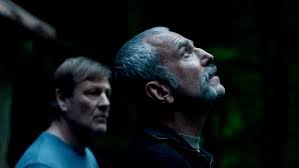
Photo caption: Sean Bean and Daniel Day-Lewis in ANEMONE. Courtesy of Focus Features.
The searing drama Anemone opens with a sixtyish man leaving his home in northern England for a motorcycle ride to a remote forest, where he hides his bike and begins hiking in, heading for coordinates handwritten on a slip of paper. Eventually, he arrives at a cabin hidden deep in the woods. The man who lives there, off the grid, as a hermit, wordlessly invites him in. The two are brothers who haven’t seen each other for two decades.
Both men are retired British soldiers who served in Northern Ireland’s Troubles. Twenty years before, Ray (Daniel Day-Lewis) abandoned his pregnant wife Nessa to become a recluse. Jem (Sean Bean) assumed Ray’s role in caring for Nessa and Ray’s biological son. Now the son (Samuel Bottomley) is emotionally floundering and Nessa (Samantha Morton) has written to Ray, asking him to return and help the son resolve his issues. Anchored resolutely in his bitterness, rage, guilt and shame, returning is the last thing that Ray wants to do.
Gem delivers Nessa’s letter right away, which Ray initially refuses to read. Gem, playing the long game, stays for a few days, patiently wearing down Ray’s resistance. Gradually, Ray unloads stories from the past that explain his choices.
Ray is an intense guy, played superbly by Day-Lewis. Having suffered traumas and indignities in his military career, he has coped by spurning all human interaction and adopting a simple life that he can control. Day-Lewis, generally recognized as the world’s best living screen actor, gets to explode in several visceral monologues about his haunting experiences.
Sean Bean is really good here in a very subtle performance. The role of Jem is far less showy than that of Ray, but Bean brings a world-weary, solid decency to Gem, who is fully engaged as he listens to Ray’s charged stories with empathy. Samantha Morton is good, too, but with far less screen time.
If you already know anything about Anemone, it’s probably that Day-Lewis came out of retirement to act in the first feature directed by his son Ronan Day-Lewis. Daniel and Ronan co-wrote the screenplay.
As a director, Ronan Day-Lewis has a gift for exquisitely framing shots – the first seven or so shots could be hanging in an art museum. The soundtrack – toggling between driving rock and silence – is singular. As a storyteller, he lets his audience figure out what’s going on as facts about Jem and Ray unspool. Ronan even throws in some magical realism apparitions and a near-apocalyptic hailstorm. Ronan Day-Lewis ends the the movie perfectly, with a shot that isn’t even a half-second too long (although it took a superfluous twenty minutes to get there).
Although Anemone’s portrait of Ray is unsurpassed, the story is not deep or surprising enough to support a two-hour running time. The dramatic tension is whether Ray is going to leave the woods and meet his son. That would be the decent thing for him to do, it may be his last chance at redemption, and that’s the outcome the audience is rooting for. Well, since this IS a movie, what do you think he’s going to do? As much as I admired much of the film, I wasn’t on the edge of my seat.
Even though it’s overlong, I’m glad I watched Anemone for the superb performances by Day-Lewis and Bean and for the stunning visuals and soundtrack.
Photo caption: June Squibb in ELEANOR THE GREAT. Courtesy of Sony Pictures Classics.
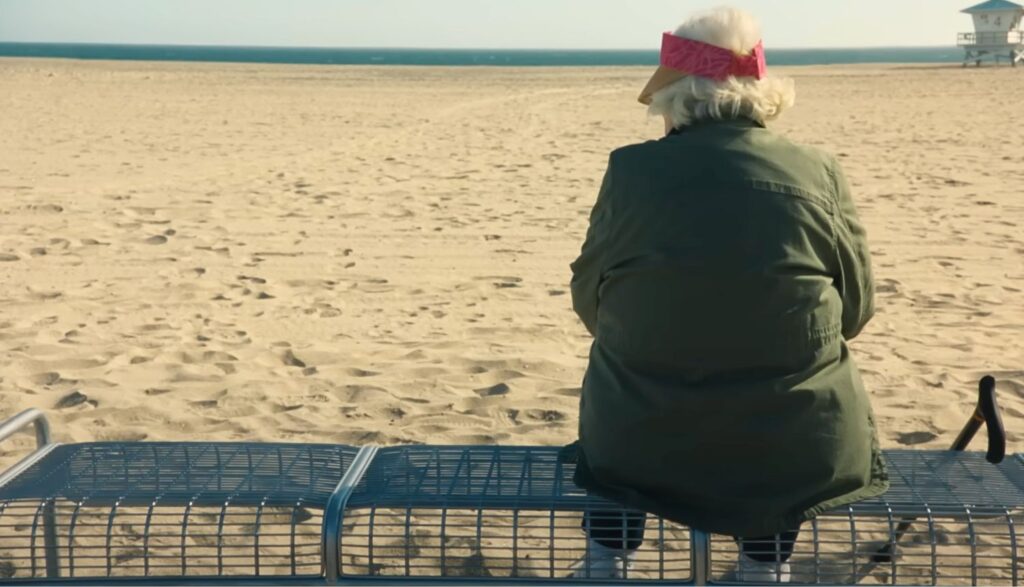
In the fine dramedy Eleanor the Great, the 94-year old widow Eleanor (played by 94-year old June Squibb) moves to New York City, near her daughter and grandson. On her way to a class for seniors at the Jewish Community Center, she is diverted to a group of Holocaust survivors, who mistake her for one of them. She is not a Holocaust survivor, but fails to correct them, and then gets in deeper when the enthusiastic college student Nina (Erin Kellyman) chooses her as the subject for a school project.
Nina’s mother has unexpectedly died six month before, and Nina is still rocked by the loss. She needs the support of her father, the celebrity journalist Roger (Chiwetel Ejiofor), but he is too consumed by his own grief to provide it. Eleanor’s grandmotherly nurturing fills the void.
Eleanor has just lost Bessie, her best friend of 50 years; the two women had been roommates as widows for the past eleven years. Grieving the loss and being new in a strange city, Eleanor is very lonely, and she adopts Nina as her own. The two become inter-generational soulmates.
But their relationship was founded on an outrageous lie – a lie that is easy to expose. We know that it is inevitable that Eleanor will, as they say, lose control of the narrative.
This is a really good movie, and not the one I expected. It’s not a geezer comedy. And it’s Nina’s movie as much as it’s Eleanor’s. As Eleanor the Great moves from a comedy of manners into an exploration of grief, the key is found in three relationships, those of Eleanor and Bessie, Nina and her dad and Nina and Eleanor.
Erin Kellyman in ELEANOR THE GREAT. Courtesy of Sony Pictures Classics.
Of course, no one can play an old gal full of piss and vinegar better than June Squibb (Nebraska, Thelma), and she doesn’t disappoint. But the revelation here is Erin Kellyman’s remarkably convincing performance as Nina; she’s great.
Ejiofor is good as Nina’s dad, and so are Jessica Hecht as Eleanor’s sandwich generation daughter and Rita Zohar as Eleanor’s dear friend Bessie.
Eleanor the Great is the first feature for Scarlett Johannson as a director and for screenwriter Tony Kamen. Johannson directs this film very ably, with near-perfect pacing. Scarlett Johannson is also a NYC native who loves NYC, and like Woody Allen and Martin Scorsese, she gets to celebrate the city in her work.
A much deeper film than its marketing would indicate, Eleanor the Great is still an audience-pleaser.