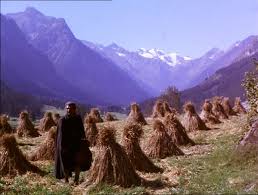
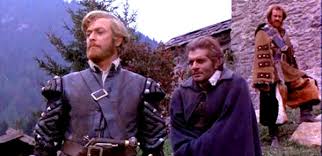
The historical epic The Last Valley is set in 1643 when a band of mercenaries led by The Captain (Michael Caine) is foraging. They happen upon a remote hamlet tucked deep in the Tyrolean Alps that, miraculously has not yet been ruined by warfare. The Captain has conscripted a wandering refugee, the teacher Vogel (Omar Sharif), for his value in an illiterate time. The Captain and Vogel broker a deal with village’s headman Gruber (Nigel Davenport) for the soldiers to spend the winter in the village, a respite from the combat, starvation and plague prevalent everywhere else.
It’s a great deal for the mercenaries – they get food and shelter (and some designated women companions) for the winter. In return, the soldiers will refrain from massacring the villagers and will protect them from other raiders.
Of course, the arrangement comes with underlying tensions. The peasants would rather not be sharing their village with strangers who are professional killers. The villagers are Catholic and most of the soldiers are nominally Protestant, although they have switched sides from time to time. The one local ideologue is a fanatic priest (Per Oscarsson), who fumes at what he sees as intolerable heresy.
There’s also always the threat of thuggish behavior from the newcomers, who are used to taking whatever they want at the point of a sword. All civil order depends on the discipline enforced remorselessly by the Captain.
The Captain and Gruber agree that Vogel, who serves as The Last Valley’s moral center, will decide disputes.
By the way, the Captain has taken Gruber’s beautiful wife (Florinda Bolkan) as his live-in companion, which Gruber accepts only because he has no choice. Gruber simmers.
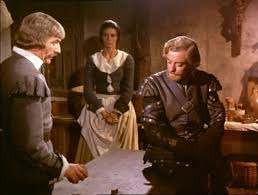
Will the two sides be able to co-exist for the entire winter? What will happen in the springtime? This was a time of superstition, cruelty and total war, so it’s unlikely that everyone will survive unscathed.
The Last Valley is set amid the Thirty Years’ War, when political power in Europe was being reset by the Reformation. Catholic emperors tried to resist losing parts of their realms to new Protestant states. From 1618 through 1648, armies fought their way back and forth across Central Europe. Smaller armed bands, both sectarian and mercenary, preyed on civilians, plundering, raping and, incidentally, spreading plagues. Europe in the mid 17th Century was a bad time to be a soldier, and far worse to be a peasant. Over five million lost their lives, and the population was reduced by 50% in parts of Germany.
So, this must clearly be the best movie about the Thirty Years War. But is it a good movie, and does it stand up today? On the plus side, the characters of the four main characters – Vogel, the Captain, Gruber and Erica – are textured and novel, and the performances of Sharif, Caine, Davenport and Bolkan are excellent (although Caine is the only actor who chose to speak English with a German accent). On the minus side, the minor characters (the best example is Hansen, played by Michael Gothard) are one-note stereotypes that only exist to create conflict for the plot. And the dialogue is often stilted or lame.
What The Last Valley does very well is to replace the the perspective of popes, emperors and kings with that of ordinary Europeans on the ground, both soldiers and civilians. This isn’t the history book (or Wikipedia) account of the Thirty Years War, it’s what most Europeans experienced.
The Last Valley features an international cast, from the UK (Caine, Davenport, Brian Blessed, Jack Shepherd, Andrew McCulloch, John Hallam), Egypt (Sharif) Brazil (leading lady Florinda Bolkan), Sweden (Per Oscarsson), Poland (Vladek Sheybal)), Greece (Yorgo Voyagis) and the US (Arthur O’Connell).
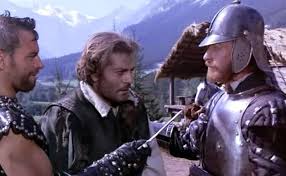
The Last Valley was directed by James Clavell, who adapted a novel by J.B. Pick.. Clavell had worked as a screenwriter, beginning with the original 1950s The Fly, before he harnessed his own experience as a WW II POW to write the autobiographical King Rat (which he got to direct) and the global hit The Great Escape. His success allowed him the time to write the novel Tai-Pai, which became a massive best-seller. Back at directing in 1967, Clavell then had a hit with To Sir, With Love. At this point in his career, Clavell directed The Last Valley.
The Last Valley was not a commercial success. I think that’s because it was marketed as a super widescreen epic; but almost a decade had passed since Spartacus, Cleopatra, How the West Was Won and The Bible – and cinema culture had moved on. That’s too bad, because The Last Valley, with its revisionist politics and dark view of humanity, fits in with the maverick cinema of the 1970s.
After directing The Last Valley took time to write another blockbuster novel, Shogun. This novel and the 1980 spin-off television series Shogun, both monster hits, were Clavell’s biggest successes and most memorable works.
The Last Valley was shot around Gschnitz in the Austrian Tyrolean Alps, a scenic place that must be immeasurably more livable than it was four hundred years ago.
The Last Valley is not yet available to stream and is very hard to find, except on pre-owned DVDs.