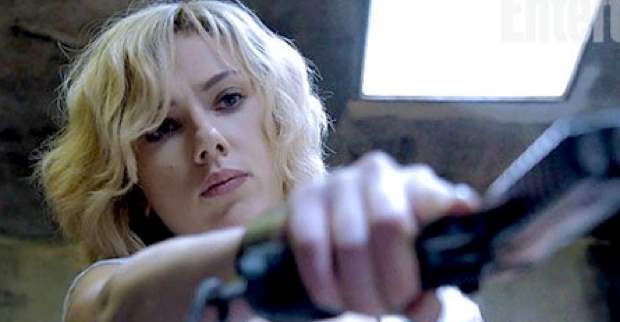
Supposedly we only use 10-20% of our brain capacity, and in the sci fi thriller Lucy, Scarlett Johannson gets to show what it would look like if we could harness 100% of our intelligence. Johannson plays the title character, who is captured by an especially merciless Chinese crime lord and then get dosed with a designer drug that unharnesses her full brainpower. Processing more information much faster than everyone else is a superpower that allows her to wreak mayhem upon the bad guys. She’s in a race against time to find and snag the rest of the world’s supply of the drug and to download what’s she’s learned to a brainiac scientist (Morgan Freeman) before she implodes. Kind of a sci fi D.O.A.
French director Luc Besson is an unapologetic lover of American action films. He really does excel at action, notably in the underrated parkour film District B13. He has also delivered kickass female characters in Leon: The Professional (Natalie Portman’s breakout role) and La Femme Nikita.
Fortunately, Besson has Scarlett Johannson’s magnetic screen presence at his disposal. Here, she gets to show off an amazing intensity that comes when her character’s superbrain is whirring away. Her throaty voice turns out to be perfect for delivering very authoritative statements. Of course, she looks great in a t-shirt (first half of movie) and a little black dress (second half). She doesn’t take herself too seriously and clearly has fun with these roles where she is kicking some serious ass.
Not too deep and with great eye candy visuals, Lucy is pedal-to-the-medal summer fun.
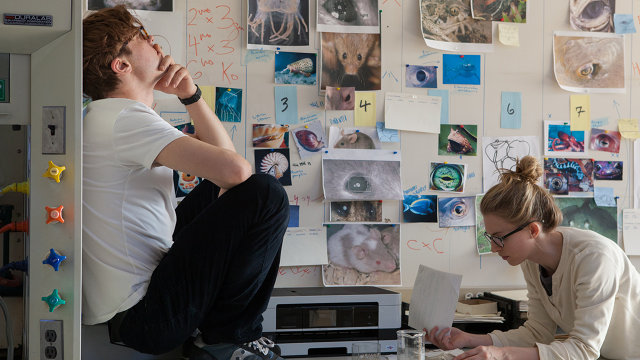
The romance I Origins (which opens tomorrow) explores the conflict between science and spirituality. Our scientist protagonist (Michael Pitt) is completely empirical and militantly anti-spiritual. He is obsessed with the study of iris scans and patterns of the eye (the “I” in the title is a pun). He is hoping to prove that eyes can be evolved, which he believes will debunk the Creationist pseudo-science of Intelligent Design. He meets a model (Astrid Berges-Frisbey) – and they don’t meet CUTE, they meet HOT. Through a string of scientifically improbable coincidences, he is able to track her down for a second encounter that is sharply romantic. They fall in love – an attraction of opposites because she is mercurial and vaguely New Agey.
Along the way, he gains a new lab assistant (Brit Marling), who is just as smart and more driven than is he. Together they find the lab breakthrough to prove his theory. The main three characters are affected by a life-altering tragedy. Seven years later, the story resumes with the public release of the discovery. As our hero takes his victory lap over religion, he is faced with new evidence that cannot be explained by science…
Writer-director Mike Cahill (Another Earth, also starring Marling) has constructed a story that sets up a discussion on the limits of empiricism. I give Cahill extra points for raising the issue without ponderosity or pretension. Some critics have harshly judged the movie, but they see it wrongly as a corny religion-beats-science movie instead of a contemplation on the possibilities. And they altogether miss the fact that the film is basically a romance, which Cahill himself sees as one of the two central aspects of I Origins. Cahill explores and compares the intense lust-at-first-sight, opposites-attract type of love with the love relationship based on common values and aspirations.
There are, however, two shots involving pivotal moments in the story (and both involving billboards) that are such self-consciously ostentatious filmmaking that they distracted me, rather than bringing emphasis to each moment.
Pitt, an actor of sometimes unsettling affect, is very good here, as he was in The Dreamers and Last Days. Berges-Frisbey and Marling deliver fine performances, too. If Marling is in a movie, it aspires to being good – I loved The East, which she co-write and starred in. Archie Panjabi, without the boots and the upfront sexiness she wears on The Good Wife, is solid in a minor part.
I Origins works both as a scientific detective story and as a meditation on romance. I found it to be smart and entertaining.
The Newburgh Sting is a credible and politically important documentary from HBO. In 2009, the FBI arrested four American Muslims with what look like bombs outside a synagogue. The Newburgh Sting examines the case by showing us the actual FBI surveillance videos and audios, along with talking heads of relatives and community members. And a different reality emerges.
As the story unfolds, the FBI enrolls an informant – a serial con man who needed FBI leverage to hang on to the ill-gotten gains of a previous scam. The informant heads to hardscrabble Newburgh, NY, and flashes cash and expensive cars; he pretends to be an international terrorist who will pay $250,000 for a “job”. The informant finds a local hustler who will say anything to scrounge some cash. The hustler rounds up three more unemployed guys who will also do anything for a little money, let alone $250,000. The informant describes and plans the job, organizes the job and provides all the materials (including fake bombs).
Whether or not this meets the legal definition of entrapment is one thing. But, as a matter of policy, it’s clear that – absent the FBI informant paying them to do so – these guys would never have been involved in such a scheme. It’s also easy for the audience to conclude that the FBI only stopped a “terrorist incident” that it manufactured, spending resources that could have been used against real terrorists with the actual means to carry out an attack.
The most distasteful part of the story is the cable news coverage of the arrests, trumpeting the FBI’s spin: the capture of a terrorist cell intent on mass murder of Americans. By the time we watch this, we have seen the video of the informant and the dumbass suspects actually plotting the “attack”, and we have a pretty clear picture of the personalities involved and what really happened. Because of the surveillance videos, it’s definitely worth a watch.
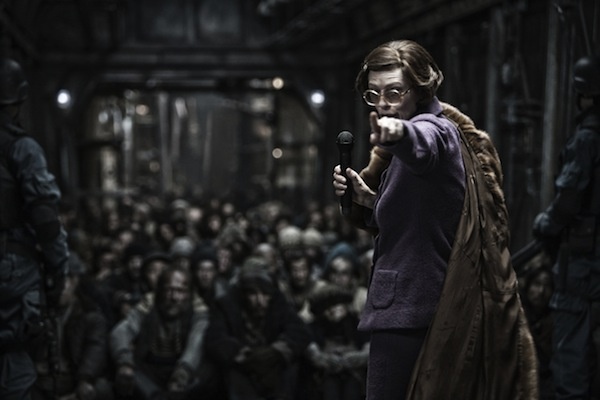
Snowpiercer is that rare sci fi thriller that effectively explores some serious questions without becoming ponderous or pretentious. Here’s the setup. In an attempt to fix global warming by chemically cooling the earth, mankind has moved the needle too far and has instead FROZEN the planet. The only survivors are a few thousand humans packed into a nuclear-powered, “self-sustainable” train that rattles around the earth on a circuitous track. The wealthy elite lives in comfort at the front of the train, while their cruel armed guards keep the wretched, unwashed poor in the back of the train. Naturally, the poor revolt and assault the front of the train.
So we have a conflict in a claustrophobic space, and the thrills come from how the poor think and fight their way up car-by-car. Because the train’s systems have been engineered to prevent this, it takes a lot of ingenuity. And it takes a lot of violence, too, and because the elite has almost run out of bullets repressing previous revolts, that violence is often of the medieval hacking-and-thumping sort.
The train in Snowpiercer, of course, is an allegory for a society with an extreme disparity of wealth – and it’s not far removed from similar societies in human history and even today. In Snowpiercer’s most pointed moments, the mouthpiece for the elite continually tells the poor that they are undeserving and lucky to get the morsels that they are allowed. But the more challenging question – and one that Snowpiercer leaves the audience to ponder – is what are the limits of order; naturally, we’re all against repression, but how about when the very survival of the species is up for grabs?
The production design of Snowpiercer is exceptional. The snowy planet is cool, but the best part of Snowpiercer is experiencing each part of the train, including the greenhouse car, the aquarium car, and (my favorite) the disco car. The imagination that went into creating a mobile space that must sustain itself with making its own food, treating its own water, educating its own kids, etc., is remarkable (and Oscar-worthy).
As the stonefaced leader of the uprising, Chris Evans is okay but doesn’t get to do much. That’s too bad, because I know he can act from his quirky role in The Iceman as hitman Mr. Freezy, who works out of his ice cream truck. Because I don’t watch superhero movies, I was unaware that Evans has recently starred as Captain America in The Avengers and as Johnny Storm in the Fantastic Four movies.
The best performance comes from Kang-ho Song as Snowpiercer’s most interesting character, a high-tech locksmith addicted, along with his 17-year-old daughter, to a drug of the future. Tilda Swinton is gloriously outrageous as a loathsome middle manager for the evil elite. After a spate of emo dramas, Octavia Spencer gets to swing her axe through a herd of bad guys. And Ed Harris, John Hurt and Alison Pill are all reliably good too.
I’m a big fan of Korean writer/director Joon-ho Bong, who made the brilliant 2003 detectives-hunting-serial killer movie Memories of a Murder (also with Kang-ho Song) and the 2009 drama Mother, which made my yearly Best Of list. Memories of a Murder is available on DVD from Netflix, and you can find Mother on DVD from Netflix and streaming on iTunes, Vudu and Xbox Video. He also co-wrote the upcoming on-the-seas thriller Sea Fog (Haemoo) which plays at the Toronto International Film Fest this fall.
You can also stream Snowpiercer on Amazon, iTunes, Vudu, YouTube, Google Play, Xbox Video and DirecTV.
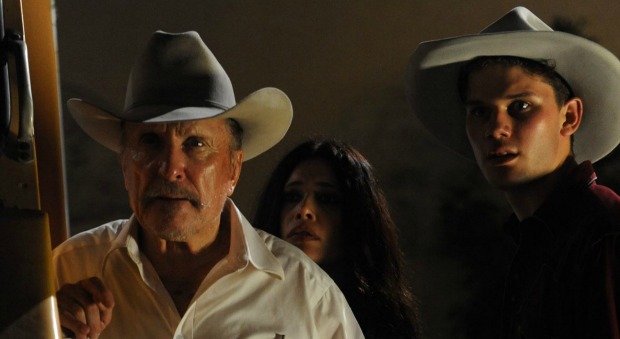
In A Night in Old Mexico, 83-year-old Robert Duvall plays a bitter 83-year-old Texas curmudgeon who has lost his ranch and enlists his new found grandson on a geezer roadtrip adventure to a Mexican bordertown. Duvall is one of our greatest actors, and, after his profound performances in The Apostle and Tender Mercies, it’s fun to let him seek debauchery and tear up cantinas. That being said, there’s really nothing remarkable or original in A Night in Old Mexico – it’s a trifle. Columbian actress Angie Cepeda is especially appealing as the hard luck gal who takes up with the guys.
A Night in Old Mexico is available on DVD from Netflix and streaming from Amazon, iTunes, Vudu and Xbox Video.
There’s a cult classic coming up this Friday night (or very early Saturday morning) on Turner Classic Movies. In the 1968 Spider Baby, a family of inbred ghouls is tended by a kind and rational caretaker (Lon Chaney, Jr.) until some greedy relatives and their shyster invade their spooky Victorian mansion and become cannibalized. Spider Baby was reportedly made for only $65,000 – and it shows. There’s the clunky and explicitly expositional beginning and ending narration and a TV sitcom look and feel. But no 1960s TV show featured a daughter kissing her skeleton father goodnight, along with cretinous uncle and aunts in the basement and negligee-clad cannibals.
Spider Baby was filmed in 1964, but was caught up in bankruptcy proceedings and not released until 1968. This explains the offensive black character, which might have passed as regrettably mainstream in the early 60s, but must have seemed odd to the more racially conscious audiences in 1968.
Chaney has fun with playing a normal human among the monsters, and there’s a sly reference to The Wolfman at the dinner table.
As Chaney’s horror career ended, Sid Haig’s was just beginning. Haig, in just his second feature, played a sex-craved Igor type. He now has over 130 screen credits, including character roles in Emperor of the North and Jackie Brown and lots of TV work. But Haig is most well-known for his horror, and it’s hard to top his portrayal of Captain Spaulding in Rob Zombie’s House of 1000 Corpses. Yikes.
Spider Baby is also known as The Maddest Story Ever Told, The Liver Eaters, Cannibal Orgy and various combinations of those titles. Spider Baby has played on Turner Classic Movies before and is available streaming from Amazon, Vudu and Xbox Video.
The Congress is really two movies – a live action fable and an animated sci fi story. In the opening part, Robin Wright plays an actress in her mid-forties named Robin Wright who followed a star-making performance in The Princess Bride with a series of disastrous career choices driven by her own bad instincts and her need to care for her special needs son. That son is now 13, her daughter is 17 and they are living in a hangar at a Mojave Desert airfield. Her agent (Harvey Keitel) approached with a deal from a smarmy studio exec (Danny Huston). That deal is a Faustian one – she will get a one-time payment in return for having herself scanned so her the studio can use her image in 100% CGI movies; if she accepts the offer, she cannot ever act again – on-screen or in the flesh.
I liked this first part, which is a smart exploration of the issues of art vs. commerce, the ethical limits of using CGI in filmmaking and the rights of individuals over use of their images. The set-up is very well done, the desert airfield is cool and Wright, Keitel, Huston and the kid actors deliver fine performances.
Then the story takes the Robin Wright character – twenty years later – into an alternative universe for animated characters who have had their humanity scanned away. She embarks on a desperate search to find out what has happened to her son and whether her daughter is now leading a revolt. This animated half of The Congress is visually arresting and shows off the talent of writer-director Ari Folman, who made the superb animated film Waltz with Bashir (about Folman’s fellow Israeli army veterans in the invasion of Lebanon). At this time, I lost interest in the tale. Now I’m not a big sci fi fan, though, and someone who DOES appreciate the genre might well enjoy it. The visuals do sparkle.
The Congress is available streaming on iTunes, Vudu, YouTube and Google Play.
I’m not sure I was comfortable learning about the “Bronies”, subjects of the documentary A Brony Tale. My Little Pony is an animated television series that is made for an audience of little girls and which features flying pastel cartoon ponies. Bronies are fans of My Little Pony who are predominantly male and between the ages of 14 and 30. As one of the My Little Pony voice actresses notes, “my pervert alarm went off”.
I was settled in for a cringefest of a freak show, but surprised to met a biker Brony, an Iraq combat vet Brony, married Bronies and just a lot of seemingly manly and normal-looking Bronies. A Brony Tale raised some serious questions of gender expectations – why can we be so repelled by someone’s surprising taste in a harmless TV show? But then we visit BronyCon – the convention for Bronies – and see a lot of them expressing themselves with very strange costuming (and FanimeCon is held close to my house, so I have a high bar for strange costuming).
A Brony Tale is only 79 minutes long – and could have shaved 4-5 minutes off the voice actress’ journey to the BronyCon. A Brony Tale is available streaming on iTunes. Still mulling this over. Hmmmm…
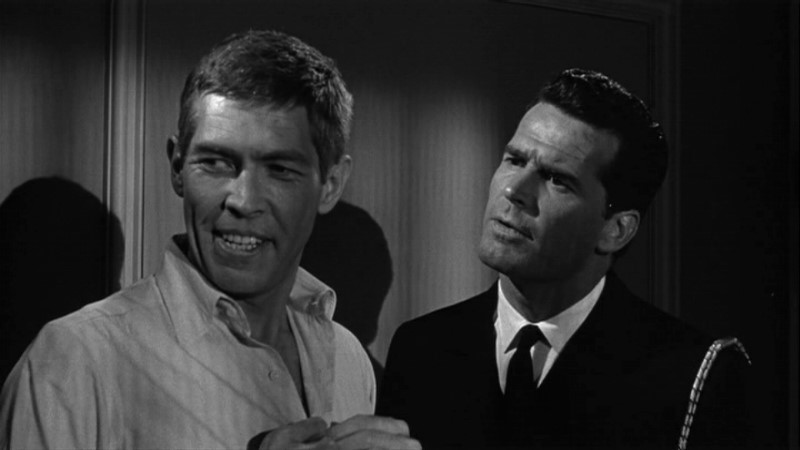
James Garner (right) with James Coburn in THE AMERICANIZATION OF EMILY
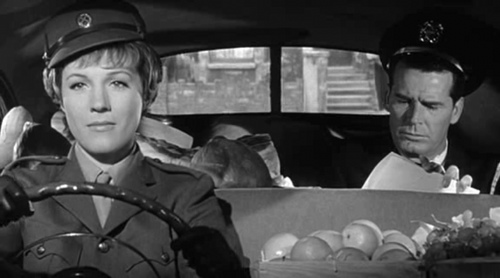
Actor James Garner has died at 86, known primarily for a brilliant television career highlighted by Maverick and The Rockford Files. Yet Garner was also a fine movie actor, and starred in an oft overlooked masterpiece, the 1964 The Americanization of Emily. Set in England just before the D-Day invasion, The Americanization of Emily is a biting satire and one of the great anti-war movies. James Garner plays an admiral’s staff officer charged with procuring luxury goods and willing English women for the brass. Julie Andrews plays an English driver who has lost her husband and other male family members in the War. She resists emotional entanglements with other servicemen whose lives may be put at risk, but falls for Garner’s “practicing coward”, a man who is under no illusions about the glory of war and is determined to stay as far from combat as possible.
Unfortunately, Garner’s boss (Melvyn Douglas) has fits of derangement and becomes obsessed with the hope that the first American killed on the beach at D-Day be from the Navy. Accordingly, he orders Garner to lead a suicide mission to land ahead of the D-Day landing, ostensibly to film it. Fellow officer James Coburn must guarantee Garner’s martyrdom.
It’s a brilliant screenplay from Paddy Chayefsky, who won screenwriting Oscars for Marty, The Hospital and Network. Today, Americanization holds up as least as well as its contemporary Dr. Strangelove and much better than Failsafe.
Almost twenty years later, Garner reteamed with Julie Andrews in one of the all time great comedies, Victor/Victoria. However, both Andrews and Garner have tagged The Americanization of Emily as their favorite film.
The Americanization of Emily is available on DVD from Netflix and streaming from Amazon, iTunes, Vudu and Xbox Video. It also plays several times each year on Turner Classic Movies and is next scheduled for September 24.
Julie Andrews and James garner in THE AMERICANIZATION OF EMILY
Richard Linklater’s BOYHOOD – opening widely next week
Pickins are slim in theaters this week, but we’ve got a great week coming up. Opening here in Silicon Valley next Friday are:
Richard Linklater’s family drama Boyhood – potentially the best movie of the year.
Philip Seymour Hoffman’s final performance in the John LeCarre espionage thriller A Most Wanted Man.
The quirky indie comedy Land Ho!.
Lucy – a Scarlet Johansson action vehicle that looks like it rocks.
While we’re waiting for THOSE movies:
Jersey Boys is mostly fun – and features another jaunty performance by Christopher Walken.
The Wife enjoyed Code Black – the documentary about emergency rooms in urban public hospitals.
I loved the rockin’ Spanish Witching and Bitching – a witty comment on misogyny inside a madcap horror spoof, which you can stream on Amazon instant, iTunes and Xbox Video.
Life Itself, the affectionate but not worshipful documentary on movie critic Ebert’s groundbreaking career, courageous battle against disease and uncommonly graceful death Life Itself is streaming on Amazon Instant, iTunes, Vudu and Xbox Video.
The art vs. technology documentary Tim’s Vermeer is a yawner.
My summertime DVD/Stream of the Week recommendations are the superb surfing documentaries Step Into Liquid and Riding Giants. Step Into Liquid is available on DVD from Netflix and streaming from Amazon, iTunes, Vudu, Hulu and Xbox Video. Riding Giants is available streaming on Amazon, iTunes, Vudu, Google Play and Xbox Video.