DVD/Stream of the Week: American Hustle

american hustleWhy is American Hustle so gloriously entertaining? It’s certainly successful as a con man movie, as a 70s period piece and as a fast-paced (sometimes almost screwball) comedy. But I think the key is that writer-director David O. Russell develops such compelling characters – lots of them – and they’re so endearingly wacky, we just need to see what happens next. That’s the recipe he used in last year’s triumph Silver Linings Playbook (and in his under-appreciated 1996 Flirting with Disaster).

American Hustle opens with the wonderfully sly disclaimer “Some of this actually happened”, and then we see Christian Bale assembling the worst comb-over in cinematic history – and we’re hooked. The story follows the arc of the real-life Abscam scandal with the FBI forcing con artists to sting elected officials in an outlandish bribery-by-phony-sheik scheme. Bale plays an unattractive yet magnetic con man. Amy Adams is his tough and sexy partner. Bradley Cooper is their hyper-ambitious FBI handler.

As we would expect, Bale, Adams and Cooper are all fun to watch with this material. But Russell ‘s cast is very deep – the secondary and tertiary characters are just as fun. Jennifer Lawrence is a force of nature as Bale’s estranged wife, who takes passive aggressiveness to an entirely unforeseen level. Jeremy Renner (The Hurt Locker) almost steals the picture as an extremely sympathetic and good-hearted local pol who doesn’t see what’s coming. And Louis C.K. is hilarious as Cooper’s put-upon boss; as he did so successfully in Blue Jasmine, C.K. plays the character completely straight and lets the material generate the laughs; many comedians make the mistake of trying to act funny in movie comedies, but C.K. has a real gift for the lethal dead pan.

American Hustle plants us firmly in the late 1970s with an especially evocative score and very fun costumes and hair. Besides Bale’s comb-over, we enjoy the tightly permed curls of Adams and Cooper, along with Lawrence’s Jersey updo. And Adams and Lawrence sport an unceasing series of dresses with severely plunging necklines.

Funny and gripping at the same time, with scads of movie stars at their very best, American Hustle is a surefire good time at the movies.   American Hustle is now available on DVD frpm Netflix and streaming from Amazon, iTunes, Vudu, YouTube and Google Play.

Enemy: Gyllenhaal plus Gyllenhaal equals…

enemy
In the psychological thriller Enemy, a guy finds out that he has an exact physical double – down to their voices and the scars on their bellies. He can’t resist looking up and meeting his twin, which unleashes some unanticipated consequences.

One guy is a tweedy college professor, kind and introspective. His doppelganger is an actor who doesn’t filter his own venal self-interest. Essentially, the difference between these two  is that one guy has a conscience and the other guy doesn’t.  They are both played by Jake Gyllenhaal.

The physical similarities even confound their partners (Sarah Gadon and Melanie Laurent).   Gadon’s performance is especially compelling in a scene when she first meets an amiable guy who doesn’t know her, but physically seems to be her husband.  Yeesh.

The key to Enemy’s surpassing the gimmick of double casting is that Gyllenhaal’s performance is so brilliant.  The difference between the two characters is so subtle.
You always know which guy you’re watching, but, other than wardrobe, it’s often hard to figure out how we can tell – it’s just in Gyllenhaal’s carriage, the occasional gesture and the hint of rapaciousness in the one character’s eyes.

Enemy is not completely literal and realistic.  Be prepared for some large and startling creatures that you will not expect.

Director Denis Villenueve knows how to deliver suspense and thrills, as he did in my top movie of 2011, Incendies, and in last year’s underrated thriller Prisoners, (also with Gyllenhaal).  Enemy isn’t as good as those films, but it’s an entertaining and mildly thought-provoking thriller.

DVD/Stream of the Week: Outrage Beyond

Takeshi Kitano dares a Yakuza to shoot him in OUTRAGE BEYOND

Takeshi Kitano returns to star in the Japanese gangster movie Outrage Beyond. It’s a sequel to writer-director Kitano’s 2011 Outrage, of which I wrote:

If you’re looking for a hardass gangster movie with deliciously bad people doing acts of extreme violence upon each other, Outrage is the film for you. But what makes Outrage stand out is the pace and stylishness of all the nastiness, as if Quentin Tarantino had made Goodfellas (only without all the extra dialogue about foot rubs and the Royale with cheese)…Kitano, much like Charles Bronson, has the worn and rough face of a man who has seen too much disappointment and brutality.

Outrage was more of a tragic noir, because you know that most of the characters probably won’t survive – and they know it, too. There is less foreboding in Outrage Beyond, which is just glorious exploitation – gangster mayhem splattering the streets. Because this is a Yakuza film, Kitano delivers the minimum one full body tattoo and one severed finger. But he also makes ingeniously lethal use of a pitching machine in a batting cage, and “Let’s play baseball” is the cruelest line in the film.

I saw Outrage Beyond at the San Francisco International Film Festival. It’s now available on DVD from Netflix and streaming from Amazon, iTunes, Vudu, Google Play and XBOX Video.

DVD/Stream of the Week: Blue is the Warmest Color

Adèle Exarchopoulos in BLUE IS THE WARMEST COLOR

The French drama Blue is the Warmest Color explores first love, capturing the arc of a young woman’s first serious romance with remarkable authenticity and a stunning performance by 19-year-old actress Adèle Exarchopoulos. Exarchopoulos plays a 17-year-old (also named Adèle) who falls in love with an out lesbian five or six years her senior. The film traces the course of their relationship over the next several years as the couple are challenged by jealousies and their different temperaments and class backgrounds, and as Adèle matures.

The acting is excellent, including Léa Seydoux (Farewell My Queen, Midnight in Paris) as the lover. But Adèle Exarchopoulos is a revelation. She is perfect as a teen typically full of curiosity and devoid of confidence, outwardly raunchy but profoundly innocent. And she has an extraordinary gift to seem utterly alone in a crowd. After watching Exarchopoulos, I felt as I did after seeing Jennifer Lawrence in Winter’s Bone – I can’t wait to see this emerging major talent again.

This is the first film I’ve seen by Tunisian-born French director Abdelatif Kechiche, who has twice before won the Cesar (the French Oscar). In Blue Is the Warmest Color, Kechiche uses the closeup more than any recent director that I can recall, and he is fortunate to have Exarchopoulos, who can pull it off. It’s an excellent reason to see Blue Is the Warmest Color on the big screen.

Blue Is the Warmest Color is three-hours long, which is an indulgent length, but not too long. I am usually impatient with movies over two hours and quick to find them overlong. But Blue Is the Warmest Color kept my interest and engagement for its duration, and I really couldn’t recommend many cuts.

There is a LOT of explicit simulated sex in this movie. The main characters’ first love scene must sample the entire lesbian Kama Sutra. That scene, reputed by some to last nineteen or twenty minutes, didn’t seem that nearly long. The film proudly earns its NC-17 rating by depicting the (apparently very satisfying) sexual aspect of a romance.

But, in the end, it’s all about Adèle’s romance and Exarchopoulos’ performance. Blue Is the Warmest Color won the top prize at Cannes, and is my pick as 2013’s best film.  It’s available on DVD from Netflix and streaming from Netflix Instant, Amazon, iTunes, Sundance Now and XBOX Video.

An alternative movie fest for St. Paddy’s Day

James Nesbitt in BLOODY SUNDAY

Happy St. Patrick’s Day. Now, tonight you CAN go out and drink green beer with all the amateur drinkers. Nothing wrong with that, if that’s your thing.

OR you could settle in for some top shelf cinema set in recent Irish history – The Troubles of Northern Ireland. For eight fine films about The Troubles, see my Best Films About the Troubles (Northern Ireland).

CINEQUEST 2014: festival recap

IDA
IDA

A deep selection of comedies, international cinema and spotlight films combined for a very strong program at Cinequest 2014. My pick for the festival’s best film is the Polish drama Ida. Although not all of the films engaged me, the only bad movie this year was the incoherent Chinese thriller Parallel Maze.

COMEDIES

This year, Cinequest programmed 22 comedy features (which seems like an unusually high number), and that paid off with some of the festival’s most popular films. I thought the funniest was the dark, dark Hungarian comedy Heavenly Shift about a rogue ambulance crew. Probably two of the top four most popular movies at Cinequest (along with Ida and the Canadian weeper Down River) were the opening night’s The Grand Seduction and the Israeli caper comedy Hunting Elephants. The American indie satire Friended to Death (which had its world premiere at Cinequest) also broke through – and I wouldn’t be surprised to see it soon in theatrical release.

INTERNATIONAL CINEMA

As I said, my pick for best film at Cinequest was Ida, about a Polish novice nun in 1962 who, just before she takes her vows, learns that she is the child of Jewish Holocaust victims. Also remarkable for its authentic and textured characters was the Slovenian classroom drama Class Enemy. And, of course, Heavenly Shift from Hungary and Hunting Elephants from Israel were festival highlights.

Once again, it’s just impossible to give too much credit to Cinequest’s international programmer Charlie Cockey. Unfortunately, just before the fest, Charlie developed a cough that kept him home in Brno, Czech Republic, so we missed him here in San Jose. Before the fest, I profiled Charlie with Cinequest’s Charlie Cockey: The Man Who Goes to Film Festivals.

SPOTLIGHT FILMS

Cinequest’s program of spotlight films are the bigger movies that are screened just once, usually at the California Theatre. In the past these have included some celebrity-driven events that have been the weakest links in the fest (only Grand Piano fit this profile in 2014).  But, over all, in the 2014 Cinequest, the spotlight films sparkled, especially: The Grand Seduction, Mystery Road, Words and Pictures, Teenage, Unforgiven and Dom Hemingway.  Cinequest also gets a lot of cred for having LA Times critic Kenneth Turan introduce last year’s Bay Area masterpiece Fruitvale Station.  In 2014’s Cinequest, you could do well just by showing up to the California Theatre every night at 7 PM.

For my comments on over 20 of this year’s Cinequest movies, see my CINEQUEST 2014 page.

photo courtesy of The Wife

The Outfit: Robert Duvall, Linda Black and Joe Don Baker on the loose in the 70s

Robert Duvall in THE OUTFIT

The Outfit (1974) is a revenge/crime story starring Robert Duvall as a bank robber released from prison who starts a campaign of terror against the crime syndicate that killed his brother.  It turns out that Duvall’s gang robbed a bank that, unbeknownst to them, was mob-owned.

The Outfit is well acted by Duvall (of course) and his fellow 70s stars Linda Black, Joe Don Baker and Bill McKinney (Deliverance and Worst Movie Teeth).  Black delivers one of her patented 70s lovable floozies, defined by a concoction of shopworn sexiness, bad luck and unreliability.  Baker is especially appealing as Duvall’s buddy.

The cast also stands out for its crew of 1950s film noir veterans:  Robert Ryan (mob kingpin), Timothy Carey (chief henchman), Jane Greer, Elisha Cook Jr and Marie Windsor.  Then there’s the dependable Richard Jaeckel, whose career bridged the decades. Joanna Cassidy plays Ryan’s bimbo du moment.

Duvall pisses off Timothy Carey in THE OUTFIT

I was most pleasantly surprised by the directing of John Flynn, who directed a handful of otherwise pedestrian crime films and action vehicles for Sly Stallone, Jan Michael Vincent and even Steven Seagal.  Flynn also did have a knack for working with good actors (James Woods, Tommy Lee Jones, Ned Beatty, Frank Langella, Danny Aiello, Brian Dennehy).

In The Outfit, Flynn shows himself to be a master of the stationary camera, the long shot and off-screen action.  The movie opens with a driver stopping at a remote gas station and getting out of the car to approach the attendant.  We see what happens in a single shot from roadside, outside the car, looking through the passenger side window and then again through the driver’s side window toward the gas station.  We see that there’s another man in the back seat, but we can’t identify him.  We only hear the ordinary music on the car radio. Still, we can tell that the driver is asking directions, and we sense that the two men in the car are up to no good.

The two men find their destination, and it turns out that they are hit men.  We see them sneaking into position around a home while the dog barks, and then we see them fire shots.  We don’t see the victim getting splattered.  We just see the dog barking his warning while we are hearing the shots.  Then the dog becomes agitated and whines.  Finally, in long shot, we see the victim prone.  It’s another very effective sequence.

Late in the story, we first sense that something has happened to Linda Black when we see the look in Joe Don Baker’s eyes in his rear view mirror.

The Outfit’s story is a little dated (not as violent as today’s crime films), but Duvall and Baker make for an appealing duo, and Flynn gives the film an interesting look. The Outfit plays this week on Turner Classic Movies and is available streaming from Amazon, iTunes and Vudu.

The trailer slaps together every scene with a gun to make The Outfit look like too much like a shoot ’em up, but it does include a great line reading from Timothy Carey.

Cinequest: Mystery Road

MysteryRoadCinequest spotlighted the contemporary murder mystery Mystery Road, set in the Australian outback.  An indigenous detective returns to his small town to encounter racist co-workers, a drunk and shiftless ex-wife and a resentful teenage daughter.  The daughter is a concern because her gal pals are starting to turn up murdered one by one.  Mystery Road is a solid but unexceptional police procedural except for two things:

  • the very strong lead performance by Aaron Pederson, who brings out the inner conflict within a guy who needed to leave his hometown and his marriage but is tormented by the consequences of those decisions; and
  • the movie’s climactic gun battle between guys using hunting rifles through telescopic sights – a real show stopper .

Hugo Weaving chews up some scenery with a supporting role as a cop with ambiguous motivation.  Weaving, with his supporting roles in The Matrix, V for Vendetta, Lord of the Rings, Transformers, etc., may be the world’s most financially successful character actor.  I first saw Weaving in the 1991 Proof, the breakout film for then 26-year-old Russell Crowe.  In Proof, Crowe plays a young buck who falls in with an eccentric blind man (Weaving) and an uncomfortably needy and manipulative woman (Genevieve Picot).  Proof (available on DVD from Netflix and streaming from iTunes and Amazon) is an excellent and oft overlooked film.  Mystery Road has its moments, too.

Cinequest: Happenings of the Eighth Day

happeningsThe extremely trippy Happenings of the Eighth Day is a pure art film, for better and for worse.  It consists of some live action sketches wedged into some moody montages of characters driving around or walking on the beach and lots of evocative snippets of file footage and news photos. The sketches often center around a movie-within-a-movie and are tongue-in-cheek funny.  The fourth wall is often broken, with the script tossed into and out of scenes and, most hilariously, when the boom lowers into a scene and then the sound guy himself sits down with the actors.  The iconic movie images range from the pioneering silent The Kiss to Fritz the Cat.  There are very graphic and provocative film clips from the Holocaust, 9/11, Sarajevo and other horrors.

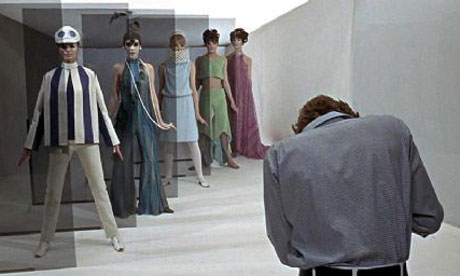
Some random comments:  There’s a frequent use of video insets.  Happenings employs the handheld background used famously in the Danish The Five Obstructions (see photo below).  Even by Hollywood standards, the actresses were merely ornamental.

Happenings isn’t about a conventional narrative, so what’s going on here? Writer/director/actor/cinematographer/co-editor/actor Arya Ghavamian says that the theme is the oppression which he felt in his boyhood Iran and continues to feel in American society, a feeling he describes as “consistent paranoia”.  Hmmm.

Here’s my ambivalence:  With its humor, vivid imagery and driving music, Happenings almost worked for me as eye candy.  But the clash between the smirking characters and the images of real atrocities seemed exploitative, and it put me off.  Now, if you buy into Ghavamian’s explicit intention – a contemplation of oppression – the atrocity shots are justified, but I didn’t find that message coherent, nor did I think that it fit within the appealing overall slyness of the film.  But, with the exception of a couple sketches that ran on too long and some moments that were annoying or offensive, I found it pretty entertaining.

Happenings of the Eighth Day is a VERY low-budget film, and its sound is particularly bad and its editing is particularly good.

I saw Happenings of the Eighth Day at its World Premiere at Cinequest in the San Jose Repertory Theatre and, I’ve got to say, no premiere in the history of cinema could have been any closer to its filming locations.  The San Jose Rep is on the Paseo de San Antonio and 75% of the movie’s exteriors were shot along the Paseo from the Cesar Chavez fountains and the Fairmont Hotel past the Post Office to The Movie Gourmet’s own personal bench between Philz Coffee and the Tangerine salon. A former Philz barrista even appears in the film.

happenings2


Movies to See Right Now

Cinequest hit HUNTING ELEPHANTS

I’m a little behind on seeing the most recent movie openings because, as usual, I’ve been so consumed by San Jose’s Cinequest film festival. You can find my comments on 20 Cinequest films at my CINEQUEST 2014 page. Remember that Encore Day – in which Cinequest reprises its most popular films – is this Sunday.

Anyway, the promising newer films that I HAVEN’T yet seen are The Grand Budapest Hotel and Tim’s Vermeer.  Still in theaters are:

  • the gloriously entertaining American Hustle;
  • superb filmmaking and a great Sandra Bullock performance in Gravity;
  • the Oscar-winning 12 Years a Slave, a good film that I do NOT recommend; and
  • the Chilean drama Gloria about an especially resilient 58-year-old woman.

My DVD of the week is Nebraska, which made my Best Movies of 2013.  Nebraska is available on DVD from Netflix and Redbox and streaming from Amazon Instant, iTunes, Vudu, YouTube, Google Play and XBOX Video.

On Monday, Turner Classic Movies is showing the 1970’s nugget The Outfit, which I’ll be profiling tomorrow.  On the 21st, TCM will show perhaps Paul Newman’s most charismatic performance in Cool Hand Luke.