LISTEN TO ME MARLON: the pain and the truth in his own words

LISTEN TO ME MARLON
LISTEN TO ME MARLON

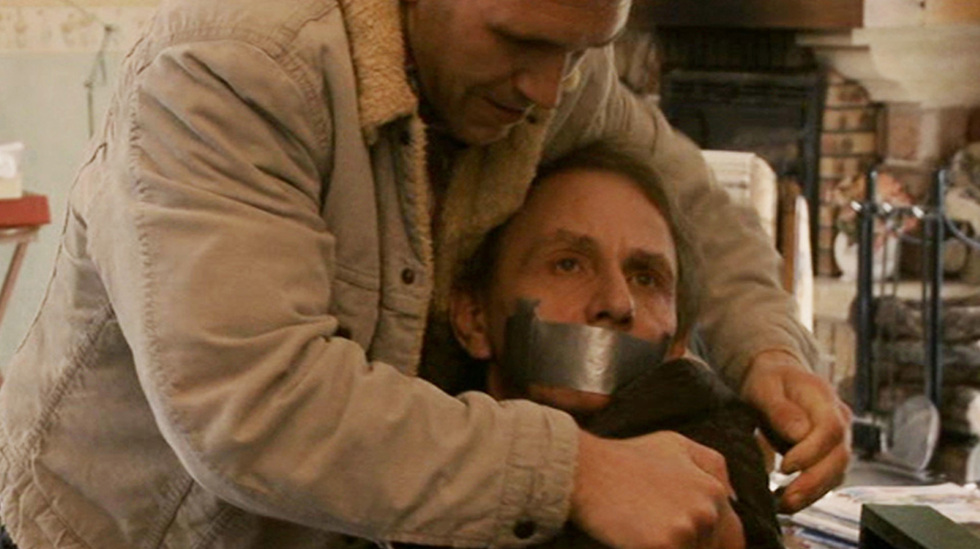
In the documentary Listen to Me Marlon, we hear Marlon Brando relate his life story in his own words – and we ONLY hear Brando’s words. Director Stevan Riley received access to hundreds of hours of audio tapes – self-recording made by Brando while he was alone – and never heard until now. These recordings, along with recorded Brando interviews and clips, are artfully assembled by Riley, and, together, amount to a deep and apparently truthful self-portrait.

Brando was playful and mischievous and often self-important, and the content of his interviews with journalists aren’t that reliable. But it’s clear that he isn’t BSing in these solitary recordings. He is open about his character flaws and their origin in his family background – a brute of a father and a sweet but erratic alcoholic mother.

Speaking in the third person, Brando describes himself as “a troubled man alone…confused”. Listen to Me Marlon is filled with nuggets:

  • On his upbringing: “My father is never going to come near that child (his first son Christian) because of what he did to me”.
  • On his art: “you want to stop that motion from the popcorn to the mouth. The Truth will do that.”
  • On the womanizing that broke up his first marriage “The beast aspect of my personality held sway”.
  • On the execrable Candy: “the worst movie I ever made” (drawing knowing chuckles from the audience).

Some of the tapes even record self-hypnosis as he battles obesity. And there’s a VERY COOL digitized talking Brando head, swirling around in blue pixels as he expounds.

There are also two outtakes where we SEE Brando’s womanizing in action as he comes on to attractive interviewers. We can recognize the instant that, as he says, he starts “thinking with his penis” and launches his flirtatious charm.

I saw Listen to Me Marlon at the San Francisco International Film Festival, where it will screen again this week. Director Riley spoke at the screening, as did noted film historian David Thomson and Brando’s children, Rebecca Brando and Miko Brando.

Rebecca Brando credits Riley for the film’s “humanity” as it treats Brando’s “childhood pain”. Miko Brando pointed out that the flashing lights in some clips came from the bio-feedback machine that Brando used at night. “He went to work as a movie star and came home – not a movie star – just a father”, said Miko, who had just seen the film for the second time.

David Thomson spoke of Brando’s “momentous” and truthful Method as the birth of “genuinely American approach to acting” and its effect on cinema: “the method is made for the close-up” because “if you are agonizing over what to say”, the audience needs to be close enough to see it.

Stevan Riley made the most of his access to the tapes – it’s a masterful job of selection and editing.   Listen to Me Marlon opens tomorrow in theaters, and I expect it to eventually play on Showtime.

DVD/Stream of the Week: THE SECRET IN THEIR EYES – see the real Oscar winner before the Hollywood version

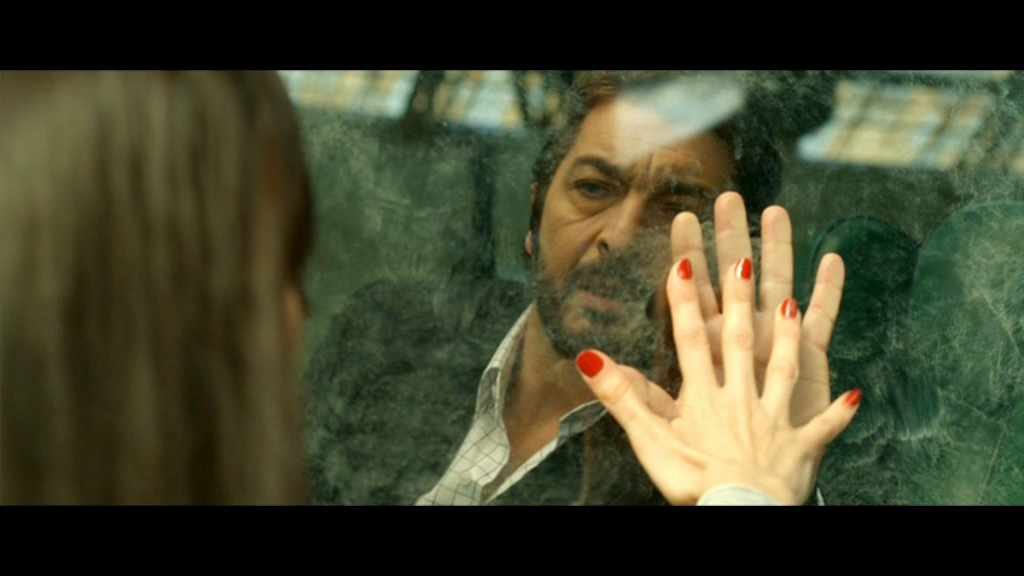
Ricardo Darin in THE SECRET IN THEIR EYES

The superb The Secret in Their Eyes (El Secreto de Sus Ojos) won the 2010 Oscar for Best Foreign Language Picture. The Hollywood remake is coming out this fall, but you should first see the original. The Secret in Their Eyes is a police procedural set in Argentina with two breathtaking plot twists, original characters, a mature romance and one breathtaking, “how did they do it?” shot. The story centers on a murder in Argentina’s politically turbulent 1970s, but most of the story takes place twenty years later when a retired cop revisits the murder.

Veteran Argentine actor Ricardo Darin shines once again in a Joe Mantegna-type role. Darin leads an excellent cast, including Guillermo Francella, who brings alive the character of Darin’s drunk assistant. Darin’s detective is a solitary guy who retracts into his lair to bang away at a novel. He has feelings for his boss, a tough judge played by Soledad Villamil. Her career and her personal life can’t wait for the detective to get his own stuff together. All three characters throw themselves into solving the murder and, when stymied, are all scarred by the lack of resolution.

The movie is titled after one element that I hadn’t seen before in a crime movie.  And then there are the major plot twists.  The final one is a jaw-dropper.

Director Juan Jose Campanella received justifiable praise for the amazing shot of a police search in a filled and frenzied soccer stadium. It ranks as one of the great single shots of extremely long duration, right up there with the opening sequence of Touch of Evil, the kitchen entrance in Goodfellas and the battle scene in Children of Men. This shot alone makes watching the movie worthwhile.

Filmmaker Billy Ray has remade the Argentine film as Secret in Their Eyes, to be released October 23 starring Nicole Kidman, Julia Roberts and Chiwetelu Ejiofor. Ray is no hack – he’s adapted the screenplays for Shattered Glass (which he also directed), Captain Phillips and the first The Hunger Games. The plot has been turned into a story about thee US federal law enforcement officials and the murder of one of their children; unfortunately, the trailer looks more like a plot-driven Law & Order, with none of the characters as singular or as memorable as in the Argentine original. We shall see.

The Secret in Their Eyes is high on my Best Movies of 2010. It’s available on DVD from Netflix and streaming from Amazon Instant Video, iTunes, Vudu, YouTube, Google Play, Xbox Video and Flixster.

TRAINWRECK: some raunchy laughs and a surprisingly good LeBron James

Amy Schumer and LeBron James in TRAINWRECK

The comedienne (do we still use that word?) Amy Schumer stars in the bawdy comedy Trainwreck as a gal whose childhood trust and intimacy issues have resulted in a chaotic adult life of wall-banging and random guy-banging.  She gives promiscuity a bad name.  When she finally happens on the perfect guy (Bill Hader), will she sabotage this opportunity?  Schumer herself wrote Trainwreck, which was directed by the current king of lowbrow comedy Judd Apatow.

Trainwreck has plenty of LOL moments, and even some shoulder-quaking laughs.  But it’s two hours long, and that’s too long to sustain the basic jokes here.  Trainwreck has jumped the shark before we get to an improbable celebrity intervention and the Madison Square Garden grand finale.

There are some glimpses of comedic genius here and there, including a brilliant take on the all-night male-female argument – the kind where the woman is amped up in a full-throttle rage and the man keeps fighting to stay awake.  Both men and women in the audience were laughing knowingly.

Trainwreck does benefit from a superb cast.  I always love to see Hader and Brie Larson (good but wasted here).  Tilda Swinton bops in for a turn as a supremely confident and self-absorbed boss.  Pro wrestler John Cena is very good as the first boyfriend, a bodybuilder with some denial issues of his own.  And Daniel Radcliffe and Marisa Tomei are very funny in a profoundly bad movie-within-the-movie.

But the real revelation here is LeBron James,who is playing himself as best friend of Hader’s character, an orthopedic surgeon.  LeBron is very, very good – just as good as the real actors.  He has an excellent sense of timing and a lot of natural appeal.  There aren’t that many movie roles for 6-foot 8-inch black men, but LeBron can definitely act.  He’s consistently a joy to watch in Trainwreck.

Amy Schumer delivers a lot of raunchy laughs in Trainwreck, just not two hours worth.  It’s definitely not a really good movie, but it will offer an evening of light laughs on home video.

THE END OF THE TOUR: the filmmakers speak

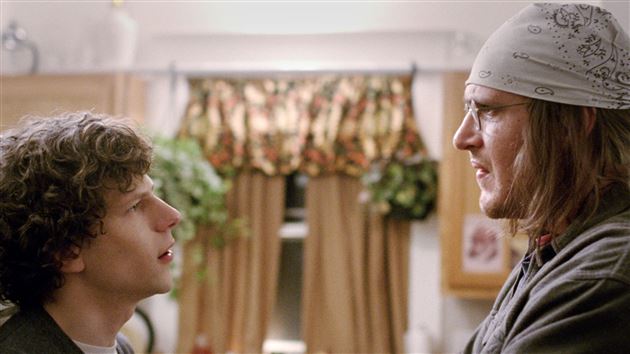
Jesse Eisenberg and Jason Segel in THE END OF THE TOUR

[SPOILER ALERT: There spoilers in this post, but – as usual – NOT in my comments on the film.]

I saw The End of the Tour at the San Francisco International Film Festival.  Director James Ponsoldt, Producer David Kanter, editor Darrin Navarro, Producer James Dahl and actor Jason Segel all spoke after the screening.

Ponsoldt said that he generally doesn’t like biopics, and didn’t want to make a film that exists “from the neck up”.  He wanted to avoid a movie that was ” just two smart guys trying to top each other”.

Ponsoldt decribed The End of the Tour as an “unrequited platonic love story, from the perspective of Lipsky”  The moment at the end when Lipsky receives a package from Wallace tells it all.  Ponsoldt said that the Rolling Stone article was killed because it wasn’t juicy enough – and Lipsky felt relieved.

Ponsoldt got access to Lipsky’s tapes of the real conversations between the two, and Eisenberg and Segel got to listen to them.  Segel noted that “popular culture was the great equalizer”, the common denominator between the two.

And how do you make a compelling movie about two guys talking? Ponsoldt adopts Waldo Salt’s guidance about screenwriting: articulate the character’s greatest human need and recognize whose story it is it? Ask if it’s a struggle for power.  Focus on whose scene it is.

Navarro said the key is to allow the conversations to feel as real as possible, making it feel like you were in the room.  He lets the “inconsistencies and inaccuracies of speech” let you know about where the characters are going.

Jason Segel sees playing David Foster Wallace as about Wallace’s feeling of “not enough”.  Segel believes that Wallace’s Infinite Jest poses question “does anyone else feel this way?” and Segel says that sometimes he DOES feel that way.

Jason Segel said that the tapes constitute the “best conversation I’ve ever heard”.  The End of the Tour is the best movie about conversation that I’ve seen.


THE GO-GO BOYS: THE INSIDE STORY OF CANNON FILMS: an improbable, wild ride

The Go-Go Boys: The Inside Story of Cannon Films

The two Israeli filmmakers Menahem Golan and Yoram Globus had a very wild ride, and the documentary The Go-Go Boys: The Inside Story of Cannon Films is their improbable story.  Golan began as a director of Israeli films and his cousin Globus (twelve years younger) became his partner; Golan was the idea man and hands-on producer and Globus secured the financing and handled the business deals.  Together, they produced over 150 movies.

In the early 1960s, they were very successful in Israel, producing many Israeli hits, including the Oscar-nominated Sallah, which won the Golden Globe.  Ambitious, they moved to Hollywood and set up shop with a Roger Cormanesque business model – make lots of cheap exploitation movies.  They hurtled to the top of the action movie genre with movies like Death Wish II, American Ninja and The Delta Force.  Along the way, they introduced us to movie ninjas, Claude Van Dam and Chuck Norris.  The Cannon Group’s signature was the simple revenge story, adorned by naked breasts and vivid explosions.  Soon the Cannon Group was making more movies each year than all the Hollywood major studios combined.

What happened? As Icarus, the ever-aspirational Golan began to seek more mainstream credibility by producing art films and big-budget Hollywood fare.  Cannon paid Sylvester Stallone twice his usual fee to star in their arm wrestling movie Over the Top.  Generally, when a company abandons its tried and true business model…Well, you can guess what happened.

I saw The Go-Go Boys: The Inside Story of Cannon Films at the San Francisco Jewish Film Festival.  It doesn’t yet have an US theatrical release date, but I’ll try to let you all know when it’s in theaters or available on DVD or streaming.  Be sure to keep watching The Go-Go Boys right through the ending credits.

Movies to See Right Now

Jesse Eisenberg and Jason Segel in THE END OF THE TOUR

The End of the Tour is the smartest road trip movie ever, starring Jason Segel and Jesse Eisenberg. It opens today, but it may be hard to find for two more weeks.

Also out today, the chilling and powerful documentary The Look of Silence is not for everyone, but it’s on my Best Movies of 2015 – So Far . It’s unsettling, but it’s an unforgettable movie experience.

I really liked Amy, the emotionally affecting and thought-provoking documentary on Amy Winehouse. In Mr. Holmes, Ian McKellen is superb as the aged Sherlock Holmes, re-opening his final case.

The coming of age comedy Dope is a nice little movie that trashes stereotypes. This summer’s animated Pixar blockbuster Inside Out is very smart, but a little preachy, often very sad and underwhelming. The Melissa McCarthy spy spoof Spy is a very funny diversion.

In case you missed it, I recently wrote about the BBC’s list of 100 greatest American films and why I cancelled my Netflix DVD service.

Could a sane man devise a con this successful? That’s the question posed by my DVD/Stream of the Week, the documentary Art and Craft. It’s available on DVD from Netflix and streaming on Amazon Instant Video, iTunes, Vudu, YouTube, Google Play and Xbox Video.

Tonight is the final evening of Turner Classic Movies wonderful Summer of Darkness series of film noir. I particularly like Beyond a Reasonable Doubt and While the City Sleeps, one of my Overlooked Noir. In Beyond a Reasonable Doubt, an anti-death penalty campaigner gets himself framed for a capital crime, but does too good a job – and then there’s a shocker of an ending. In While the City Sleeps, the noir cynicism is so deep that the GOOD GUY uses his girlfriend as bait for a serial killer.

Next, week on August 4, TCM plays the The Best Years of Our Lives, an exceptionally well-crafted, contemporary look at American society’s post WW II adaption to the challenges of peacetime. Justifiably won seven Oscars. Still a great and moving film.

Dana Andrews and Joan Fontaine in BEYOND A REASONABLE DOUBT

THE END OF THE TOUR: smartest road trip movie ever

Jesse Eisenberg and Jason Segel in THE END OF THE TOUR

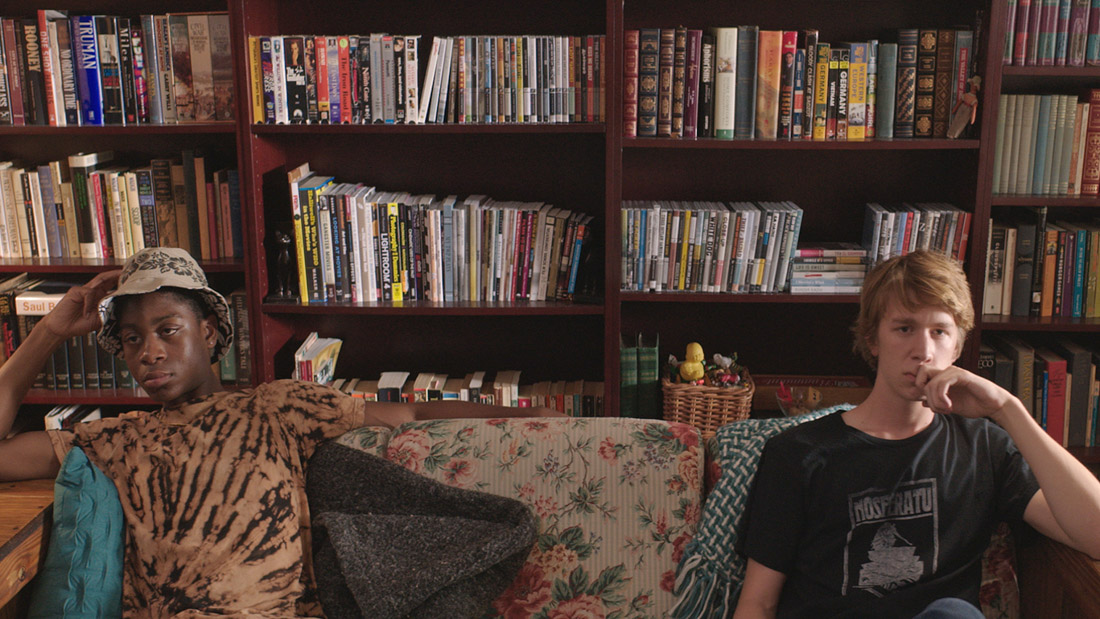
The brilliantly witty and insightful road trip movie The End of the Tour isn’t great because of what happens on the road – it’s great because we drill into two fascinating characters and see how their relationship evolves (or doesn’t evolve).  Leads Jason Segel and Jesse Eisenberg are both Oscar-worthy, and The End of the Tour is on my Best Movies of 2015 – So Far.

In 1996, David Lipsky (Jesse Eisenberg) is a novelist of modest success, having deeply embraced the New York City writer’s scene, and is supporting himself as a  journalist for Rolling Stone Magazine. Suddenly- and out of nowhere – David Foster Wallace (Jason Segel) explodes  on the scene with his masterpiece Infinite Jest and is immediately recognized as a literary genius.  Lipsky is confounded by Wallace’s meteoric rise – and jealous and resentful, too.

Lipsky arranges to accompany Wallace on the last few stops of his book tour and record their conversations, so Lipsky can write a profile of Wallace for Rolling Stone.  It’s clear that Lipsky plans to write a sensationalistic celebrity take down – and Wallace is so odd that there’s plenty of ammunition.

All of this REALLY HAPPENED.  Years later, after Wallace’s death, Lipsky wrote a memoir of the encounters, on which the movie is based.  Eisenberg and Segel got to listen to the tapes of the actual conversations between the two.

The End of the Tour is a battle of wits between two very smart but contrasting guys.    Wallace is new to fame, very personally awkward, not at all confident and gloriously goofy; he seems to be an innocent, but he’s VERY smart and not entirely naive.  Lipsky is all Chip On the Shoulder as he probes for Wallace’s weaknesses.  As different as they are, the two are competitive and snap back and forth, verbally jousting for the entire trip.  At one point, Lipsky accuses Wallace of pretending to be not as smart as he is as a “social strategy”.

As funny as is their repartee, it becomes clear that Wallace is inwardly troubled, and clinging to functionality by his fingernails.  Wallace gets more confident and begins to trust Lipsky, but Lipsky is still predatory, glimpsing into Wallace’s medicine cabinet and chatting up an old flame of Wallace’s.  Still, the intimacy of a road trip forces them to share experiences, which COULD become the basis for a bond.

They even share moments of friendship.  But will they become friends?  Is there real reciprocity between them?

Who has the power here? Wallace has the power of celebrity, and dominates Lipsky’s chosen vocation.  Lipsky has the power to destroy and humiliate Wallace.  Ultimately, as we see in the movie, the person who NEEDS the most will cede the power in the relationship.

Director James Ponsoldt has succeeded in making a brilliantly entertaining drama about two smart guys talking.  There’s never a slow moment.   We’re constantly wondering what is gonna happen.  Ponsoldt has already made two movies that I love – Smashed and The Spectacular Now. No one else has made conversation so compelling since the My Dinner with Andre, and The End of the Tour is much more accessible and fun than that 80s art house hit.

Ponsoldt fills the movie with sublime moments.  In one scene, we see the two watching a movie with two female companions.  In the darkened theater, two characters are focused on the screen and two are gazing at others.  It’s a shot of a couple of seconds, nothing happens, and there’s no dialogue – but the moment is almost a short story in and of itself.

For a true-life drama, The End of the Tour is very funny.  The humor stems from situations (the two rhapsodize on Alanis Morisette, of all people), behavior (Wallace’s peculiarities and Lipsky’s limitless snoopiness) and the very witty dialogue.  There’s a classic moment when Lipsky has Wallace talk on the phone to Lipsky’s wife (Anna Chlumsky) and is very uncomfortable with the results.

What is the funniest line in the movie?  Who wins the battle of wits?  And what’s their relationship at the end?  Those questions propel the audience along the smartest road trip movie ever – The End of the Tour.

THE LOOK OF SILENCE: chilling and powerful

THE LOOK OF SILENCE
THE LOOK OF SILENCE

In the powerful and chilling The Look of Silence, documentarian Joshua Oppenheimer explores the aftermath of genocide in a society that has never experienced a truth and reconciliation process. This is Oppenheimer’s second masterpiece on the Indonesian genocide of 1965-66 in which regime-sponsored death squads executed over one million suspected political opponents. Today, the victims’ families live among the murderers.

The Look of Silence centers on 44-year-old optometrist Adi, as he investigates the murder of Ramli, the older brother he never knew. Earlier, Oppenheimer had filmed Ramli’s killers as they describe and act out Ramli’s savage torture, mutilation and murder. They are unrepentant and even nostalgic about their crimes. Their matter-of-fact recollections are sickening. We see Adi watching this video, trying to contain his rage and disgust. Later, Adi – in the guise of fitting them for new glasses – is able to confront those responsible. He faces the actual machete-wielding killers, the leader of the village death squad, the higher-up who ordered the killings and even one of his own relatives.

What makes this bearable to watch (and even more affecting) is meeting Adi’s family: his earthy 80-something mother, his frail and batty 103-year-old father, his giggly 7-year old daughter and his 10-year-old son. There’s plenty of humor in this warm family. But in one scene, the son receives a ridiculously twisted propaganda version of the genocide in public school.

The “Silence” in The Look of Silence is reinforced by the spare soundtrack. We often hear only “crickets” (frogs, actually).

The Look of Silence is the companion to Oppenheimer’s The Act of Killing, which made my list of Best Movies of 2013. In The Act of Killing, Oppenheimer got the unapologetic killers to re-enact their atrocities for the camera – even relishing their deeds. The Act of Killing contains some of the most bizarre moments in any documentary EVER, including a cross-dressing mass murderer and a staged Bollywood-like musical number of Born Free, complete with dancing-girls in front of a waterfall, in which the garotted dead reappear to thank the killers for sending them on to the afterlife. The Act of Killing is more of a jaw-dropper. The Look of Silence – because it is more personal, is more powerful.

The Look of Silence stands alone – you can fully appreciate it without having seen The Act of Killing. But what I wrote about The Act of Killing is true for both films: “hypnotically compelling – you can’t believe what’s on the screen, can’t believe that you’re still watching it and can’t stop watching”.

I saw The Look of Silence at the San Francisco International Film Festival before its limited theatrical release slated for July 17. It’s one of the best films of 2015.

AN HONEST LIAR: deception and the deceived

AN HONEST LIAR
AN HONEST LIAR

The enjoyable documentary An Honest Liar tells the at times surprising story of magician James Randi – “The Amazing Randi”.  A staple of television talk shows for decades, Randi relished exposing and debunking fakirs who claimed that mere trickery constituted some supernatural power.

Randi became famous for hounding celebrity spoon-bender Uri Geller (and good sport Geller shows up in the movie).  I didn’t know that magic fan Johnny Carson had reached out to Randi before Geller’s appearance on The Tonight Show with satisfying results.

The Can’t Miss segment of this film is Randi’s elaborate unmasking of Peter Popov, the Christian “faith healer” – it’s priceless.

Finally, An Honest Liar takes a VERY unexpected turn when there turns out to be a deception at the heart of Randi’s own personal life.  This makes the movie’s ending especially heartfelt.

An Honest Liar is available streaming on Netflix Instant, Amazon Instant Video, iTunes, YouTube and Google Play.

DVD/Stream of the Week: ART AND CRAFT – could a sane man devise a con this successful?

ART AND CRAFT
ART AND CRAFT

The startling documentary Art and Craft is about an art fraud. Of prolific scale. And which is apparently legal. By a diagnosed schizophrenic.

We start with a guy named Mark Landis. He is very good at photocopying (!) great art works, applying paint to make them seem like the real thing, putting them in distressed frames and donating them to museums in the name of his late (and imaginary!) sister. He has done this hundreds of times, fooling scores of snooty museum curators in the process.

Why does he do this? Why can’t he stop? What’s with the imaginary sister? Those answers probably lie within his schizophrenia, a disease which doesn’t impair his skill or his cunning. Landis himself, once you get over his initial creepiness and become comfortable in his Southern gentility and wry mischievousness, is one of 2014’s most compelling movie characters.

Why doesn’t his fraud constitute a criminal act? Because he doesn’t profit from selling his fakes, he just gives them away. And he doesn’t take the tax write-off.

How come he doesn’t get caught? These are PHOTOCOPIES for krissakes! Those answers are in the self-interest and professional greed of the museum professionals – embodied by one puddle of mediocrity who becomes Landis’ obsessive Javert.

All of these combine to make Art and Craft one of the year’s most engaging documentaries. I saw Art and Craft at the San Francisco International Film Festival, where it was an audience hit.  Art and Craft is available on DVD from Netflix and streaming on Amazon Instant Video, iTunes, Vudu, YouTube, Google Play and Xbox Video.