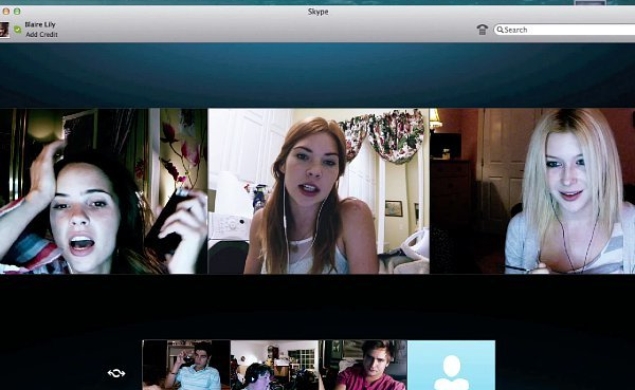
In the very satisfying horror film Unfriended, it’s the one-year anniversary of a teenage girl’s suicide, and her bullying peers convene via webcams on social media. But their computers are hijacked by an Unknown Force who starts wreaking revenge. The kids become annoyed, then worried and, finally, panicked for their lives.
Here’s something I’ve never seen before: the entire movie is compiled of the characters’ screenshots. The critic Christy Lemire says that “Unfriended is a gimmick with a ridiculous premise, but damned if it doesn’t work”, and she’s right. Writer Nelson Greaves and Director Levan Gabriadze came up with this device, and their originality pays off with a fun and effective movie. Unfriended is available to rent on DVD from Netflix and Redbox and streaming from Amazon Video, iTunes, Vudu, YouTube, Google Play and Flixster.
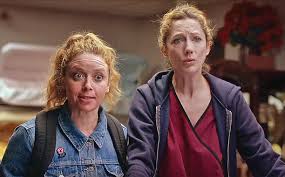
Natasha Lyonne and Judy Greer in ADDICTED TO FRESNO
In the limp comedy Addicted to Fresno, the appealing Natasha Lyonne (Slums of Beverly Hills, Orange Is the New Black) plays an inspirational, plays-by-the-rules Fresno hotel maid. She has taken in her wayward sister (Judy Greer), whose sex addiction has made her otherwise unemployable, and gotten her a similar job. Having just left Sex Addiction Rehab, the sister is supposed to be in recovery, but is far from it. Misadventures ensue.
The problem with Addicted to Fresno is that the screen-writing is mid-level sit-com, only much dirtier. I generally like sex comedies, but Addicted to Fresno is pretty much unwatchable.
Addicted to Fresnois (justifiably) hard to find in theaters and also streaming on Amazon iTunes and Vudu.
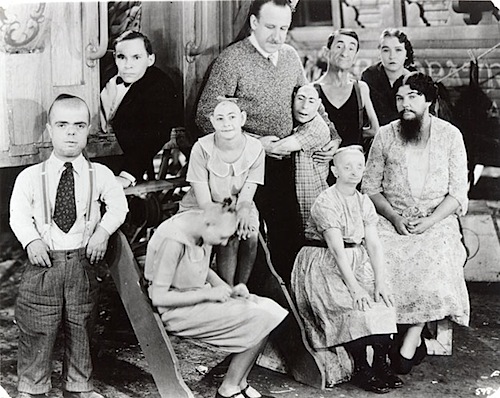
Bad things happen at the circus. And bad things happen in Freaks. This is one of the most unsettling horror films (and the least politically correct), because it was filmed in 1932 with real circus freaks. If you have teenagers jaded by today’s empty horror flicks, this will knock them for a loop. Only 64 minutes.
Freaks is often televised around Halloween. It’s available on DVD from Netflix and streaming from Amazon Instant Video, iTunes, Vudu, YouTube, Google Play, Xbox Video and Flixster.
The Martian – an entertaining Must See space adventure – even for folks who usually don’t enjoy science fiction;
Bridge of Spies – Steven Spielberg’s Cold War espionage thriller with Tom Hanks, featuring a fantastic performance by Mark Rylance.
Sicario – a dark and paranoid crime thriller about the drug wars.
Prophet’s Prey – a Showtime documentary about child sexual abuse in a polygamous religious cult.
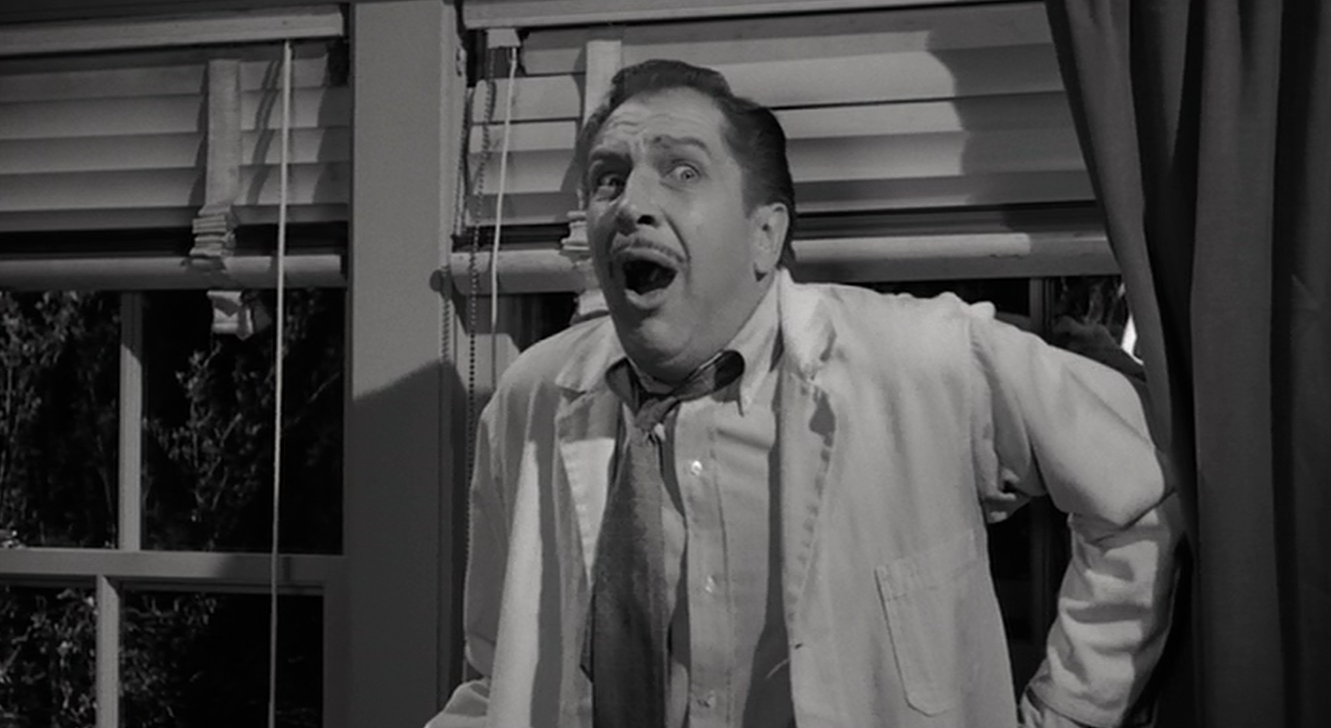
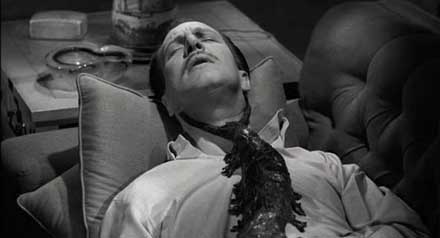
On Halloween, Turner Classic Movies is bringing us a campy Vincent Price horror classic from 1959, The Tingler. It has a scary premise – a parasite embedding itself in people’s spine and feeding on them – unaware until they feel a tingle AND THEN IT MAY BE TOO LATE!
You really haven’t sampled film noir if you haven’t seen Out of the Past (1947), and it’s coming up on Turner Classic Movies on November 5. Perhaps the model of a film noir hero, Robert Mitchum plays a guy who is cynical, strong, smart and resourceful – but still a sap for the femme fatale…played by the irresistible Jane Greer. Director Jacques Tourneur told Greer, ” First half of the movie – Good Girl; second half – Bad Girl.”
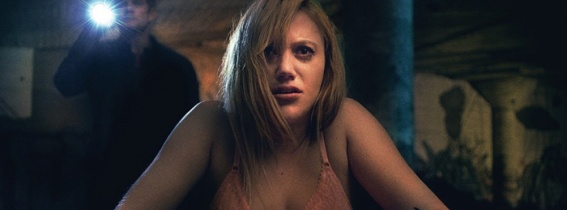
The Movie Gourmet doesn’t watch many horror movies, but I really liked the inventive, scary and non-gory It Follows. 19-year-old Jay (Maika Monroe) has sex with a guy who then tells her that he has passed on to her a kind of supernatural infection – a monster will follow her and kill her if she doesn’t pass it on to someone else. The monster shambles along at zombie speed and takes the form of a different human being each time. It’s terrifying – there’s a constant sense of dread and a convulsive shock every time It appears.
Writer-director David Robert Mitchell has created a very scary horror film with an excellent soundtrack and a minimum of makeup, special effects and hardly any blood. It’s even more frightening that she’s being stalked by something that usually looks normal.
Before the screening, I had to sit through several trailers from the horror genre. There was NOTHING in those trailers that I hadn’t seen before in The Shining, The Exorcist or a multitude of less elevated films. I have to note the contrast with It Follows, which is definitely something that you haven’t seen before.
The very talented actress Maika Monroe is almost always on-screen and she proves that she can carry a movie. I first noticed her in At Any Price , where she played the son ‘s girlfriend. That role was especially well-written – beginning as a simple teen from a broken family looking for some fun, her journey takes several surprising turn – and Monroe’s performance was memorable. Until fairly recently, Monroe was pursuing a professional career in freestyle kite surfing.
All the acting is good in It Follows, but Keir Gilchrist is especially good at portraying the ACHING sexual frustration of a teenage boy.
It Follows has a wonderful sense of place. It is set and was shot in the Detroit suburbs, the rural lakefront and the decaying inner city. The extraordinary High Lift Building in Detroit’s Water Works Park serves as the exterior for the climactic set piece.
But the key to It Follows is its originality – without expensive f/x or disgusting gore – it’s likely the best horror movie of the year. It Follows is available on DVD from both Netflix and Redbox and streaming from Amazon Instant Video, iTunes, Vudu, YouTube, Google Play and Xbox Video.
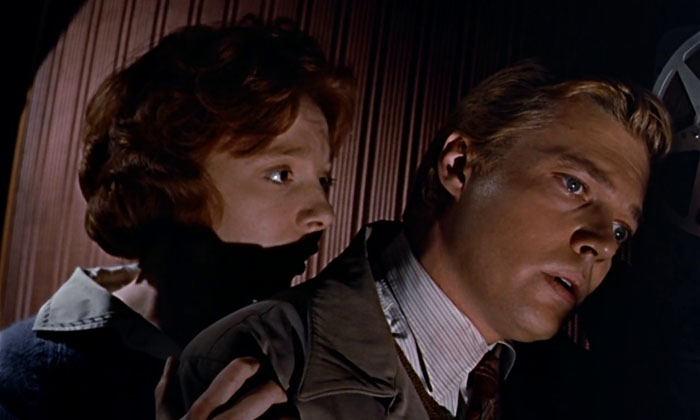
Here is the best-ever psycho serial killer movie. Peeping Tom was released in 1960, the same year as Psycho. The British film critics didn’t know what to make of a thriller where the protagonist was so disturbing, and they trashed Peeping Tom so badly that its great director Michael Powell (The Life and Death of Colonel Blimp, Stairway to Heaven, Black Narcissus, The Red Shoes) wasn’t able to work again in the UK. But I think Peeping Tom is an overlooked masterpiece and even better than its iconic counterpart Psycho.
Karlheinz Böhm plays a mild-mannered urban recluse who most people find socially awkward, but wouldn’t necessarily suspect to be a serial killer. The very innocent downstairs neighbor (Anna Massey) finds him dreamy and in need of saving – not a good choice.
Two aspects elevate Peeping Tom above the already high standards of Hitchcockian suspense. First, he’s not just a serial killer – he’s also shooting the murders as snuff films. Second, we see the killer watching home movies of his childhood – and we understand that ANYONE with his upbringing would be twisted; he’s a monster that repels us, but we understand him.
Until the last decade, Peeping Tom was unavailable, but you can find it now on DVD from Netflix and streaming from Amazon Instant Video, iTunes, YouTube, Google Play and Xbox Video. HIGHLY RECOMMENDED.
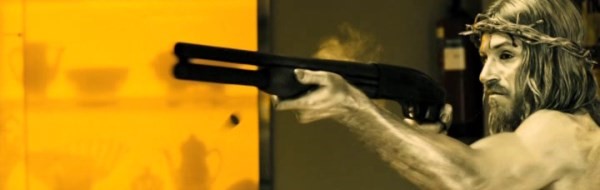
The rockin’ Witching and Bitching (Las brujas de Zugarramurdi), by Spanish cult director Alex de la Iglesia, features a gang of robbers – one is dressed as a silver Jesus on the cross and another as a Green Army Guy – on the lam rocketing into an occult nightmare. They run smack dab into a coven of witches – the full-out Macbeth-stir-the-cauldron kind of witches. This film has the feel of an early Almodovar madcap comedy – if Almodovar were into goth horror. It’s all rapid-pulsed fun – and surprisingly smart.
The underlying theme is misogyny. The male characters grouse about the stereotypical complaints about women – all while themselves exemplifying the worst of the stereotypical male flaws. For example, one guy complains that his ex won’t consent to joint custody on the grounds of his irresponsibility – yet he brings their seven-year-old along on an armed robbery. One underlying joke is that the men see women as bitches, but it’s the men who spend the whole movie bitching. Another is that the men become trapped by REAL witches whose ball busting far exceeds the men’s most negative misogynistic fantasies.
These Spanish actors are wonderful, including the great Carmen Maura (Almodovar’s Women on the Verge of a Nervous Breakdown and Volver) and appropriately named hottie Carolina Bang. They’re very adept at the deadpan delivery of lines like this:
Driver: This village is damned. They hold witches sabbaths.
Boy: What’s that?
Robber: Like a kegger but medieval.
De la Iglesia maintains a deliciously frantic pace throughout. The final orgiastic ritual goes on a long time but maintains audience engagement.
This was the first de la Iglesia movie that I’d seen, but I’m definitely going to check out more of his work. Speaking of which, he nicely sets up a sequel. But go ahead and watch Witching and Bitching now – streaming in Amazon Instant, iTunes and Xbox Video.
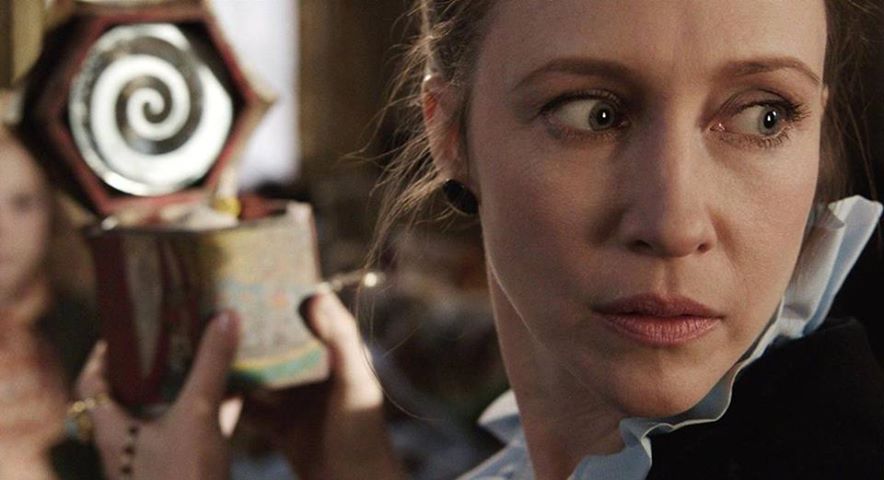
Just right for Halloween week, the satisfying shocker The Conjuring begins in a familiar way. In 1971, a couple (Ron Livingston and Lili Taylor) moves into an old, isolated farmhouse with their five daughters. The youngest kid finds a creepy old music box, the dog refuses to come inside the house, all the clocks stop at 3:07 AM, the house is always chilly and there’s a boarded-up cellar. If you’ve ever seen a scary movie, you know that THIS HOUSE IS HAUNTED. Soon, the family desperately seeks the help of husband and wife ghostbusters (Vera Farmiga and Patrick Wilson).
Interestingly, the story is based on a real occurrence. The real ghost experts soon afterward took on the notorious house in Amityville, Long Island.
What makes The Conjuring work so well? First, the performances of Vera Farmiga and Lili Taylor elevate the material. Each is gifted with the capacity to mix passion, inner strength and fragility.
Director James Wan superbly paces the action, letting our sense of dread build and build until we jump in our seats. He uses a handheld (but not jumpy) camera to provide cool angles and a point of view that helps us relate to the characters.
And there is no gore. There are a few scary images, but The Conjuring relies on good, old-fashioned surprises and our discomfort with the occult to supply the fright.
The Conjuring is available on DVD from Netflix and Redbox and streaming from Amazon Instant Video, iTunes, Vudu, YouTube, Google Play, Xbox Video and Flixster.
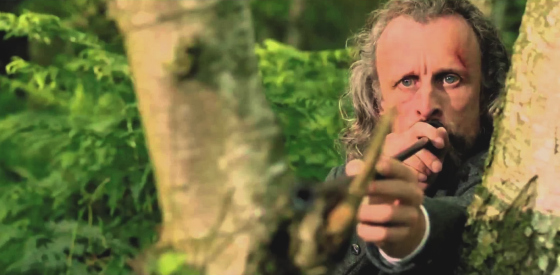
Technically, the Dutch thriller Borgman is a horror film, but it’s horror for adults, without the gore and with lots of wit. The shock doesn’t come from monsters unexpectedly lurching out of nowhere. The entertainment comes from the OMG moments of the “don’t ask the weird guy into your house!” and “don’t let the sinister guys watch your kids!” variety.
The setting is the architecturally striking and well-tended home of an affluent Dutch family and their Danish nanny. The husband is an aggro corporate schemer who is a real scumbag – selfish, racist and chauvinistic, with the capacity for a violent rage. His wife Marina is repressed and neurotic. But they are highly functional until a homeless guy, Camiel Borgman, happens by and circumstances compel them to put him up. Borgman feels entitled to more and more outrageous impositions – and soon it’s apparent that he’s even more sinister than he is obnoxious.
What if Charles Manson wasn’t a drug addled hoodlum and instead used his deranged charisma with remarkable skill? Borgman leads a crew of normal looking but murderous henchmen, who operate with the ruthless efficiency of Navy Seals. (Watch for the scar near the younger woman’s shoulder-blade.) Vaguely gifted with mind control, he can apparently create dreams by squatting naked gargoyle-like above Marina while she slumbers with her husband. There is violence aplenty, but it tends to come through a bonk on the head or some poison in a glass.
Dark comedy stems from the matter-of-factness of the murders and body disposal (as in tossing corpses into a lake and then diving in for a relaxing swim). Every once in a while, there’s a hilariously sinister moment, like the supremely random appearance of some whippets that seem more like hellhounds.
The acting is uniformly excellent, including the kids, but Jan Bijvoet as Borgman and Hadewych Minis as Marina are stellar.
Some questions are never answered (who are those three guys at the beginning and why are they hunting the homeless guys?). Is this a cult or aliens or what? The audience needs to accept some ambiguity. But the overall story arc is clear – no good is going to come of these people once they meet Camiel Borgman and his friends.
There is a subtext here: is this family so bourgeois that it deserves its fate? Fortunately, this subtext isn’t as in-your-face as in some recent self-loathing Eurocrap like Happy Days or Finsterworld, so it’s not at all off-putting. But Borgman can be enjoyed without going there at all.
Borgman is superbly written and directed by Alex van Warmerdam, a 62-year-old Dutch actor with only a handful of writing and directing credits.
I don’t often recommend a horror movie, but I’m all in on Borgman. Take it from me – you haven’t seen this movie before, and it’s endlessly entertaining. Borgman is available on DVD from Netflix and streaming from Amazon, iTunes, Vudu, YouTube, Google Play and Xbox Video.
Just for Halloween, The Movie Gourmet is presenting a special SCARE WEEK. It’s all horror, all of the time. But even folks who normally avoid the horror genre will find someone to enjoy here. I don’t like Gore Horror, so there’s relatively little blood and guts in this international program. Here’s the lineup.
Monday: Borgman (2014 – Netherlands). This is horror for adults, without the gore and with lots of wit. Borgman is available on DVD from Netflix and streaming from Amazon, iTunes, Vudu, YouTube, Google Play and Xbox Video.
Tuesday: The Conjuring (2013 – US). Based on true events, The Conjuring scares without ANY gore. There are a few scary images, but The Conjuring relies on good, old-fashioned surprises and our discomfort with the occult to supply the fright. Women, in particular, who avoid this genre will relate to the performances of Vera Farmiga and Lili Taylor. The Conjuring is available on DVD from Netflix and Redbox and streaming from Amazon Instant Video, iTunes, Vudu, YouTube, Google Play, Xbox Video and Flixster.
Wednesday: Witching and Bitching(2014 – Spain). Witching and Bitching is a witty comment on misogyny inside a rockin’ horror spoof. Witching and Bitching is now streaming on Amazon Instant, iTunes and Xbox Video.
Thursday: Peeping Tom (1960 – UK). This is the best-ever psycho serial killer movie, better than its contemporary Psycho. It’s so scary and unsettling that it ruined the career of its storied director Michael Powell. It’s undoubtedly the best movie in The Movie Gourmet’s Scare Week program. You can also find it on DVD from Netflix and streaming from Amazon Instant Video, iTunes, YouTube, Google Play and Xbox Video.
Friday: It Follows (2015 – US). The key to It Follows is its originality – without expensive f/x or disgusting gore – it’s likely the best horror movie of this year. It Follows is available on DVD from both Netflix and Redbox and streaming from Amazon Instant Video, iTunes, Vudu, YouTube, Google Play and Xbox Video.
Also Friday: My Movies to See Right Now will include the ultra-campy The Tinglerwith Vincent Price.
Saturday: Freaks (1932 – UK) with real circus freaks. If you have teenagers jaded by today’s empty horror flicks, this will knock them for a loop. Only 64 minutes. Freaks is often televised around Halloween. It’s available on DVD from Netflix and streaming from Amazon Instant Video, iTunes, Vudu, YouTube, Google Play, Xbox Video and Flixster.
So enjoy – and don’t go alone into the darkened basement to investigate that strange sound!