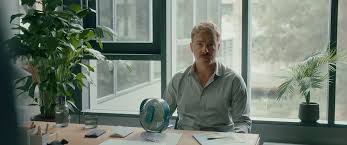
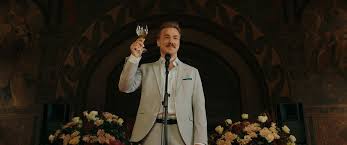
Photo caption: Albrecht Schuch in PEACOCK. Courtesy of Oscilloscope Laboratories.
In the droll and absurd comedy Peacock, Matthias (Albrecht Schuch of All Quiet on the Western Front) works in a most unusual companion service; he gets paid for jobs like masquerading as a client’s fictional partner. Matthias has so perfected being a chameleon that he has lost all sense of himself. This disquiets his wife and colleagues, and, when the vengeful ex-husband of a client terrorizes him, Mattias’ world starts to unravel.
Albrecht Schuch in PEACOCK. Courtesy of Oscilloscope Laboratories.
If you like Ruben Ostland’s work (Force Majeure, The Square, Triangle of Sadness), you’ll like Peacock. In fact, there’s a scene in Peacock that borrows A LOT from the chimp impersonator scene in The Square.
Austrian director Bernhard Wenger won a prize at Venice, where Peacock was also nominated for Best Film in the Critic’s Week.
I screened Peacock for NashFilm. It’s being shown at six Laemmle theaters in LA this Wednesday.
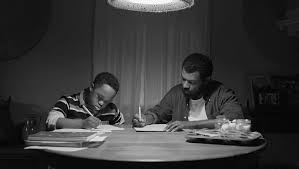
Photo caption: Jeremiah Daniels and William Catlett in COLOR BOOK. Courtesy of NashFilm.
NashFilm, the Nashville Film Festival, opens on Thursday, September 18 and runs through September 24 with its mix of indies, docs and international cinema, including world and North American premieres. I’ve highlighted the highest profile festival events, including Nicole Kidman’s personal appearance, in my NashFilm preview.
Today, I’m focusing on two indie Must Sees at NashFilm. One is an emerging writer-director’s first feature and the other reflects a resurgence from an indie filmmaking icon.
Color Book: After the sudden death of his wife, Lucky (William Catlett) is left to parent their son Mason (Jeremiah Daniels), who has Down syndrome. Now grieving and trying to make ends meet on a one income, Lucky faces the unrelenting struggles of single parenting – why does everything have to be so hard? Although he has a hard time asking for help, in many ways, Lucky is the ideal dad – affectionate, patient and consistent. Lucky wants to thrill Mason with his first major league baseball game, but the two get a bigger dose of Atlanta’s transit system than they would ever want. The journey is far more more meaningful than is the destination. Atlanta writer-director David Fortune has won eight festival awards in the US and France with his inaugural film. The black and white cinematography by Nikolaus Dummerer is exquisite. Without a hint of sentimentality, Color Book is authentic and endearing.
The Baltimorons: In this sweet and funny movie about second chances, a cracked tooth sends a guy to an emergency dentist; the misfortune of an impounded car launches the two of them into a raucous nighttime adventure through Baltimore that could result in romance. Cliff (Michael Strassner) is a floundering goof, a comedian who hasn’t performed during his months of new-found sobriety. In contrast, the highly functional dentist Didi (Liz Larsen) is personally reeling from her divorce, which has left her lonely and gashed a hole in her confidence. So, we have two talented people in moments of vulnerability and recovery. What happens is funny, but The Baltimorons succeeds because of its humanity – we really care about Cliff and Didi. The Baltimorons is the first film directed by indie film legend Jay Duplass since 2012. Festival audiences in Austin, Philadelphia and San Luis Obispo loved this film, which won the Best Narrative Feature Audience Award at SXSW. I expect The Baltimorons, after its theatrical run this fall, to become a word-of-mouth Holiday hit on the streaming platforms.
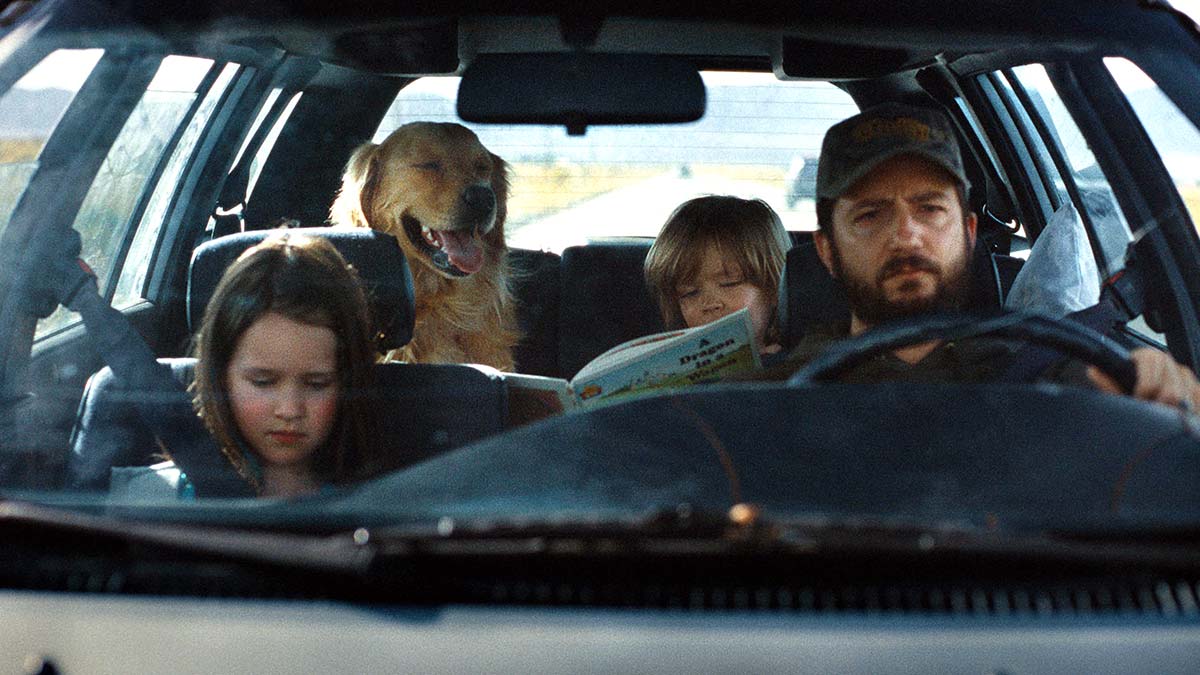
Molly Belle Wright, Wyatt Solis and John Magaro in OMAHA. Courtesy of NashFilm.
And here are two other indie discoveries in the NashFilm program.
Omaha: This concise, searing drama is a showcase for John Magaro (Past Lives), who stars as an especially devoted dad who has been financially ruined by his late wife’s final illness. His inability to provide for his kids has filled him with desperation and profound shame, but he is determined to insulate his kids from his stress. He bundles the two kids into his barely drivable car for a a road trip across the Great Basin toward Nebraska. The purpose of the road trip is mysterious, and even the whip-smart nine-year-old daughter can’t guess it. Omaha is the first feature for director Cole Webley, working off a screenplay from Richard Machoian (God Bless the Child, The Killing of Two Lovers). Webley has a gift for portraying those seemingly minor life moments that tell the audience so much about relationships and motivations. The emotionally powerful ending is shattering.
Peacock: In this droll and absurd comedy, Matthias (Albrecht Schuch of All Quiet on the Western Front) works in a most unusual companion service; he gets paid for jobs like masquerading as a client’s fictional partner. Matthias has so perfected being a chameleon that he has lost all sense of himself. When the vengeful ex-husband of a client terrorizes him, Mattias’ world starts to unravel. Austrian director Bernhard Wenger won a prize at Venice, where it was also nominated for Best Film in the Critic’s Week. If you like Ruben Ostland’s work (Force Majeure, The Square, Triangle of Sadness), you’ll like Peacock.
All in all, this year’s NashFilm presents 140 films from 30 countries. Peruse the program and get tickets. Here’s the trailer for Color Book.
Photo caption: Liz Larsen and Michael Strassner in THE BALTIMORONS. Courtesy of NashFilm.
The always exquisitely curated NashFilm, the Nashville Film Festival, opens on Thursday, September 18 and runs through September 24 with a diverse menu of cinema. The Nashville Film Festival is the oldest running film festival in the South (this is the 56th!) and is an Academy Award qualifying festival. The program includes a mix of indies, docs and international cinema, including world and North American premieres.
The most high profile events at NashFilm will be:
Opening night’s Man on the Run, the story of Paul McCartney’s life and career after the breakup of the Beatles, fresh off its world premiere two weeks ago at Telluride. Director Morgan Neville has delivered two of the very best recent biodocs (Won’t You Be My Neighbor?, Roadrunner: A Film about Anthony Bourdain).
Nicole Kidman will appear personally for Q&A and a special screening of Cold Mountain.
The centerpiece biodoc John Candy: I Like Me.
The closing night film, Kiss of the Spider Woman, starring Diego Luna, Tonatiuh and Jennifer Lopez.
Omaha, an indie drama starring John Magaro that garnered buzz at Sundance.
Rebuilding, another Sundance indie drama starring Josh O’Connor.
The Baltimorons, the first film directed by Jay Duplass since 2012, a sweet and funny film that won the Best Narrative Feature Audience Award at SXSW.
The Nashville Film Festival embraces its home in Music City with a strong program of music films. This year, NashFilm celebrates the beloved John Prine with You Got Gold. There’s also Finding Lucinda, a singer-songwriter’s road trip to explore the stories that formed the powerfully raw songs of Lucinda Williams. There are also documentary features on genre-buster Sun Ra, grunge icon Eddie Vedder, Gospel artist Carl Bean, emerging flamenco star Yerai Cortés and Christian rappers LeCrae and the 116 Clique. It’s hard to imagine a more diverse slate of music docs.
My favorite element of most NashFilm fests is the discovery of new auteurs with their ballyhooed first films. This year’s slate includes these first films:
Peacock: new Austrian director Bernhard Wenger won a prize at Venice, where his droll debut was also nominated for Best Film in the Critic’s Week.
Mad Bills to Pay: the Bronx’s Joel Alfonso Vargas was nominated for Best First Film at Berlin and won a NEXT Special Jury Award at Sundance
Color Book: Atlanta’s David Fortune has won eight festival awards in the US and France with his inaugural film.
Fucktoys: Nashville’s hometown girl Annapurna Sriram, who also stars, won a Special Jury award at SXSW with her first feature.
Slanted: Chinese-Australian filmmaker Amy Wang won the Grand Jury Prize at SXSW with her calling card.
All in all, this year’s NashFilm presents 140 films from 30 countries. Peruse the program and get tickets. I’ll be publishing my fest recommendations on September 16. Here’s the trailer for The Baltimorons.
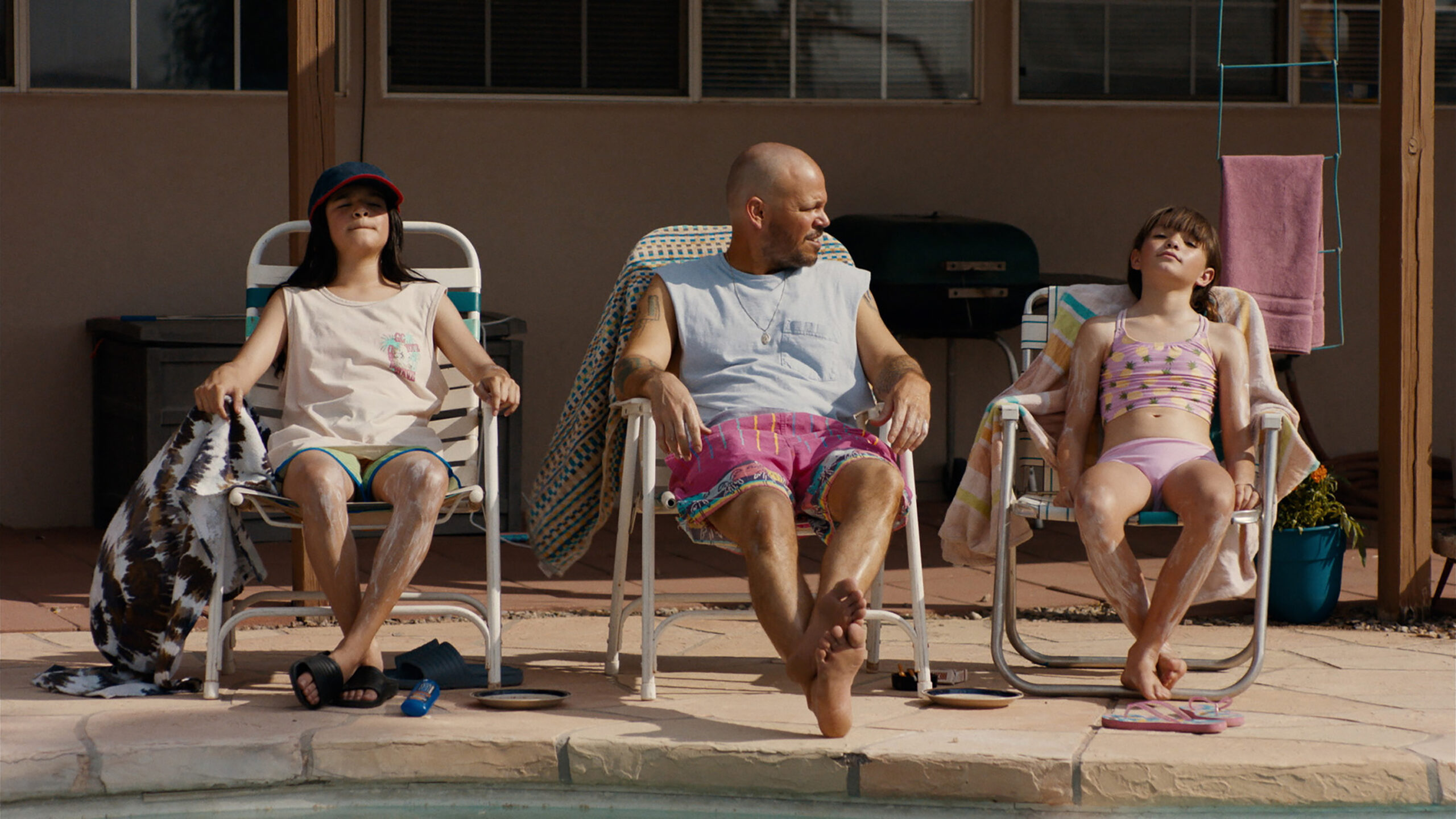
Photocaption: Rene Perez Joglar (center) in IN THE SUMMERS. Courtesy of NashFilm and Music Box Films.
In the remarkably authentic and evocative In the Summers, two sisters fly to Las Cruces, New Mexico, for annual summer visits with their divorced dad. The father, Vincente, played by Rene Perez Joglar (AKA the rapper Residente) is a spirited and talented underachiever who tries to show them a Disney Dad experience; the girls soak up the fun, but also absorb lessons about Vincente’s less reliable characteristics. Each summer, the girls return to Las Cruces with additional savvy and sponge up real world lessons from Vincente’s changing behavior.
The girls arrive expecting last year’s Vincente, but they get a new model, shaped by his changing circumstances and emotional needs, and reflecting how he sees himself. From year to year, Vincente bounces between unearned swagger to self-loathing distraction to an uneasy humility. It’s a compelling coming of age for the daughters.
Carmen (Emma Ramos), the bartender at the local pool hall, is the one consistent sounding board who can validate what the girls are experiencing with their dad.
Joglar’s performance, only his second acting role in a narrative feature and first lead, is remarkable. He is able to portray a character who is the same man at the core, but whose behavior each year is formed by the cumulative slings and arrows of his life.
The three sets of actors playing Violeta and Eva as they mature (Dreya Castillo and Luciana Eva Quinonez, Kimaya Thais and Allison Salinas, Sasha Calle and Lio Meliel) are excellent. So is Emma Ramos (New Amsterdam) as Carmen.
Writer-director Alessandra Lacorazza Samudio is able to convey so much narrative without spoon-feeding the audience. She positions the audience in the point of view of the watchful daughters, as they they to assess what is going on with their own father. She also gets fine performances out of actors with little or no movie experience. In the Summers is a triumphant debut feature for Lacorazza and marks the emergence of very promising filmmaker,
In the Summers made my list of Best Movies of 2024 after being my favorite film at last month’s Nashville Film Festival, and it’s streaming now on Amazon, AppleTV, YouTube and Fandango.
Photo caption: Frederika Milano and Gem Deger in ENDLESS SUMMER SYNDROME. Courtesy of NashFilm and Altered Innocence.
In the simmering French drama Endless Summer Syndrome, a professional couple and their two very attractive teenage kids are enjoying August, as upscale Parisians like to do, in a roomy, well-appointed country home. Their idyll is rocked when the mom is tipped off that the dad may be sexually involved with one of the adopted kids. She furtively investigates, trying to find out what is going on with whom. We know that there will be a reckoning once she finds out, but no one in the audience will guess the shattering ending.
First-time director and co-writer Kaveh Daneshmand keeps the tension roiling. All four actors give superb performances: Sophie Colon as the mom, Matheo Capelli as the dad, Frederika Milano as the daughter and Gem Deger as the son. Colon is especially effective, as the audience sees most of the developments (but not all) through her lens. I was surprised to learn that only one of the four actors (Capelli) has substantial film experience.
I screened Endless Summer Syndrome for the Nashville Film Festival. It releases into arthouse theaters this weekend.
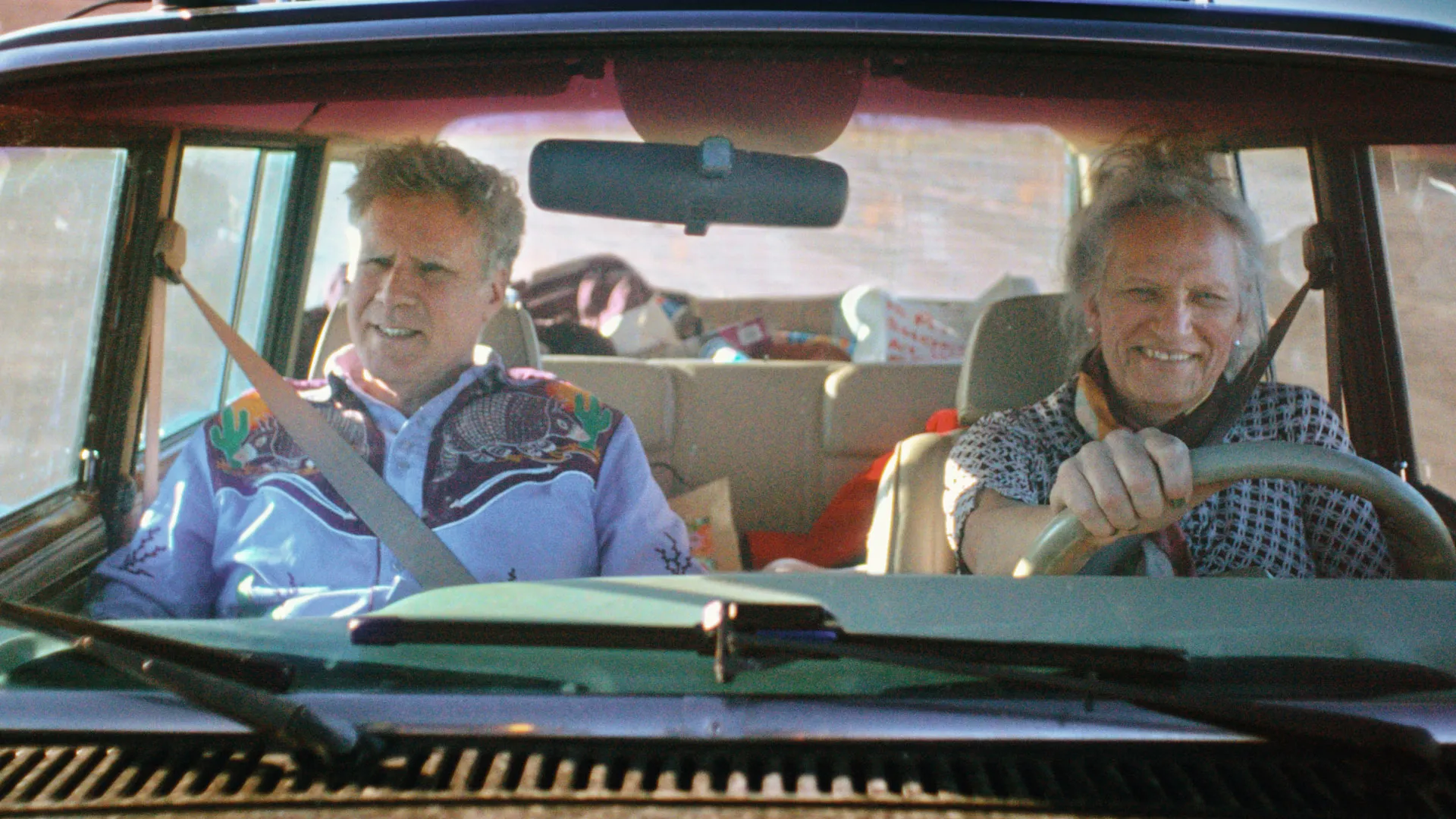
Will Ferrell and Harper Steele in WILL & HARPER. Courtesy of Netflix.
The always exquisitely curated Nashville Film Festival opens on Thursday, September 19 and runs through September 25 with a diverse menu of cinema. The Nashville Film Festival is the oldest running film festival in the South (this is the 55th!) and is an Academy Award qualifying festival. The program includes a mix of indies, docs and international cinema, including world and North American premieres.
Programming Director Lauren Thelen says, “I’m impressed, honored and excited to screen this year 150 films from 25 countries. I continue to be impressed by the diverse range of cinema out there, and I’m eager to see how our audience will react.”
I’ve sampled the program and, later this week, will recommend three films by new directors and an indie doc with 100% African-American voices.
One sure fire crowd-pleaser will be the Netflix doc Will & Harper, featuring a road trip by Will Farrell and his longtime friend, former SNL writer Harper Steele, who has transitioned.
See it here first: several films in the program have already secured distribution and will be available to theater and/or watch-at-home audiences. Before just anybody can watch them, you can get your personal preview at the Nashville Film Festival: Will& Harper, Bob Trevino Likes It, In the Summers, Exhibiting Forgiveness and Endless Summer Syndrome.
Check out the program and buy tickets at the festival’s Film Guide. Watch this space in a couple days for my NashFilm recommendations. Here’s the festival trailer.
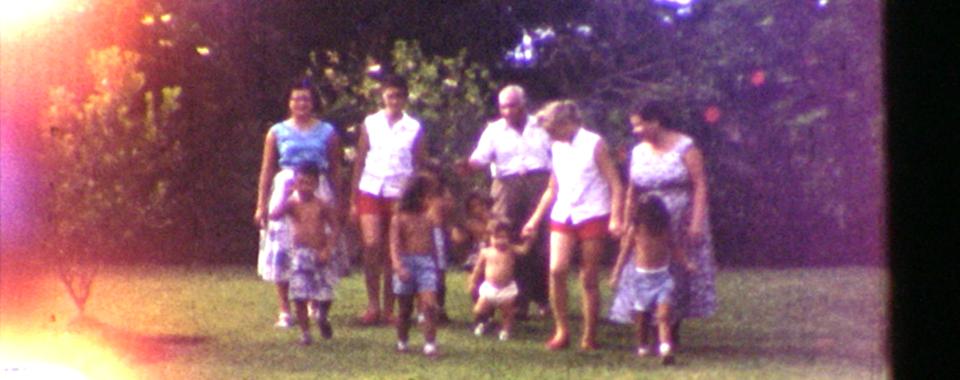
Photo caption: A scene from Tracey Arcabasso Smith’s RELATIVE. Courtesy of Gravitas.
Relative is filmmaker Tracey Arcabasso Smith’s reflective exploration of intergenerational sexual abuse in her own family. As Smith lovingly, but insistently, interviews her family members, she uncovers an epidemic of abuse in generation after generation. Relative becomes ever more powerful as Smith refuses to sensationalize, but stays centered on the strength and humanity of the women on camera. Finally, Relative takes us to how the cycle of abuse can be broken.
This is a brilliantly edited film (by Jeremy Stulberg, Ian Olds and Natasha Livia Motola) – first person testimonies are inter-cut with the home movies of a lively family – a family we now understand was stained with corrosive secrets.
Relative is the first feature for director Arcabasso Smith. (BTW the unadorned word Relative is a great title for this story.)
I screened Relative for the 2022 Nashville Film Festival. It’s now available to stream on Amazon (included with prime), AppleTV, Vudu and YouTube.
Photo caption: Carol Duarte and Josh O’Connor in LA CHIMERA. Courtesy of Neon.
The star of the Italian genre-shifter La Chimera is really its director, Alice Rohrwacher, with her inventive storytelling. Rohrwacher’s story does have a protagonist, Arthur (Josh O’Connor – the marriage-age Prince Charles in The Crown); when we meet him, he is grubby, weary and returning to a Tuscan village where his heart has been broken by a woman and where he has been betrayed by friends. We wonder what has drawn this Italian-speaking Englishman back to a place that hasn’t treated him well.
He shows up at the villa of Flora (Isabella Rossellini), the mother of his disappeared girlfriend, Beniamina. Flora adores him, and her new housekeeper/companion/voice student Italia (Carol Duarte) is quite taken by him. He is also welcomed by a rabble of village ne’er-do-wells, as rowdy and vibrant as Arthur is surly, and as course as Arthur is cultured.
It turns out that these vulgar roughnecks are tombaroli – nighttime robbers of ancient Etruscan graves, who then sell the artifacts to a more sophisticated fence, to be trafficked in the shady marketplace of antiquity dealers, collectors and ethically-challenged museums. It turns out that Arthur, who seems to know a lot about archaeology, has a gift in water-witching the locations of undiscovered tombs.
La Chimera, which has started out as a dramatic portrait of a man broken and alienated, becomes a heist procedural, and then a comic thriller, and a charming romance (as Italia gives Arthur “Italian lessons” in gestures, not vocabulary). There’s a sudden break in the fourth wall, a dream sequence with magical realism and even an homage to Mack Sennett. All the while, the tombaroli serve as a comic Greek chorus, right up to a neo-noir ending, dotted with yet more magical realism.
Here’s where La Chimera was a success for me. I always wanted to know what would happen next. I was continually surprised by the changes in tone. The Wife, however, thought that Rohrwacher threw in at least one genre too many.
But by bit, and rarely overtly, Rohrwacher unspools the mysteries of the backstory. Why is Arthur here? What happened to Beniamina? What is Arthur’s bond to these trashy scalliwags? Does Arthur have a professional training, a supernatural gift or both? By the end, we have a pretty good idea of the answers – well enough to make the story coherent without Rohrwacher spoonfeeding us all the exposition.
When I think about it, other than the novelty of the grave-robbing, the plot points are individually familiar – a bitter release from prison, heartbreak from losing a love, the heist, the noirish fatalism. What keeps us on our toes is the inventiveness in the film’s evolving tone.
However, my head was also more involved than my heart, probably because I cared about the the Flora and Italia characters so much more than I cared about Arthur.
The cast is very good, with Rossellini (what a treasure!) and Duarte as the standouts.
I appreciate a filmmaker who is always aware that she’s storytelling in cinema, instead of, for example, just filming a play. Rohrwacher takes full advantage of the opportunities to vary sequence, construction, and mood. La Chimera is a Must See for cinephiles.
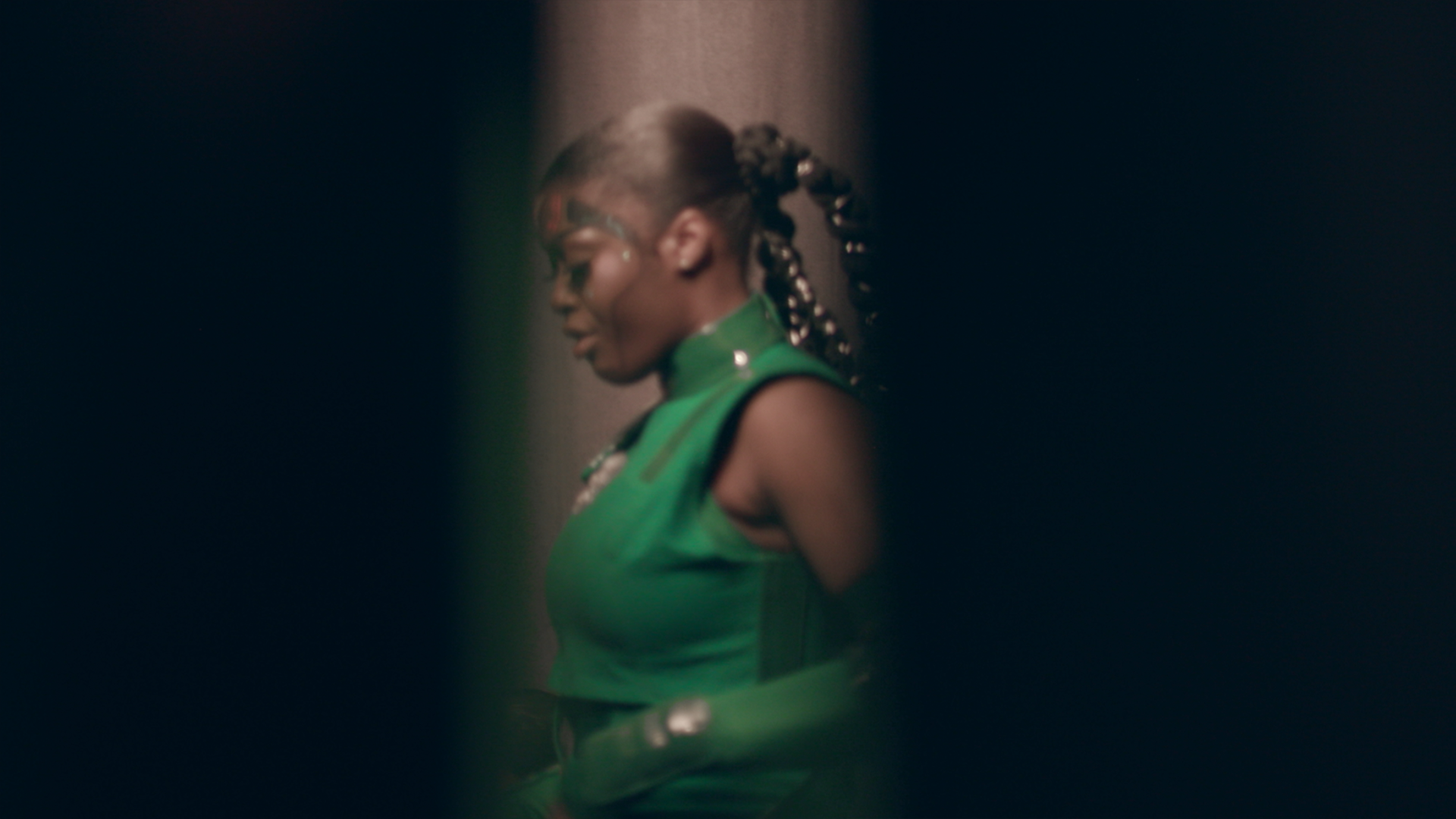
Photo caption: Tierra Whack in CYPHER. Courtesy of Hulu.
Filmmaker Chris Moukarbel toys with us in Cypher, an ingenious narrative in the form of a pseudo documentary about rapper Tierra Whack.
As in any music doc, we meet Whack (smart, genuine and naturally charming) and trace her artistic emergence. Whack’s real life team and Moukarbel’s real-life crew play themselves. Fifteen minutes in, they meet a fawning fan in a diner, an interesting woman who soon veers into conspiracy talk. Whack continues with a world tour, on the road to shooting a music video. Whack and Moukarbel are unsettled when secretly-filmed video of them shows up on social media. Moukarbel is hounded by the unbalanced daughter (Biona Bradley – perfect) of the woman in the diner. The intrusions become increasingly menacing, and are tied to the same conspiracy theory. Reeling, the film crew visits the daughter, but the threats only escalate, all the way to a showdown on a video shooting set.
It’s hard to tell when the story dips in and out of fiction, and this is definitely not a movie you’ve seen before. Cypher reminds us that we can enjoy and appreciate moies, even when we’re not sure what’s going on.
Shere Hite in THE DISAPPEARANCE OF SHERE HITE. Courtesy of IFC Films.
The Disappearance of Shere Hite: This film, a triumph for director Nicole Newnham (Crip Camp), explores the life and times of the groundbreaking sex researcher and best-selling author. A woman of uncommon confidence, determination and resourcefulness, Hite sailed into the face of the patriarchy. Denied resources and respect by the academic establishment, her guerilla research uncovered pivotal truths of female sexuality and spoke them for the first time. The resulting sensation brought fame, acclaim and notoriety to Hite, accompanied by both financial success and a vicious backlash. The persistence of that backlash, and its personal toll, caused Hite to essentially revoke her own celebrity. Hite did not suffer fools, and was fearless until she wasn’t.
We meet a slew of Hite’s intimates in this superbly sourced film and gain insight into her personality. Shere Hite speaks to us directly in file footage and in her writings, voiced by Dakota Johnson.
For those of us who were roaming the earth in the 1970s, it’s still jarring to see the cultural resistance to what we now accept as biological fact. For those experiencing this story for the first time, it’s astonishing and powerful. I understand that women under age forty-five, having missed Shere Hite’s moment of ubiquitous media presence, are responding strongly to this film.
I screened The Disappearance of Shere Hite for the Nashville Film Festival, and it topped my Must See at NashFilm. It opens in theaters this weekend.