THE MASTERMIND: when selfishness exceeds talent

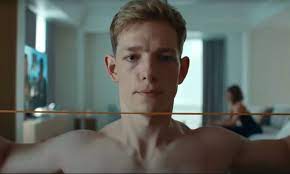
Photo caption: Josh O’Connor in THE MASTERMIND. Courtesy of MUBI.

In Kelly Reichardt’s dark comedy The Mastermind, a slacker steals valuable paintings from a museum in suburban New England in 1970. But The Mastermind is less of a heist film than a character study of a man with little character.

James Blaine Mooney (Josh O’Connor) is James to his wife and parents and J.B. to his friends. His guiding value is selfishness. With a degree in the arts, he is an occasional cabinet-maker who lets his hardworking wife (Alana Haim) support his family with a real job, while he sponges off his mom (Hope Davis). Instead of working, J.B. spends his time fantasizing how to make money without working. He lands on a scheme to rob the local art museum and fence the paintings.

He is smart enough to get the paintings out of the museum and hide the loot. But then his own character flaws begin to betray him. Having watched many crime movies, we all know that any criminal conspiracy is only as strong as its weakest link. But J.B. has employed three untrustworthy low lifes as crime partners. Of course, J.B. is too unreliable himself to recognize reliability in anyone else. And then The Mastermind follows J.B. as he tries to avoid the consequences of his choices – and his flight becomes a consequence in and of itself.

What makes this a comedy? The running joke is that J.B. never makes the responsible, prudent choice throughout the movie, always taking what he sees as the easy path, regardless of morality or loyalty.

Usually, a movie audience roots for the heist to be successful. Here, we don’t sympathize with the museum, which doesn’t value its collection enough to invest in even the most basic security. But we don’t care about J.B. either, because he is a shit who only needs the money so he doesn’t have to get a job. We do care about other people in J.B.s life, and he ruins the lives of his wife and family, puts at risk his dear friends and his own sons, fleeces his mother, and surely humiliates his father.

Josh O’Connor is very good as a man who never misses a chance to think only of himself. I would recommend another film with a heist element, La Chimera, where O’Connor plays a more complex character.

Fine actors all, Davis, Haim, Bill Camp, Gaby Hoffman and John Magaro are perfect in supporting roles. Hoffman is especially strong as an old friend who recognizes how dangerous J.B.’s affable charm really is. Davis has an inspired moment when she breaks a corn cob in half – and then quickly assesses which half has moire kernels,

Writer-director Reichardt is an acclaimed indie filmmaker who usually makes languorous, observational movies and gets excellent performances out of actors like Michele Williams, Lily Gladstone and Jared Harris. Her Wendy and Lucy is a masterpiece. There is more humor (the quiet, sly kind) and much, much more plot in The Mastermind than in Reichardt’s other works. I keep waiting for Reichardt to make another Wendy and Lucy, which is probably as unfair as waiting for Orson Welles to make another Citizen Kane.

Reichardt, who was only six years old in 1970, completely nails the verisimilitude of the time and place.

The very best thing about The Mastermind is the original music by Rob Mazurek, usually a solitary jazzy cornet or drums. The Mastermind is Mazurek’s first feature film score, but his Wikipedia page details an impressive and varied career as a musical artist.

Bottom line: The Mastermind is an exceptionally well-made film about a guy who we wouldn’t like to know in real life, but who ultimately gets his just desserts.
CHALLENGERS: three people and their desire

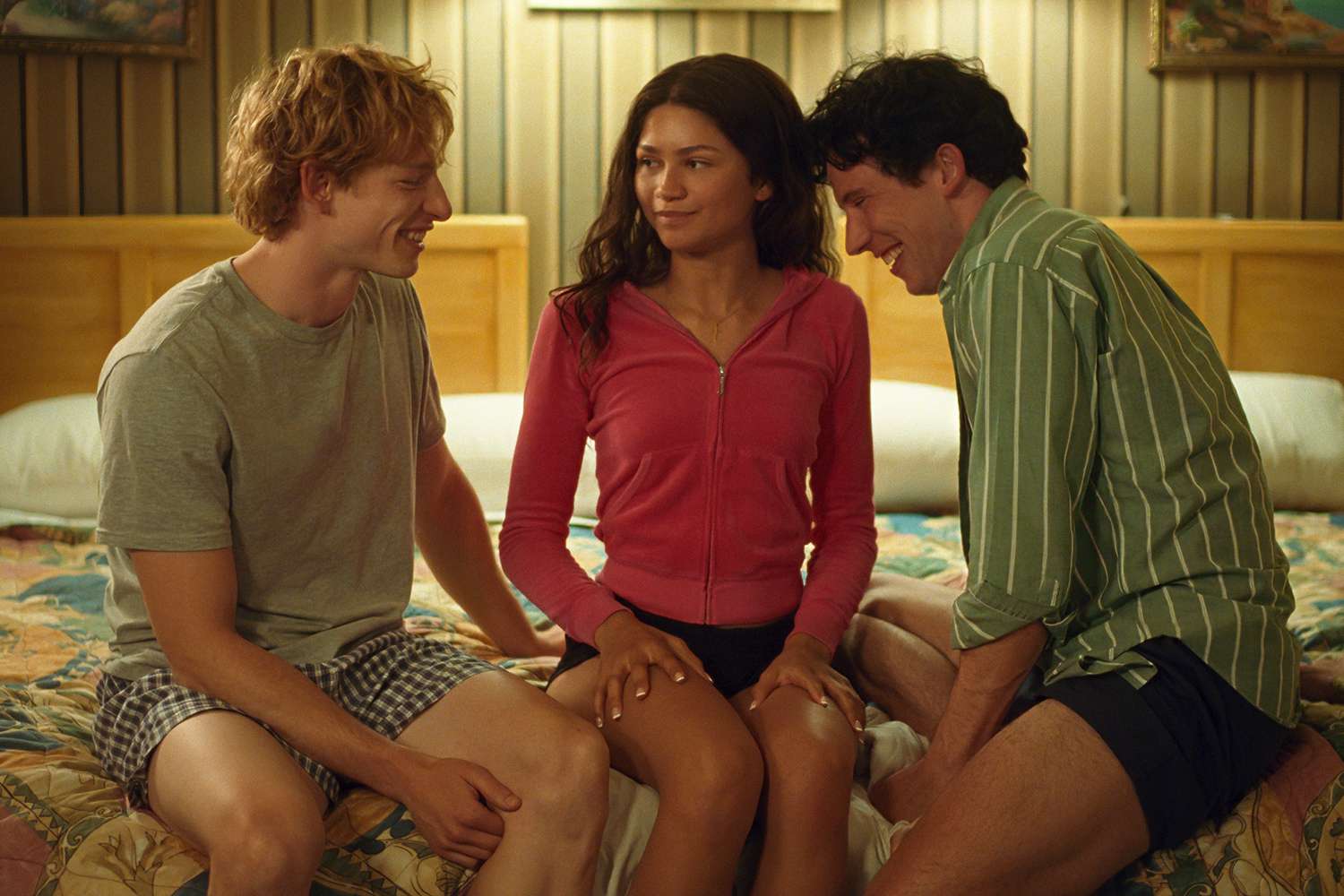
Photo caption: Bill Faist, Zendaya and Josh O’Connor in CHALLENGERS. Courtesy of MGM.

Challengers is an absorbing and entertaining set of character studies, wrapped in a love triangle and set in the world of tennis.  Anything but a conventional sports movie, Challengers is remarkably insightful about what it takes to be successful in any competitive endeavor. Director Luca Guadagnino tells his story of three people over 13 years, flashing back and forth between their encounters in the present and roughly 8, 11, 12 and 13 years before.

When we first meet Tashi (Zendaya), she is a juniors champion about to dominate collegiate tennis and already a celebrity; she is clearly headed for Tiger Woods/Michael Jordan territory, where she will be the headliner whenever she competes and her endorsement revenue will dwarf her winnings.  Tashi is highly intelligent, beautiful, driven and confident, and, as a teen, is already an astute and clear eyed observer of human character.

Patrick (Josh O’Connor) and Art (Bill Faist) are, as most teen boys, much simpler.  They are classmates and besties.  Their tennis is not in Tashi’s stratosphere, but they are good enough to contend for the U.S. juniors doubles championship, and to realistically aspire to pro careers.

As tennis players, Patrick and Art are very equally matched.  But, then there is the matter of testosterone – too much (Patrick) and perhaps not enough (Art). 

Patrick has swagger – sometimes that of a charming rogue and sometimes that of a boor or bully.  There’s a saying in sports that is usually applied to baseball pitchers and football quarterbacks – “He has a million dollar arm and a ten cent head“.  That describes Patrick, who is too undisciplined to keep his temper in check and who has too much misplaced pride to accept coaching.

Art, on the other hand, is so  fundamentally decent that we wonder where his ambition comes from.  (Hint: it’s not from within Art himself.)

That’s what we come to learn about the three characters.  One of the keys to Challengers is when each character figures out the other two.  Tashi takes the measure of Patrick and Art with breathtaking rapidity.  Patrick and Art come to understand the others, but much later and at different times.  When the last light switch is toggled on, there’s an explosion.

Guadagnino’s previous three films (I Am Love, A Bigger Splash, Call Me by My Name) form what we calls his Desire Trilogy, and all three abound in sensual desire.  Challengers could have been titled Desire, in the sense that competitive success pivots on who has the most desire, who wants it more than their peers, who has enough drive to fuel the grueling training and who has the killer instinct in competition.

Guadagnino is known for sensual films, set in beautiful places (a palazzo-like house in Milan, a glorious Mediterranean island and the Northern Italian countryside) and with abundant, tantalizing gourmet food. In contrast, Challengers takes place in hotel and motel rooms, tennis courts and locker rooms and the moment closest to food porn involves churros in a Stanford campus cafe. Guadagnino focuses the sensuality on the tennis scenes and the closeups of his actors as they hunger for victory or for sex.

There’s a constant undercurrent of lust, but calling Challengers primarily a love triangle would be too pat. It’s just such a rich depiction of the strengths and weaknesses of the characters, their respective vulnerability to manipulation and their relative levels of ambition.

Zendaya in CHALLENGERS. Courtesy of MGM.

One key to the story in Challengers is when the characters figure each other out. One takes the measure of the other two immediately; each of the other two finally get the others, but at different times.

Challengers is superbly acted. Zendaya’s performance is a revelation, both in the way she hides Tashi’s thoughts from the guys and in her remarkable physicality. Guadagnino uses closeups and quick cutting to make Faist and O-Connor look like they’re playing high level tennis. Zendaya, ripping the ball in long shots, looks like she is ready for the U.S. Open.

Josh O’Connor – the feckless marriage-age Prince Charles in The Crown and the surly protagonist of La Chimera  (by another Italian filmmaker, Alice Rohrwacher) – finally gets to play a character with joie de vivre, and he’s excellent.

Bill Faist in CHALLENGERS. Courtesy of MGM.

I hadn’t seen Bill Faist (West Side Story) before, and his performance in Challengers is often the most interesting. Affable, malleable and conflict-avoidant, the young Art knows when unrequited love is causing his unhappiness. But then, he’s also unhappy when he seems to have it all, and he doesn’t understand why.

Challengers is a wonderful two-hours-and-eleven minutes movie, but I think that there’s an even better one-hour-and-fifty-five minute movie inside; Guadagnino invests too much time in the final confrontation, drawing it out with plenty of slow-motion and house music. Still, this is one of the best films of 2024.

LA CHIMERA: six genres for the price of one

Photo caption: Carol Duarte and Josh O’Connor in LA CHIMERA. Courtesy of Neon.

The star of the Italian genre-shifter La Chimera is really its director, Alice Rohrwacher, with her inventive storytelling. Rohrwacher’s story does have a protagonist, Arthur (Josh O’Connor – the marriage-age Prince Charles in The Crown); when we meet him, he is grubby, weary and returning to a Tuscan village where his heart has been broken by a woman and where he has been betrayed by friends. We wonder what has drawn this Italian-speaking Englishman back to a place that hasn’t treated him well.

He shows up at the villa of Flora (Isabella Rossellini), the mother of his disappeared girlfriend, Beniamina. Flora adores him, and her new housekeeper/companion/voice student Italia (Carol Duarte) is quite taken by him. He is also welcomed by a rabble of village ne’er-do-wells, as rowdy and vibrant as Arthur is surly, and as course as Arthur is cultured.

It turns out that these vulgar roughnecks are tombaroli – nighttime robbers of ancient Etruscan graves, who then sell the artifacts to a more sophisticated fence, to be trafficked in the shady marketplace of antiquity dealers, collectors and ethically-challenged museums. It turns out that Arthur, who seems to know a lot about archaeology, has a gift in water-witching the locations of undiscovered tombs.

La Chimera, which has started out as a dramatic portrait of a man broken and alienated, becomes a heist procedural, and then a comic thriller, and a charming romance (as Italia gives Arthur “Italian lessons” in gestures, not vocabulary). There’s a sudden break in the fourth wall, a dream sequence with magical realism and even an homage to Mack Sennett. All the while, the tombaroli serve as a comic Greek chorus, right up to a neo-noir ending, dotted with yet more magical realism.

Here’s where La Chimera was a success for me. I always wanted to know what would happen next. I was continually surprised by the changes in tone. The Wife, however, thought that Rohrwacher threw in at least one genre too many.

But by bit, and rarely overtly, Rohrwacher unspools the mysteries of the backstory. Why is Arthur here? What happened to Beniamina? What is Arthur’s bond to these trashy scalliwags? Does Arthur have a professional training, a supernatural gift or both? By the end, we have a pretty good idea of the answers – well enough to make the story coherent without Rohrwacher spoonfeeding us all the exposition.

When I think about it, other than the novelty of the grave-robbing, the plot points are individually familiar – a bitter release from prison, heartbreak from losing a love, the heist, the noirish fatalism. What keeps us on our toes is the inventiveness in the film’s evolving tone.

However, my head was also more involved than my heart, probably because I cared about the the Flora and Italia characters so much more than I cared about Arthur.

The cast is very good, with Rossellini (what a treasure!) and Duarte as the standouts.

I appreciate a filmmaker who is always aware that she’s storytelling in cinema, instead of, for example, just filming a play. Rohrwacher takes full advantage of the opportunities to vary sequence, construction, and mood. La Chimera is a Must See for cinephiles.