

ORWELL: 2+2=5: we didn’t get the message

Photo caption: ORWELL: 2+2=5. Courtesy of NEON.

The impassioned and innovative documentary Orwell: 2+2=5 is less a biopic of the author George Orwell than a cry of alarm, imploring us to heed Orwell’s message about resisting totalitarianism and its tools of propaganda and repressive violence. It’s a distress signal – and an urgent one.

Primarily through clips from movie versions of 1984 and Animal Farm, we are reminded of Orwell’s revulsion at those who deny objective fact and try to pervert public opinion. War is Peace. Freedom is Slavery. Ignorance is Strength. Big Brother. Thought Police. Newspeak.

Historical clips illustrate figures like Hitler, Stalin, Franco and Pinochet employing these methods. And contemporary news clips focus on the evil deeds of today’s authoritarian nationalists in Russia, China, Myanmar, Hungary, Italy, France and, notably, in the US.

Orwell: 2+2=5 takes us from Orwell’s work to instances of book burning from the Nazis through to today, including a jarring list of books banned in American libraries. Orwell found goosestepping particularly offensive, and Orwell: 2+2=5 shows us plenty of contemporary examples of that, too.

When Orwell wrote Animal Farm and 1984, he had seen Goebbels’s Big Lies in action and experienced Stalinist thought-oppression. But, although he hadn’t seen AI, election deniers or corporate hegemony of television news, Orwell: 2+2=5 makes it clear that his guiding principles still apply.

We do get just enough content about Orwell’s life to help understand what shaped him. He spent five years in his early twenties as a colonial policeman in Burma, which caused him to understand (before his peers) that European colonization was exploitation based on white supremacy and that he himself had been an instrument of repression. He fought against fascism in the Spanish Civil War, where his leftist unit was purged by communists. Physically disabled from wounds in Spain, he got another chance to fight fascism in World War II by working for the BBC, ironically, as a propagandist.

Orwell: 2+2=5 is the work of Oscar-nominated documentarian Raoul Peck. His James Baldwin biopic I Am Not Your Negro was also innovative; Peck chose to present Baldwin’s thinking through only his own words, in archival recordings or voiced from Baldwin’s writings, unadorned by talking heads. As in I Am Not Your Negro, the editing in Orwell: 2+2=5 is brisk.

Orwell: 2+2=5 is a fine film and an important piece of advocacy. It’s playing in arthouse theaters, but difficult to find.
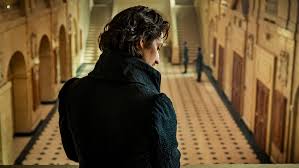
THE COUNT OF MONTE-CRISTO: you think you’ve seen a revenge movie?

Photo caption: Pierre Niney in THE COUNT OF MONTE-CRISTO. Courtesy of Samuel Goldwyn Films.

The French epic The Count of Monte Cristo is a relentlessly entertaining three hour plunge into betrayal, revenge and forgiveness – and some spectacular French real estate. Alexander Dumas published the original adventure novel 185 years ago, and it’s been made into over 100 movies and episodic series. This version, by writer-directors Alexandre de La Patelliere and Matthieu Delaporte, is pretty fun, and gorgeous to look at.

The sweeping story spans 24 years, beginning in 1815 when the protagonist, Edmond Dantes, (Pierre Niney) is nineteen years old and on the verge of a wonderful life. A seafaring prodigy, he has just earned the captaincy of his own ship, which will earn him affluence, and he’s about the marry the stunningly beautiful love of his life. But three other jealous and resentful men manufacture a false charge and railroad into a life sentence of solitary confinement in a remote island dungeon. Before he know what has hit him, Dantes has been suddenly and unjustly stripped of everything he had or could have had.

After languishing in hopeless squalor for six years, he makes contact with another prisoner who has a plan for an escape – but it will take them another eight years to implement. In The Count of Monte-Cristo‘s most thrilling scene, he manages a skin-of-the-teeth escape. He then tracks down an immense medieval fortune and returns to France with a new identity – the Count of Monte-Cristo – and the power and status of great wealth.

He can no take revenge on the three men who betrayed him, but killing them is not enough for Dantes – this is not the kind of revenge movie that we’re used to. Dantes needs to break them completely – he needs to deprive them of their wealth, their status, their families and their own sense of self-worth. To do that, he creates and manipulates an elaborate web of traps.

The base assumptions and societal mores of early 19th century France, of course, are utterly anachronistic to our modern sensibilities , but de La Patelliere and Delaporte make Dantes’ situation relatable. The first two hours of the story is remarkably adherent to the source material. De La Patelliere and Delaporte reworked the some of the revenge devices at the end, but they were true to Dumas’ overall story arc. And, who, these days, has actually read the original? (I’ll admit that I have only read the Classics Illustrated comic book as a boy.)

De La Patelliere and Delaporte, along with cinematographer Nicolas Bolduc make this a visually splendid film, aided by impressive chateaus, period costumes and the attractive cast.

Niney is an able enough actor to carry the film, appearing in 90 percent of the scenes and aging 24 years. The rest of the cast is fine, too, with Patrick Mille sparkling as the ever-grinning, vile speculator Danglers, one of Dantes’ three main targets.

The Count of Monte-Cristo is available to watch for free on kanopy and to rent from Amazon,AppleTV, YouTube and Fandango. There are many similar titles, including a 2025 mini-series,so be sure to get the 2024 French movie with the hyphen in the title.