
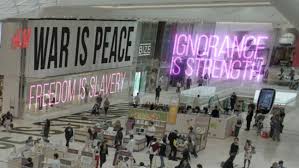
The impassioned and innovative documentary Orwell: 2+2=5 is less a biopic of the author George Orwell than a cry of alarm, imploring us to heed Orwell’s message about resisting totalitarianism and its tools of propaganda and repressive violence. It’s a distress signal – and an urgent one.
Primarily through clips from movie versions of 1984 and Animal Farm, we are reminded of Orwell’s revulsion at those who deny objective fact and try to pervert public opinion. War is Peace. Freedom is Slavery. Ignorance is Strength. Big Brother. Thought Police. Newspeak.
Historical clips illustrate figures like Hitler, Stalin, Franco and Pinochet employing these methods. And contemporary news clips focus on the evil deeds of today’s authoritarian nationalists in Russia, China, Myanmar, Hungary, Italy, France and, notably, in the US.
Orwell: 2+2=5 takes us from Orwell’s work to instances of book burning from the Nazis through to today, including a jarring list of books banned in American libraries. Orwell found goosestepping particularly offensive, and Orwell: 2+2=5 shows us plenty of contemporary examples of that, too.
When Orwell wrote Animal Farm and 1984, he had seen Goebbels’s Big Lies in action and experienced Stalinist thought-oppression. But, although he hadn’t seen AI, election deniers or corporate hegemony of television news, Orwell: 2+2=5 makes it clear that his guiding principles still apply.
We do get just enough content about Orwell’s life to help understand what shaped him. He spent five years in his early twenties as a colonial policeman in Burma, which caused him to understand (before his peers) that European colonization was exploitation based on white supremacy and that he himself had been an instrument of repression. He fought against fascism in the Spanish Civil War, where his leftist unit was purged by communists. Physically disabled from wounds in Spain, he got another chance to fight fascism in World War II by working for the BBC, ironically, as a propagandist.
Orwell: 2+2=5 is the work of Oscar-nominated documentarian Raoul Peck. His James Baldwin biopic I Am Not Your Negro was also innovative; Peck chose to present Baldwin’s thinking through only his own words, in archival recordings or voiced from Baldwin’s writings, unadorned by talking heads. As in I Am Not Your Negro, the editing in Orwell: 2+2=5 is brisk.
Orwell: 2+2=5 is a fine film and an important piece of advocacy. It’s playing in arthouse theaters, but difficult to find.