THE TESTAMENT OF ANN LEE: dreary, self-important and very, very odd

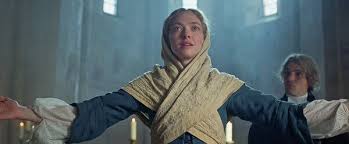
Photo caption: Amanda Seyfried in THE TESTAMENT OF ANN LEE. Courtesy of Searchlight Pictures.

Let’s get this out of the way at the outset – I don’t care for movie musicals, and, beforehand,  I didn’t know that The Testament of Ann Lee was a musical.  But I did not walk out on The Testament of Ann Lee because it is a musical – I walked out because it is a dreary, self-important musical.

This is a biopic of the woman who came to lead the Shaker religious sect in 18th century England, seen by followers as a female Christ, and founded the utopian Shaker settlement in America. 

The talented and ever appealing Amanda Seyfried stars as Ann Lee, and this is the third feature for Mona Fastvold as a director. Fastvold co-wrote Brady Corbet’s Vox Lux and The Brutalist, and Corbet co-wrote The Testament of Ann Lee. with Fastvold.  In trying to make a compelling portrait of spiritual zeal, the filmmakers had to address two challenges – the life  of Ann Lee itself and the Shakers themselves – and they failed.

First, Ann Lee grew up in Manchester, England, in the mud-1700s, where even the families of artisans lived in what we would see as squalor.  Already a religious non-conformist, Ann kept getting impregnated by her husband’s inconsiderate rutting, resultng in the birth of four babies, each of whom died before the age of one.  Then, she was committed to an asylum.  It’s no wonder that this experience would prompt Ann to lead her sect into celibacy.  All this (sexual abuse, grief, depression, renouncement of sex) is not fun to watch.

Second, the Shakers were so named because they moved their bodies during worship to express ecstasy (“shaking”).  These movements are depicted by the filmmkaers, well, oddly.  The film opens with a group of women dressed like Pilgrims doing what looks like spastic Tai Chi.  Later, it becomes clear that  the Shaker’s  movements are choreographed like Broadway numbers.  The Shakers make up for their celibacy by rhythmically thrusting their arms instead of their hips.  I am familiar with how spiritually euphoric Pentacostals act and even recently experienced Whirling Dervishes in Turkey.  But Fastvold and Corbet’s Shaker “shaking” begins as offputtingly contrived before it lapses into the unintentionally funny.

The music, by Daniel Blumberg, who justifiably won an Oscar for The Brutalist’s score, is throbbing.  Most of The Testament of Ann Lee was filmed in Hungary with mostly Hungarian technical crew.  This is a technically well-crafted film, and the verisimilitude of the 18th century settings is excellent.

In a courageous and fully committed  performance, Amanda Seyfried captures both Ann Lee’s suffering and her charismatic self-confidence.  And Seyfried sings very well.

Nevertheless, unless you are convinced that you are Christ, stay away.
MANK: biting the hand

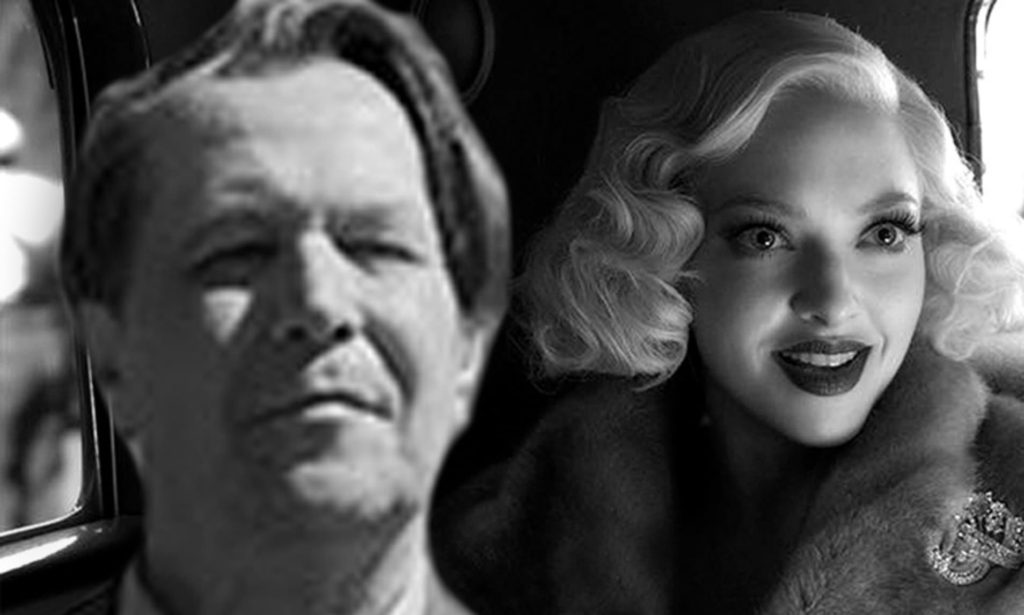
Gary Oldman and Amanda Seyfried in MANK

David Fincher’s Mank is a black-and-white beauty of a film, a portrait of troubled talent in Classic Hollywood.

Mank is a character study of Herman J. Mankiewicz (Gary Oldman) as he pens his Oscar-winning screenplay for Citizen Kane. Mankiewicz was an Algonquin Round Table wit whose misfortune was that he despised the one thing that he excelled at. He was a master writer and fixer of Hollywood movie scripts, but he would rather have been in Manhattan trading bon mots with his peers in the intelligentsia. He particularly the industrial, ultra-commercial and course movie studio bosses and despised their politics.

It didn’t help that Mankiewicz was a raging alcoholic and compulsive gambler (although not a womanizer). He was so hard to handle that Orson Welles essentially imprisoned him at a remote California desert ranch to write Citizen Kane.

Mankiewicz had one unsurpassed idea for a script – the story of media mogul (and frustrated politician) William Randolph Hearst. Mankiewicz had been a frequent guest of Hearst and his companion Marion Davies at Hearst Castle. The problem is that telling this story would piss off the owner of the world’s biggest publicity machine and horrify the movie studio heads who employed screenwriters. And, most poignantly, it would betray Mankiewicz’s kind friend Marion Davies.

Mankiewicz had served as the court jester at Hearst Castle, and the term comes up repeatedly in Mank, most importantly in a cutting remark by Herman’s little brother Joseph Mankiewicz.

The Wife stayed with Mank and finished it, but she advised me that Mank is much more appealing to cinephiles who already know the “inside baseball” of the old movie studio system and the making of Citizen Kane. Indeed, when the likes of Louis B. Mayer, Ben Hecht, Joseph Mankiewicz, Irving Thalberg and John Houseman popped up, it instantly resonated with me.

The entire cast is excellent, but Amanda Seyfried is beyond great as Marion Davies. Charles Dance (coming off his Lord Mountbatten in The Crown) is perfect as William Randolph Hearst. Muckraker-turned-socialist-gubernatorial-candidate Upton Sinclair is played by…(wait for it)…Bill Nye the Science Guy.

David Fincher is one of our greatest directors (Se7en, Fight Club, Zodiac, The Social Network, Gone Girl). Fincher’s father Jack Fincher wrote the screnplay for Mank (and clearly shared Herman Mankiewicz’ acid view of the Hollywood hierarchy), so this is clearly a labor of love for David Fincher.

As a tribute to both Citizen Kane and the Golden Age of Hollywood, Mank is just gorgeous, as beautiful a black-and-white film as any directed by John Ford or shot by Sidney Toler, Nicholas Musuraca or John Alton. Mank’s cinematographer is Erik Messerschmidt (TV’s Mindhunter).

Mank is going on my list of Best Movies of 2020 – So Far. I see Oscar nominations coming for Fincher, Messerschmidt and Seyfried. Mank is streaming on Netflix.

Lovelace: soap opera – not that there’s anything wrong with that

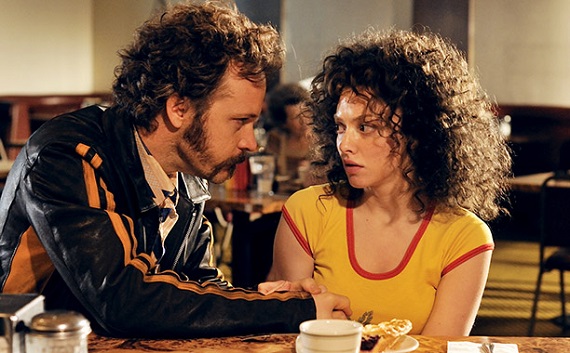
Peter Sarsgaard and Amanda Seyfried in LOVELACE

Lovelace is a soap opera about a nice girl who meets the Wrong Guy and, before she knows it, she’s in a porn movie.  The movie is cleverly constructed.  First, it outlines the true story of the naive and troubled young woman soon-to-become porn star Linda Lovelace, culminating in the 70s porn megahit Deep Throat.  Doing so, it captures both the polyester period and the appeal of the then-novel campy humor in Deep Throat.   Then it fills in the blanks, completing the flashbacks of earlier scenes (and inserting new ones) so we see the relentless abuse of Lovelace by her Wrong Guy husband. His abuse of her – even pimping her out – is horrific.

It’s generally a well-acted film.  The appealing Amanda Seyfried works as Lovelace.   The most welcome aspect of the film is the goofy team of Hank Azaria, Bobby Cannavale and Chris Noth as the pornographers – they’re very funny and lighten the film.

As we would expect, Peter Sarsgaard makes for the most despicable movie husband since Lawrence Fishburne’s Ike Turner in What’s Love Got to Do With It.  His sadistic sociopath is both smarmy and sadistic.

An unrecognizable Sharon Stone is excellent as the rigidly devout Catholic mother who insists that Lovelace return to her physically abusive husband and obey him (although, to be fair, the mom can’t imagine the depth of the abuse).

Robert Patrick is excellent as her terse father, especially in one particularly heartbreaking scene.  So many of Patrick’s roles are in action movies, so I’m glad that he got a chance to play a rigidly unemotional guy that is having deep emotions.

Some of the other casting is pretty random.  James Franco is completely wrong as Hugh Hefner.  Hef is cool only because of the Playboy Empire.  Franco is cool because he’s Franco.  Here Franco doesn’t swap out his own personal magnetism for the real Hef’s stiff reserve.  Less would have been more.  And, oddly, Chloe Sevigny receives a credit for what may be less than five seconds on-screen.

The real Linda Lovelace wasn’t particularly deep, and neither is Lovelace.  As well-crafted as it is – and with the superb performances of Skarsgaard, Stone, Patrick, Azaria, Cannavale and Noth – the central cautionary tale of Lovelace – the fall and redemption of a sympathetic character – nonetheless remains a not very profound soap opera.

Les Miserables: Now I’m miserable, too

Let’s get this out of the way first – having neither seen nor desired to see the Broadway musical Les Miserables, I am not the target audience for this movie.  I don’t care for melodramas – and Les Mis is two melodramas in one – the story of the saintly Jean Valjean being chased for decades by the monomaniacal Javert and a romance between two kids.  So I was mostly bored.  If, however, you love Les Mis, you’ll probably enjoy this long, long, lavish all-star effort from director Tom Hooper (The King’s Speech, The Damned United, John Adams).

The cast is mostly excellent.  Hugh Jackman, Anne Hathaway, Eddie Redmayne (My Week with Marilyn), Amanda Seyfried, Samantha Barks and Aaron Tveit are all excellent singers and give outstanding performances.  Redmayne is exceptional.  Sasha Baron Cohen and Helena Bonham Carter are very funny in the comic roles (the highlight of the movie for lowbrow me). The other lead is Russell Crowe, who really can’t match the singing ability of the other actors, which is a distraction.

Hooper has made the costumes and make-up very realistic for the filthy and scabby period.  This, for me, was jarring when juxtaposed against the artificiality of the characters breaking into song and some very cheesy CGI sets.

Now here’s one of my pet peeves – movies that should be over but linger like an unwanted guest.  Here, both of the plot threads (the chase and the romance) are resolved, yet the movie goes on for three more songs, including a death scene and the stirring finale.  Aaaack.