
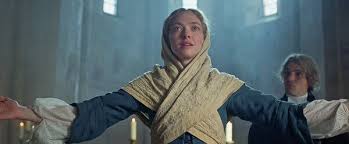
Let’s get this out of the way at the outset – I don’t care for movie musicals, and, beforehand, I didn’t know that The Testament of Ann Lee was a musical. But I did not walk out on The Testament of Ann Lee because it is a musical – I walked out because it is a dreary, self-important musical.
This is a biopic of the woman who came to lead the Shaker religious sect in 18th century England, seen by followers as a female Christ, and founded the utopian Shaker settlement in America.
The talented and ever appealing Amanda Seyfried stars as Ann Lee, and this is the third feature for Mona Fastvold as a director. Fastvold co-wrote Brady Corbet’s Vox Lux and The Brutalist, and Corbet co-wrote The Testament of Ann Lee. with Fastvold. In trying to make a compelling portrait of spiritual zeal, the filmmakers had to address two challenges – the life of Ann Lee itself and the Shakers themselves – and they failed.
First, Ann Lee grew up in Manchester, England, in the mud-1700s, where even the families of artisans lived in what we would see as squalor. Already a religious non-conformist, Ann kept getting impregnated by her husband’s inconsiderate rutting, resultng in the birth of four babies, each of whom died before the age of one. Then, she was committed to an asylum. It’s no wonder that this experience would prompt Ann to lead her sect into celibacy. All this (sexual abuse, grief, depression, renouncement of sex) is not fun to watch.
Second, the Shakers were so named because they moved their bodies during worship to express ecstasy (“shaking”). These movements are depicted by the filmmkaers, well, oddly. The film opens with a group of women dressed like Pilgrims doing what looks like spastic Tai Chi. Later, it becomes clear that the Shaker’s movements are choreographed like Broadway numbers. The Shakers make up for their celibacy by rhythmically thrusting their arms instead of their hips. I am familiar with how spiritually euphoric Pentacostals act and even recently experienced Whirling Dervishes in Turkey. But Fastvold and Corbet’s Shaker “shaking” begins as offputtingly contrived before it lapses into the unintentionally funny.
The music, by Daniel Blumberg, who justifiably won an Oscar for The Brutalist’s score, is throbbing. Most of The Testament of Ann Lee was filmed in Hungary with mostly Hungarian technical crew. This is a technically well-crafted film, and the verisimilitude of the 18th century settings is excellent.
In a courageous and fully committed performance, Amanda Seyfried captures both Ann Lee’s suffering and her charismatic self-confidence. And Seyfried sings very well.
Nevertheless, unless you are convinced that you are Christ, stay away.