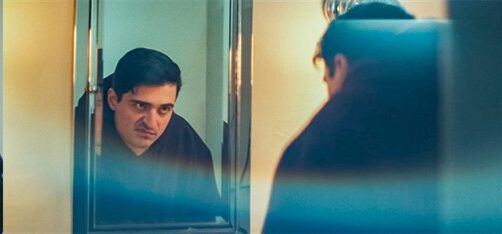
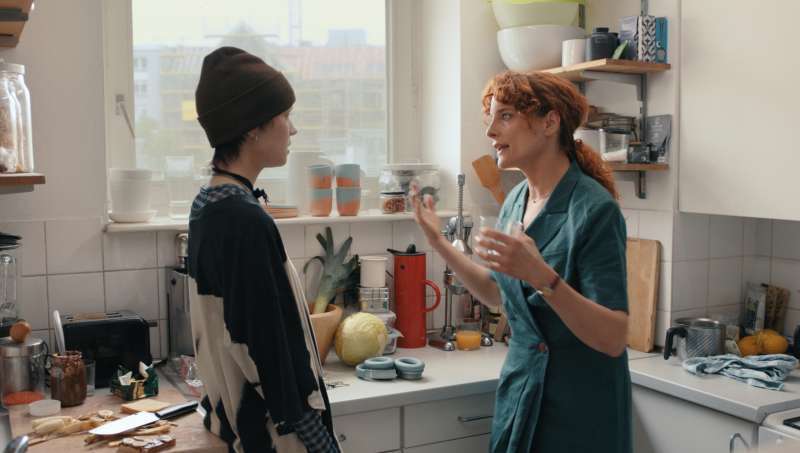
The dark sci fi comedy Daddy: is set in a future where only a limited number of men are approved by the government to father children. Four guys apply for the privilege and are isolated in a mountain lodge to wait for the expert evaluator, who doesn’t immediately show up. As they try to figure out what’s going on and what they should do, they succeed only in demonstrating how unfit they would be as parents – until things get all Lord of the Rings. It’s a very funny skewering of both male overconfidence and male angst.
Finally, the guys get an unexpected visitor, who may or may not be the evaluator that they expect. What’s impressive about this episode is how each man’s instinctual reaction, different from each other’s, can be so profoundly wrongheaded.
The mountain lodge is equipped with an artificial baby model (a doll). Co-writers Neal Kelley and Jono Sherman refrain from overusing this prop in slapstick. It’s far funnier to glimpse the doll as it seems to silently rebuke the foolhardiness around it.
Daddy is the second feature and first feature, respectively, for for co-directors/co-writers Kelley and Sherman, who also play two of the guys. Cinequest’s online festival Cinejoy hosts the world premiere of Daddy.
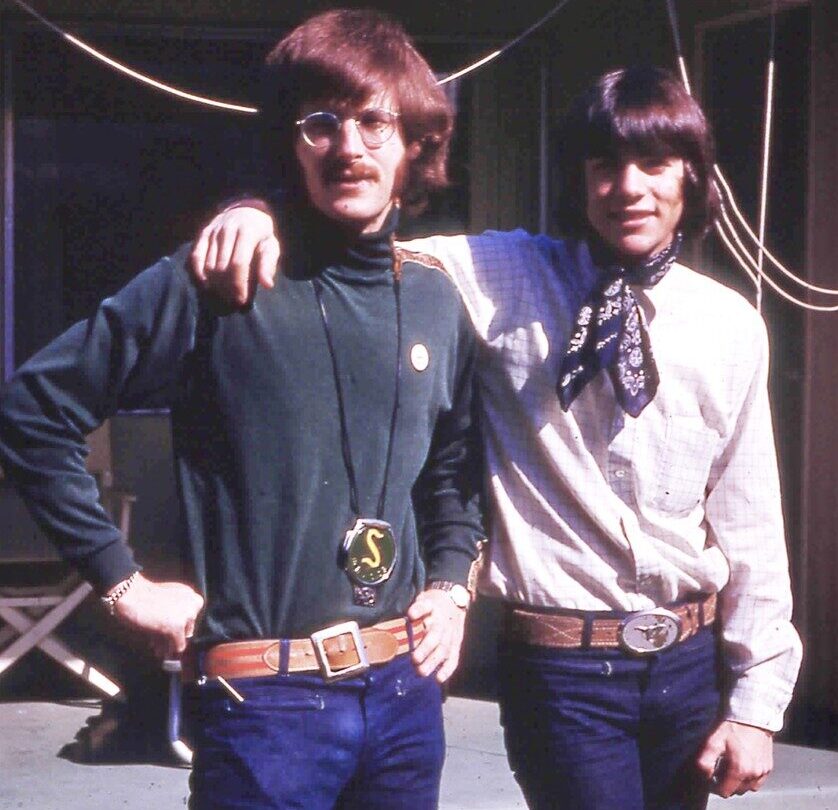
The Levin Brothers during their time with People! in BROTHERS BROKEN. Courtesy of Cinequest.
The documentary Brothers Broken contains a singularly refreshing aspect on a familiar phenomenon – the breakup of a 60s rock band. But here, the band breaks up, not because of drugs or ego, but because of a cult. And the estranged band members are brothers. The band doesn’t last long, but the brothers’ arc covers a 58-year arc.
Those brothers were the creative force behind the San Jose band People!, which was poised for future success after their hit I Love You in 1967. But at that point, one brother joined Scientology, and was forbidden to have contact with the rest of the band, including his own brother.
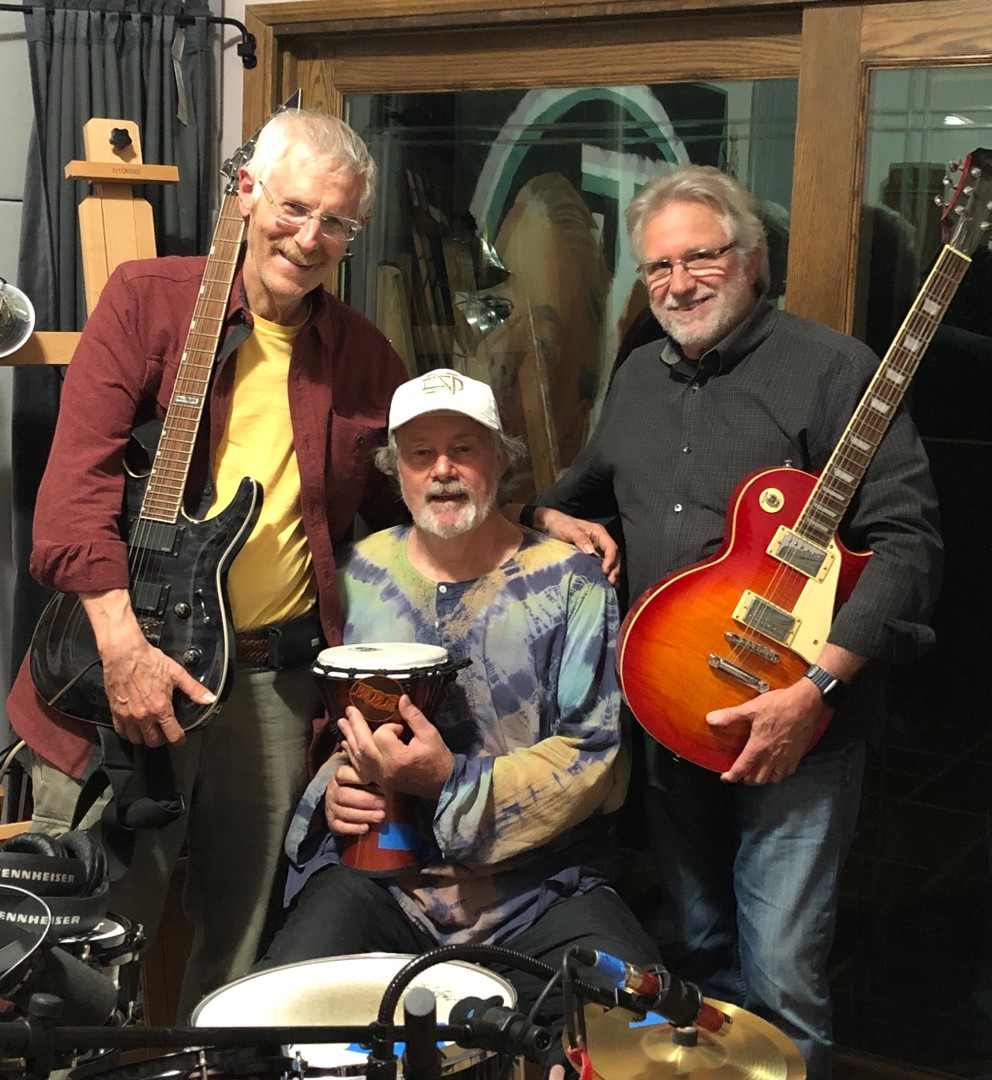
That former Scientologist brother, Geoff Levin, has co-directed Brothers Broken and says, “This has been a 75 year journey. 8 years ago I was on the verge of death. A deep depression caused by close to fifty years in Scientology almost ended my life. I came out of the cult and I am very grateful to my family and friends who have helped me recover. “
People! band members today in BROTHERS BROKEN. Courtesy of Cinequest.
There have been excellent Scientology documentaries, most notably Alex Gibney’s Going Clear: The Prison of Belief. Here, the Scientology aspect benefits from the brothers’ relatability and authenticity.
Not all is happy in Brothers Broken, because Geoff’s decision is still costing him dear family relationships. But Brothers Broken is an audience pleaser.
Brothers Broken is the first feature for co-directors Geoff Levin and Lily Richards. Cinequest’s online-festival Cinejoy hosts the US premiere of Brothers Broken. Fitting for Cinequest, the brothers and the band are from San Jose!
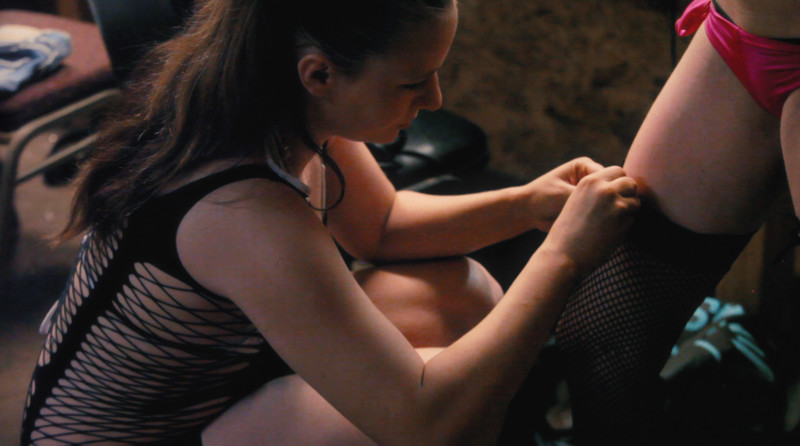
Photo caption: DESTINY ON THE MAIN STAGE. Courtesy of Cinequest.
In the brilliant documentary Destiny on the Main Stage, a female director (and almost all-female crew) chronicle three years in the lives of Dallas-area strippers – and it’s authentic and NOT sensationalist or exploitative. The strippers include both a 20-year veteran very comfortable in her vocation and a former stripper organizing to help women exit the business. And, of course there are the very young women who are puddles of bad choices. Over the three years, the subjects’ lives take some very gripping turns.
This is not an advocacy film that seeks to criticize or promote the industry. This is cinéma vérité, and the pivotal events in the women’s lives are depicted as they happen. Hearing the strippers’ voices through a female lens/gaze/perspective is both novel and insightful. Director Poppy de Villenueve says, “These events are revealed as part of life, filmed in a nuanced way, reflecting something these women rarely are given the opportunity to have revealed.“
What Destiny on the Main Stage is filled with, instead of titillation, is humanity. De Villenueve says, “It is difficult to find real intimacy and connection these days, but by highlighting it in the darkest environments, I believe we move the world towards a better, kinder place.”
This is a serious film that could become an audience favorite, too. Destiny on the Main Stage is the second feature for director Poppy de Villenueve. Cinequest’s online festival Cinejoy hosted the world premiere of Destiny on the Main Stage, and it’s playing the in-person Cinequest in August..
Lea Drinda and Anne Ratte-Polle in EVERYBODY WANTS TO BE LOVED. Courtesy of Cinequest.
This German dramedy Everybody Wants to Be Love is a triumph of the harried mom genre. As a psychotherapist, Ina (Anne Ratte-Polle) spends her workdays listening to whining and naval-gazing. Then she goes home to her self-absorbed boyfriend and her teen daughter – and the job of teenagers is to be self-absorbed.-Nobody is most narcissistic and entitled than Ina’s mom. It’s the mom’s birthday, and she is rampaging with demands. The daughter is threatening to move in with Ina’s ex, and the boyfriend wants to move the family to Finland for his career. As Ina is swirling around this vortex of egotism, she gets some sobering news about her own health. As everyone converges on the birthday party, what could possibly go wrong?
Everybody Wants to Be Loved is the first feature for director and co-writer Katharina Woll, who is a perceptive and clear-eyed observer of human behavior. Woll maintains the perfect level of simmering as Ina’s indignities build toward a meltdown.
Anne Ratte-Polle is excellent as the long-suffering Ina, whose tank is about to hit Empty if she doesn’t start putting her needs above those of everybody else.
The rest of the cast is excellent, too, including Urs Jucker as Ina’s maddening boyfriend. Lea Drinda is very good as the teen daughter who pushes Mom to get what she wants, but knows when to stop.
Cinequest’s online festival Cinejoy will host only the second screening of Everybody Wants to Be Loved in the US. It’s one of my picks for theBest of Cinejoy. Watch it through March 13 at Cinejoy.
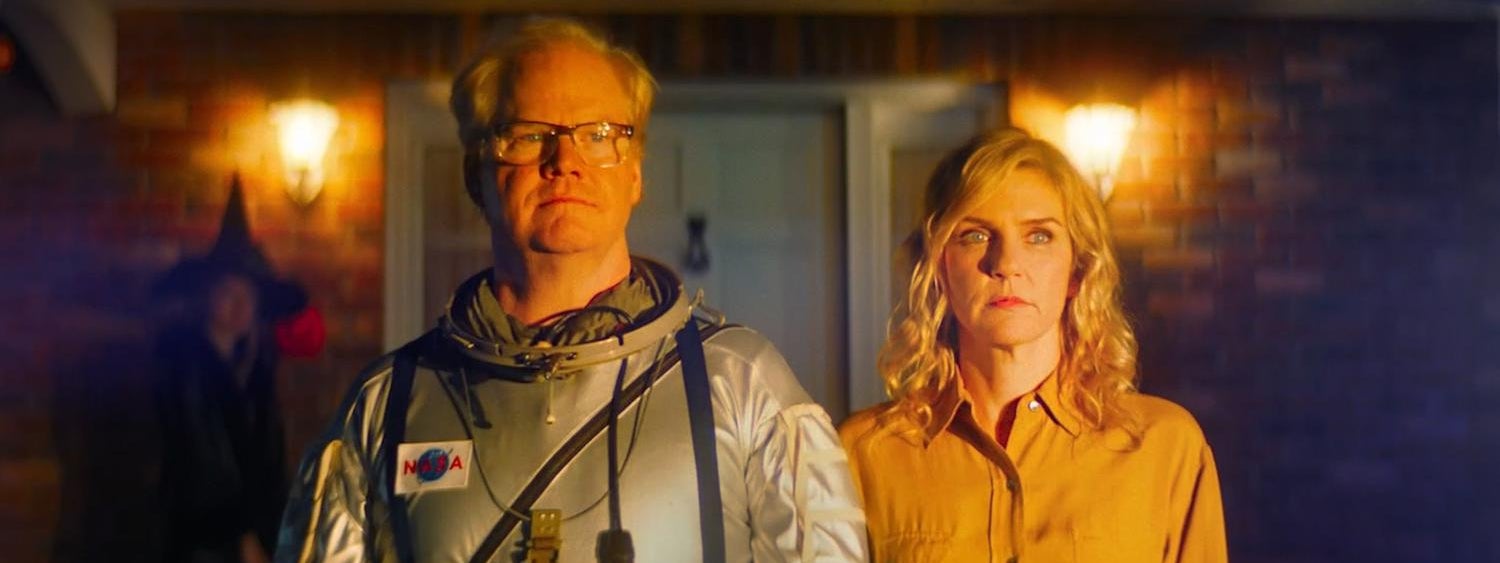
Jim Gaffigan and Rhea Seehorn in LINOLEUM. Courtesy of Blue Fox Entertainment.
Colin West’s Linoleum, a gentle story of a lovable loser with a nose-diving kid’s science TV show, is superficially about the guy’s eccentric attempt to build a real rocket in his garage; but it’s really three love stories – or are they one love story? Although West peppers some clues throughout, it’s not until the final act that the audience connects the dots about what is going on. Linoleum is hard to review – or even describe – without spoilers, but let’s just say that it is a highly original and sweet film.
Our TV host Cameron (Jim Gaffigan) is an astronomer who seems overqualified for his charmingly corny children’s show. He takes the science seriously, but not himself. Cameron is the kind of affable guy who always gets run over by the more self-interested among us.
Cameron is married to Erin (Rhea Seehorn) a smarty pants aeronautical engineer who is direcying programs at a provicial air and space museum. Like Cameron, she started out as a whiz kid and is wondering. Unlike Cameron, who is placidly content, she is wondering how she got stuck in the bush leagues. Erin’s dissatisfaction with her career, and with Cameron’s lack of ambition, is threatening their marriage.
The teenage girl in the story meets the new boy in high school, and they tentatively stumble into a guileless friendship. This thread in Linoleum is especially charming.
The comedian Jim Gaffigan has shown that he’s also a fine actor (Light from Light), and Rhea Seehorn (Better Call Saul, Veep) is one of our finest TV actors. Both are very good in Linoleum.
The first two acts of Linoleum are fairly easy-to-follow, with a couple small mysteries that could be imagined or hallucinated. The third act, which I will not spoil, becomes more confusing until West connects the threads of the story and we understand what we’ve been watching ll along. Viewers who need linear stories may be frustrated, but the payoff is splendid.
I saw Linoleum at the opening night of Cinequest, with Gaffigan and West in attendance.
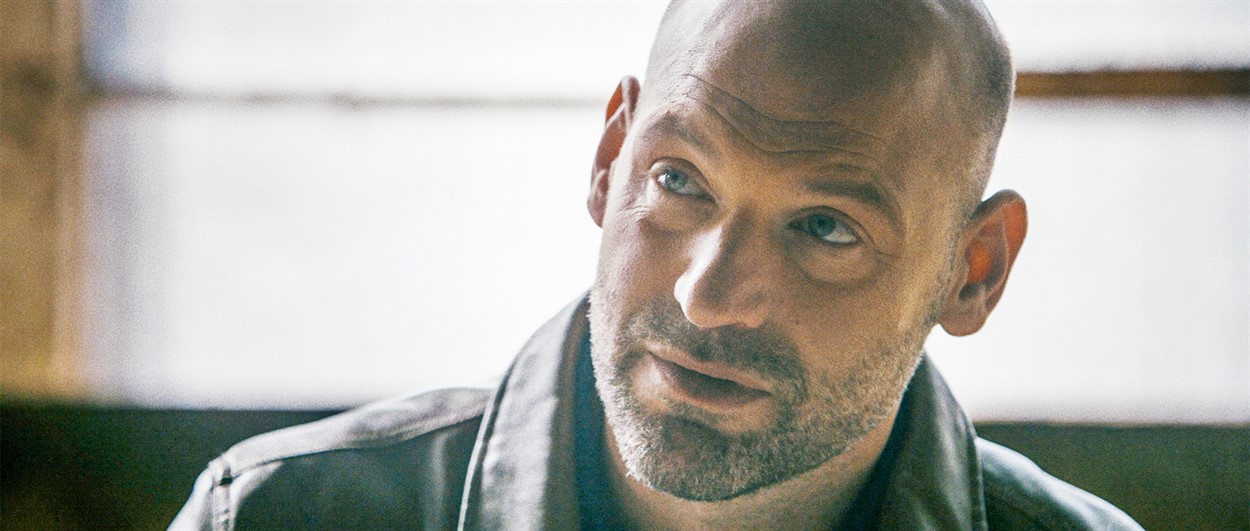
Corey Stoll in WHAT WE DO NEXT. Courtesy of Magano Movies and Media.
Writer-director Stephen Belber’s taut drama What We Do Next featured the best acting ensemble at Cinequest, with searing performances by Karen Pittman, Michelle Veintimilla and Corey Stoll.
I was familiar with Corey Stoll’s work since his turns in House of Cards and Homeland, but Karen Pittman (The Morning Show, Yellowstone) and Michelle Veintimilla (Seven Seconds, Gotham) were revelations.
The story unfolds in seven segments over a a span of years. It opens with Sandy (Pittman) compassionately counseling a teenage Elsa (Veintimilla) to survive abuse from Elsa’s father. Years later, the lawyer Paul (Stoll) reconnects with Sandy, now a rising NYC politician; the two game out how an innocent miscalculation years before could erupt into a career-killing political scandal today. Each of the characters becomes more entangled by the choices of the others, and the dominoes fall.
What We Do Next explores the difficulty that those traumatized and ill-equipped by upbringing have navigating the legal system and making constructive choices.
I am not unfamiliar with political crisis management, and most segments of the story rang true.
I attended What We Do Next’s world premiere at Cinequest, with Stephen Berber in attendance. After four days rehearsal in the producer’s backyard, What We Do Next was shot in six days – in a COVID bubble in Louisville. I’ll let you know when What We Do Next is released theatrically or on demand.
Photo caption: Jennifer Levinson in TRUST. World premiere at Cinequest. Courtesy of Menemsha Films.
After a pandemic-driven hiatus, Cinequest returns in-person for the first time since March 2020. Beginning on August 16, this year’s festival will be live at downtown San Jose’s California Theatre, Hammer Theater and 3Below. On August 25, the program moves to Campbell’s Pruneyard Cinemas through August 29.
I’ve already seen almost twenty offerings from Cinequest 2020, and here are my initial recommendations. As usual, I focus on the world and US premieres. Follow the links for full reviews, images and trailers. I’ve also included some tips for making the most of the Cinequest experience under “Hacking Cinequest”.
MUST SEE
This year’s festival Must Sees are the first features from three female filmmakers: writer/actor/producer Jennifer Levinson with Trust, documentarian Nira Burstein with Charm Circle and co-writer/actor Elizabeth Hirsch-Tauber with 12 Months.
Trust: Writer-actor Jennifer Levinson’s absorbing exploration of family betrayal must be the best screenplay at Cinequest. Kate (Levinson) is rocking her college experience when her mother unexpectedly dies. Kate returns to her hometown for the funeral, and apprehensively re-engages with her estranged family. They just might cringe their way through the funeral until an estate planning blunder explodes. Often darkly hilarious, Trust is elevated by Levinson’s textured characters. Kate’s strait-laced, conflict-averse brother is clinging onto functionality by his fingernails. The oldest sister is a flamboyant hot mess, but her astonishingly bad behavior seems to stem from some undiagnosed disorder. Their nogoodnik of a father hides a profound weakness and desperation behind his sleazy gloss. Kate herself has the decency that evades her nuclear family, but she’s immature and too prickly. How will Kate find closure when she has no control over the motives of the others? World premiere. Trailer at bottom of this post.
Charm Circle: You think YOUR family has issues? In this superbly structured film, writer-director Nira Burstein exquisitely unspools the story of her own bizarre family, a cautionary and ever-surprising chronicle of mental illness. Bay Area premiere.
12 Months: This uncommonly authentic film traces the year-long span of a romance, using vignettes that are snapshots of the relationship’s evolution. Just like a real life relationship, 12 Months has moments that are playful and moments that are searing. 12 Months is entirely improvised by its director and its stars, who are extremely keen and perceptive observers of relationship behavior, and they don’t hit a single wrong note. World premiere.
INTERNATIONAL CINEMA
Lidia Vitale and Ludovica Mancini in Gabriele Fabbro’s THE GRAND BOLERO at Cinequest. Courtesy of Cinequest.
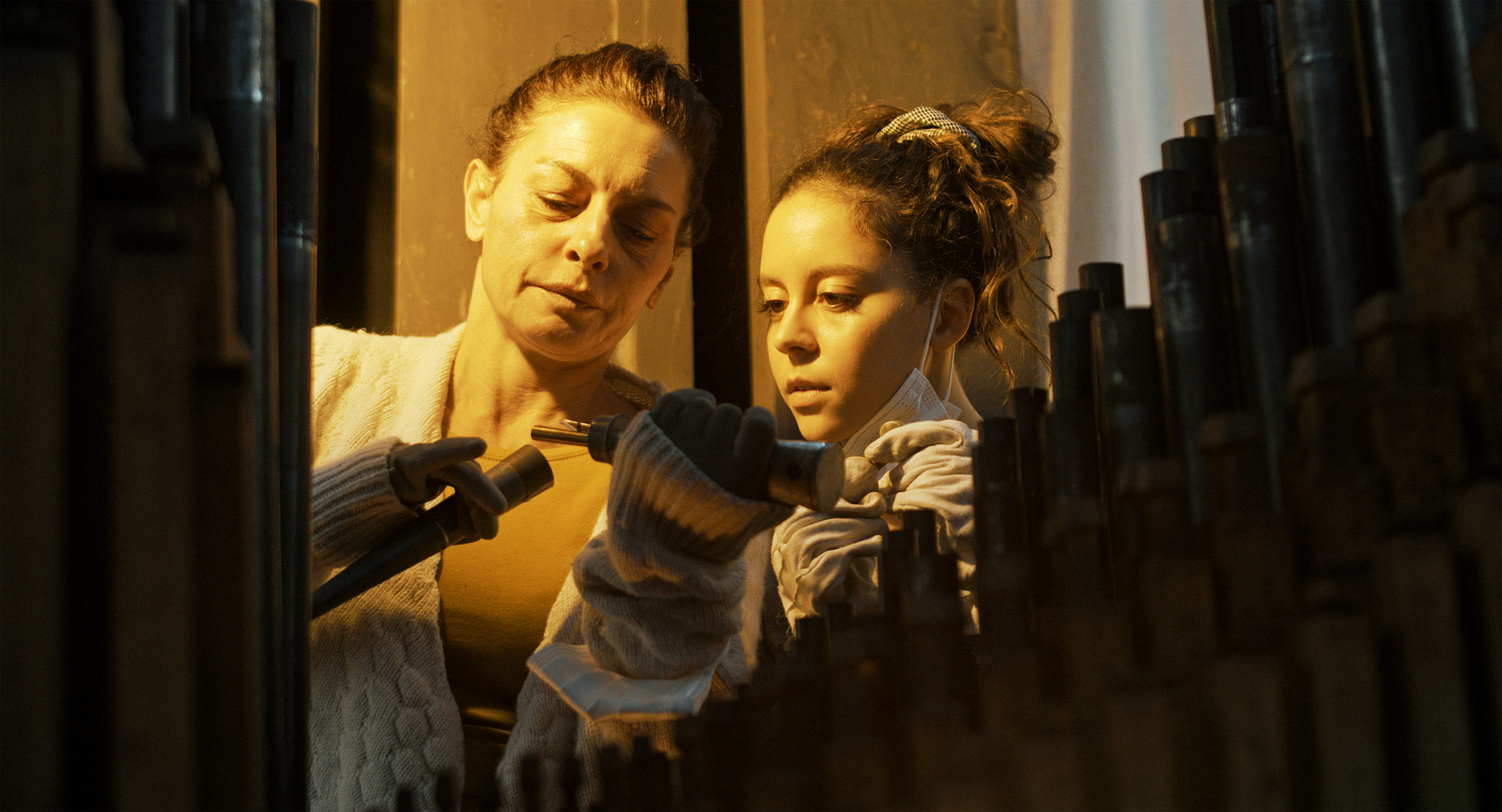
The Grand Bolero: Early in COVID’s devastating assault on Northern Italy, a middle-aged organ restorer is locked down in a centuries-old church; a salty curmudgeon, she cruelly resists the assistant forced upon her – a runaway young mute woman with no place else to shelter. But the young woman’s unexpected musical gift unlocks passion in the older woman. Passion evolves into obsession, propelling the story to an operatic finale. The Grand Bolero is the most visually beautiful film that I’ve seen in some time, and the music is powerfully evocative. It’s a remarkable first feature for director, co-writer and editor Gabriele Fabbro and his cinematographer Jessica La Malfa. Bay Area premiere.
DOCUMENTARY
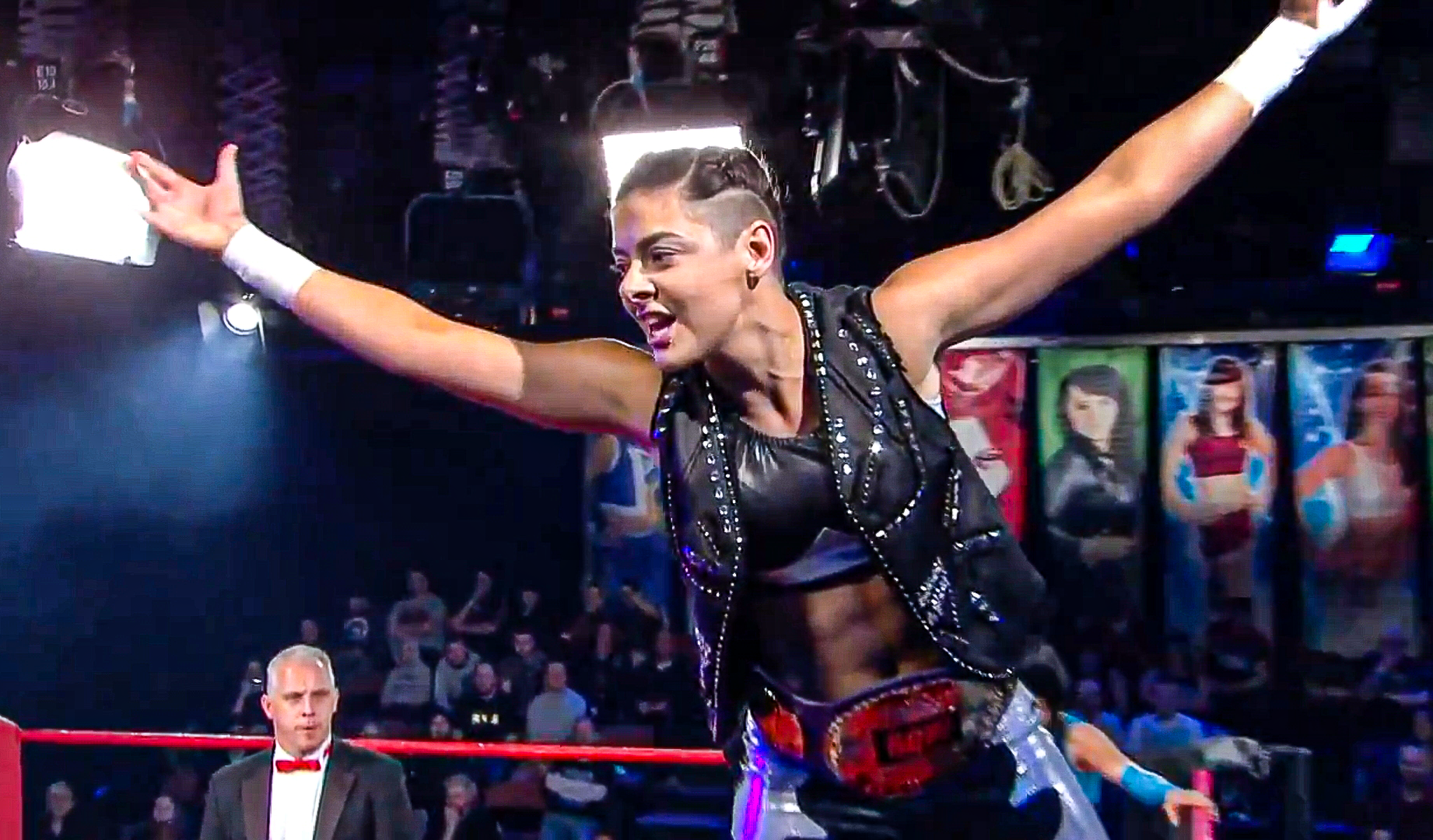
Charlie Morgan in OUT IN THE RING. Courtesy of Ryan Bruce Levey.
Out in the Ring is Ryan Bruce Levey’s encyclopedic yet irresistible history of LGBTQ professional wrestlers. Out in the Ring chronicles straight wrestlers like Gorgeous George who pretended to be gay, and the many gay wrestling stars like Pat Patterson who were forced to stay in the closet. It’s also a showcase for today’s panoply of queer wrestling stars. Both unflinching and uplifting. World premiere.
Tell Me a Memory is a simple, yet engrossing, LGBTQ+ oral history. One or two at a time, individuals from Memphis (did you know they call themselves Memphians?) tell their own stories. The subjects are impressively diverse – in age, gender, race and identity. Coming Out in the Bible Belt is a common thread. This is a gentle and emotionally powerful film. World premiere.
AND TWO I HAVEN’T YET SEEN
Jim Gaffigan and Rhea Seehorn in LINOLEUM. Courtesy of Blue Fox Entertainment.
Of the Cinequest films that I haven’t been able to screen yet, the most favorable buzz comes from Linoleum, the Jim Gaffigan science comedy that opens the festival, and the political satire Land of Dreams. Both have distributors – they’ll be in theaters, but you can see them early at Cinequest.
HACKING CINEQUEST
Cinequest recovers its Downtown San Jose vibe, with concurrent screenings at the 1122-seat California, the 550-seat Hammer and the 257-seat 3Below – all within 1600 feet of each other. This year’s beer garden is across the street from the California.
At Cinequest, you can get a festival pass for as little as $179, and you can get individual tickets as well. Take a look at the entire program, theschedule and the passes and tickets.
As usual, I’ll be covering Cinequest rigorously with features and movie recommendations. I usually screen (and write about) over thirty films from around the world. Bookmark my CINEQUEST page, with links to all my coverage. Follow me on Twitterfor the latest. And here’s the trailer for Trust.
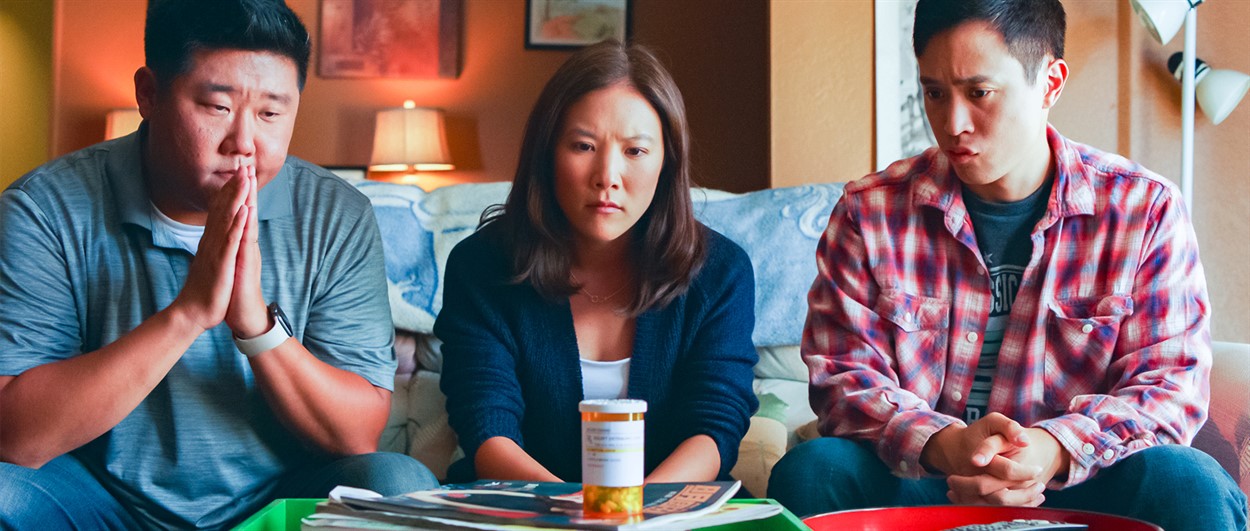
Peter S. Kim, Ally Maki and Hayden Szeto in DEALING WITH DAD. Courtesy of Cinequest.
Comedies abound at this year’s Cinequest. Here are four:
Dealing with Dad is a topical family comedy with an Asian-American cast. Three adult siblings – the super-achiever oldest sister, the passive middle brother and the infantilized youngest brother, a gaming slacker – meet at their parents’ home. The dad, whose harsh and never-bending expectations battered them as kids, has become paralyzed (and defanged) by severe depression. Their differences spawn lots of laughs, but Dealing with Dad addresses both depression and the issues that many second-generation Asian-Americans face because of their immigrant parents’ parenting styles. Cinequest audiences will appreciate that Dealing with Dad is set in MILPITAS.
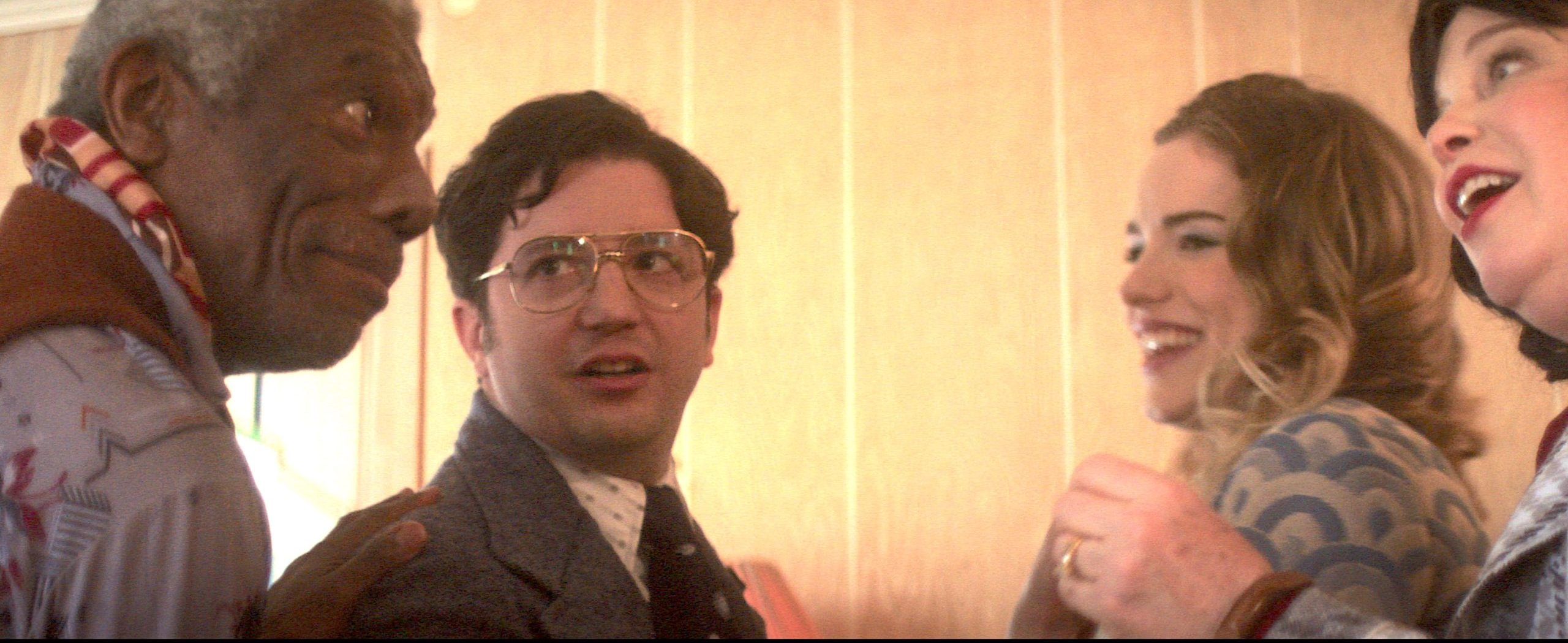
18 1/2is a dark comedy that sends up the paranoid thriller genre. A low-level government clerical worker (an excellent Willa Fitzgerald) finds herself in possession of the infamous 18 1/2 minute gap in the Watergate Tapes. Of course, co-writers Daniel Moya and Dan Mirvish had to devise a way to get this MacGuffin in her hands; given the paranoia, deviousness and clumsiness of the Nixon White House, their solution is surprisingly plausible. Double crosses and red herrings escalate, as does the dark, dark humor. Richard Kind and Vondie Curtis-Hall sparkle in supporting roles.
Sweet Disaster, from Germany, is driven by the protagonist’s ever-unleashed impulsiveness and utter lack of boundaries. Frida (Friederike Kempter) encounters and falls for an airline pilot and audaciously charms him into a relationship; their affair lasts just long enough for her to become impregnated and for him to abandon her for his ex. Consumed by the urge to win him back, Frida throws propriety to the winds. Frida’s zany roller coaster is tempered by sweet relationships with her apartment neighbors, a precocious teenage neighbor and a Greek Chorus of card-playing older women.
Alpha Male, from Poland, is another dark comedy. A feckless young man has been dispatched by his girlfriend to a smoking cessation self-help group. Given the chaos of the community center, he ends up in the wrong room, among a men’s support group headed by a charismatic instructor. He hangs around anyway – and even returns – because this group has better food. The group focuses on their resentment of women, which seems silly and harmless at first, but descends into a paranoid fixation on an imagined organization of women seeking to emasculate them. Both the misogyny and their submissiveness to their bullying leader are taken to absurd levels.
Charlie Morgan in OUT IN THE RING. Courtesy of Ryan Bruce Levey.
Out in the Ring is Ryan Bruce Levey’s encyclopedic yet irresistible documentary history of LGBTQ professional wrestlers. There is no sports entertainment that is more macho than pro wrestling. Or more flamboyant. Or, as it turns out, more queer.
Out in the Ring takes us back to the 1940s, when the straight journeyman wrestler Gorgeous George became a star and transformed wrestling by affecting a gay pose as his gimmick. George was just the first to do so, and Out in the Ring traces the many straight wrestlers who have pretended to be gay.
At the same time, many of wrestling’s best performers were closeted, notably the great Pat Patterson. Out in the Ring focuses on Patterson’s career and personal life, and how he grew into an important executive in the business. Out in the Ring surveys a long list of LGBTQ wrestlers who were forced to stay in the closet, like Patterson and Susan Tex Green.
[Personal note: The Movie Gourmet is a Boomer who, as a child, was glued to the TV for KTVU’s Saturday pro wrestling broadcasts, announced by Walt Harris. (Harris also called also roller derby.) In that era, Pat Patterson was a dominant presence in Bay Area pro wrestling.]
Out in the Ring showcases the panoply of today’s Out wrestling stars, led by Charlie Morgan and Mike Parrow. The variety is astounding: gay men, lesbians, bisexual women and men, transsexual men and transsexual women, asexual and nonbinary. There are those who make their queerness a signature of their act and those that don’t. They tell us about the homophobia that they have faced and their relief and joy from coming out.
Ry Levey has brought many films to Cinequest as a publicist, especially Canadian indies. The exquisitely sourced Out in the Ring is his first feature as a director.
I screened Out in the Ring for its US premiere at Cinequest. Both unflinching and uplifting, it’s a documentary as fun to watch as pro wrestling.
Raya Burstein and Uri Burstein in CHARM CIRCLE. Photo courtesy of Cinequest.
Inthe superbly structured documentary Charm Circle, writer-director Nira Burstein exquisitely unspools the story of her own bizarre family. At first, we meet Burstein’s father, a sour character who inexplicably is about to lose his rented house, which has become unkempt, even filthy. He is mean to Burstein’s apparently sweet and extraordinarily passive mother, and the scene just seems unpleasant.
But then, Nira Burstein brings out twenty-year-old videos that show her dad as witty, talented and functional. We learn a key fact about the mom, and then about each of the director’s two sisters.
Some of the publicity about Charm Circle describes the family as eccentric, but only one daughter is a little odd – three family members are clinically diagnosable. Charm Circle is a cautionary story of untreated mental illness and the consequences of failing to reach out for help.
This is Nira Burstein’s first feature, and she has two things going for her: unlimited access to the subjects and a remarkable gift for storytelling. Charm Circle works so well because of how Burstein sequences the rollout of each family member’s story.
I attended a screening of Charm Circle, with a Nira Burstein Q&A at the Nashville Film Festival. In July and August, it will play both the San Francisco Jewish Film Festival and Cinequest.