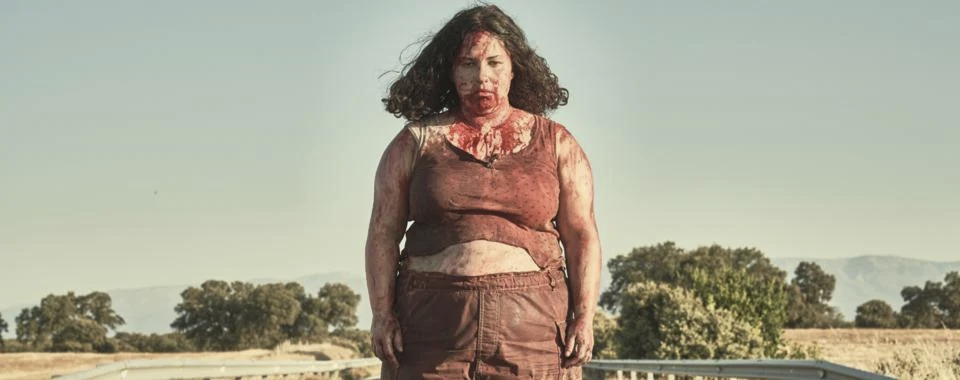
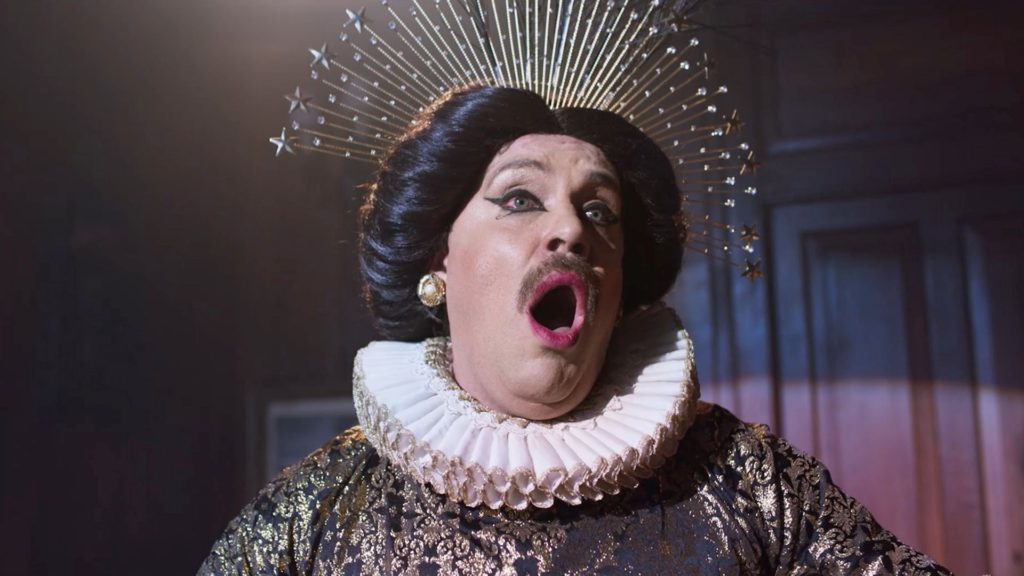
Photo caption: Laura Galán in PIGGY. Courtesy of Magnolia Pictures.
In the fresh and darkly hilarious Spanish horror movie Piggy, Sara (Laura Galán) is an overweight teenager cruelly teased by her peers. She works in her family’s butcher shop, which supplies her tormentors with a surfeit of unkind pork-related nicknames. Her affectionate but clueless dad and her brusque martinet of a mom aren’t much comfort.
One day, at the town swimming pool, mean girls sadistically traumatize her. Sara makes a shocking decision, and Piggy becomes a kind of Carrie meets Beauty and the Beast thrill ride as Sara is bounced along to the satisfying conclusion.
Piggy is the first feature for writer-director Carlota Pereda, a veteran television director. It’s based on her award-winning 2018 short with the same Spanish title, Cerdita, and also staring Galán. Galán gets all the teen angst and impulsiveness just right and, in a piñata-like role, is a helluva good sport.
Horror films turn on whether the protagonist can survive, and, often, on whether the victims deserve their demise; Pereda has a lot of fun with both.
I screened Piggy for the Nashville Film Festival, where it was one of my Under the Radar picks. Piggy opens this week at the Alamo Drafthouse and then rolls out nationally. This movie is a hoot.
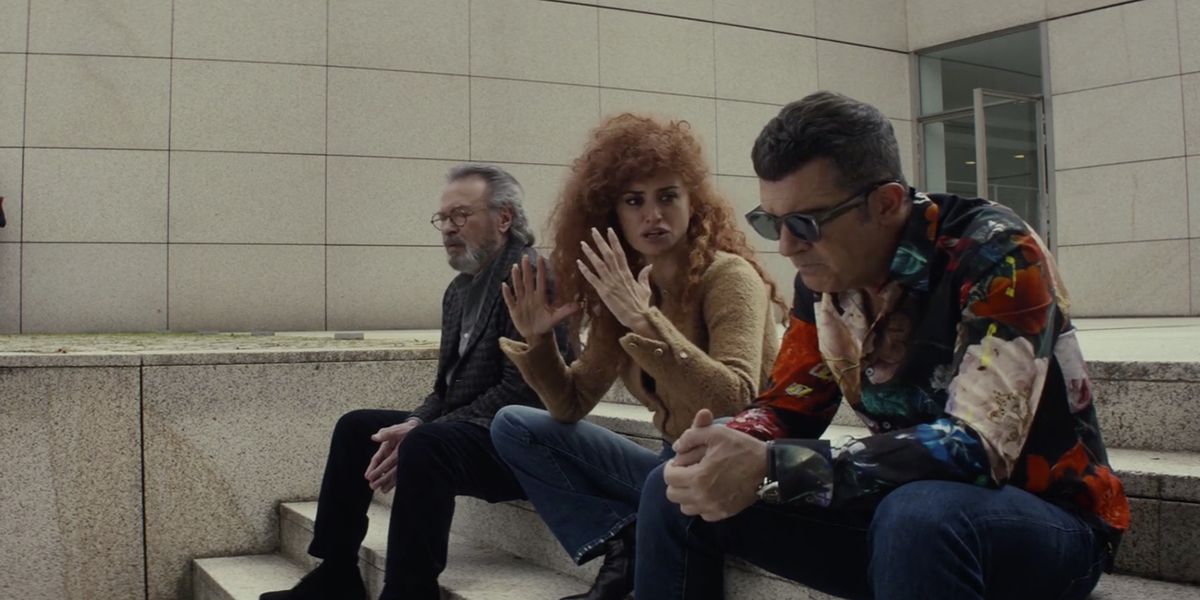
Photo caption: Oscar Martínez, Penélope Cruz and Antonio Banderas in OFFICIAL COMPETITION. Courtesy of IFC Films.
The smart and biting satire Official Competition uses the world of filmmaking (where better?) to send up professional jealousies. A billionaire wants to produce a great movie as his legacy, so he assembles a filmmaking Dream Team: the famed director Lola (Penélope Cruz), the global movie star Félix (Antonio Banderas) and the renowned sage actor Iván (Oscar Martínez). Their egos come along, too.
Ivan, a leading acting teacher who pioneers new and challenging theater, is the critical and academic world’s most esteemed actor. There’s a wonderful scene where Ivan and his wife (a children’s’ author) sit in their boho apartment listening to an avant garde audio performance.
Felix, in contrast, has become a world-wide celebrity by starring in what Martin Scorsese calls global audio-visual entertainment to distinguish these movies from cinema. Adored by millions of fans and used to having his whims and appetites satisfied by toadies, Felix is convinced that he has earned his reputation as a great actor. (And he shows up to every event with a different bimbo on his arm.)
The tycoon has purchased a Nobel Prize-winning novel (that he hasn’t read) to be adapted into a screenplay. It’s about a rivalry between brothers. (In one of Official Competition’s many delicious ironies, this source material is very pedestrian, several rungs below East of Eden, for example.)
Lola (Cruz wears a wig that is a mountain of reddish tangles) is a piece of work herself. She enjoys abusing her power as director and is devoid of personal boundaries.
Felix and Ivan are oil and water,and Lola, for artistic reasons (and more than a touch of sadism), provokes their latent rivalry, seeking to enhance what will be the tension in their on-screen rivalry. In nine days of rehearsals before the shoot, Lola plunges Ivan and Felix into a series of evermore ridiculous, intrusive and degrading acting exercises. She has them read lines under a huge, suspended rock, binds their bodies together in cling wrap, and overamplifies their kissing noises.
Lola’s caprices accomplish two things with Ivan and Felix. She turns their passive contempt for each other into open hatred. And she makes them hate her, too.
Each actor (and Lola, too) has a massive ego begging to be deflated, and the battles between them in Official Competition are very, very funny.
The ending of Official Competition is perfect – one of the cleverest and most satisfying that I’ve seen in a good long while.
The Argentines Mariano Cohn and Gastón Duprat co-directed Official Competition, which they co-wrote with Andrés Duprat. Official Competition is being described as an arch takedown of the movie industry, but the egos parodied here are present in many walks of life.
Cruz, Banderas and Oscar Martínez (the hilariously dark Wild Tales) each deliver dynamite performances. Irene Escolar is very good in a deadpan and essentially silent role as the billionaire’s daughter cast in the movie.
[Note: Prior to Official Competition, the Spanish stars Cruz and Banderas had only shared the screen for about two minutes in I’m So Excited; they did not work together in Pain and Glory, in which they both appeared in different segments.]
Official Competition, so far the wittiest film of 2022, is in theaters.
Tp honor Cinequest, now underway, here’s the best of the over thirty films that I reviewed at the 2019 Cinequest. The searing dystopian fable Buy Me a Gun takes place in an imaginary near future, in which Mexico’s conquest by narco cartels is so complete that all other institutions have collapsed.
Buy Me a Gun’s Mexico is a bandit society run by rival warlords and their fighters – a new feudal age with automatic weapons. It’s a world of cruelty, where all the mothers and teen daughters have been taken by the cartels as sex slaves. And it’s a surreal Mexico, desolate of people, the population having dwindled due to lack of women.
The cartel fighters spend essentially all of their time in four pursuits: the drug trade, raiding for women and girls, partying and playing baseball.
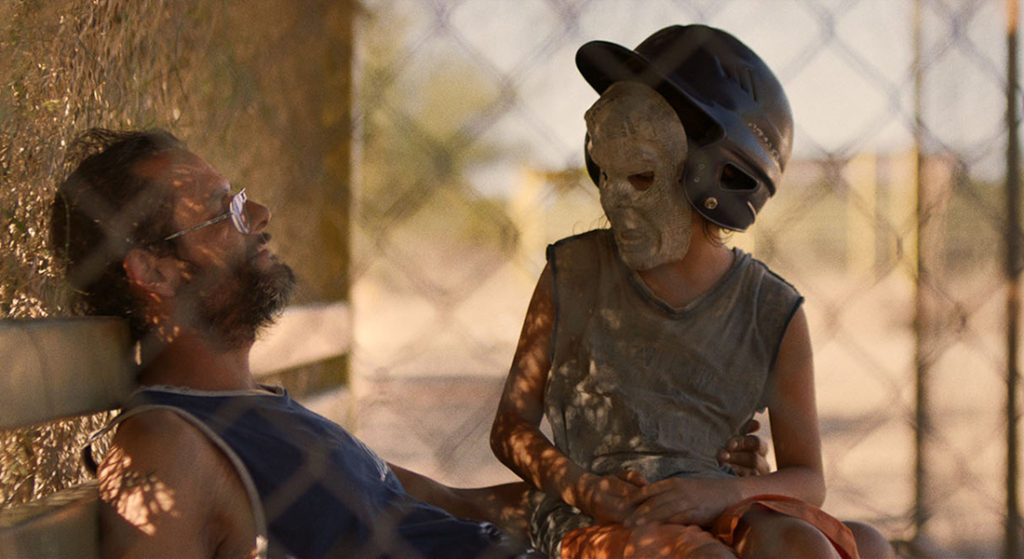
We meet one surviving man who is not in a cartel. Rogelio (Rogelio Sosa) has been imprisoned by a cartel to perform as the groundskeeper of the baseball field at their base. Rogelio is addicted to drugs, and he knows that his life is subject to the whim of any of the fighters at any moment, particularly the terrifying and gender-ambiguous cartel commander (Sostenes Rojas).
While Rogelio walks the tightrope of narco murderers, he is hiding a high stakes secret in plain sight. He has a 10-year-old daughter Huck (Mathilde Hernandez) who he is protecting from the fighters by pretending that she is a boy. If the cartel fighters discover his ruse, he will certainly be killed and his daughter will certainly become a sex slave. Because he can’t escape (and there is no place to escape TO), this is Rogelio’s best option, as harrowing as it is.
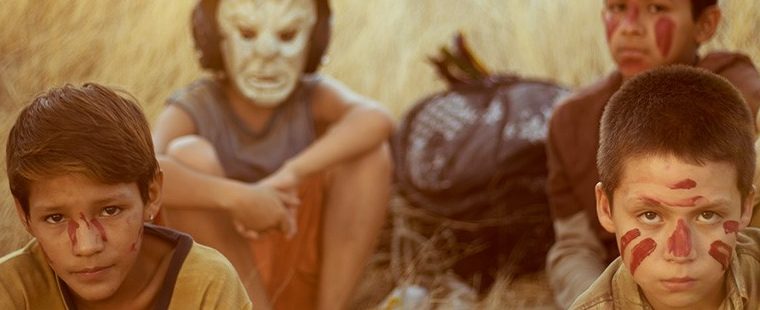
Rogelio Sosa and Mathilde Hernandez in BUY ME A GUN. Photo courtesy of Cinequest.
Huck is not the only child at the narco base – she has a pack of feral friends, some horribly disfigured from the environment of violence and the cartel’s cruelty.
While in the throes of his addiction, the groundskeeper is decent, resourceful and brave – devoted to his daughter in a hopeless situation. This is an extraordinary performance by Rogelio Sosa.
One childish mistake puts the dad and daughter in jeopardy. Will she escape the danger? Buy Me a Gun turns into a heart-pounding thriller.
Buy Me a Gun is written and directed by Julio Hernández Cordón, and it’s an impressive achievement, one of the most original films I’ve seen in this decade. One scene in particular, involving a trumpet and purple smoke to illustrate smoking drugs, is genius. Along with Huck, there are child characters that Hernández Cordón has named Tom and Sawyer.
The only crappy thing about Buy Me a Gun is its title, which would better fit a shallow crime movie than such a profound fable.
I screened Buy Me a Gun the 2019 Cinequest before its theatrical release in Mexico. At the 2020 Ariel awards (Mexico’s Oscars) , it garnered eight nominations including for Best Picture, Director and Screenplay and Best Supporting Actor for Sostenes Rojas. Buy Me a Gun is now is now streaming on Amazon, AppleTV, and YouTube
Photo caption: Milena Smith, Penélope Cruz and Aitana Sánchez-Gijón in PARALLEL MOTHERS. Photo courtesy of Sony Pictures Classics.
In Parallel Mothers, Pedro Almodóvar gives a lush melodrama, sandwiched between bookended dives into today’s unhealed wounds from the Spanish Civil War.
Two women meet in a Madrid maternity ward, each about to give birth to her first child. Neither is in a relationship and neither pregnancy was planned, although the circumstances differ strongly. Both are haunted – one by a family tragedy and the other by her parents’ dysfunction.
Janis (Penélope Cruz) is in confident middle age, a fashion photographer. She is worldly and independent, with a support system led by her bestie (Almodóvar veteran Rossy de Palma).
Ana (Milena Smit) is a teenager tossed from her throw-up-his-hands father in Granada to her self-absorbed actress mother in Madrid.
Janis and Ana bond with their babies and with each other. It’s difficult to write about their story because there’s a Big Reveal which I will not spoil.
The story of mothers and babies makes for a compelling 100-minute or so movie on its own. But the film begins and ends with segments in which a war crime from the Spanish Civil War touches characters. When Spain suddenly transitioned from the Franco dictatorship to a democracy, the nation addressed accountability for the Civil War’s atrocities differently than did, say, South Africa or North Ireland, and Parallel Mothers is Almodóvar’s comment on the continuing wounds.
And here’s my quandary: although the characters overlap, I just don’t see the unity that Almodovar intends between the mom/baby story and the Civil War legacy story. Sorry, Pedro – this just looks like two different (good) movies cobbled together to me.
Penélope Cruz in PARALLEL MOTHERS. Photo courtesy of Sony Pictures Classics.
Penélope Cruz is entering her fourth decade of Big Screen luminosity. She remains one of the most compelling presences in cinema.
Milena Smit as excellent as the troubled and immature Ana, who grows and changes more than any character in Parallel Mothers. It’s an impressive breakthrough performance, and Smit bears watching.
Penélope Cruz had already made the American art house faves Jamón Jamón and Belle Epoque before she joined the Almodóvar repertory, but it’s worth reflecting on the Spanish actresses, like Smit, that Almodóvar has introduced us to: Carmen Maura, Victoria Abril, Marisa Paredes, Cecilia Roth, Rosario Flores, Assumpta Serna and Chus Lampreave. (Plus Antonio Banderas and Javier Cámara, as well!)
Aitana Sánchez-Gijón is very good as Ana’s mom, who is initially is reflexibly insufferable, but whose role becomes more complicated as we learn about her.
Israel Elejalde is excellent as the one significant male character. It’s always great to see Rossy de Palma, who is unchallenged by her role as sympathetic sidekick. Julieta Serrano, another Almodóvar favorite also appears.
After beginning his career with two decades of subversively hilarious comedies, Almodóvar has made some of the most profound work in recent cinema. Parallel Mothers is well-crafted and engaging, but doesn’t rank with Almodóvar’s best: Talk to Her, Bad Education, Broken Embraces.
In the rapturously filmed period drama Dance of the 41, Mexican politician Ignacio de la Torre (Alfonso Herrera), a political Icarus if there ever were one, marries President Porfirio Diaz’s daughter Amada (Mabel Cadena). It’s the turn of the 20th Century, and de la Torre starts scheming with breathtaking recklessness.
The risk comes from the fact that de la Torre is in a secret club of gay aristocrats, closeted in plain sight in the most macho and homophobic mainstream culture. He has married Amada so she can be his beard, but his new bride, unaware of her new hubbie’s secret, was expecting her own sexual awakening. Instead, he spurns her for a torrid love affair with Evaristo (Emiliano Zurita).
De la Torre had married the boss’ daughter in a bid for advancement, expecting her to submit to being his pawn. But, hurt at not being desired, she calls on her dad’s capacity as an enforcer. It all culminates in a formal queer bacchanal that turns heartbreaking.
Dance of the 41 is a fictionalized (but very plausible) telling of a historical event, the salacious scandal called the “Dance of the Forty-One” or the “Ball of the Forty-One”.
I found the century-old story of Mexican LGBTQ history and the forbidden love between the men to be less interesting than the story between the husband and the young bride he had wildly underestimated. He is trapped because he’s gay and ambitious, but he is also a dick who is relying on male privilege to dismiss a young woman’s needs and aspirations and to cynically use her.
Director David Pablos and cinematographer Carolina Costa have created a visually extravagant film that makes use of its architecturally stunning locations. Much of Dance of the 41 takes place in gorgeously lit – candlelight.
I screened Dance of the 41 for the 2021 SFFILM. It is now streaming on Netflix.
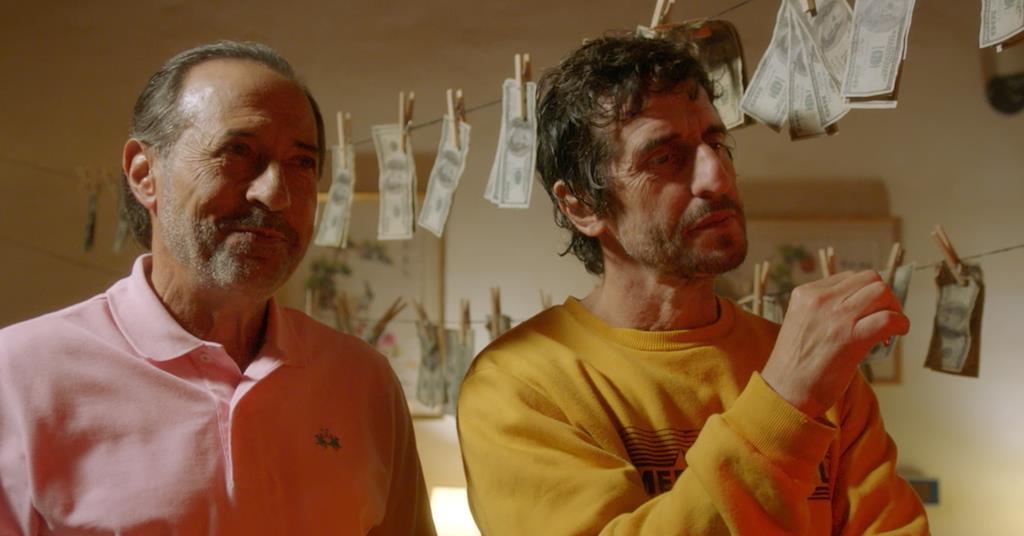
Guillermo Francella and Diego Peretti in THE HEIST OF THE CENTURY. Photo courtesy of Mill Valley Film Festival.
The Heist of the Century, a delightful crime tale from Argentina, tells a story that would be unbelievable – except it all really happened.
Most improbably, one of the masterminds is Fernando (Diego Peretti), a dope-smoking, new agey martial arts instructor. He has an idea for One Big Score – a bank robbery that will take hours, during daylight, in the middle of the city, and is certain to mobilize the entire police force. Fernando enlists a highly disciplined, professional criminal Luis Mario (Guillermo Francella); initially skeptical of and resistant to both Fernando and the job, Luis Mario joins Fernando in planning and assembling a team.
The planning is meticulous, including unexpected elements like studying the SWAT Team manual on hostage negotiations and attending acting class. Three of their solutions to defeating the bank’s security demonstrate undeniable genius.
The heist itself, with the seconds ticking and the bank surrounded by an army of police, is thrilling. The thieves have a formidable opponent in the police negotiator Sileo (an excellent Luis Luque); he is a wise and solid pro surrounded by lesser minds – and he doesn’t appreciate being made to look like Wiley Coyote.
However, what looks like a triumph might come to ruin – because of the most human of foibles. The ending is amazing.
The Heist of the Century is the true story of the 2006 Banco Rio robbery in Acassuso, Argentina, a seaside suburb of Buenos Aires. Fernando Araujo, the original mastermind, is credited as one of the screenwriters.
The Heist of the Century is directed by Ariel Winograd, who emphasizes the contrasting personalities of Fernando and Luis Mario and creates a perfect balance between the humor and the thrills. Winograd spices the soundtrack with music ranging from The Kinks, spaghetti westerns to Motown and opens with a cheesy James Bondesque tune.
Guillermo Francella, who plays Luis Mario, played Ricardo Darin’s drunk assistant in The Secrets of Their Eyes. In this movie, Francella’s real life daughter Ana plays Mario Luis’ daughter Lu.
I screened The Heist of the Century for the Mill Valley Film Festival in October 2020. Now you can stream it from HBO Max, Amazon, Vudu and YouTube.
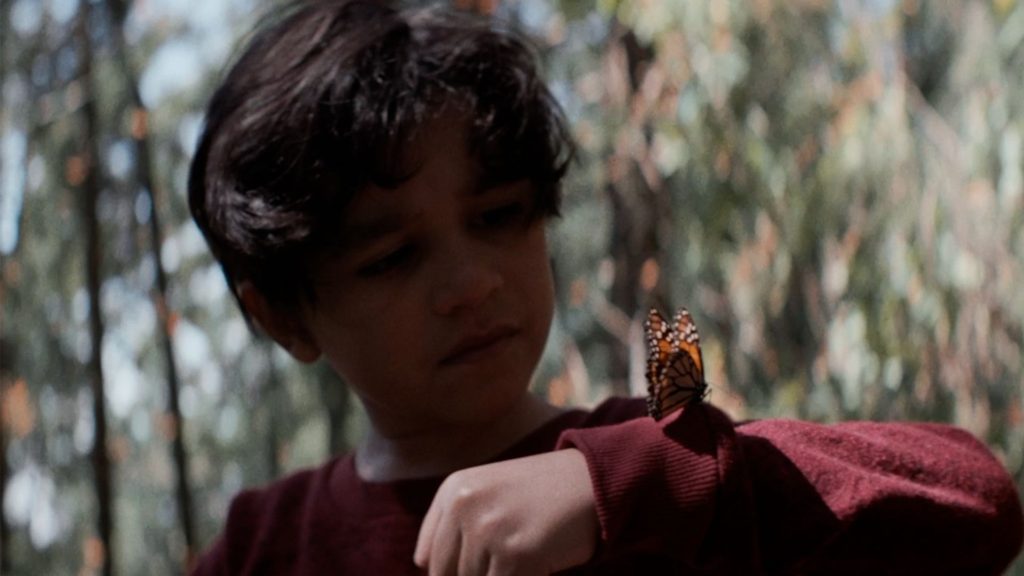
Photo caption: Tenoch Huerta in SON OF MONARCHS. Courtesy of SFFILM.
In the contemplative indie Son of Monarchs, things seem to be going well for the young biologist Mendel (Tenoch Huerta). His career as a scientist at an elite NYC institution seems to be starting well, his mentor respects and encourages him, his peers invite him to socialize and he’s dating a woman with a very unusual hobby. But something is not right, and it’s that Mendel’s very identity is unresolved,.
Mendel comes from rural Michoacán, which Nature has blessed with Monarch butterflies and cursed with disasters that traumatized Mendel in his childhood. The same childhood experiences have built his passion to understand life and have estranged him from his brother and their homeland. When he has occasion to revisit Michoacán, he can no longer compartmentalize his inner conflict.
SON OF MONARCHS. Courtesy of SFFILM.
Son of Monarchs is the second feature for writer-director Alexis Gambis, who makes the most out of the visual contrast between chilly NYC and the vivid warm of Michoacán.
Tenoch Huerta is very good as the somber, restless Mendel. Gabino Rodriguez (recently in the deadpan Fauna and a very scary villain in Sin Nombre) brightens the Michoacán segment.
I first saw Son of Monarchs at this year’s San Francisco International Film Festival (SFFILM). It’s now streaming on HBO Max.
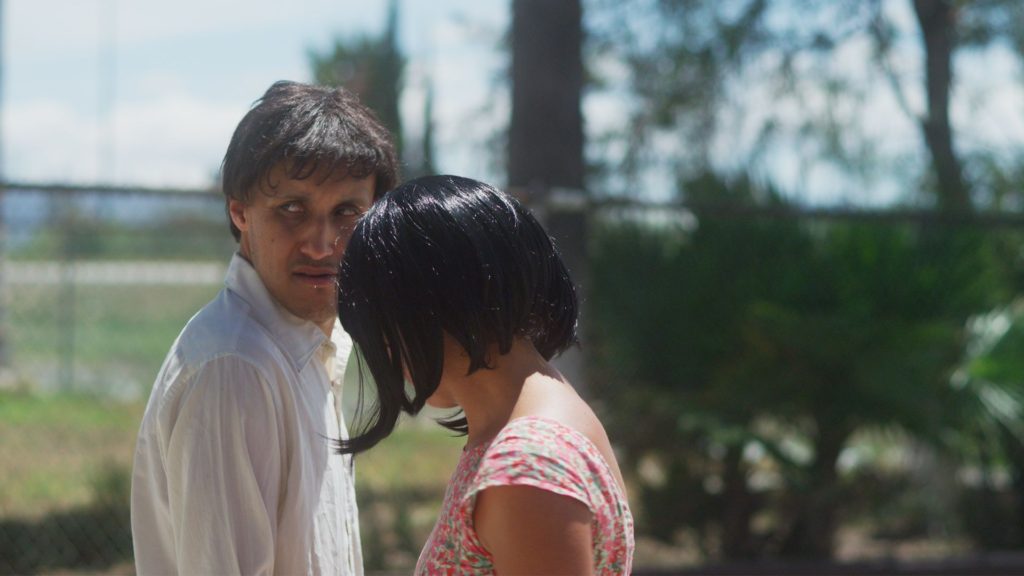
Gabino Rodriguez and Luisa Pardo in Nicolás Pereda’s FAUNA. Photo courtesy of SFFILM.
In Fauna, Luisa (Luisa Pardo) and her boyfriend Paco (Francisco Barreiro), both actors, visit Luisa’s remote Mexican hometown and meet up with her brother (Gabino Rodriguez), stepping into humor even drier than the parched landscape. They intend to visit Luisa’s parents (Teresa Sanchez and José Rodríguez López).
Paco wanders into the town, looking for some smokes. He meets an older man, who makes the encounter unnecessarily awkward. It turns out that the man was his girlfriend’s father.
Luisa runs some lines with her mom, and it’s clear to the audience that the mom is much better than the “professional actress”.
In the highlight of Fauna, the three guys go out for a beer. The dad is fascinated by Paco’s tiny role in a big episodic TV series and has him “perform” in the cantina. It’s a masterpiece of cringe humor and comic timing.
José Rodríguez López, always deadpan, is hilarious as Luisa’s dad. Where has this actor been? Despite being nominated for a 1991 Ariel (Mexico’s Oscar) for his first movie performance, Fauna is only his seventh feature film.
More than halfway though, Fauna pivots. Luisa’s brother has been reading a mystery , and the film begins to mirror the book. The deadpan continues throughout all of Fauna’s 70 minutes.
Mexican-born writer-director Nicolás Pereda lives in Toronto, and Fauna competed as a Canadian film at the Toronto Film Festival.
I screened Fauna at the San Francisco International Film Festival (SFFILM). It’s been released into some theaters, but is hard to find.
Thanks to the Film Noir Foundation, two newly restored classics of film noir are available on DVD. Both are from Argentina – and one of them is a masterpiece.
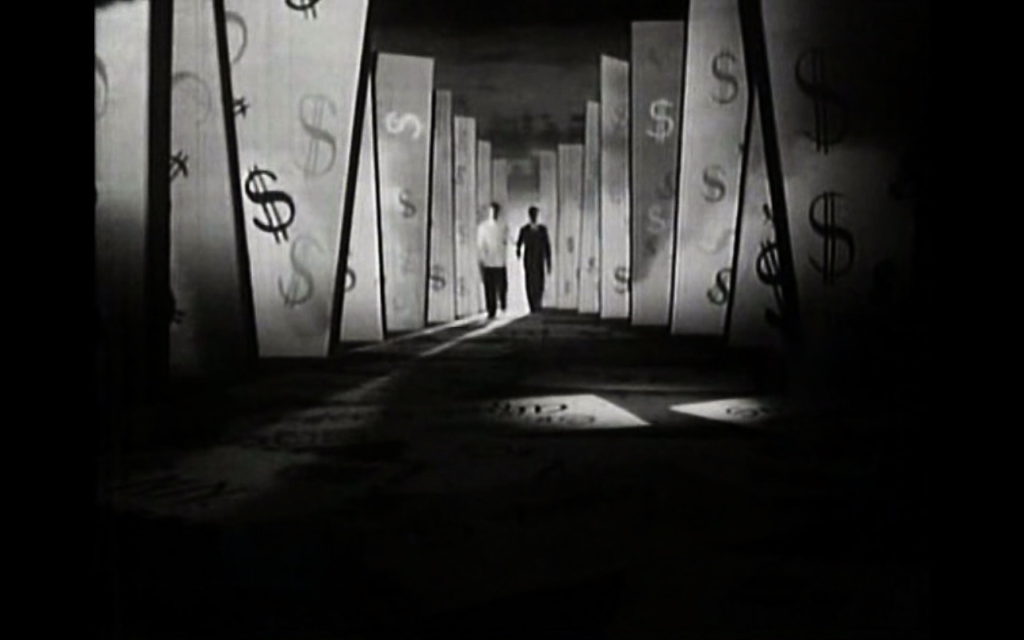
The masterpiece isLos tallos amargos(The Bitter Stems), one of the most imaginative and psychological movies of the classic film noir era. Because of his insecurities, a man invents imagined threats, but his real nemesis is himself. The shocking and ironic ending that would have been far too dark for any Hollywood film of the era.
Los tallos amargos was listed as one of the “50 Best Photographed Films of All-Time” by American Cinematographer. Its storied dream sequence is one of the most surreal in cinema. Los tallos amargos won the Silver Condor (the Argentine Oscar) for both Best Picture and Best Director (Fernando Ayala).
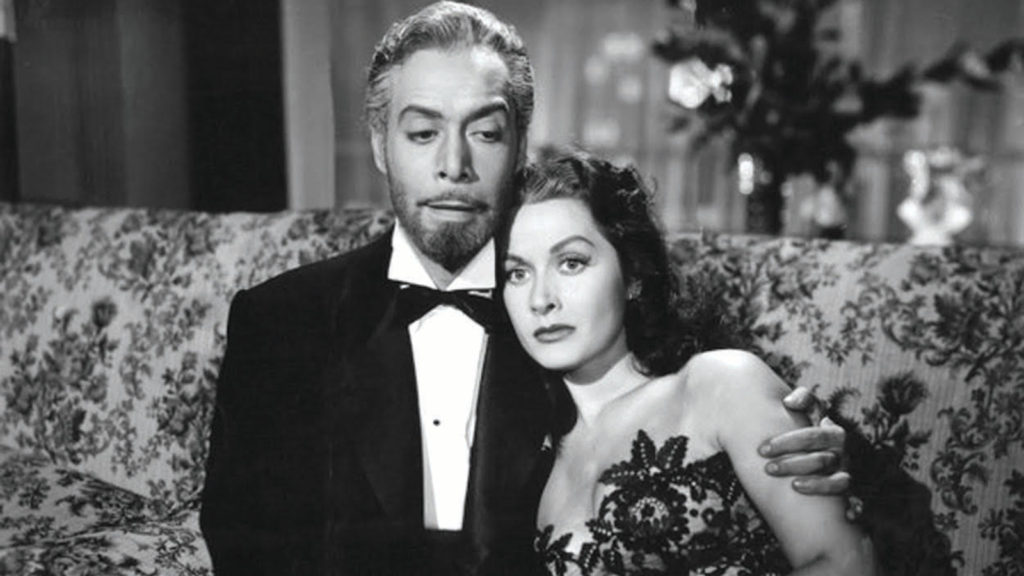
Narciso Ibáñez Menta and Laura Hidalgo in THE BEAST MUST DIE
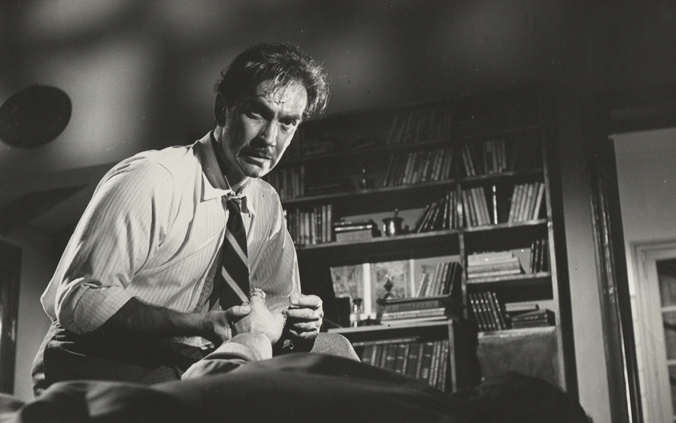
The other film newly available on DVD is The Beast Must Die, which begins with the murder of a man so despicable that every other character has at least one motive for killing him. A visiting detective novelist becomes a murder investigator. As he peels back the onion, the whodunit revolves around which motive propelled the act of murder. There is a big reveal and a shocking ending.
The Los tallos amargos and The Beast Must Die DVDs can be pre-ordered from the Film Noir Foundation, and they will ship beginning November 2, 2021.
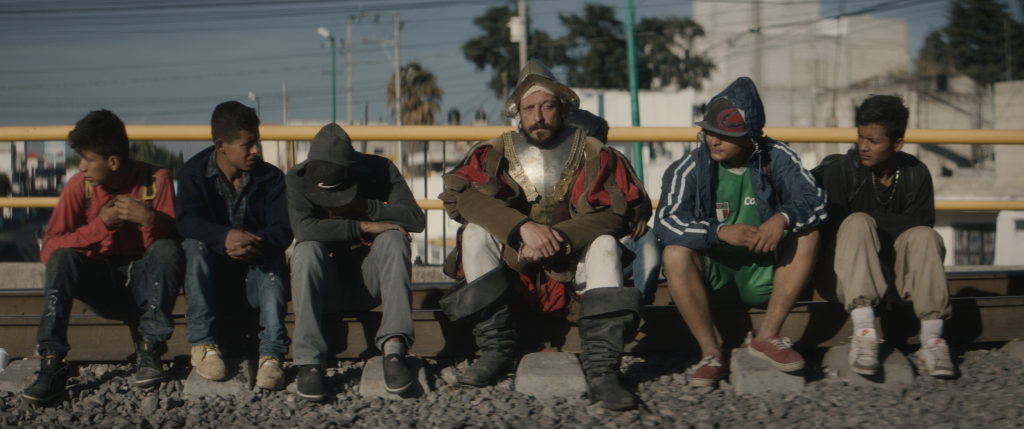
In director and co-writer Rodrigo Reyes’ highly original docu-fable 499, one of Hernán Cortés’ soldiers (Eduardo San Juan Breñais) is transported centuries into the future and plunged into contemporary Mexico. The movie’s title reflects a moment 499 years after Cortés’ conquest of the Aztecs in 1520; the conquistador and the audience discover that the dehumanization inherent in colonialism has persisted to plague modern Mexico.
I’m calling Reyes’ medium a “docu-fable” because it is all as real as real can be (the documentary), except for the fictional, 500-year-old conquistador (the fable).
Cast upon a Veracruz beach after a shipwreck (but 500 years later), the conquistador is terribly disoriented, and retraces Cortés’ march from Veracruz to Tenochtitlan/Mexico City. Seeing everything with a 500 year old lens, he is initially disgusted that the Indians that he conquered are now running things.
Soon he finds a Mexico reeling from narco terror. He meets Mexicans who have been victimized by the cruel outrages of the drug cartels, those risking their lives to hop a northbound train, and those in prison. In the emotional apex of 499, one mother’s account of a monstrous atrocity, clinical detail by clinical detail, is intentionally unbearable.
Reyes wants the audience to connect the dots from Mexico’s Original Sin – a colonialism that was premised on devaluing an entire people and their culture. Will the conquistador find his way to contrition?
499, with its camera sometimes static, sometimes slowly panning, is contemplative. Cinematographer: Alejandro Mejía’s work won Best Cinematography at the 2020 Tribeca Film Festival.
499 opens at San Francisco’s Roxie on September 3 with Rodrigo Reyes in attendance, and will play the Roxie for a week before its national rollout.