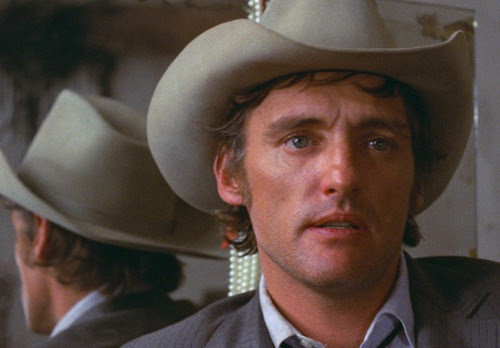
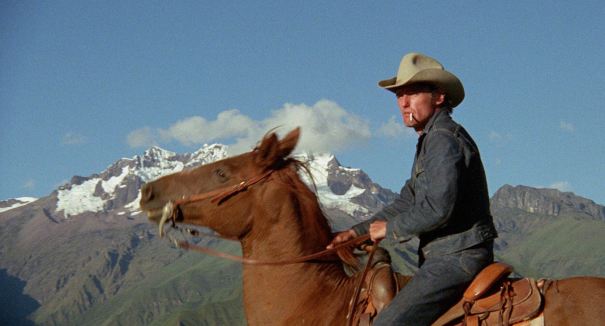
The Last Movie is Dennis Hopper’s notoriously “lost film”, buried by a hostile movie studio in 1971 and still generally unavailable. Given Hopper’s drug addled, out-of-control state during this decade, I was expecting a mess. But what is on the screen is an excellent 1970s art film, beautifully shot by László Kovács. There is a surreal thread that not everyone will buy into, but I think the movie works as a whole.
Hopper plays a Hollywood horse wrangler who is in Peru for a location shoot. He has gone native. setting up local girlfriend Maria (Stella Garcia) in a modern house. He’s already alienated, but a fatal accident on the movie set triggers him into rejecting Western modernity in favor of indigenous Peru. His paradise in the Andes becomes elusive as he meets Ugly American visitors. And then things get really weird, as the local indigenous people begin acting out the movie shoot – only without film. It is a parable of colonialism.
That weirdness, Hopper’s experimentation with the non-chronological construction of the film and some disjointedness/incoherence in the story will be off-putting for many viewers and keeps The Last Movie from being a Great Film. Roger Ebert called it “a wasteland of cinematic wreckage” and condemned it to one star. That said, the setting and Kovács’ cinematography make for a visually stunning film.
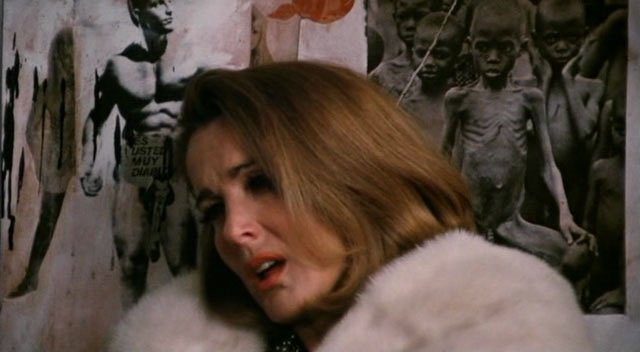
Hopper is always interesting as an actor, but The Last Movie features excellent, perhaps career-topping, performances by Stella Garcia, Julie Adams and Don Gordon.
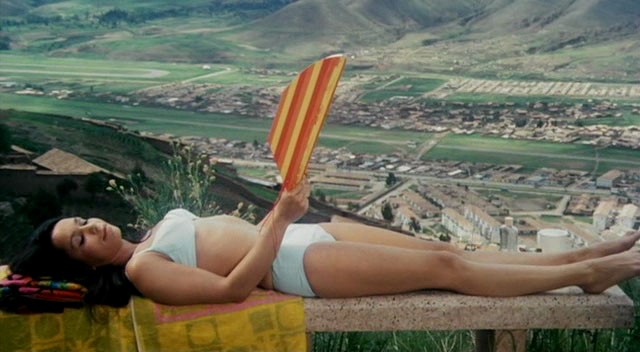
- Garcia projects the inner strength and ambition of a Maria who sees herself as far more than the gringo’s plaything. On the face of it, Maria seems exploited. but she has a strong sense of her value and she insists on getting her due. Anyone who sees her as only arm candy is underestimating her at their own risk. Garcia had already amassed 23 of her 30 screen credits before The Last Movie, then played the top female character in Joe Kidd, and didn’t do much screen acting afterwards.
- Julie Adams plays the sexually voracious wife of a visiting American businessman, capable of cruelly inflicting humiliation. With a career that started in the Studio Era (she co-starred with James Stewart and Rock Hudson in 1952’s Bend of the River), I can’t imagine that she got many scripts like this, and her performance is incendiary.
- Prolific character actor Don Gordon plays Neville, another American expat. Neville is the guy who thinks up a get-rich-quick idea but doesn’t take into account that someone richer, more powerful and with more business sense can take the whole thing away from him. Gordon’s drunk scene is just perfect, especially in capturing how really drunk people don’t notice things about themselves or others. Gordon had the fourth lead in Bullitt and Papillon, and guest-starred in scores of television shows, but his very best work was in The Last Movie and in Hopper’s searing Out of the Blue (aka No Looking Back).
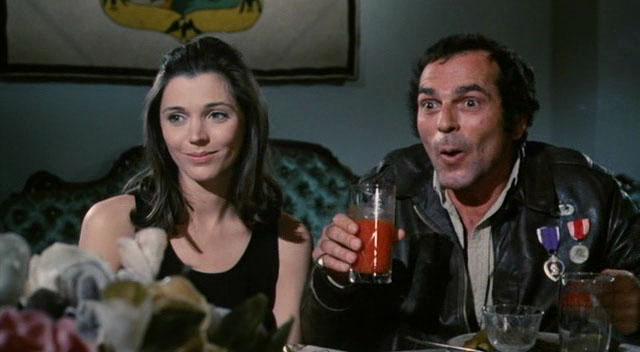
And here’s some fun for movie fans. Fabled outlaw director Sam Fuller plays the director of the movie-within-the-movie. Various cinema notables show up as part of the film crew and at the cast party: Toni Basil, Rod Cameron, Peter Fonda, Henry Jaglom, Kris Kristofferson, Dean Stockwell, Sylvia Miles, John Philip Law, James Mitchum, Michelle Phillips (Dennis Hopper’s wife for eight DAYS), Dean Stockwell and Russ Tamblyn.
What happened to The Last Movie and why did it become a Lost Film? First, Dennis Hopper’s self-indulgence and drug abuse caused him to discard his script, co-written by Stewart Stern, and wing it on the principal photography by cobbling together improvisations that appealed to him at the time. Then Hopper hung on to the film, constantly re-editing it, blowing past his deadline by six months. Universal Pictures mogul Lew Wasserman had given Hopper $i million and creative control; finally getting a movie that was late and grievously over budget – and a movie he found incoherent – Wasserman was outraged and buried The Last Movie’s distribution and publicity. The fiasco ruined Hopper’s reputation in the industry, and he wasn’t able to direct another movie until Out of the Blue in 1980.
I got to see The Last Movie at a 2017 special event curated by the now defunct Cinema Club Silicon Valley. The screening of The Last Movie was preceded by Along for the Ride, the 2016 Dennis Hopper documentary from the perspective of Satya De La Manitou, Hopper’s personal assistant and wing man for forty years. (Along for the Ride is streamable from The Criterion Channel, Amazon, Vudu and YouTube.) The double feature was accompanied by a panel discussion with Along for the Ride director Nick Ebeling, filmmaker Alejandro Adams, film professor Sara Vizcarrondo and critic Fernando Croce.
Hopper regained the rights to The Last Movie in 2006, but was unable to release it on DVD before his death in 2010. Still close to a Lost Film, The Last Movie is only streamable on kanopy, and it occasional screens at repertory arthouses. I’m choosing not to embed the trailer because it unforgivably gives away the last shot.