MAGELLAN: slower than the slowest slow boat

Photo caption: Gael Garcia Bernal in MAGELLAN. Courtesy of Janus Films.

The historical epic Magellan tells the story of explorer/conquistador Ferdinand Magellan’s interactions with people of the Philippines, and most of the movie is set in the Philippines. Magellan begins in 1511, a decade before his most famous voyage, with Magellan serving a more senior Portuguese conquistador. Then the film touches briefly on his life back in Portugal before, again, briefly showing him leading a Spanish-sponsored voyage back to the Philippines.

The strongest element of Magellan is the depiction of historical events from the points of view of both Magellan and of the indigenous Filipinos. I also appreciated Magellan’s equating the superstitious qualities of the Spanish Catholic veneration of religious objects and the indigenous tribe’s idol worship.

Most of us know that Magellan commanded the first expedition to sail around the globe. As Magellan shows, Magellan himself didn’t survive to return home. As Magellan does not point out, a surviving Spanish crew led by one of Magellan’s subordinates did complete the groundbreaking voyage.

Magellan also gets credit for discovering what we know as the Strait of Magellan, the safest navigable route between Atlantic and Pacific Oceans. This is essential history, but it is only possibly referenced in Magellan in a scene where the sailors are all terrified of stormy seas and Magellan isn’t doing anything about it.

Many of the stills from the movie illustrate Magellan on a sailing ship, but I chose to post the image above because very little of this movie about the world’s most famous sailor is at sea.

Magellan is played by Gael Garcia Bernal, a fine actor and a magnetic presence, who isn’t asked to do much here. I doubt that the real Magellan was as passive as the character is written here.

Renowned Filipino writer-director Lav Diaz tells this story in two hours and forty minutes of intermittently interesting action. Diaz is an intentional practitioner of a cinematic style called slow cinema, which I am coming to loathe. I actually enjoy much longer shots and much more deliberate pacing than do most, but I just can’t take slow cinema, which feels to me like it is violating the rhythm of storytelling for no reason.

Magellan seemed longer than 140 minutes to me. I found the pace to range between insufferable and excruciating.

Magellan was the Philippines submission for the Best International Feature Oscar. It is streaming on the Criterion Channel.

THE SECRET AGENT: we’re all back in 1977, and he’s running for his life

Photo caption: Wagner Moura in THE SECRET AGENT. Courtesy of NEON.

The Secret Agent is both a superb movie and an unexpectedly original immersive experience. Writer-director Kleber Mendonça Filho embeds his slow burn thriller into 1977 Brazil, and Mendonça creates an unsurpassed sense of time and place, which is absolutely absorbing.

Wagner Moura plays a man traveling under an assumed name, making his way across the country in a VW Beetle. Eventually, we learn that his name is Armando, and he’s returning to his home city of Recife. He’s on the down low now, on the run from something, but when he later learns the particulars of the threat against him, his flight becomes increasingly urgent and cloak-and-dagger.

In the first scene, at a rural gas station, Mendonça tells us three things about the setting. Disorder reigns. Life is cheap. The police are unabashedly corrupt.

Mendonça doesn’t paint a picture of a regime like Pinochet’s Chile, where th state itself is hunting down its perceived dissenters and eliminating them by imprisonment, torture and extra-judicial execution. Rather, Mendonça’s 1977 Brazil is chaotic, where the government, casually and without much organization, tolerates or even perpetrates murder at the private whims of the rich. While the rich and their henchmen call their targets “communists”, this isn’t ideological, it’s for the most personal of interests, such as revenge and greed. Indeed, Armando isn’t a dissident activist; he’s a technology professor whose success at his job has become inconvenient for a crooked industrialist.

The cops are portrayed, often comically, as vulgar louts; the ongoing feeling of menace in The Secret Agent stems from their unaccountability. The Secret Agent simmers with tension until Mendonça brings the story to a boil with Hitchcockian suspense in a humdrum government office and an explosively thrilling chase through the sidewalks and alleys of Recife.

In juxtaposition to the life-and-death stakes of Armando’s story, it is Carnival time, and the population at large is embracing boisterous partying and carefree sensuality. The local media has created a fantastic bogeyman to sell newspapers, which Mendonça hilariously brings to life. There are recurring themes of sharks, dismembered legs and movies.

One of the movies (also shark-themed) is Jaws. Besides the movies and popular music, Mendonça brings us the cars and the dress of 1977, down to details like a Nadia Comaneci poster in the background. I have no idea how he filled the street of Recife with hundreds of extras, all dressed as in 1977 fashion. It’s very, very hot, and the men wear their shirts open, or not at all.

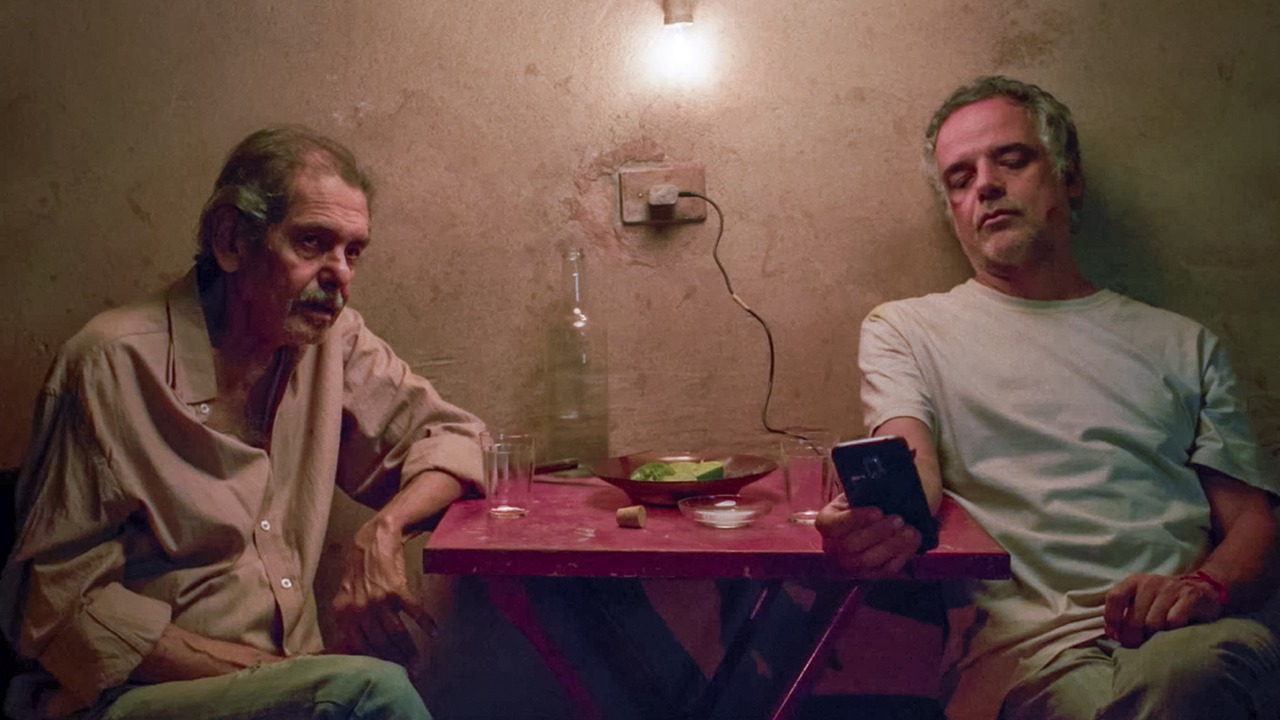
We’re jarred when we see an iPhone on a tabletop, Mendonça’s clever tipoff that he has jumped the story 48 years into the future.

The plot is about what will happen to Armando, and Mendonça reveals the answer in a surprisingly non-exploitative way. It’s underplayed, and it’s really perfect.

Wagner Moura carries the film, emanating Armando’s unusual decency, intelligence, and determination (and maybe too much stubborness for his own good).

As good as is Moura, The Secret Agent astounds with its amazingly deep cast and pitch-perfect performances. We come to know even the most minor characters as distinct individuals without tereotypes, and there are over 20 indelible performances. In particular, the child actor Enzo Nunes, playing Armando’s six-year-old son, gives a strongly textured performance reacting to Armando’s explanation of his mother’s death. Their are eight villains, each loathsome in entirely singular ways. This is the first year that the Academy Awards are granting an Oscar for casting, and The Secret Agent is justifiably nominated.

Mendonça had a US arthouse hit in 2016 with the Sonia Braga showcase Aquarius. That film was critical of the political status quo, and the Brazilian government’s refusal to submit it for the Best Foreign Language Picture Oscar created a controversy, detailed in this New York Times article.

The Secret Agent is nominated for four Oscars: Best Picture, Best International Picture, Best Actor and Best Casting. It should have been nominated for Best Director. You can stream it from Amazon, AppleTV, YouTube and Fandango.

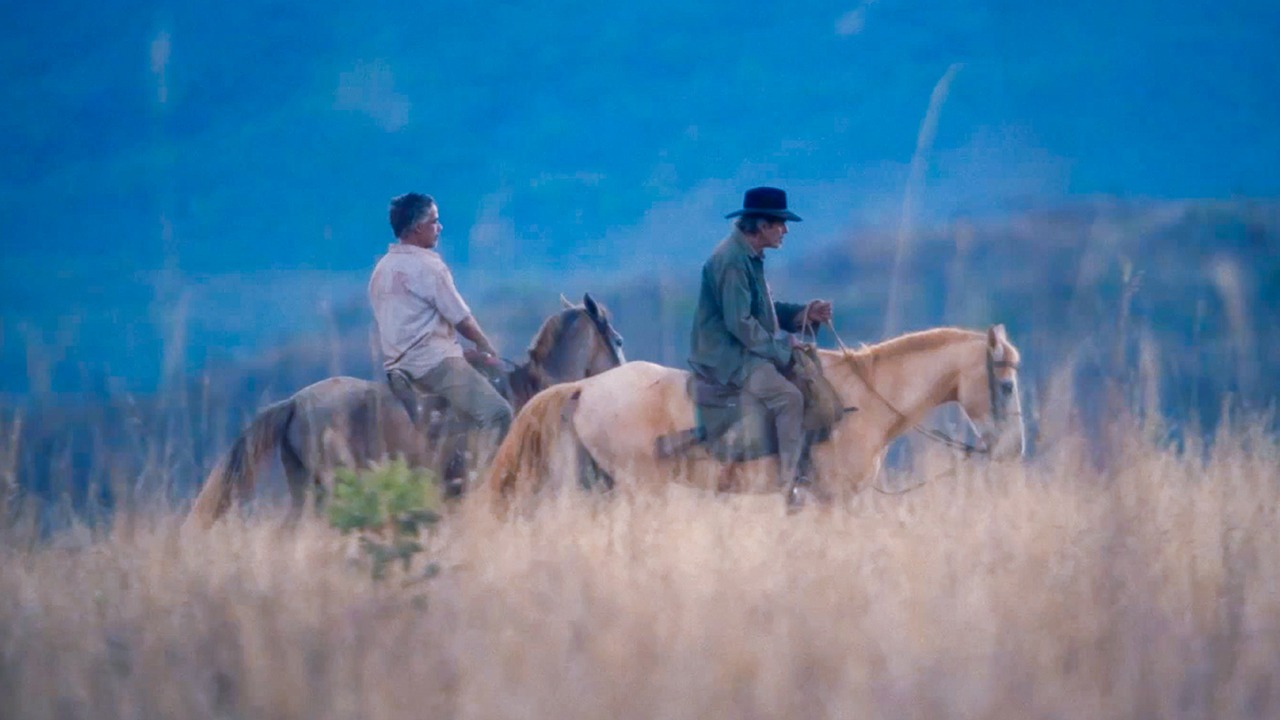
SAME OLD WEST: where men are men but aren’t great shots

A scene from Erico Rassi’s SAME OLD WEST. Courtesy of Cinequest.

The contemporary Brazilian western Same Old West begins with two men slugging it out over a woman, before they start hiring gunmen to take out the other. She is the only woman in the film, only on screen for about 45 seconds, and, as one who knows her well observes, she has had bad luck with husbands.

Same Old West takes us into a Brazil that is neither Rio de Janeiro nor the Amazon rainforest. This is a flat and arid land that looks like it could be in Spain, Mexico or the American Southwest.  It’s a remote and backward place where hired killers are still call gunmen instead of hit men. The gunmen don’t own a .44 magnum or a Glock or an AK-47 among them – they use their hunting rifles. This is a place where making an escape on horseback is still absolutely normal.

Literally, the plot of Same Old West sounds male-oriented – a bunch of guys hunting each other with gun violence on their minds. But, it’s really about men who have been rejected by women, and their inability to understand it or to move on. They’re aspiring to toxic masculinity, but they’re too laughably pathetic to achieve it. Female audiences will appreciate the sharp critique of maleness at its most dunderheaded.

Same Old West is being characterized as a drama, which isn’t really wrong because it’s about murderous manhunts. But I see it as a dark comedy that skewers male cluelessness. The very sparse and overly formal dialogue, delivered deadpan, is remarkably droll. If you like your humor as dry as the landscape, Same Old West is downright hilarious. 

Same Old West is the second feature for writer-director Erico Rassi. It’s a visually striking and richly atmospheric film, with hints of Sergio Leone.

Cinequest hosts the world premiere of Same Old West, which I’ve highlighted in my Best of Cinequest.

A scene from Erico Rassi’s SAME OLD WEST. Courtesy of Cinequest.

AQUARIUS: spirit, thy name is Sonia Braga

Sonia Braga in AQUARIUS

In the Brazilian character-driven drama Aquarius, Sonia Braga plays Clara, the last owner of a beachfront condo who hasn’t sold out to a developer who owns the rest of the condos.  The conflict is between Clara, who refuses to sell and those her want her to.  But Aquarius is really about Clara, and it takes its time setting up her character; it’s 26 minutes before we even see the developers.   We must understand her to understand her motivation – and her will.

Aquarius moves through scenes with a lifeguard at the beach, with girlfriends at club, at family parties,  not to move the plot, but to invest in revealing aspects of Clara’s character.  Having conquered cancer, lost her husband, raised children and built an artistic career, Clara has some mileage on her – enough to know what she wants and needs. Having earned the authority to live her life as she pleases, Clara is a wilful free spirit.  And, as everyone finds out, she is absolutely fearless.

It’s a career-capping performance for Sonia Braga, still luminous 40 years after Donna Flor and Her Two Husbands.  Mid movie, there’s a scene when Clara’s adult children try to have an awkward conversation about the financial benefits of selling the apartment.  She doesn’t make it easy for them, and their long-submerged feelings about their father and their mother surface.  With piercing observations and cold-eyed disappointment, Clara is as masterful over her children as when they were infants.  It’s hard to imagine a better movie scene this year.  Braga is brilliant.

The young Brazilian television actor Humberto Carrão is exceptional as Clara’s ever smiling foil Diego, whose youth and punctilious civility mask a capacity to engage in any tactic, even very dirty tricks.

I viewed Aquarius at the Mill Valley Film Festival.

Aquarius is critical of the political status quo, and the Brazilian government’s refusal to submit it for the Best Foreign Language Picture Oscar has created a controversy detailed in this New York Times article.