Three Faces of Nathalie Baye

Photo caption: Nathalie Baye in THE RETURN OF MARTIN GUERRE

Nathalie Baye, one of the world’s most distinguished screen actors, died this week, leaving a formidable body of work. She was nominated ten times for a César, France’s Oscar-equivalent and won four times. Her over 100 screen credits included work with the greatest directors and in the most aspirational films, but also smaller movies and smaller roles.
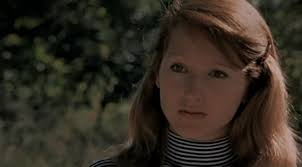
Nathalie Baye in DAY FOR NIGHT

Here are three Baye roles that illustrate both the sweep of her career and her acting range:

  • Day for Night, Francois Trauffaut (1971). Truffaut himself plays a movie director trying to ride herd on a cast and crew whose egos, neuroses and libidos are running amok, and leads a strong ensemble cast with Jacqueline Bisset, Valentina Cortese and Tauffaut’s leading-man-in-residence Jean-Pierre Leaud. At age 25, Baye plays the script girl Joelle (a job now termed the script supervisor), who persists in her assignment while chaos swirls about her. They say that acting is reacting, and Baye’s performance as the focused cinephile brought her widespread notice. “I’d drop a guy for a film. I’d never drop a film for a guy.”(Currently hard to find, despite its place in Truffaut’s oeuvre.)
  • The Return of Martin Guerre, Daniel Vigne (1982). AT 34, Baye plays the 16th-century peasant Bertrande, whose husband had left a decade earlier. When the villagers hail the return of her husband after all those years, Bertrand, despite complicated feelings, takes up with him. After the couple is settled in and has had a child, the village is shocked by the appearance of Bertrande’s actual husband, revealing that the first guy is an imposter, and that Bertrande must have known. The imposter is put on trial. Amazingly, these are actual historical events and characters. This is the greatest of the Baye performances that I have seen; more on this later. (Amazon, AppleTV, YouTube.)
  • The Flower of Evil, Claude Chabrol (2003). The 55-year-old Baye plays Anne, the second wife of a business mogul living in an estate outside Bordeaux. He presides over a family rife with poisonous relationships. Smugly entitled, Anne seeks local elective office, but her campaign becomes derailed by both a family secret about Nazi collaboration in the past and a real-life homicide in the present. As Baye’s Anne moves from petty status-seeking to desperation, Chabrol deliciously skewers the upper class. (AppleTV, YouTube.)

The marvel of Baye’s performance in The Return of Martin Guerre is that the audience needs to accept the possibility that Bertrande recognizes the returnee as her husband, and THEN realize that she knowingly embraced the imposter as her husband. She had to play the character both ways at once. These events occurred 300 years before photography, and people physically change over a decade, which explains the villagers accepting the resemblance between the imposter and the husband. Because the husband was a nogoodnik who abandoned Bertrande, we would expect her to greet his return with complicated feelings at first. Baye’s Bertrande was a triumph of ambiguity.

The Return of Martin Guerre matched France’s two biggest stars in their prime at age 34. The imposter is played by 17-time César nominee Gerard Depardieu, before he plunged enthusiastically into all seven deadly sins and disgraced himself with boorish comments about and behavior toward women.

Baye herself severely glammed down to play a medieval peasant. Baye was living with Johnny Hallyday (France’s greatest pop singer and the French Elvis) at the time and was part of France’s most sensational celebrity couple.

Baye liked to work a lot. I recently was surprised to see her as a minor character in some forgettable fluff (Downton Abbey: A New Era) and exclaimed “hey’,that’s France’s Meryl Streep!,
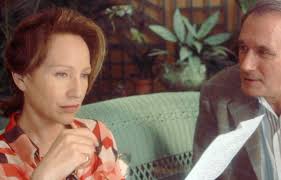

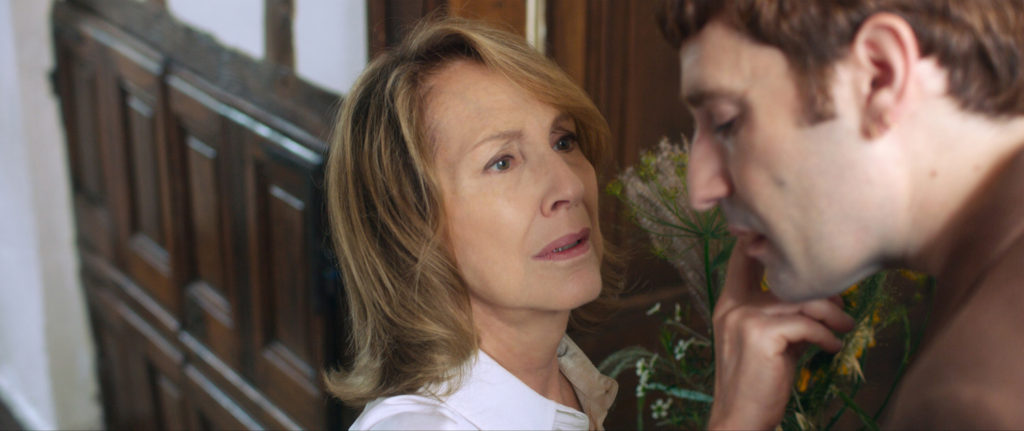
Nathalie Baye (left) in THE FLOWER OF EVIL

MY BEST PART: growing up, with a boost from mom

Photo caption: Nicolas Maury in MY BEST PART. Courtesy of Altered Innocence.

In the French coming of age dramedy My Best Part, the young actor Jérémie (Nicolas Maury) is teetering on the verge of a breakdown. Not that Jérémie is generally a stable person – he is so needy and dramatic that he attends Jealous Anonymous.  But he loses a gig that he was counting on, his credit card is declined, and worst of all, Jérémie’s smothering jealousy sabotages his relationship with his veterinarian boyfriend (Arnaud Valois), Jérémie’s neurotic fit having disrupted ferret surgery.

With his tail between his legs, Jérémie Paris retreats to hos boyhood home in rural Limousin (the area around Limoges) and the arms of his mother (Nathalie Baye). Jérémie is open to infantilization, but the matter-of-fact Mom is anything but neurotic. With prodding from his mom, will he start behaving like a sane, stable grownup and get his life back on the rails?

Nathalie Baye and Nicolas Maury in MY BEST PART. Courtesy of Altered Innocence.

I’ll watch ten-time César Award nominee Nathalie Baye in anything. Here, in an unchallenging role, she brightens every scene with the sniveling son.

One of the world’s funniest actors, Laure Calamy gets to play a hilarious meltdown in a brief turn as a narcissistic film director.

My Best Part is the feature directing debut for Maury, who also co-wrote the screenplay. My Best Part was nominated for the César for Best First Film.

Parts of My Best Part drag, especially a slooooooow nighttime poolside scene. The final scene, in which Jérémie sings lyrics that explicitly detail his character’s growth, is off-putting and self-indulgent.

My Best Part opens Feb 25 on VOD and at the Glendale Laemmle.

MOKA: whodunit mixed with psychological thriller

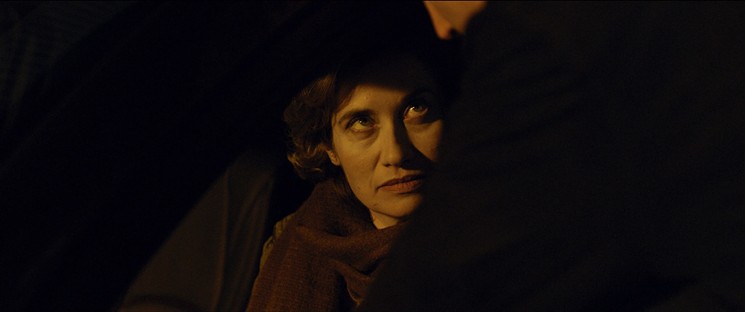
Emannuelle Devos in MOKA

In the atmospheric ticking clock drama Moka, Emanneulle Devos plays Diane, a Swiss woman whose daughter has been killed in a hit-and-run accident.  Months afterward, she is still consumed with grief.  Impatient with the slow and uncertain pace of the police investigation and with her husband’s attempts at finding closure, Diane launches her own investigation to find the responsible party and make them pay.

Diane starts connecting dots and begins to suspect Marlène (Nathalie Baye), a shopowner from a neighboring town in France.   Diane adopts the alias of Hélène and, creepily, begins to infiltrate Marlène’s life.  Moka is a whodunit mixed with psychological thriller – who is really the perp and what is Diane capable of doing?

I, for one, didn’t see the big plot twist coming.  Director Frédéric Mermoud adapted the screenplay from the Tatiana De Rosnay novel.

The prolific French actress Emanneulle Devos made a splash in 2001 with Read My Lips and popped up recently in the indie Frank & Lola.  Devos has a very compelling quality.  She excels at playing women who are very intense and possibly dangerous, women like Diane in Moka.

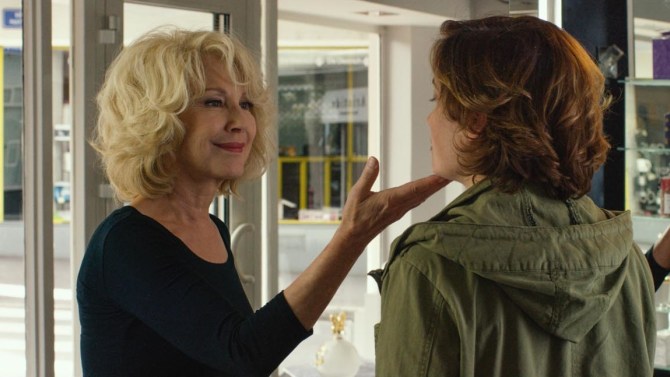
Nathalie Baye and Emmanuelle Devos in MOKA

Nathalie Baye is the Meryl Streep of France, nominated ten times for France’s Best Actress award.  She started off in 1972 as Joëlle the script girl in Trauffaut’s Day for Night, and had risen to international stardom by 1982 and her performance in The Return of Martin Guerre – one of the greatest acting turns in all cinema. In Moka, Baye’s Marlène is a seemingly uncomplicated woman.  We correctly suspect that she’s something else under the surface, but we don’t guess what that really is.  It’s great to see Baye take this supporting role and nail it.

Moka is a well-crafted fuse-burner and a showcase for two great actresses. You can stream it from Amazon, iTunes, Vudu, YouTube and Google Play.

MOKA: whodunit mixed with psychological thriller

Emannuelle Devos in MOKA

In the atmospheric ticking clock drama Moka, Emanneulle Devos plays Diane, a Swiss woman whose daughter has been killed in a hit-and-run accident.  Months afterward, she is still consumed with grief.  Impatient with the slow and uncertain pace of the police investigation and with her husband’s attempts at finding closure, Diane launches her own investigation to find the responsible party and make them pay.

Diane starts connecting dots and begins to suspect Marlène (Nathalie Baye), a shopowner from a neighboring town in France.   Diane adopts the alias of Hélène and, creepily, begins to infiltrate Marlène’s life.  Moka is a whodunit mixed with psychological thriller – who is really the perp and what is Diane capable of doing?

I, for one, didn’t see the big plot twist coming.  Director Frédéric Mermoud adapted the screenplay from the Tatiana De Rosnay novel.

The prolific French actress Emanneulle Devos made a splash in 2001 with Read My Lips and popped up last year in the indie Frank & Lola.  Devos has a very compelling quality.  She excels at playing women who are very intense and possibly dangerous, women like Diane in Moka.

Nathalie Baye is the Meryl Streep of France, nominated ten times for France’s Best Actress award.  She started off in 1972 as Joëlle the script girl in Trauffaut’s Day for Night, and had risen to international stardom by 1982 and her performance in The Return of Martin Guerre – one of the greatest acting turns in all cinema. In Moka, Baye’s Marlène is a seemingly uncomplicated woman.  We correctly suspect that she’s  something else under the surface, but we don’t guess what that really is.  It’s great to see Baye take this supporting role and nail it.

Moka is a well-crafted fuse-burner and a showcase for two great actresses.

Nathalie Baye and Emmanuelle Devos in MOKA