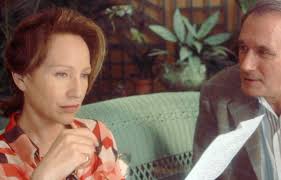
Nathalie Baye, one of the world’s most distinguished screen actors, died this week, leaving a formidable body of work. She was nominated ten times for a César, France’s Oscar-equivalent and won four times. Her over 100 screen credits included work with the greatest directors and in the most aspirational films, but also smaller movies and smaller roles.
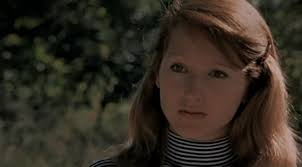
Here are three Baye roles that illustrate both the sweep of her career and her acting range:
- Day for Night, Francois Trauffaut (1971). Truffaut himself plays a movie director trying to ride herd on a cast and crew whose egos, neuroses and libidos are running amok, and leads a strong ensemble cast with Jacqueline Bisset, Valentina Cortese and Tauffaut’s leading-man-in-residence Jean-Pierre Leaud. At age 25, Baye plays the script girl Joelle (a job now termed the script supervisor), who persists in her assignment while chaos swirls about her. They say that acting is reacting, and Baye’s performance as the focused cinephile brought her widespread notice. “I’d drop a guy for a film. I’d never drop a film for a guy.”(Currently hard to find, despite its place in Truffaut’s oeuvre.)
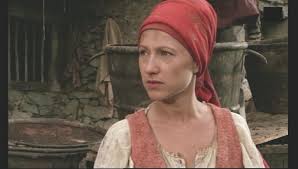
- The Return of Martin Guerre, Daniel Vigne (1982). AT 34, Baye plays the 16th-century peasant Bertrande, whose husband had left a decade earlier. When the villagers hail the return of her husband after all those years, Bertrand, despite complicated feelings, takes up with him. After the couple is settled in and has had a child, the village is shocked by the appearance of Bertrande’s actual husband, revealing that the first guy is an imposter, and that Bertrande must have known. The imposter is put on trial. Amazingly, these are actual historical events and characters. This is the greatest of the Baye performances that I have seen; more on this later. (Amazon, AppleTV, YouTube.)
- The Flower of Evil, Claude Chabrol (2003). The 55-year-old Baye plays Anne, the second wife of a business mogul living in an estate outside Bordeaux. He presides over a family rife with poisonous relationships. Smugly entitled, Anne seeks local elective office, but her campaign becomes derailed by both a family secret about Nazi collaboration in the past and a real-life homicide in the present. As Baye’s Anne moves from petty status-seeking to desperation, Chabrol deliciously skewers the upper class. (AppleTV, YouTube.)
The marvel of Baye’s performance in The Return of Martin Guerre is that the audience needs to accept the possibility that Bertrande recognizes the returnee as her husband, and THEN realize that she knowingly embraced the imposter as her husband. She had to play the character both ways at once. These events occurred 300 years before photography, and people physically change over a decade, which explains the villagers accepting the resemblance between the imposter and the husband. Because the husband was a nogoodnik who abandoned Bertrande, we would expect her to greet his return with complicated feelings at first. Baye’s Bertrande was a triumph of ambiguity.
The Return of Martin Guerre matched France’s two biggest stars in their prime at age 34. The imposter is played by 17-time César nominee Gerard Depardieu, before he plunged enthusiastically into all seven deadly sins and disgraced himself with boorish comments about and behavior toward women.
Baye herself severely glammed down to play a medieval peasant. Baye was living with Johnny Hallyday (France’s greatest pop singer and the French Elvis) at the time and was part of France’s most sensational celebrity couple.
Baye liked to work a lot. I recently was surprised to see her as a minor character in some forgettable fluff (Downton Abbey: A New Era) and exclaimed “hey’,that’s France’s Meryl Streep!,