Cinequest: The Illiterate

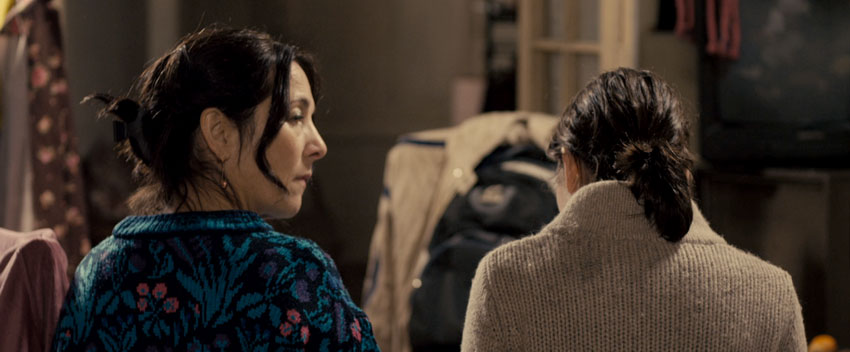
AnalfabetasThe Illiterate is a Chilean two-hander of a drama. A woman in her mid-50s can’t read. She navigates life by telling passersby that she has lost her glasses and needs them to read the signage to her. A woman in her 20s comes to read her the newspaper. Prompted by an unread letter from the older woman’s father, the younger woman decides to teach her to read. The older woman is proud and prickly, and they clash. Each has a meltdown as we move from first to second to third act. When she finally reads the looming letter from the father, it’s underwhelming.

The illiterate is played by the accomplished and appealing Chilean actress Paulina Garcia (Gloria), and The Illiterate is mostly an excuse for Garcia to act up a storm. Not much else here.  Too bad, because I love promoting Chilean cinema and really wanted to like this.

Cinequest: Unforgiven

Unforgiven
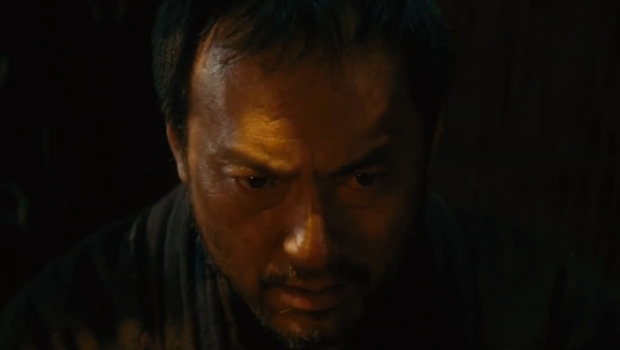
Unforgiven is the Japanese remake of Clint Eastwood’s Oscar-winning Unforgiven, starring Ken Watanabe (Inception, The Last Samurai, Letters from Iwo Jima).   Since Clint’s career was boosted by a remake of Yojimbo (A Fistful of Dollars), it’s fitting that his Unforgiven is remade as a samurai (technically a post-samurai) film.  [Remarkably, it’s been 22 years since Clint’s Unforgiven – a powerful comment on both violence and movie violence.]

This Unforgiven is set in remote northern Japan beginning in 1869, as the samurai of the defeated Shogun are hunted down by the new government.  We all know the story – a prostitute is disfigured, and her peers hire some retired killers to kill the perps.  One of old vets is Jubee (Watanabe) the once invincible action hero who is now defeated and still reeling from personal loss (Eastwood’s Bill Munney in the 1992 film). When a younger man is troubled by his first kill, Jubee advises, “Drink until you forget. You’ll remember later”. His conscience remains tortured by an unpardonable atrocity that he committed during his fighting days.

Some of the vistas are so grand that they remind me of Kurosawa’s Ran and Kagemusha.  Director Sang-il Lee’s version is more beautiful, funnier and more crisply-paced than Eastwood’s original.  But Eastwood’s was more profound – and the comment on violence was more accessible.  In both versions, there’s a ruthless and despicable villain to be dispatched. The killing is unadorned and very, very personal.

Ken Watanabe is always good, and here he channels Clint to produce a character worn down and defeated by tragedy, but still plenty dangerous.  In perhaps an even better performance, Akira Emoto plays his comrade Kingo (the Morgan Fairchild role).

It’s pretty ambitious to remake a movie that won the Academy Award for Best Picture.  Unforgiven passes the test.  It’s a damn fine movie.

Cinequest: Grand Piano


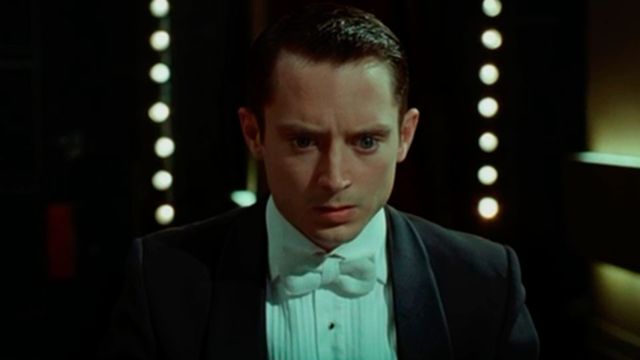
grandpianoExpressly Hitchcockian in style, Grand Piano is a wannabe thriller that unfortunately falls short. Elijah Wood plays a superstar concert pianist who has spent five years in seclusion after melting down from stage fright. As he sits at the piano for his big comeback concert, he receives a threat: if he misplays even one note, either he or his wife will be immediately killed. Already a bundle of nerves, he must navigate his way through the performance while trying to find his tormentor.

What Grand Piano has going for it is Elijah Wood. Who else would you cast for wide-eyed terror (or wide-eyed anything for that matter)?  But the plot is just too contrived to engage us. So the manipulative suspense is there, but, ultimately, not the thrills.

Cinequest: Hunting Elephants

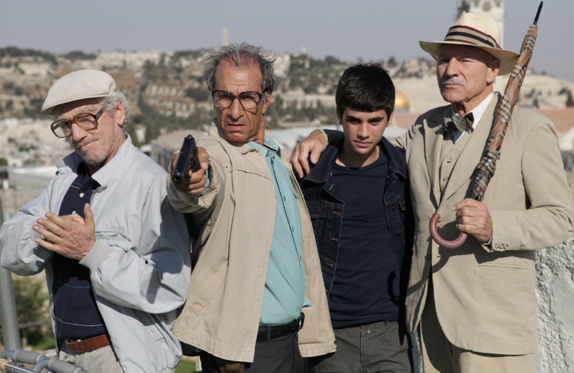
Hunting ElephantsAlong with The Grand Seduction, the Israeli caper comedy Hunting Elephants has been the audience favorite at Cinequest. Apparently, Israelis see just as little generosity, fair-mindedness and decency in their bankers as we do in ours. When a particularly smarmy banker goes too far, a victimized family unleashes a team of septuagenarians led by a 12-year-old to make things right. The old guys are veterans of Irgun, the Zionist terrorists (or freedom fighters, depending on your perspective) who forced an end to the British Mandate in Palestine, so they’re a particularly tough set of characters (even ravaged as they are by age). To their – and his – discomfort, they are teamed with an effete and pretentious scoundrel from the British stage (Patrick Stewart).

The genius of Hunting Elephants is that it combines the comic potential of a coming of age story, a geezer liberalization tale, a gang-that-couldn’t-shoot-straight saga and a fish-out-of-water (the Patrick Stewart character) farce. Mixed with the poignancy of the boy and the old men grasping for some dignity, the result is satisfying crowd pleaser.

Cinequest: I’m the Same, I’m Another

imthesameimtheotherIn I’m the Same, I’m Another, a man in his 30s is on the run with a 10-year-old girl. Writer-director Caroline Strubbe challenges the audience to figure out why and from whom and to what end they are running – and even what is the relationship between the man and the girl.  Although I’m the Same, I’m Another is a Belgian film, the two Dutch-speaking characters primarily speak in English.
We worry about the welfare of the child, so there is a consistent tension over the film’s 110 minutes. At the end, we learn the general category of the relationship between the man and the girl and the trajectory of what will happen to each of them, but not much more.
I generally like movies that require the audience to meet the story halfway instead of having the story all wrapped and dropped on your porch like a UPS parcel. And I’m definitely OK with an ambiguous ending. But I’m the Same requires a helluva investment from the audience – two hours with not much action and plenty of anxiety.  Ultimately, I didn’t think that the payoff was worth the two hours of angst.
SPOILER ALERT: What I’m the Same does especially well is the portrait of the girl who has been traumatized by a sudden loss. Although she is not overtly abused by the man, and although he provides her with basic needs, and although her need for attachment draws her to bond with him, it’s clear that he is not going to be able o address her emotional damage in the long run.  Because they hide out in an industrial outpost on the northern British coast, both their impoverished and furtive circumstance and the dreary setting contribute to a pretty grim cinematic experience.

Cinequest: Words and Pictures

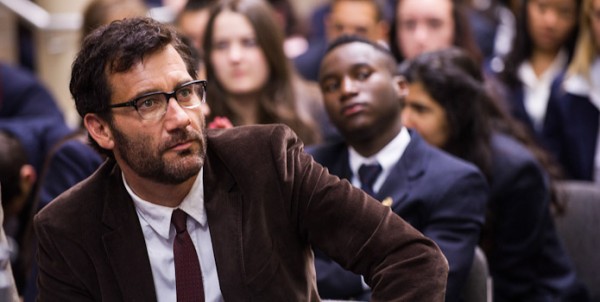
words picturesIn the unusually thoughtful romantic comedy Words and Pictures, Clive Owen and the ever-radiant Juliette Binoche star as sparring teachers. The two play world-class artists – Owen a writer and Binoche a painter – who find themselves in teaching jobs at an elite prep school.  As they spiritedly disagree over whether words or pictures are the most powerful medium of expression, they each admire and are drawn to the other’s talent and passion.

Words and Pictures contains the wittiest movie dialogue in many moons and reminds us that real wit is more than some clever put downs.   Owen’s English teacher worships the use of language to evoke original imagery and also revels in pedantic wordplay – the more syllables the better.  When his boss asks him, “Why are you always late?”, he retorts “Why are you always dressed monochromatically?”.

The reason that he IS always late is that he’s an alcoholic hellbent on squandering his talent and alienating his friends and family.  This is a realistic depiction of alcoholism and of its byproducts – unreliability, broken relationships and fundamental dishonesty.  In an especially raw scene, he expresses his self-loathing by using a tennis racquet and balls to demolish his own living space.  Top notch stuff.

Binoche plays a woman of great inner strength and confidence who has been shaken by the advances of a chronic illness.  According to the credits, Binoche herself created her character’s paintings.

Words and Pictures sparkles until near the end. When the students make the debate over words vs pictures explicit in the school assembly, the intellectual argument loses its force and the tension peters out.  So it may not be a great movie, but Words and Pictures is still plenty entertaining and a damn sight smarter than the average romantic comedy.

Cinequest: Zoran, My Nephew the Idiot

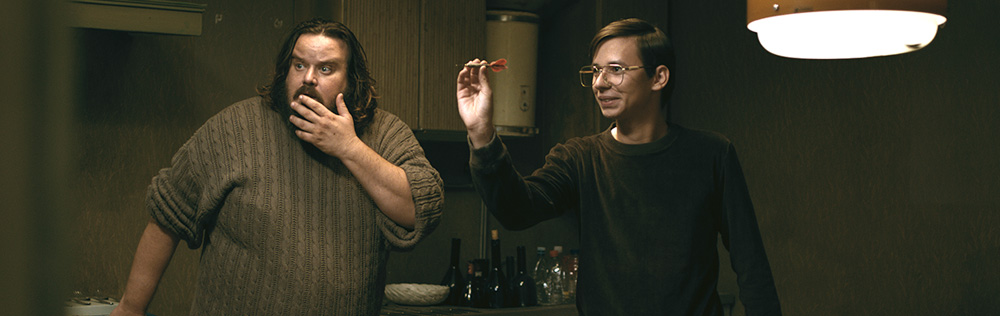
ZoranThe Italian comedy Zoran, My Nephew the Idiot is centered around Paolo, a hard-drinking slob who works in a cafe kitchen in the Italian region that borders Slovenia.  Boorish as he is, Paolo is mostly marked for his unrestrained selfishness.  “You are a bad man,” he is told.  When an aunt dies, he is dismayed to learn that, not only has he not inherited anything of value, he is to burdened for a few days by her grandson, his nephew. Having been raised in isolation, the nephew is an odd duck with some tendencies of autism and/or Asberger’s. Paolo wants to dump the kid until he finds out that the nephew is a savant in one area that Paolo just might be able to exploit.

The comedy comes from the outrageousness of Paolo’s bad behavior (a very funny sprinkling of ashes, for example) and his venal attempts to profit from the nephew.  Of course, he has an opportunity for redemption at the end.  Although I wouldn’t go out of my way to see it, it’s all pretty funny, and Zoran, My Nephew the Idiot is a pretty satisfying little comedy.

DVD/Stream of the Week: Nebraska

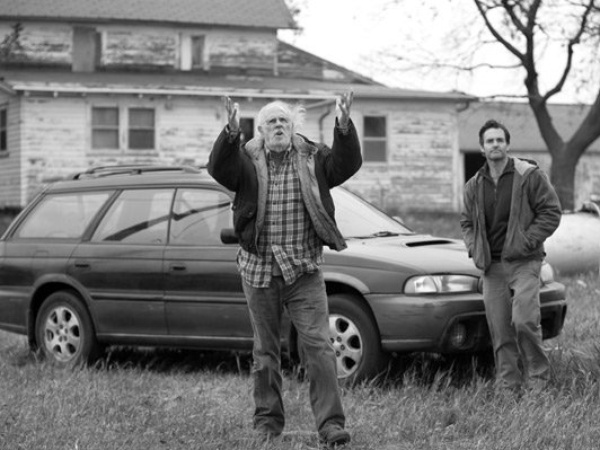
In the funny, poignant and thought-provoking Nebraska, a Montana geezer named Woody (Bruce Dern) gets a sweepstakes come on in the mail and believes that he has actually won a million dollars. Unwilling to accept the explanations from his loved ones, Woody is determined to get to Omaha to claim his fortune – by walking if necessary. His son David (Will Forte from Saturday Night Live) decides to drive him, and their journey takes them through Woody’s tiny Nebraska hometown.

At first, we see that Woody is bitter, drinks too much, is sometimes addled and drives his loved ones crazy. As the story progresses, we learn that Woody’s bitterness is rooted in frustration of his modest aspirations by both circumstance and by his own shortcomings. And we see David longing for a relationship with his father that he had never thought possible before. David makes a valiant effort, but Woody is long past any sentimentality. In Nebraska, director Alexander Payne (Sideways, The Descendants) has another triumph of endearingly flawed characters.

There are many laughs in Nebraska, the funniest coming from Woody’s wife’s salty exasperation, David’s repellant cousins and the hilarious theft of a generator.

The acting is outstanding. Bruce Dern deservedly got an Oscar nomination. It’s a character that is revealed to be more and more complex. Is he demented, or is he in denial, or is he lying? Some of each for sure, but it’s always hard to tell. Dern has stated that he called upon his own experience with unsupportive parents to play the film’s most searing scene, in which David takes a reluctant Woody back to see Woody’s now abandoned childhood home. June Squibb, who play’s Woody’s wife, was also nominated for an Oscar; indeed, she gets to deliver most of the funniest lines.

But there are two other exceptional performances that I don’t want to overlook. As the son, Will Forte plays Woody’s straight man. It’s a far less flashy role – and perhaps more challenging role. But Forte lets us see past the son’s stoicism to his pain, embarrassment, frustration, determination and love.

And Actress Angela McEwan has the tiny part of the small town newspaper publisher. She just gets one brief exchange with Forte and then a second scene where she looks at a truck driving past. That look is one of the unforgettable moment in cinema this year.

Finally, my parents were from Nebraska, and I have spent plenty of time in the state. I must say that I have NEVER seen such a dead on take on small town Nebraska and Nebraskans. If you see Nebraska, you really don’t need to visit the real Nebraska to capture the full experience.

I found Nebraska to be an exceptionally evocative family portrait, and I’ve liked and admired it the more I’ve thought about it. One of my Best Movies of 2013 and nominated for the Best Picture Oscar, it is available on DVD from Netflix and Redbox and streaming from Amazon Instant, iTunes, Vudu, YouTube, Google Play and XBOX Video.

Cinequest at festival midpoint

photo courtesy of The Wife

The 2014 edition of Cinequest has emphasized comedy, and that has paid off with some of the festival’s biggest hits:

  • The Grand Seduction: Cinequest’s opening night film was this uproarious Canadian knee-slapper – a Waking Ned Devine with random acts of cricket.
  • Friended to Death: this sharply funny idie satirizes our obsession with social media. TMI becomes LOL.
  • Heavenly Shift: the hilariously dark (very dark) Hungarian comedy about a rogue ambulance crew with a financial incentive to deliver its patients dead on arrival.
  • Hunting Elephants: an Israeli caper comedy with Patrick Stewart (as you’ve never seen him).

The other most popular Cinequest hits have been the exquisite Polish drama Ida and the Canadian weeper Down River.  I also particularly like the Slovenian class room drama Class Enemy.

Most of these films are still scheduled to play in the last half of the festival.  Subject to Cinequest’s exhibition rights, I’m guessing that the most likely candidates for Cinequest’s Encore Day on Sunday, March 16 are Ida, Friended to Death, Down River, Hunting Elephants and Class Enemy.

Cinequest: Friended to Death

FRIENDED TO DEATH
FRIENDED TO DEATH

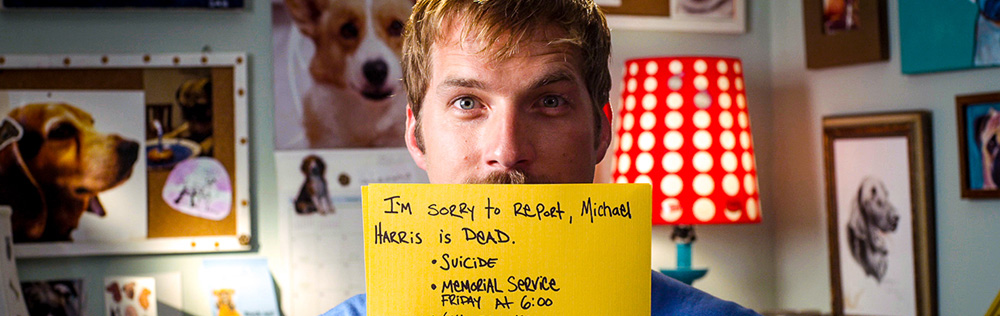
What kind of douchebag would fake his own death to see who shows up to his funeral?  Indeed, in the comedy Friended to Death, there’s a reason why everyone calls Michael Harris a douchebag.  He is a colossal jerk who revels in the misfortunes of others.  In his job as a parking enforcement officer, he’s a gleeful Johnny Appleseed of misery.  Worse yet, he is a social media addict who narcissistically insists on constantly blasting his escapades on Facebook and Twitter.  He’s oblivious that his own social media proves himself to be the asshole everybody says that he is.

You know that Michael is ripe for a comeuppance, and he gets a dose of his own medicine when one of his premature vehicle tows unleashes an unhinged enemy for life.  There are plenty of madcap moments as Michael (Ryan Hansen from TV’s Friends with Benefits) and his reluctant co-conspirator Emile (James Immekus) frantically try to conceal their hoax.

Friended to Death writer-director Sarah Smick and co-writer Ian Michaels archly comment on the “social” in social media.   Their Michael Harris says “I have 417 friends – you don’t expect me to know ALL of them!” and “I speak in text”.  Really smart comedy writing is pretty rare, and Smick and Michaels have the gift.  Michaels got the idea after reading about a guy who faked his own death and wrote scathing rebukes to those who missed his faux memorial.  By dropping that kernel into our current environment of over-sharing, Smick and Michaels were able to alchemize it into a biting social satire.

Smick and Michaels are longtime collaborators who married last October.  In 2011, Smick and Michaels brought their equally funny Here’s the Kicker to Cinequest; (Michaels directed that one).   Here’s the Kicker is available streaming on YouTube and is also is out on DVD.

In Friended to Death, Smick and Michaels play characters trying to expose the fraud.  They are very good in their roles, as is veteran Robert R. Shafer (Bob Vance in The Office) as that boss who just can’t restrain himself from yelling.

In Friended to Death, TMI becomes LOL.  Pointedly smart and well-crafted dark comedies don’t come along every day.  Don’t miss Friended to Death, playing again at Cinequest tonight and on Friday.