DVD/Stream of the Week: MANCHESTER BY THE SEA – disabled by grief, can he step up to responsibility?

Casey Affleck and Lucas Hedges in MANCHESTER BY THE SEA

The powerfully affecting drama Manchester by the Sea centers on the New England janitor Lee (Casey Affleck), who must take over care of his dead brother’s teenage son Patrick (Lucas Hedges). The searing performance by Affleck and the masterful story-telling by writer-director Kenneth Lonergan combine to make Manchester by the Sea a Must See and one the year’s very best films.

As the movie opens, we see Lee dealing with a series of apartment tenants, and we learn that he is emotionally isolated, and extremely reluctant to become entangled in any human relationships, even with willing females. Underneath, he is a witty guy, but he masks that with a stoic veneer. We also see that he is suppressing a rage that occasionally erupts.

Why is he like this? It’s hinted that there has been a tragedy for which he feels guilty. Mid-movie, that tragedy is depicted, and it’s hard to imagine a worse one. This is a man who, faced with an event that cannot be undone, has been disabled by grief and guilt. It becomes clear why he is so reluctant to take over the role as his nephew’s guardian.

Patrick has all the typical willfulness and teenage thirst for independence – all while expecting Lee to chauffeur him around his rich teen social life. Any teen is disaffected to some extent, but Patrick’s troubled mother has not been in the picture, and now his father has died. Lee is Patrick’s favorite uncle, and he is hurt and confused by Lee’s reaction, and he doesn’t understand why Lee is unwilling to drop everything to parent Patrick.

The friction between the two is remarkably realistic. Both Patrick and Lee have quick, sarcastic tongues, which make their scenes pretty funny, too. In fact, Manchester by the Sea is filled with humorous moments. There’s that awkwardness: how are you supposed to act when there is a death in the family – and yet something funny happens? Lonergan has an eye for the little things that go wrong in life: when the decedent’s last effects are misplaced, when the gurney won’t fold down to fit into the ambulance, when the cell phone buzzes in the funeral. And when the most horrible tragedy is marked by a forlorn plastic bag of junk food and beer.

A family death is naturally dramatic, and Lonergan uses this event to explore intense feelings of grief, guilt, responsibility and resentment. Absolutely every character acts like people do in real life. The result is a remarkable sense of authenticity.

Affleck has produced some of the greatest recent screen acting performances, in The Assassination of Jesse James by the Coward Robert Ford, Gone Baby Gone and Ain’t Those Bodies Saints. This performance is a career topper, a surefire Oscar-winner that will lead his obit. Just note how Affleck’s Lee answers a bad news phone call and the way he wordlessly eyeballs his ex-wife’s new husband.

Young Lucas Hedges steps up to play against Affleck, and Hedges makes his Patrick completely compelling and believable. Hedge’s Patrick is smart, wounded, insecure, needy, prideful and a smart mouth that we like being around.

As befits a Lonergan movie, all of the acting in Manchester By the Sea is top rate. The final scene between Michelle Williams and Affleck is utterly heartbreaking. I particularly liked C.J. Wilson as the family’s partner in their fishing boat.

As good as it is, Manchester by the Sea is not for everyone. The Wife and her sister had a meh reaction because they weren’t absorbed by Lee’s lack of apparent affect and didn’t think that the story’s arc paid off.

This is the third movie directed by the major American playwright Kenneth Lornergan. who has directed three movies. The first was another actor’s showcase, the excellent 2000 drama You Can Count on Me with Laura Linney as a well-grounded single mom and Mark Ruffalo as her reliably unreliable brother.

Lonergan made his second film, the near-masterpiece Margaret, in 2007. The studio fought with Lonergan over the film’s editing, cut it over his objection, and issued it to theaters in a blink-and-you’ve-missed-it release in 2011. In 2012, a DVD was released with both the studio’s 150-minutes version and with Lonergan’s preferred 186-minute cut. I own the DVD, and have seen the director’s cut. It’s an amazing film, and there’s an even better (shorter) one in there.

You Can Count on Me addresses responsibility, and Margaret deals with the consequences of an act that can’t be undone. Manchester by the Sea deals with these themes even more successfully and evocatively.

Manchester by the Sea is available on DVD from Netflix and Redbox and to stream from Amazon, iTunes, Vudu, YouTube and Google Play.


Michelle Williams and Casey Affleck in MANCHESTER BY THE SEA

THE SENSE OF AN ENDING: you can’t revisit the past and guarantee closure

Jim Broadbent in THE SENSE OF AN ENDING

The veteran actor Jim Broadbent paints a remarkable portrait of Tony, the main character in the British drama The Sense of an Ending, and he makes it look easy. Retired and long-divorced, Tony is entirely comfortable is a solitary life that he has chosen, perhaps not voluntarily, by being so damn selfish and curmudgeonly. In some very funny moments, we learn that he does not suffer fools. An incident revives a brief period of passion in his youth, and he can’t let it go (although we know that he really should). As he plunges on, he unpeels the mystery, layer by layer, and discovers more emotional turmoil than he is prepared to deal with. He learns that we cannot always find closure, especially if it depends on the feelings of others and acts and words with cannot be undone.

As good as Broadbent is, the best scenes are with Tony’s ex-wife (Harriet Walker – who really shines in this film) and the romantic interest of his youth (the irreplaceable Charlotte Rampling).

You are forgiven if, after reading a capsule or watching the trailer, you think that The Sense of an Ending is another 45 Years; after all both focus on a retired British gentleman whose life is rocked by an unexpected call or letter and both feature stunning performances by Charlotte Rampling. But it is not. 45 Years meditates on the power and durability of memories and then shifts into a study of relationships; we see intimacy without the sharing of all truths, and see how the truth can be toxic and destructive. In contrast, The Sense of an Ending explores how emotional detachment is very protective, and what happens when one ventures into emotional vulnerability. 45 Years was Charlotte Rampling’s movie, while she has only a couple of brief, although hard-hitting, scenes in The Sense of an Ending.

The Sense of an Ending played at Cinequest before its theatrical release and was well-received by the audience. I like The Sense of an Ending more than does the critical consensus, perhaps because it’s the best new movie widely released in the Bay Area this week.

THE LAST WORD: a forceful dose of Shirley MacLaine

THE LAST WORD
THE LAST WORD

In the comedy The Last Word, Shirley MacLaine plays a control freak of absolutely unstoppable will. This is a person who is obsessed with getting her own way on even the most inconsequential detail. She is living a wealthy retirement, having been forced out of the company she founded when her behavior becomes too unbearable for everyone else. Facing her mortality, she decides to employ an obituary writer (Amanda Seyfried) to favorably pre-write her obit. The challenge, of course, is that no one – family members, former co-workers, anyone – has anything nice to say. This sets up an Odd Couple comedy until it becomes an Odd Trio when Harriet seeks to improve her obit profile by mentoring a disadvantaged nine-year-old (AnnJewel Lee Dixon).

Often contrived, The Last Word isn’t a masterpiece, but it has three things going for it:

  • Shirley MacLaine is in full willful grandeur, and her performance is tour de force.
  • Supporting players: Anne Heche is priceless in a “she is your daughter” scene. AnnJewel Lee Dixon is a force of nature herself, kind of a Shirley Mini-Me. Philip Baker Hall is a wonderful match for Maclaine. Thomas Sodoski is always appealing.
  • The remarkably smart soundtrack, which almost becomes a character of its own.

I did also appreciate the brief homage to Reservoir Dogs, the slo-mo power stride with sunglasses (pictured above).

I saw The Last Word at Cinequest at a screening with director Mark Pellington, who noted that The Last Word took 25 days to film. Crediting his music supervisor for finding obscure and affordable songs, he said, “the music works on an infectious level”. Describing the scene where the three actresses take a moonlit dip in a pond, he said, “I love that their laugh deflates the symbolism of it”. His favorite scene was the obne when Philip Baker Hall tells Shirley MacLaine, “I knew what I was getting when I married you”, which inspired Pellington’s next movie Nostalgia (now in post-production).

DVD/Stream of the Week: LOVING – the love story that made history

LOVING Credit: Ben Rothstein/Focus Features
Ruth Negga and Joel Edgerton in LOVING. Credit: Ben Rothstein/Focus Features

The landmark 1967 US Supreme Court case Loving v. Virginia overturned state laws that banned interracial marriage. Loving is the story of the real couple behind that ruling, and it’s a satisfying love story of two modest people who would rather not have been forced to make history.

Ruth Negga and Joel Edgerton convincingly bring the lead characters to life. As the more vibrant character, Negga is especially winning. Edgerton is just as good as he plays the stolid and far less demonstrative husband.

Marton Csokas, with his pitiless, piercing eyes, is remarkably effective as the Virginia sheriff dead set on enforcing Virginia’s racist statute in the most personally intrusive way. Too often, actors seem to be impersonating Rod Steiger in In the Heat of the Night when they play racist Southern sheriffs, but Csokas brings some originality to his performance.

Loving is directed by one of my favorites, Jeff Nichols of Shotgun Stories, Take Shelter and Mud (which he calls his “Arkansas Trilogy”). Nichols specializes in leisurely paced dramas that evoke their settings in the rural South. Nichols’ languid style works well in telling stories that have moments of shock and violence. However, there is no dramatic courtroom face off or thrilling high point as we watch these people live their workaday lives, so Loving drags a bit in places. Nevertheless, Nichols does an excellent job of depicting the ongoing dread of racist terror that these people lived under.

Michael Shannon, who owes his career breakthrough to Nichols’ Shotgun Stories and stars in his Take Shelter and Mud, shows up in a sparkling cameo as a LIFE magazine photographer. If you perform a Google image search for “Richard Mildred Loving”, you’ll find the real LIFE photos, which make it clear that Nichols went to great lengths to make the characters and the settings look very, very much like the Lovings and their environment. I don’t need “lookalikes” in a historical movie, but the makeup and wardrobe on Edgerton and Negga (and especially Richard Loving’s mother) are remarkably close to the real people. And the scenes at the drag race and on the Loving’s sofa are recreated in almost chilling accuracy.

I studied Loving v. Virginia, along with other major civil rights and individual rights cases, in law school in the mid-1970s . Then, the idea that a government could outlaw a marriage between people of different races (and even the word “anti-miscegenation”) already seemed ridiculously obsolete and perversely quaint. But I hadn’t realized that the ruling in Loving v Virginia was only 8 years old at the time I studied it. California had such a law, too, which wasn’t repealed until 1948, and I have a friend whose Filipino and Mexican-American parents were kept from marrying by that statute.

History is made by real people. Loving is both good history and a watchable personal story. You can watch on DVD from Netflix and Redbox or stream it from Amazon, iTunes, Vudu, YouTube and Google Play.

Cinequest: (re)ASSIGNMENT (now THE ASSIGNMENT)

Michelle Rodriguez in THE ASSIGNMENT

In the gloriously pulpy revenge thriller The Assignment, a vengeful plastic surgeon (Sigourney Weaver) captures a hit man (Michelle Rodriguez) and performs sexual reassignment surgery on him, releasing a new hit woman (also Michelle Rodriguez) into the world – and lethal mayhem ensues.

The Assignment comes from the master of the genre thriller, director Walter Hill (The Warriors, The Long Riders, Southern Comfort, 48 Hrs.). Hill is a story-teller who enjoys a brisk pace, and The Assignment flies along its 95 minutes.

Michelle Rodriguez, the toughest of the Tough Chicks, nails the hit man/hit woman roles. She plays the male character very naturally (with a little CGI help in a glimpse of his naked frontside). When the protagonist becomes a woman, Rodriguez keeps her eyes very male – and very pissed off. Her performance at the moment of gender reveal is perfect.

Sigourney Weaver had the audience roaring at her character’s narcissism. Weaver and Tony Shaloub successfully pull of the highly stylized genre dialogue. Anthony LaPaglia is excellent as a mid-level gangster.

Don’t expect Brokeback Mountain for the trans set. This is, after all, an involuntary gender reassignment. The main character is a man who is turned biologically into a woman, while still identifying internally as a man. The gender reassignment is a plot device, and it is a hostile act, not a means of self-fulfillment.

75-year-old Walter Hill was present at the Cinequest screening. Costing only $2.8 million, The Assignment was shot in Vancouver over only 25 days. Hill said that he was “wanted to do a neo-noir comic booky kind of thing” (which well-describes The Assignment). The film was adapted from Hill’s graphic novel, which has been out in France since last year; it will be released in the US before the end of March. Hill expects a sequel to the graphic novel.

The Cinequest audience – by no means the usual action thriller crowd – reacted very favorably to The Assignment. Shown at Cinequest with the title (re)Assignment, his film is being released with the title The Assignment. It’s available now on Ultra VOD and YouTube. It will open nationally on April 7, but only on 30 screens. I’ll let you know when it becomes more widely available – because I enjoyed it!

Cinequest: CARRIE PILBY

CARRIE PILBY
CARRIE PILBY

The title character in the agreeable misfit comedy Carrie Pilby (Bel Powley) is literally a genius, a girl with such high intelligence that she enrolled at Harvard at age 14. That experience proved to be better for her intellectual development than for her emotional development. Now she’s 19, a year out of college and holed up in her Manhattan apartment pretending that she’s anti-social because no one is smart enough to engage with her. She emerges only to see her therapist (Nathan Lane), who assigns her some tasks to draw her out, and comic adventures ensue.

Carrie sequentially encounters three dreamy-looking guys and all of the male characters except one are very sensitive. But Carrie Pilby isn’t a Chick Flick that men won’t enjoy.

Powley is very good at making the audience relate to someone by definition very unlike us. She has mastered the comic take and has excellent timing.

I watched Carrie Pilby at Cinequest; at a screening with director Susan Johnson. Johnson says that the source material, a popular novel, “was about not judging a book by its cover”.  She continued, “Think about your own journey and not judging others – that’s kind of deep for a comedy”. Johnson, who shot the film in only 20 days, said that her favorite scene was the prayer scene.

Carrie Pilby is an enjoyable comedy. It opens theatrically on March 31, on VOD on April 4 and will be on Netflix in September.

Cinequest: THE PROMISE

Oscar Isaac in THE PROMISE

In a predictable trudge through the Armenian Genocide, The Promise delivers nothing that we haven’t seen before. Oscar Isaac plays an impoverished Armenian from the Anatolian outback who dreams of becoming a doctor. To afford medical school in Constantinople, he uses the dowry available after his betrothal to a sweet and prominently-schnozzed local girl. For his studies, he moves alone to the big city, where he meets a cosmopolitan Armenian beauty (Charlotte Le Bon), who has been living in Paris with her boyfriend, an iconoclastic American journalist (Christian Bale). Just as sparks fly between Isaac and Le Bon, World War I erupts and the Turks persecute and then massacre Armenians, causing the two to flee separately for their lives. Isaac’s medical student finds himself hiding in his home village, married to his fiance. Le Bon’s sophisticate is on the run with Bale’s journalist as he covers the developments. Will the Armenian lovers meet again in Eastern Turkey, and will he stay true to his marital vows?

The talents of Isaac and Bale are wasted in this movie. Isaac’s character is so top-to-bottom decent and so buffeted by developments that are not his fault, there just isn’t much texture to portray. Similarly, Bale’s reporter, while purportedly an international man of mystery, is just a Jeff Bridgesey teddy bear of a guy at his core.

The Promise is not as bad as the epically bad epic The Ottoman Lieutenant, and has much higher superior production values and a moderately better screenplay. Both movies share the beginning of World War I and the Armenian Genocide, along with an American protestant mission in southeastern Turkey. As in The Ottoman Lieutenant, there’s an unintentional audience laugh – when Isaac’s mother intones “I told them you were dead”.

Keep walking.

Cinequest: THE COMMUNE

THE COMMUNE
THE COMMUNE

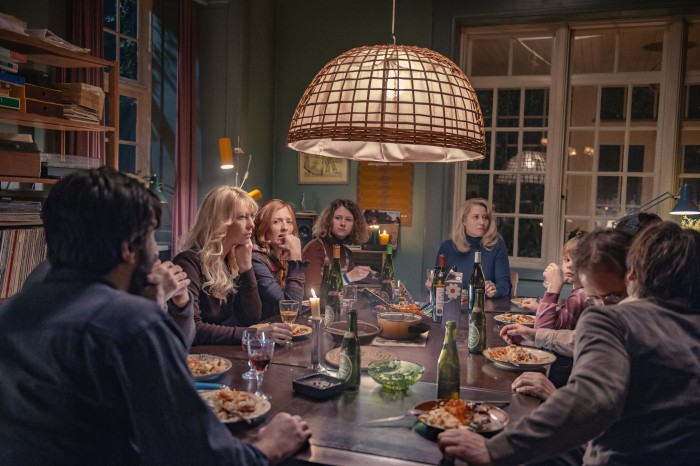
In the Danish family drama The Commune, Erik (Ulrich Thomsen) is an architecture professor married to the television newscaster Anna (Trine Dyrholm).  Erik is very reserved, tends to be harsh and does not suffer fools.  Anna is bubbly.  They have a watchful 14-year-old daughter.

Erik inherits a huge house and wants to sell it.  Anna wants to move the family in.  Erik points out that it’s totally impractical and too expensive to keep up.  Anna suggests taking in their friends as tenants – essentially starting a commune.  After all, it’s the 1970s.  What could possibly go wrong?

The folks who move in, of course, are a collection of oddballs.  Anna embraces everyone’s eccentricities, and Erik tries, but it’s hard for him.  At this point, we think we’re watching a comedy of manners – but we’re wrong.

The Commune is really the story of Erik and Anna and their marriage.  Each is having a mid-life crisis that will test their marriage.  The foibles of the commune are just a distraction.

Trine Dyrholm gives a remarkable performance as Anna.  Is Anna shockingly open-minded and permissive, a desperate enabler or is she masking an internal implosion?

I loved writer-director Thomas Vinterberg’s earlier films Celebration (Festen) and The Hunt (Jagten).  Vinterberg’s Funny Funny Squirm rhythm in The Commune reminds me of Celebration.  But the payoff in The Commune just doesn’t match Celebration and The Hunt, which are exceptionally good films.  I especially detested the death of a character in The Commune, which I found to be grossly manipulative.

Still, Dyrholm’s performance is stunning, and Vinterberg remains a master at the cold-eyed observation of human behavior.  I saw The Commune at Cinequest.

Cinequest: UNA

UNA
UNA

The psychological suspense movie Una revolves around two twisted people, one of whom has been damaged by trauma.  Here’s what the audience can be confident really happened: at age 14, Una (Rooney Mara) was seduced by a much older man, Ray (Ben Mendelsohn); she became infatuated with Ray and they carried on a sexual relationship for three months until he was caught and imprisoned for four years.  Upon leaving prison, he changed his name and started a new life.  It’s now fifteen years after the original crime and Una has tracked him down.

We can tell that Una is obsessed with Ray.  What we don’t know is whether Una is seeking vengeance or whether she is in love with him – or both.  She’s so messed up that even she may not know.

Lolita was a novel with a famously unreliable narrator.  Una presents us with TWO unreliable narrators.  Almost every statement made by Ray COULD be true, but probably isn’t.  He was in love with her, he came back for her, she was his only underage lover, he’s not “one of them”, he’s told his wife about his past – we just can’t know for sure.  Ben Mendelsohn delivers a performance that tries to conceal whatever Ray is thinking and feeling but allows his desperation to leak out.

The excellent actor Riz Ahmed (Four Lions, The Reluctant Terrorist) is very good as Ray’s work buddy, who must deal with one totally unforeseeable surprise after another.

Una really relies on Rooney Mara to portray a wholly unpredictable character in every scene, and she succeeds in carrying the movie.  Mara’s face is particularly well-suited when she plays a haunting and/or haunted character, and it serves her well here.

I watched Una at Cinequest, where it was a Spotlight Film.  Its theatrical release is expected later this year.


Cinequest: THE OTTOMAN LIEUTENANT

THE OTTOMAN LIEUTENANT

The adventure romance The Ottoman Lieutenant, which had its world premiere at Cinequest and is now playing in theaters, is SO bad, so LAUGHABLY bad, that it’s hard to predict whether it will be quickly forgotten or linger in our memories as a benchmark in badness.

Just before World War I, a willful and affluent young American (Hera Hillmar), runs off to remote Turkey to deliver a truck-full of medical supplies to a dreamy young doc (Josh Hartnett), who is running a Protestant mission in an Armenian area of Anatolia.  She encounters the title character (Michael Huisman) and sparks fly.  The natural political conflict between the two men escalates in a fit of sexual jealousy.  Since the title is “The Ottoman Lieutenant” instead of “The American Missionary Doctor”, we know where things are headed…In fact, anyone who has ever seen a movie knows where EVERYTHING is headed in what must be the year’s most predictable movie

The blame starts with the unimaginative story and leaden dialogue from writer Jeff Stockwell.   Director Joseph Ruben contributes the cliché of horse-riding across a grassy plain, bodies rocking in the saddles and bouncing up and down rhythmically, accompanied by SWELLING music.  Not once.  Not twice.  But three times.  The kisses erupt into industrial-scale heavy breathing after precisely two counts (“one-thousand-one, one-thousand two, now let’s hear heavy breathing!”).  There’s even some bad CGI of a passenger ship – kind of Titanic Lite.

The Ottoman Lieutenant also features a dreadful performance by its lead.  Hera Hilmar, known for 25 episodes of Davinci’s Demons, misreads lines and generally fails to interest us at all.  She’s not even interesting when losing her virginity.  Would a better actress elevate this material?  Perhaps, but not all the way into an even mediocre film.  It doesn’t help when Stockwell has Hillmar utter the most obvious observation, “Jude, you’re angry!”, drawing unintended chuckles from the audience.

But it’s Hartnett who leaves us with the most memorable moment of The Ottoman Lieutenant.  He embraces Hilmar after her character’s deflowering and then shoves her back, bellowing, “I can smell him!”.  At my screening, fully one-third of the audience erupted into hearty laughter – an LOL moment unintended by the filmmakers.  Later, I realized that this line was the only unpredictable moment in the film.

The one appealing aspect of The Ottoman Lieutenant is Michael Huisman’s performance.  Huisman (Treme, Game of Thrones) is a very charismatic actor, and, if this movie could have been saved, he would have been up to it.  The Turkish actor Haluk Bilginer is pretty good as the lieutenant’s commander.  Ben Kingsley gets to emote as an older doctor made irascible by personal loss.

While watching a movie, I scribble notes in the dark; this time, The Wife snatched my notebook and wrote, “This is the worst movie ever”.  Tossing multiple millions of dollars at the budget for this movie was like over-inflating a used condom.