HAMNET: a grieving couple finally aligns

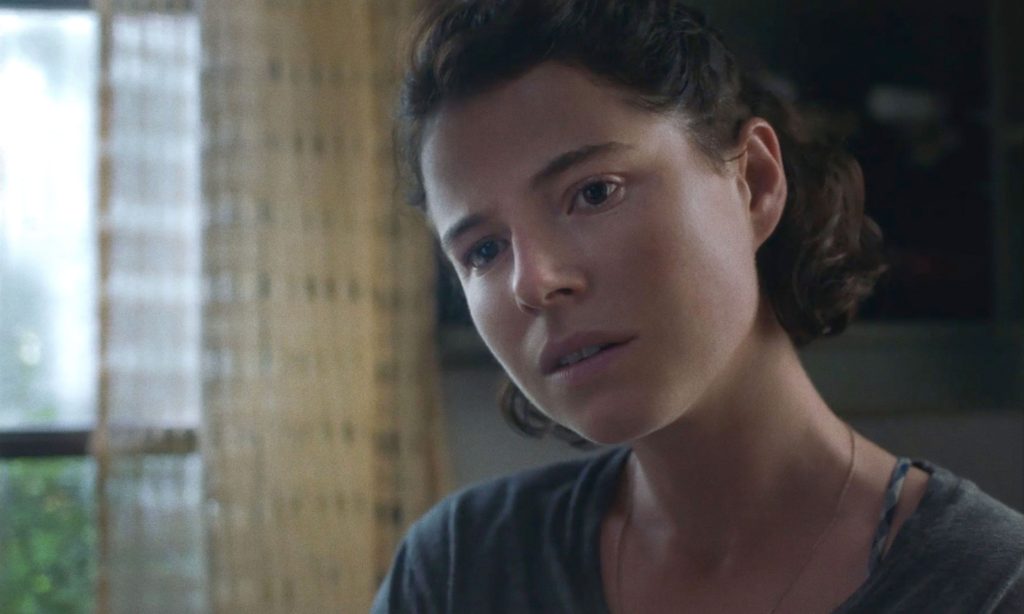
Photo caption: Jessie Buckley in HAMNET. Courtesy of Focus Features.

In Chloe Zhao’s glorious Hamnet, based on the Maggie O’Farrell novel, a couple must deal with the death of a child. That couple is none other than William Shakespeare (Paul Mescal) and his wife Agnes (Jessie Buckley).

Will is an aspiring writer with ambitions too big for their provinical hometown of Stratford. Agnes is just the kind of woman that we imagine would attract Shakespeare – smart, spirited, earthy and a determined non-conformist. The two fall in love and start a family, settling into an affectionate relationship and comfortable parenting partnership.

As someone who runs a London theater company, Will is necessarily away on business in London much of the time. To Agnes, who stays raising the kids in Stratford, where there is no theater, Will’s world is only theoretical. Although, he sends money for the family and even buys the biggest house in town, she just has no way of comprehending what he really does in London.

No European family in the late 1500s could hope to avoid pestilence, and tragedy strikes the Shakespeares – unfortunately while Will is away from home.

People do not experience grief the same way nor on the same timeline. Heartbroken parents may not feel like they are sharing the suffering together. Often, marriages do not survive the death of a child.

Hamnet is framed in a very 21st Century perspective – about using one’s art to process grief and express one’s feelings. In Hamnet, Will works out his grief by penning Hamlet, and Agnes can only align her grief with Will’s by experiencing his play.

Jessie Buckley’s performance as Agnes is wondrous. She perfectly captures Agnes’ freethinking independence, lusty passion and nurturing motherhood. When Agnes suffers her loss, Buckley shows her in the deepest despair and in her profound resentment of Will. Her personal catharsis makes for the most emotionally powerful movie ending of the year.

From her movie debut in the disturbing Beast, followed by acclaimed performances in Wild Rose and The Lost Daughter, Buckley has demonstrated that she is unsurpassed as a screen actor. Her work in Hamnet is a tour de force, and she will be nominated for a Best Actress Oscar.
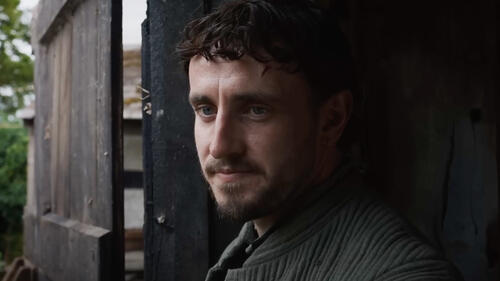
Paul Mescal in HAMNET. Courtesy of Focus Features.

This is Jessie Buckley’s movie, but Paul Mescal is very good as William Shakespeare, even if he doesn’t have as much to do in the first two acts. Mescal blossoms in the third act as Shakespeare writes, directs and then acts in Hamlet. In particular, Mescal’s Shakespeare recites the To Be. Or not to be. speech as he contemplates taking his life, and it’s never been so raw and powerful. And I have never see the King’s Ghost played as compellingly as does Mescal in the play-within-the-movie.

There are also fine supporting performances by the esteemed Emily Watson as Agnes’ mother-in-law and and Joe Alwyn as Agnes’ brother.

I loved how director Chloe Zhao presents the Globe Theater – as the site of the most spectacular entertainment that the audience would have ever seen or imagined. The crowd enters with the anticipation of a throng entering an NFL stadium on game day. When the play begins, there’s a hush as the audience is enthralled at the wonder of it all – the backdrop, the costumes, the swordplay, and even the primitive special effects.

Zhao, of course, won Best Director and Best Picture Oscars for Nomadland. That indie triumph earned her the payday of a Marvel franchise movie with big stars, The Eternals. Her early film, The Rider, with a nonprofessional actor as the protagonist, made me into a huge Chloé Zhao fan.

The play Hamlet ends with Fortinbras of Norway striding on stage amid the corpses to summarize things, and Zhao doesn’t go there. She avoids the anti-climax by following Billy Wilder’s screenwriting advice – Don’t stick around. I’m very impressed with any filmmaker who ends their film not even one second too late. After all, even Alfred Hitchcock made the mistake of ending Psycho with a psychological expert played by Simon Oakland explaining that Norman Bates’ psychological disorder really does exist and blah blah blah. So, I would say that Chloe Zhao ends Hamlet better than Shakespeare did.

Hamnet is one of the Best Movies of 2025.
WICKED LITTLE LETTERS: a sparkling Jessie Buckley and an interesting take on repression

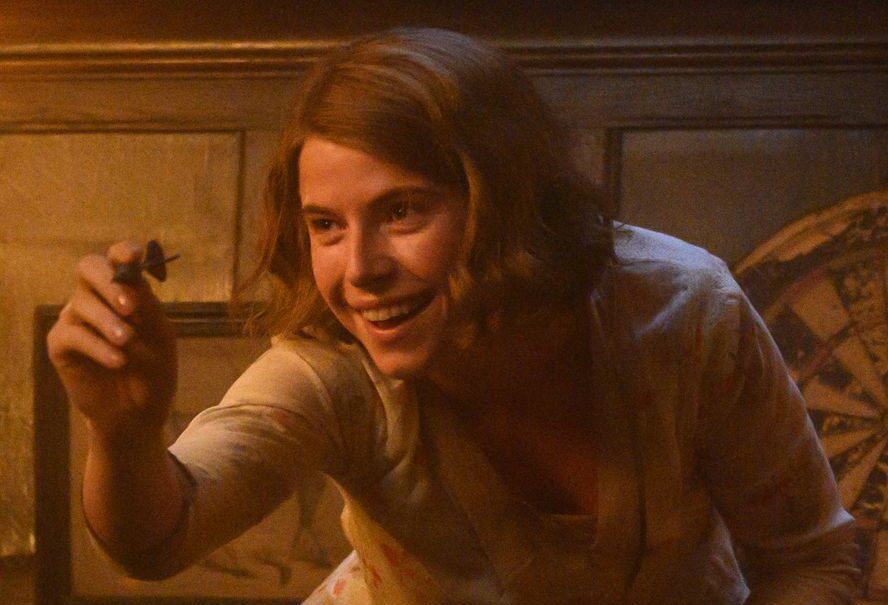
Photo caption: Jessie Buckley in WICKED LITTLE LETTERS. Courtesy of Sony Pictures Classics.

Jessie Buckley sparkles in the comedy Wicked Little Letters, about a contretemps between English neighbors that erupted into scandal. It’s 1920, and, though although no longer technically in the Victorian (or even Edwardian ) Period, Victorian social mores prevailed, and the stuffiness, repression and classism make easy targets for Wicked Little Letters.

Buckley plays Rose, a vibrant single mom who may or may not be a war widow. Foul-mouthed and a joyous carouser, Rose is decidedly tot adhering to the social and sexual mores of the time. Her ultrareligious and ridiculously proper neighbor Edith, (Olivia Colman) on the other hand, could be a poster girl for devout virginity; Edith lives under the tyranny of her father Edward (Timothy Spall), a bullying, racist, patriarchal prig.

The two women start out friendly, but inevitably fall out. Edith is shocked to received a series of profane, obscene and vituperative letters. Edward brings in the police, and soon Rose is on trial for sending the letters, although she denies it. What will happen to Rose? Who really sent the poison pen letters? Wicked Little Letters‘ story closely follows a true story, which you can read about if you Google “Littlehamption Letters Scandal“.

Here’s the most interesting aspect of Wicked Little Letters. We are used to watching people who are sexually and/or socially repressed acting out perversely (see the TV preacher or right wing politician scandal du jour). But here, we have someone who is so angry about BEING repressed, that the perverse behavior comes out of her rage.

This really isn’t much of whodunit, because the authorities, blinded by their own stupidity and classism, and ignorant of forensic tools like handwriting analysis (not to mention the scientific method), keep missing the obvious solution. A fictional young female cop (Anjana Vasan) is the stand-in for the 21st century audience and can see what her superiors miss. Once it’s revealed who is really sending the letters, Wicked Little Letters finishes a little too slowly.

But we get to enjoy a charismatic performance by Jessie Buckley, deploying a deliciously crooked grin as she brings a devil-may-care woman to life. Buckley is so good as troubled characters (Beast, Wild Rose, The Lost Daughter, Women Talking), and it’s great to see her letting loose as a fun-loving character.

Olivia Colman, of course, is superb as Edith, a woman who is not nealy as one-dimensional as she first appears. The great actor Timothy Spall (who has lost a reported 100 pounds over the past several years) has fun with a character who has no nuance whatsoever, unless you count varying shades of bigotry and entitlement.

I caught Wicked Little Letters very late in its its theatrical run and I expect that it will be leaving theaters soon; I’ll let you know when it is available to watch at home.

THE LOST DAUGHTER: maddening mothering

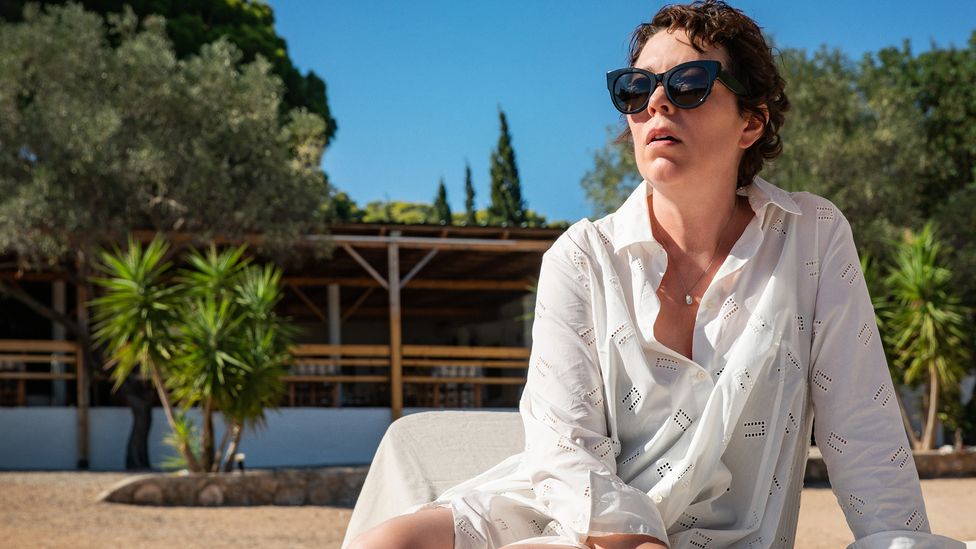
Photo caption: Olivia Colman in THE LOST DAUGHTER. Courtesy of Netflix.

The Lost Daughter is a dark thinkpiece about the impact of maternal obligation to a talented and ambitious woman. We meet Leda (Olivia Colman), a middle-aged comparative literature professor as she arrives for a vacation at a Greek beach. Leda is comfortable traveling alone, and decidedly not sociable.

Leda’s tranquility is harshly disrupted when a large, rambunctious family spills onto the beach from a nearby rental villa, shepherded by their force of nature alpha female Callie (Dagmara Dominczyk). This crowd is a course, vulgar and shady family of Greek-Americans from Queens. Leda is resentful, but she is also intrigued by Nina (Dakota Johnson), a young mother who is unhappily exhausted by parenting her little girl.

When Callie makes neighborly chitchat, Leda pointedly says to Nina, “Kids are a crushing responsibility“. When Leda takes an action that is inexplicable and troubling, we start wondering, “what is going on with her?”. Thereby launches a slow burn exploration of how custodial parents, trapped by their responsibility to always be “on the job” without respite or support, can become drained, depressed, even maddened.

We see flashbacks of a young Leda (Jessie Buckley), a promising scholar on the verge of emerging as a major thought leader, getting whipsawed by her two young daughters, who are adorable yet relentlessly needy.

The young Leda meets a backpacker, who gives her an insight into obligation: “Attention is the rarest and purest form of generosity”. Then, young Leda makes a decision that has major ramifications for her career, her family and which still molds the person who is on the Greek beach today.

The Lost Daughter does not take a Hallmark card, children are such a joy view of motherhood. Parenting is complicated, and it challenges different people differently.

The actress Maggie Gyllenhaal directed (this is her debut) and adapted the screenplay from the novel by Elena Ferrante.

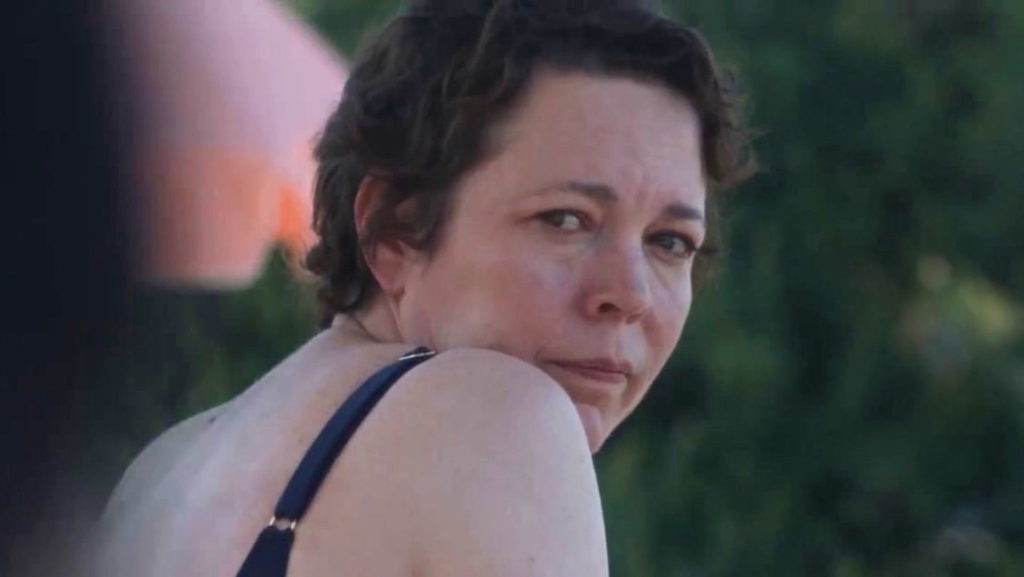
Olivia Colman in THE LOST DAUGHTER. Courtesy of Netflix.

Olivia Colman is brilliant as Leda – so contained and self-confident yet utterly unpredictable. You just gotta keep watching this seemingly staid woman and see how she is going to surprise us next. Colman has earned a best actress Oscar nomination for this performance..

Olivia Colman is now 48, but I didn’t appreciate her until the 2013-17 series Broadchurch. Since 2018, she’s compiled an astonishing body of work – winning the Best Actress Oscar for The Favourite, being Oscar-nominated for The Father, and wining the best actress Emmy for playing Queen Elizabeth II in The Crown.

Jessie Buckley in THE LOST DAUGHTER. Courtesy of Netflix.

Jessie Buckley, one of my favorites since her debut in the psychological thriller Beast, has earned a best supporting actress nomination.

Ed Harris and Peter Sarsgaard (Gyllenhaal’s real-life hubbie) are excellent in minor supporting roles.

The Lost Daughter is a thinker with two superb performances, but it may be too dark and unsettling for many audiences. The Lost Daughter is streaming on Netflix.

Stream of the Week: BEAST – finally unleashed … and untethered

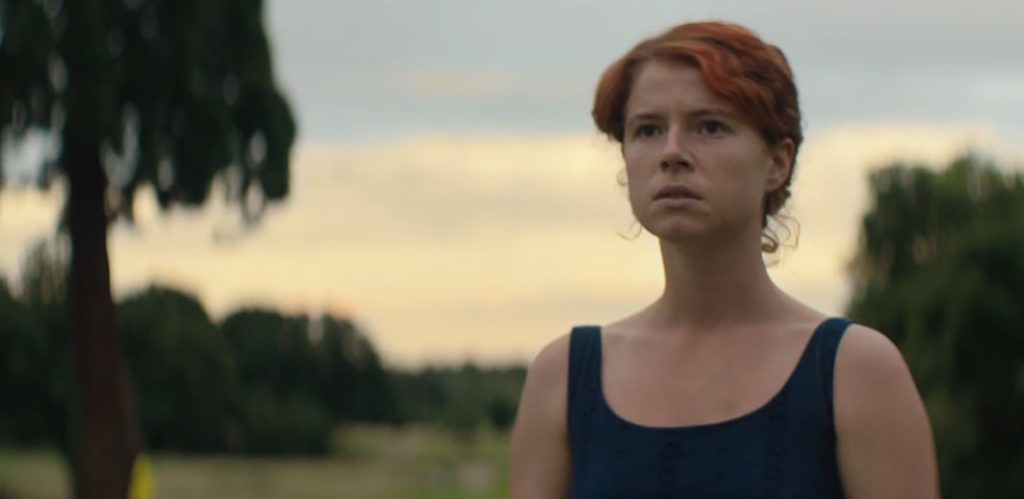
Jessie Buckley in BEAST

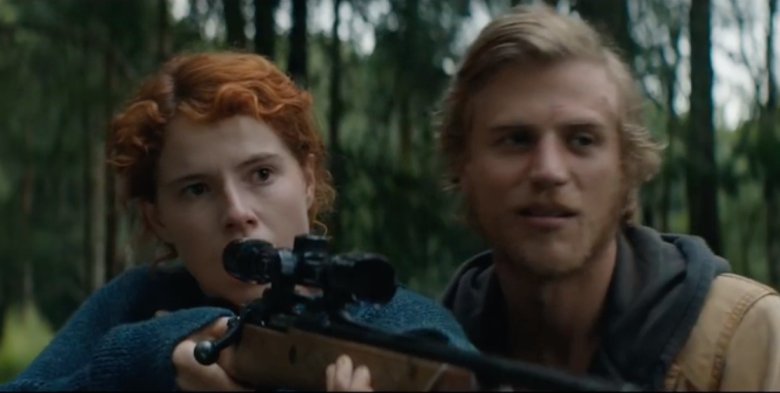
The psychological thriller Beast is set on the British Channel Island of Jersey, where the young woman Moll lives with her affluent family. Moll (Jessie Buckley) is the disregarded and put-upon step-sister in her own family – ignored except when being assigned the task de jour. Only the local cop is sweet on Moll, which brings her revulsion. Moll is dramatically rescued from a bad situation by the scruffy, somewhat feral, dreamy-eyed Pascal (Johnny Flynn). Moll and Pascal fall in love.

It turns out that Moll has within herself confidence, strength and passion – all long and cruelly suppressed by her mother. Pascal pulls Moll from her horrid family and unleashes, for better and for worse, Moll’s true persona. So this is a pretty fair romance to this point, but I did mention that Beast is psychological thriller. A serial killer has been prowling Jersey, raping and murdering young women and girls. The police suspect…Pascal.

Now we experience some unsettling ambiguity. Does Moll protect Pascal because she thinks him innocent? Or because she thinks that he’s the murderer? In his impressive first feature, writer-director Michael Pearce finally reveals something in Pascal’s past that gives us pause. And, even later, we learn something about Moll’s past, too. Holy shit. And we’re off on a roller coaster, wondering what Moll is going to do next and why, all the way to the shocking ending.

Jessie Buckley and Johnny Flynn in BEAST

The reason that Beast works so well is the stunning performance of Jessie Buckley. As an audience, we’re always drawn to Buckley’s Moll, at first understanding and relating to her defeatedness, inner rage and lust. But then Buckley keeps us from knowing exactly what’s going on inside, although we learn to accept that it sure is unpredictable. Buckley is Irish, and her singing career was launched on an American Idol-type show in Britain. She’s since acted in some British Isles television series. She is an incredible force of nature in this role.

Geraldine James in BEAST

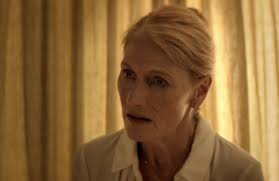
Veteran actress Geraldine James gets the juicy role of the controlling and oppressive mother, her every remark filled with manipulation, shaming and the inducement of guilt. The mom is by FAR the least sympathetic character – and this story also has a serial killer in it. Johnny Flynn is very good as Pascal.

But it’s Jessie Buckley’s performance and Michael Pearce’s story that should bring you to see Beast. It’s a heckuva ride. You can stream Beast on Amazon, iTunes, Vudu, YouTube and Google Play.

BEAST: finally unleashed … and untethered

Jessie Buckley in BEAST

The psychological thriller Beast is set on the British Channel Island of Jersey, where the young woman Moll lives with her affluent family. Moll (Jessie Buckley).  Moll is the disregarded and put-upon step-sister in her own family – ignored except when being assigned the task de jour.  Only the local cop is sweet on Moll, which brings her only revulsion.  Jessie is dramatically rescued from a bad situation by the scruffy, somewhat feral, dreamy-eyed Pascal (Johnny Flynn).  Moll and Pascal fall in love.

It turns out that Moll has within herself confidence, strength and passion – all long and cruelly suppressed by her mother. Pascal pulls Moll from her horrid family and unleashes, for better and for worse, Moll’s true persona.  So this is a pretty fair romance to this point, but I did mention that Beast is psychological thriller. A serial killer has been prowling Jersey, raping and murdering young women and girls. The police suspect…Pascal.

Now we experience some unsettling ambiguity. Does Moll protect Pascal because she thinks him innocent? Or because she thinks that he’s the murderer?  In his impressive first feature, writer-director Michael Pearce finally reveals something in Pascal’s past that gives us pause. And, even later, we learn something about Moll’s past, too.  Holy shit.  And we’re off on a roller coaster, wondering what Moll is going to do next and why, all the way to the shocking ending.

Jessie Buckley and Johnny Flynn in BEAST

The reason that Beast works so well is the stunning performance of Jessie Buckley. As an audience, we’re always drawn to Buckley’s Moll, at first understanding and relating to her defeatedness, inner rage and lust.  But then Buckley keeps us from knowing exactly what’s going on inside, although we learn to accept that it sure is unpredictable.  Buckley is Irish, and her singing career was launched on an American Idol-type show in Britain.  She’s since acted in some British Isles television series. She is an incredible force of nature in this role.

Geraldine James in BEAST

Veteran actress Geraldine James gets the juicy role of the controlling and oppressive mother, her every remark filled with manipulation, shaming and the inducement of guilt.  The mom is by FAR the least sympathetic character – and this story also has a serial killer in it.  Johnny Flynn is very good as Pascal.

But it’s Jessie Buckley’s performance and Michael Pearce’s story that should bring you to see Beast.  It’s a heckuva ride.