
TEENAGE SEX AND DEATH AT CAMP MIASMA: witty, bizarre and riotously funny

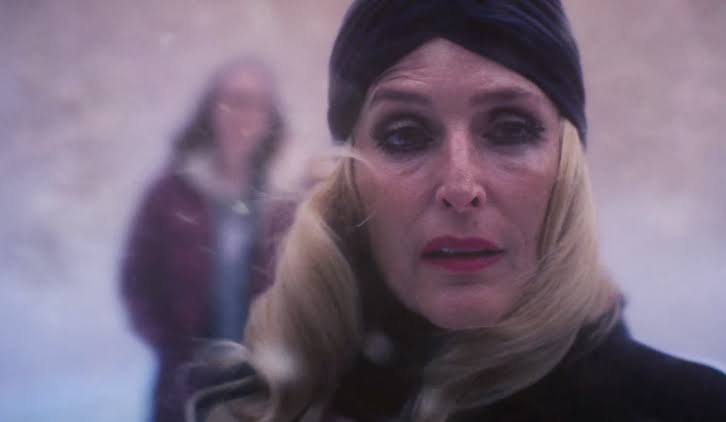
Photo caption: Gillian Anderson in TEENAGE SEX AND DEATH AT CAMP MIASMA: Courtesy of MUBI,

In Jane Schoenbrun’s witty and pleasingly bizarre Teenage Sex and Death at Camp Miasma, the promising young filmmaker Kris (Hannah Einbinder) has been tapped to make yet another sequel to a slasher movie franchise. The once popular Camp Miasma movie franchise has slipped into oblivion, and the movie studio that owns the intellectual property wants to re-monetize it. The origin story of the slasher character was transphobic, so the studio intends to use Kris, who is polyamorous, to queer-wash the newest Camp Miasma movie.

The Camp Miasma movies are devoid of any cinematic aspiration, but the cynical studio execs just want to cash in with more schlock. What the suits don’t know is that Kris herself is a huge fan of the franchise, and that Kris, who over-intellectualizes everything, has envisioned elevating the next chapter into something artsy and meaningful. And she’s obsessed with casting Billy, the actress who played the Final Girl in the original 1980s Camp Miasma.

Billy (Gillian Anderson) retired early from acting and now lives a reclusive life in the abandoned summer camp that was fictionalized as Camp Miasma in the movies. Billy is more than a little weird, and she both fascinates and unsettles Kris. I strongly recommend Schoenbrun’s own video narration of a scene in the NYT; there’s absolutely no gore in this clip.

As the two rewatch the original movie, Schoenbrun spins Teenage Sex and Death at Camp Miasma into a loving homage to and parody of the slasher movie genre. They send up all the slasher movie tropes – a bunch of teens doing things their parents wouldn’t like, impending virgin deflowering, the nocturnal emergence of a slasher villain and the plot importance of the Final Girl. Here, the slasher villain is Little Death, who wears an HVAC vent on their head and wields a bayonet-like spear.The body horror is intentionally so unrealistic (Old Faithful-scale geysers of blood instead of mere spurts) that it’s not as cringe-worthy as are most teen splatter movies.

Kris proudly proclaims herself to be polyamorous as if she’s earning some woke-ism points. But polyamorous threesomes may be equitably more reciprocal in theory than in practice. Kris’ girlfriend and the girlfriend’s boyfriend seem to be getting more of their needs met than does Kris. Basically, Kris is masking that she is a puddle of sexual unfulfillment. Will her stirrings be awakened?

In another comic thread, Teenage Sex and Death at Camp Miasma sharply mocks the cynical business side of Hollywood, including perhaps the most disastrous movie pitch ever,
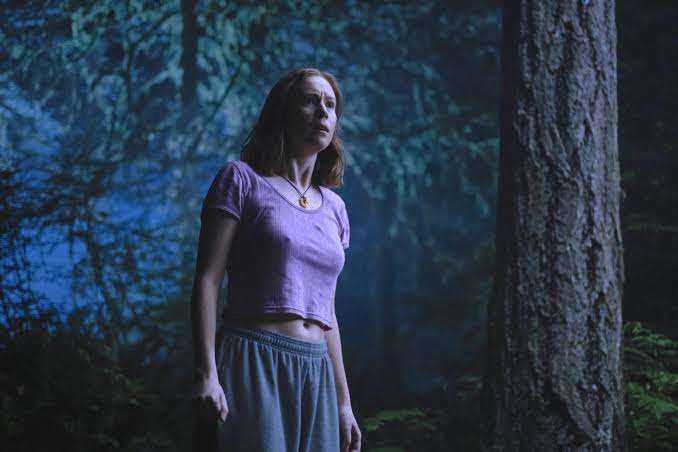
Hannah Einbinder in TEENAGE SEX AND DEATH AT CAMP MIASMA: Courtesy of MUBI,

Hannah Einbinder carries the movie, reaping all the humor in Kris’ pretensions and her sexual unease, along with her Final Girl vulnerability. Einbinder, a standup comic and daughter of SNL original cast member Laraine Newman, won an Emmy for the TV series Hacks.

Gillian Anderson goes full creepster and nails Billy’s teetering between assured self-control and psychosis.

Amanda Fix plays the young Billy acting in the first Camp Miasma film, and her performance is unexpectedly haunting. Dylan Baker strikes the perfect tone as a studio exec. Prolific character actors Patrick Fischler and Kevin MacDonald are very fun as slasher movie tropes – the ominous townsman and the local sheriff; wait through the final credits for their final gag.

In 2024, I wrote that Schoenbrun’s evocative psychodrama I Saw the TV Glow was the “emergence of a great filmmaker”, and that was a good call by me. In Teenage Sex and Death at Camp Miasma, they have successfully braided together a romantic comedy, a sexual awakening film, a horror movie and a slasher parody. Teenage Sex and Death at Camp Miasma is very smart and riotously funny.
I SAW THE TV GLOW: brimming with originality

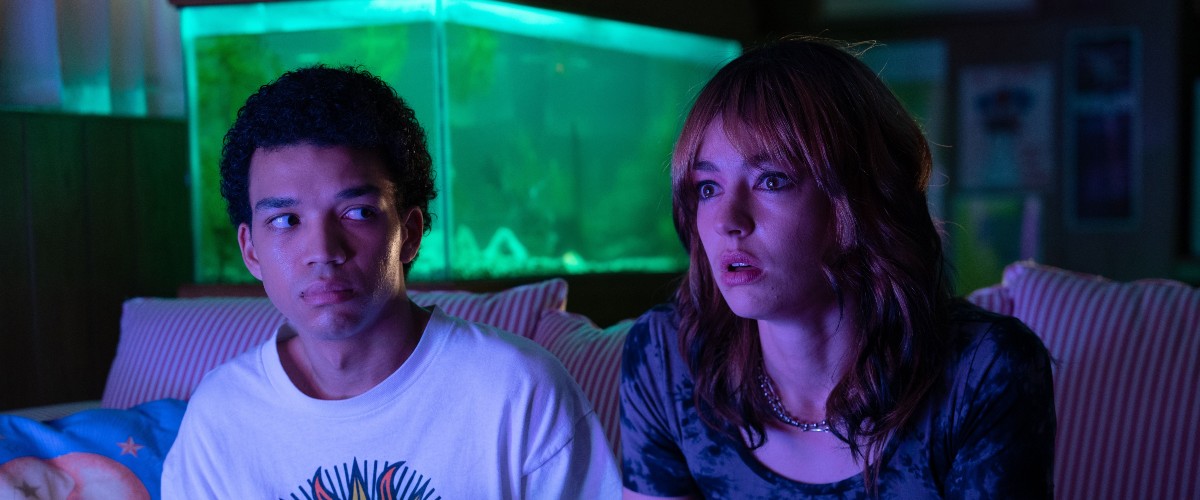
Photo caption: Justice Smith and Bridgette Lundy-Payne in I SAW THE TV GLOW. Courtesy of A24.

The evocative psychodrama I Saw the TV Glow is unlike any movie you’ve seen and marks the emergence of gifted filmmaker. Set in 1996, in the last days of what we now know to be the pre-Internet age, two suburban teens are captivated by a very trippy, highly stylized TV show. The fictional show, The Pink Opaque, has its own internal mythology, and kid characters, Isabel and Tara, battle the the monster of the week sent by Mr. Melancholy. The teens, Owen and Maddy, follow The Pink Opaque with the devoted fervor of fans of The Prisoner and Doctor Who.

Both Maddy and Owen feel alienated by mainstream high school culture, and Maddy (Bridgette Lundy-Payne) is okay with that. She is comfortable with being gay and confident that the burbs have nothing to offer her. Unplagued by self-doubt, she’s is eager to leave for an environment with more excitement and diversity.

Two years younger, Owen (Justice Smith as the young man Owen) is a puddle of anxiety, hesitance and awkwardness. He isn’t confident about ANYTHING, let alone his identity. Maddy tells him that she likes girls and asks about Owen’s preference; he responds, “I think I like TV shows”.

Owen’s parents won’t let him stay up to watch The Pink Opaque at 10:30 pm Saturday night, so Maddy slips him VHS tapes. The show speaks to them in away that nothing else in their lives does, and they bond in their earnest devotion.

Suddenly, Maddy disappears without a trace, with only her TV burning in the backyard. And then, The Pink Opaque gets abruptly cancelled. Now Owen must navigate the harshness of life without his most pivotal supports, and it’s a rough ride. The story skips ahead eight years, and then twenty more, to the present.

I Saw the TV Glow is the third feature for writer-director Jane Schoenbrun (their first two films were credited to Dan Schoenbrun). I Saw the TV Glow is a mesmerizing slow burn that doesn’t spoon feed the audience, but requires active engagement. Masterful in tone, Schoenbrun spins their tale with the eerie and suspenseful fell of a horror film, but it is not horror – the only thing that gets slashed and splattered is a young man’s nostalgia.

Most of I Saw the TV Glow takes place at night, in darkness highlighted with vivid neon-like colors. The cinematographer was Eric Yue (A Thousand and One). The kids’ perspective, attitudes and speech resonate with perfect pitch; these characters are utterly authentic (in sharp contrast to Disney Channel sitcoms). Brimming with originality, Jane Schoenbrun is gifted with very special talents.

This should be a breakthrough performance by Justice Smith. Everything about his Owen telegraphs his discomfort in his own skin and his fear of doing something embarrassing. His voice quavers with hesitation. It’s a haunting performance, and the audience’s fear for what will happen to Owen drives the movie.

Lundy-Payne gets to deliver a remarkably chilling monologue as Maddy.

How popular will this film be with teens? Hopefully, teens will be attracted by the horror look-and-feel and seduced by the realism of the teen characters.

I Saw the TV Glow stands to become a cult film for all the right reasons – it’s unlike any prior movie and it resonates with anyone who felt like an outsider in adolescence. Trippy and spooky, midnight screenings await.

That being said, I Saw the TV Glow is not for everyone. Some viewers may become impatient with the pace or confused by the construction of the narrative. This isn’t conventional storytelling.

I Saw the TV Glow debuted at Sundance and was nominated for awards at the Berlinale and SXSW. After a limited release in the spring, it’s back in some theaters now; I Saw the TV Glow can be streamed from Amazon, AppleTV and Fandango.