a Sicilian Mafia double bill: THE TRAITOR and SHOOTING THE MAFIA

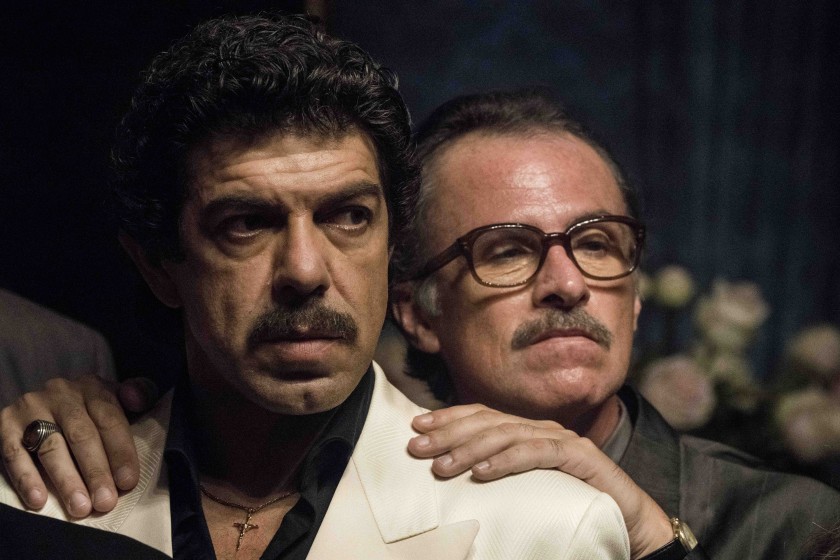
Pierfrancesco Favino and Totò Riina in THE TRAITOR, Photo courtesy of Sony Pictures Classics

Mafia movies have long been a cinematic staple and two current films explore the original Sicilian Mafia, the Cosa Nostra. The true life epic The Traitor and the documentary Shooting the Mafia cover the same territory – the Cosa Nostra‘s utter domination of Sicily until prosecuting judges Giovanni Falcone and Paolo Borsellini convicted almost 400 mafiosi in the bizarre Maxi Trial in 1986-87, the Mafia War on the State and assassination of the judges, leading to public outrage and arrests which have somewhat tamed the Cosa Nostra. Both films even feature the real village of Corleone, the home village of the fictional Godfather.
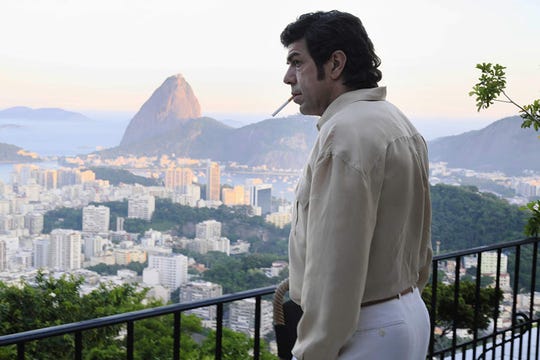
Pierfrancesco Favino in THE TRAITOR, Photo courtesy of Sony Pictures Classics.

The Traitor chronicles the career of Tommaso Buscetta, a mafia figure who traded in billions of dollars worth of heroin. Then, an internal gangland power grab led to the murders of his sons and to his arrest by very harsh Brazilian authorities. Buscetta retaliated by turning state’s evidence and testifying against his former Mafiosi, becoming the first and most important Sicilian Cosa Nostra informer.

The Traitor opens at a Mafia party where Buscetta (Pierfrancesco Favino) is sniffing out betrayal by his colleagues. It’s poker wisdom that, if you can’t spot the player who is :”the fish”, then it’s you. Or, as Victor Mature said in Gambling House, “You know what I think, Willie? I think I’m the fall guy.

Written and directed by Marco Bellocchio, The Traitor is a two-and-a-half hour epic that spans decades and three continents. The highlight is the Maxi Trial, held in a super-secure fortified arnea, ringed by over 400 defendants caged around the top.

Pierfrancesco Favino is very, very good as Buscetta, a guy who is firmly devoted to his personal code. Luigi Lo Cascio from The Best of Youth also appears as a Buscetta friend.
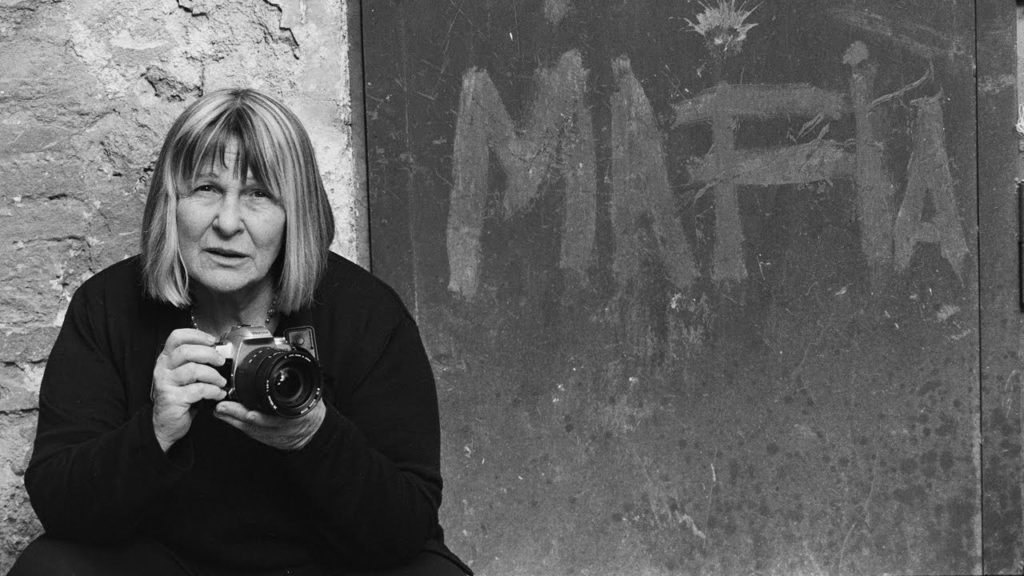
Letizia Battaglia in SHOOTING THE MAFIA

The documentary Shooting the Mafia introduces us to Letizia Battaglia, a talented Palermo photographer, whose photojournalistic specialty became photographing murder victims – scores, perhaps hundreds of corpses, bullet-riddled and bomb-mangled, in pools of blood. Her work also documented the grief. trauma and outrage of the Sicilian population.

Battaglia is open and unapologetic about her lusty personal appetites – and she over-shares. She would be an interesting subject for a biodoc even if she photographed ears of corn.
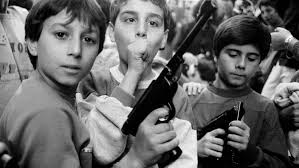
A Letizia Battaglia photograph in SHOOTING THE MAFIA

Shooting the Mafia, an Irish and US production, is directed by Kim Longinotto.

The Traitor can be rented from all the major streaming services. Shooting the Mafia can be streamed on iTunes, YouTube and Google Play.
LORO: just eye candy

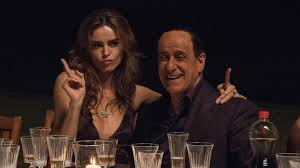
Kasia Smutniak and Toni Servillo in LORO

Loro is director Paolo Sorrentino’s take on the career end of the despicable Italian media mogul and former prime minister Silvio Berlusconi. The Berlusconi character has a different name, but there’s no mistake that it is the hair-dyed, ever-grinning Berlusconi.

The movie Loro is actually the combination of two television programs. In the first, we see Berlusconi’s corruption through the POV of another amoral grasper, Sergio (Ricardo Scarmacia). Sergio seeks his fortune by collecting a brigade of cocaine-fueled escorts to sexually entertain Berlusconi. In the second half, we follow Berlusconi himself as, out of power, he is unable to climb back into power, he loses his wife and he is sexually humiliated by a 20-year-old aspiring actress. Sorrentino gets his licks in by making Berlusconi, finally, pathetic.

Loro stars Sorrentino’s frequent collaborator Toni Servillo, who is able to play the Berlusconi character as a figure powerful to get all he desires…and then not.

I had high expectations of Loro because I loved Sorrentino’s The Great Beauty and Youth. Sorrentino is a master of the eye candy and those movies are especially beautiful, but also tell stories compelingly. Ultimately, Loro is much more interesting visually than it is thematically.

Loro, which got a screening at the San Francisco international Film Festival, has just concluded a wisp of a theatrical release in the Bay Area. It can be streamed from Amazon, iTunes, Vudu, YouTube and Google Play.

CALL ME BY YOUR NAME: first love in a luscious Italian summer

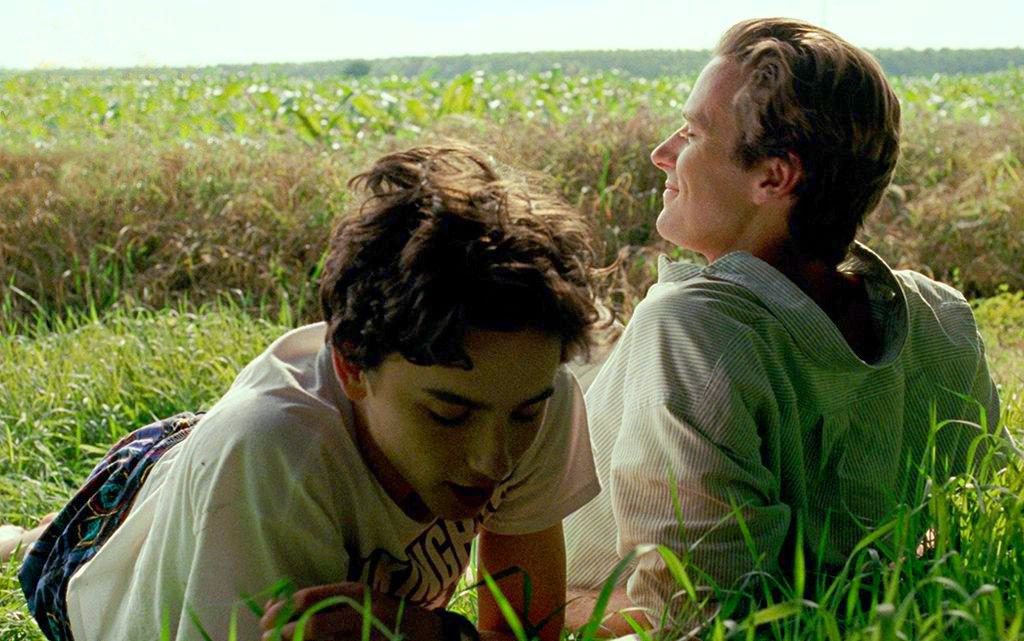
Timothée Chalamet and Armie Hammer in CALL ME BY YOUR NAME

Call Me by Your Name is an extraordinarily beautiful story of sexual awakening set in a luscious Italian summer.  The film is gorgeous and magnificently well-acted, but flawed.

Each year, the family of 16-year-old Elio (Timothée Chalamet) spends the summer in a villa in Northern Italy.  Elio’s father is an American professor of ancient Greek and Roman culture, and each summer he invites a different grad student to live in their villa and work on scholarly pursuits.  In this summer of 1981, that lucky grad student is the 26-year-old Oliver (Armie Hammer).  Elio is attracted to Oliver, who is a closeted gay man. Oliver is attracted to Elio, but initially resists Elio’s overtures.  What follows between the two of them is an enthralling and authentic exploration of first love.

Timothée Chalamet is really perfect as Elio, a musical prodigy who is beating off the girls with a stick.  Even really handsome and talented 17-year-olds have some awkwardness, especially while they’re trying too hard to be cool.  Chamalet captures that perfectly, along with the obsessive longing of a first romance.  (Chalamet is also in Lady Bird, where he plays the dreamy kid who plays in a band, the object of Lady Bird’s desire.)  Armie Hammer is also superb as the more worldly Oliver, whose external confidence masks inner conflicts.

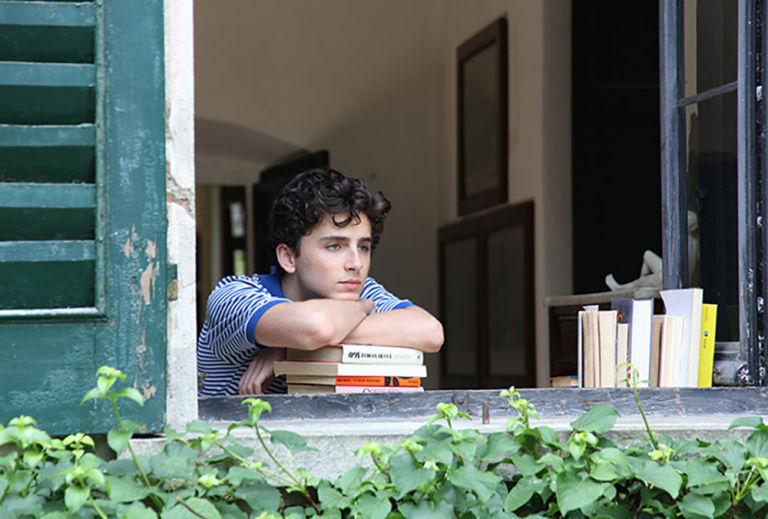
Timothée Chalamet in CALL ME BY YOUR NAME

The story of the two main characters would have made a perfect film, but famed screenwriter James Ivory adds some distracting implausibility with the other characters.  First, there are Elio’s impossibly cool and understanding parents (Michael Stuhlbarg and Amira Casar) who practically push their teen son into the arms of an older man; nobody has parents like that, especially TWO of them.  (And, yes, I did understand the dad’s motivation, made almost explicit in his final monologue).  Second, Elio hurts the feelings of a girl (in a way that almost every male has hurt some girl).  Later, she forgives him and it’s all made to be okay.  This is just too convenient for Elio, and I didn’t buy it.

And then there’s one of my own movie pet peeves.  I generally despise musical interludes in movies, when the dialogue is suspended and a song is played over a montage of imagery.  This usually indicates a lack of imagination in the story-telling.  A movie gets negative bonus points from me when the music is an insipid pop ballad.  In Call Me by Your Name, there are two such Euro-pop interludes.

On the other hand, the depiction of the Italian countryside, with its rustling breezes, orchards heavy with fruit, ancient buildings and  is pure travel porn.  I think that The Wife would have walked out of Call Me by Your Name – not because she wouldn’t have liked it – but to make reservations for a return to Tuscany.  Director Luca Guadagnino (A Bigger Splash, I Am Love) has a gift for making his native Italy unbearably attractive on the screen.  Between the work of Guadagnino and Paolo Sorrentino (The Great Beauty), Italy has been well-celebrated in recent films.

Call Me By Your Name is a very good movie, and the core story of Elio and Oliver is great cinema.