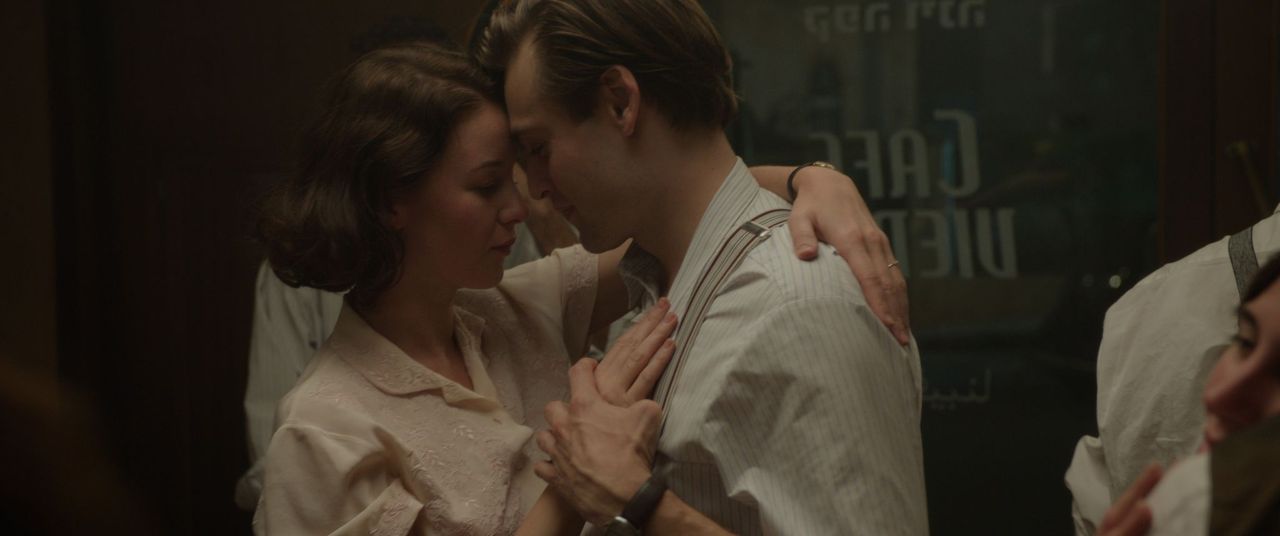
SHOSHANA: two lovers amid a deepening conflict

Photo caption: Irina Starshenbaum and Douglas Booth in SHOSHANA. Courtesy of Greenwich Entertainment.

The thriller Shoshana is a historical drama set in pre-Israel Palestine that revolves around a love story between two people on different sides. The Jewish journalist Shoshana Borochov (Irina Starshenbaum) is a committed Zionist and a supporter of the paramilitary group Haganah. Thomas Wilkin (Douglas Booth) is the Assistant Superintendent of Criminal Investigation for the British authorities.

All of the significant characters in Shoshana were real people, and the story takes place from 1933 to 1944. We don’t see many movies set in this time and place. The Ottoman Empire had ruled Palestine for 400 years, until the Ottomans were expelled by the British in WW I. The British then took over governing Palestine, with its majority Arab population and small Jewish community, under an international agreement – the British Mandate – and with a policy that there should be a Jewish homeland in Palestine. The Arab residents have been living with a few Jews, but are horrified by the specter of mass Jewish immigration, and they revolt. Tit for tat murders begin between Arabs and Jews, which the British try to suppress. Soon there are rival Jewish paramilitary organizations, each with a different take on how to deal with the British, with the Arabs and with each other. When the British sharply limit Jewish immigration and frustrate the efforts to form a Jewish-majority state, the Jews react with anger against the British.

It becomes a lethal gam of three-dimensional chess. Shoshana does a pretty good job in helping the audience track who is who – and who wants to kill who. Shoshana was directed by the veteran Michael Winterbottom (Welcome to Sarajevo, Jude, The Claim, A Mighty Heart and The Trip movies).

Thomas Wilkin and Shoshana Borochov forge an 11-year relationship in an environment that becomes more stressful every year. But Thomas is unwilling to stop being a British policeman, and Shoshana is unwilling to put aside her Zionist beliefs. They love each other, but not enough for either to abandon deeply-held values or their personal identities.

What could doom their relationship is not just arguing politics at the dinner table, but something more ominous – there are plenty of players who want each of them dead. The situation is explosive – often literally. And neither can hide in a Tel Aviv still small enough that everybody knows each other.

The British are trying to cope with what we now know as asymmetrical warfare. A British officer sneeringly asks a Zionist terrorist why he is blowing up women and children, and gets the reply “Because we don’t have the resources that you do“. Ironically, the British in Shoshana are themselves employing mass reprisals, extrajudicial executions and torture that would clearly be considered war crimes today.

Of course, British colonial rule was known for arrogant, racist, and culturally tone-deaf twits, and they are represented by Shoshana‘s villain, police official Geoffrey Morton (the fine actor Harry Melling).

Arabs and their cause may not be depicted in depth in Shoshana, but are shown as victims of both Jewish terrorism and British atrocities.

The historical events constitute the origin stories for both the nation of Israel and the Israeli-Palestinian conflict. The British throw up their hands and fal to provide for Palestinian self-determination within the borders of Palestine. The Jewish organizations in Shoshana later evolved into the two major Israeli political parties of the past 75 years, and the Haganah morphed into the Israeli Defense Forces. Israel has since become a military power and now faces its own asymmetrical warfare.

Given the impact of this history upon the current day, we might have expected more films about this period. After all, there are a zillion films about the Holocaust and a lot set in post-1948 Israel. In 1960, Otto Preminger made the blockbuster film Exodus from the 1958 Leon Uris novel which was the biggest best seller in US since Gone With the WindExodus was set in the period between 1946 and 1948. (My parents saw Exodus at a drive-in with me as a small boy in the back seat.) No less than the pioneering Zionist leader and Israeli prime minister David Ben-Gurion said of the novel, “as a piece of propaganda, it’s the greatest thing ever written about Israel“.

Shoshana is far more clear-eyed and nuanced than ExodusShoshana reflects a historical setting that was complicated, and tells the story of lovers’ inner conflicts amid a dynamic and perilous external conflict. Shoshana, which I reviewed earlier this year for the San Francisco Jewish Film Festival, is now streaming on Amazon, AppleTV, YouTube and Fandango.
SHOSHANA: two lovers amid a deepening conflict

Photo caption: Irina Starshenbaum and Douglas Booth in SHOSHANA. Courtesy of Greenwich Entertainment.

The thriller Shoshana is a historical drama set in pre-Israel Palestine that revolves around a love story between two people on different sides. The Jewish journalist Shoshana Borochov (Irina Starshenbaum) is a committed Zionist and a supporter of the paramilitary group Haganah. Thomas Wilkin (Douglas Booth) is the Assistant Superintendent of Criminal Investigation for the British authorities.

All of the significant characters in Shoshana were real people, and the story takes place from 1933 to 1944. We don’t see many movies set in this time and place. The Ottoman Empire had ruled Palestine for 400 years, until the Ottomans were expelled by the British in WW I. The British then took over governing Palestine, with its majority Arab population and small Jewish community, under an international agreement – the British Mandate – and with a policy that there should be a Jewish homeland in Palestine. The Arab residents have been living with a few Jews, but are horrified by the specter of mass Jewish immigration, and they revolt. Tit for tat murders begin between Arabs and Jews, which the British try to suppress. Soon there are rival Jewish paramilitary organizations, each with a different take on how to deal with the British, with the Arabs and with each other. When the British sharply limit Jewish immigration and frustrate the efforts to form a Jewish-majority state, the Jews react with anger against the British.

It becomes a lethal gam of three-dimensional chess. Shoshana does a pretty good job in helping the audience track who is who – and who wants to kill who. Shoshana was directed by the veteran Michael Winterbottom (Welcome to Sarajevo, Jude, The Claim, A Mighty Heart and The Trip movies).

Thomas Wilkin and Shoshana Borochov forge an 11-year relationship in an environment that becomes more stressful every year. But Thomas is unwilling to stop being a British policeman, and Shoshana is unwilling to put aside her Zionist beliefs. They love each other, but not enough for either to abandon deeply-held values or their personal identities.

What could doom their relationship is not just arguing politics at the dinner table, but something more ominous – there are plenty of players who want each of them dead. The situation is explosive – often literally. And neither can hide in a Tel Aviv still small enough that everybody knows each other.

The British are trying to cope with what we now know as asymmetrical warfare. A British officer sneeringly asks a Zionist terrorist why he is blowing up women and children, and gets the reply “Because we don’t have the resources that you do“. Ironically, the British in Shoshana are themselves employing mass reprisals, extrajudicial executions and torture that would clearly be considered war crimes today.

Of course, British colonial rule was known for arrogant, racist, and culturally tone-deaf twits, and they are represented by Shoshana‘s villain, police official Geoffrey Morton (the fine actor Harry Melling).

Arabs and their cause may not be depicted in depth in Shoshana, but are shown as victims of both Jewish terrorism and British atrocities.

The historical events constitute the origin stories for both the nation of Israel and the Israeli-Palestinian conflict. The British throw up their hands and fal to provide for Palestinian self-determination within the borders of Palestine. The Jewish organizations in Shoshana later evolved into the two major Israeli political parties of the past 75 years, and the Haganah morphed into the Israeli Defense Forces. Israel has since become a military power and now faces its own asymmetrical warfare.

Given the impact of this history upon the current day, we might have expected more films about this period. After all, there are a zillion films about the Holocaust and a lot set in post-1948 Israel. In 1960, Otto Preminger made the blockbuster film Exodus from the 1958 Leon Uris novel which was the biggest best seller in US since Gone With the Wind. Exodus was set in the period between 1946 and 1948. (My parents saw Exodus at a drive-in with me as a small boy in the back seat.) No less than the pioneering Zionist leader and Israeli prime minister David Ben-Gurion said of the novel, “as a piece of propaganda, it’s the greatest thing ever written about Israel“.

Shoshana is far more clear-eyed and nuanced than Exodus. Shoshana reflects a historical setting that was complicated, and tells the story of lovers’ inner conflicts amid a dynamic and perilous external conflict. Shoshana releases into theaters this weekend.

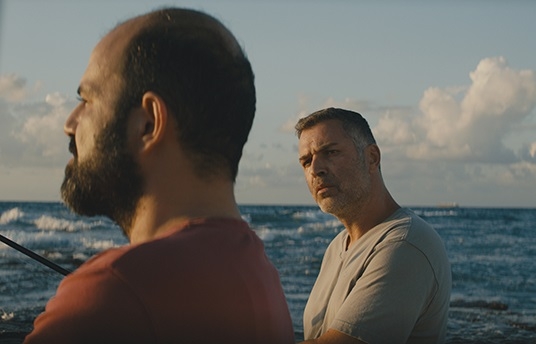
MEDITERRANEAN FEVER: the depressed writer and the crook

Amer Hlehel and Ashraf Farah in Maha Haj’s MEDITERRANEAN FEVER. Courtesy of SFJFF.

In Mediterranean Fever, a depressive writer becomes friends with his shady neighbor and the two embark on a dark journey.

Waleed (Amer Hlehel) is an Arab Israeli living in Haifa, and he’s left his job as a bank clerk to write a novel. His wife’s job as a nurse supports them, and Waleed handles the laundry and schleps the kids to school. The novel is not going well because Waleed suffers from depression; he is so paralyzed with hopelessness that he wants to give up on the therapist that his wife sends him to.

Waleed initially disdains his new, less-educated neighbor Jalal (Ashraf Farah), who day drinks, smokes and, when Waleed is staring at his blank screen, listens to obnoxiously loud music. Jalal is a whiz at anything construction-related and is generous with Waleed’s family. But Waleed is finally drawn to Jalal’s sketchiness: Jalal owes well more than he can pay to some menacing gangsters, is comfortable with his own brutal means of informal debt collection, has a girlfriend on the side and knows his way around the underworld.

Waleed’s wallowing in despair is only brightened when he recognizes that Jalal is a crook (but for an especially morbid reason we learn later). And he sparkles when he finally figures out the cause of his young son’s gastrointestinal distress (the movie’s title is a play on this).

In her second feature, Israeli Arab writer-director Maha Haj has created two memorable guys, and the story of Mediterranean Fever is entirely character-driven. Much of the humor stems from the odd couple of Waleed and Jalal.

I don’t want to describe the tone of Mediterranean Fever, as I do many films, as “darkly funny” because its tone is singular. Haj has written a story about that unfunniest of topics, depression, and keeps us watching with subtle, observational humor.

After a slow burn, Mediterranean Fever pays off with a shocking twist, followed by an epilogue with a character’s hilarious reaction to learning a new neighbor’s occupation. And, yes, that scene is darkly hilarious.

Most of the Arab films we see from this part of the world are about people living in Palestine and occupied territories. In Mediterranean Fever, we glimpse into the day-to-day life of Israeli Arabs – and middle-class Israeli Arabs at that. We also see a Haifa where middle- and working-class families occupy apartments right across the road from a glorious beach; (In the US, these would all be converted into short-term vacation rentals.)

Mediterranean Fever won the Un Certain Regard screenplay prize at Cannes. I screened Mediterranean Fever for the SLO Film Fest; it’s playing at the 2024 San Francisco Jewish Film Festival – July 19 at the Vogue and July 31 at the Piedmont.

The SFJFF is here

Photo caption: Amer Hlehel and Ashraf Farah in Maha Haj’s MEDITERRANEAN FEVER at the SLO Film Fest Courtesy of San Francisco Jewish Film Festival.

The San Francisco Jewish Film Festival (SFJFF) always a major event for Bay Area cinephiles, opens today. The SFJFF is the world’s oldest and largest Jewish film festival, and the program offers over 60 films from Israel, Palestine, Australia, Canada, Colombia, Cyprus, Ethiopia, France, Germany, Hungary, Italy, Poland, Ukraine, the US and the UK. Here’s my festival preview.

This year, I’m recommending three comedies.

  • Mediterranean Fever: A depressive writer becomes friends with his shady neighbor and the two embark on a dark journey. Second feature for Israeli Arab director Maha Haj. Although it’s dark and funny, I don’t want to describe Mediterranean Fever, like I do many films, as “darkly funny” because the tone is singular. Haj has written a story about that unfunniest of topics, depression, and keeps us watching with subtle, observational humor.  In Mediterranean Fever, we glimpse into the day-to-day life of Israeli Arabs – and middle-class Israeli Arabs at that. Won the Un Certain Regard screenplay prize at Cannes. Here’s my full review.
  • The Monkey House: This witty, twisty comedy is the latest from popular and prolific Israeli writer-director Avi Nesher. Set in pre-Internet 1989, novelist Amitay (Adir Miller) has gone a long time without a best seller, and sees his literary legacy fading. His ego is uplifted by an American grad student who plans to publish about his body of work; but, when that falls through, Amitay plans an elaborate ruse – he hires the flighty, wannabe actress Margo (Suzanna Papian) to impersonate the grad student. Plenty of unanticipated complications threaten to derail the scheme and humiliate Amitay, especially to his recently-widowed, longtime crush Tamar (Shani Cohen). Nesher, evidently a gimlet-eyed observer of human behavior, delivers lots of plot twists in this smart and funny movie. Nominated for 11 Israeli Academy Awards.
  • Between the Temples: In Nathan Silver’s comedy, Jason Schwartzman plays a cantor whose wife’s death the year before has plunged him into despair; he is so paralyzed by depression, he has even lost his ability to sing. He has a chance meeting with his childhood music teacher (Carol Kane), now a retired widow. Despite her age and his resistance, she insists on joining the bat mitzvah class he teaches at the temple. She’s a force of nature and may have enough gusto to overcome his angst. As their friendship evolves, will it bring him out of his funk? There are plenty of LOL moments. Kane is excellent, and so is Madeleine Weinstein as the rabbi’s lovelorn daughter. Dolly De Leon, who stole Triangle of Sadness, sparkles as a relentlessly determined Jewish mother.

The SFJFF runs through August 4 in select San Francisco and Oakland venues. Peruse the program and purchase tickets at SFJFFHere’s the trailer for Between the Temples.

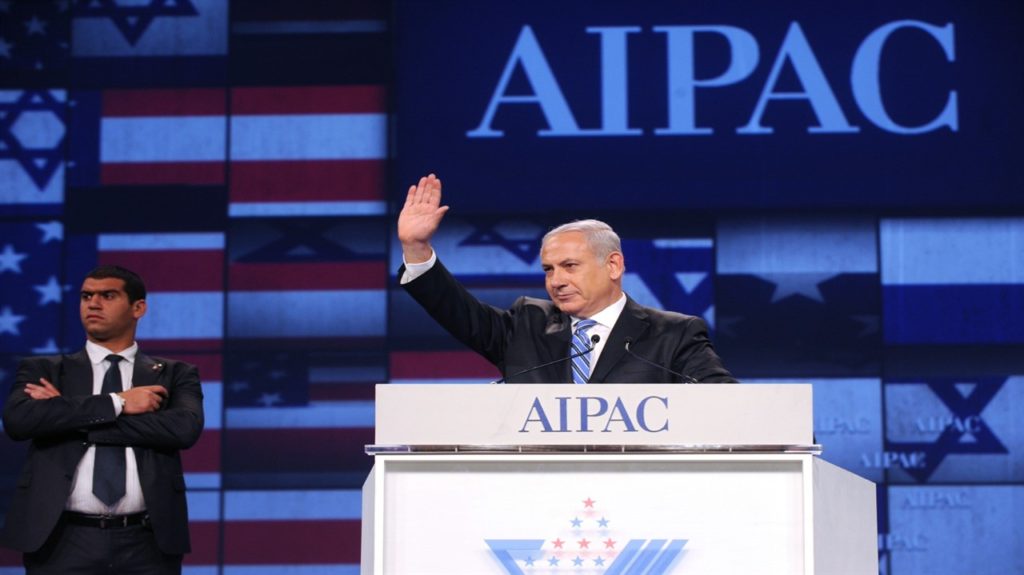
KINGS OF CAPITOL HILL: evolution of a lobby

Benjamin Netanyahu in KINGS OF CAPITOL HILL. Photo courtesy of JFI.

The Israeli documentary Kings of Capitol Hill traces the history of an American political institution, the American Israel Public Affairs Committee (AIPAC). Founded as a lobby group to advocate for the interests of Israel, AIPAC has grown in power and has shifted (and narrowed) its mission.

AIPAC is controversial because the policies of the recent right-wing Israeli governments, supported by AIPAC, and those of most Jewish-Americans have diverged.

Kings of Capitol Hill highlights two pivotal moments. The first came in 1984 when Paul Simon unseated Charles Percy as US Senator from Illinois, and AIPAC was given the credit and the accompanying political fearsomeness. The second came a decade later, when AIPAC abruptly rejected bipartisanship to become a mouthpiece for the Israeli Right and the US Republican Party.

For 60 years, AIPAC leaders have refused to be interviewed about the organization. Israeli filmmaker Mor Loushy has secured the oral histories of many of AIPAC’s top leadership from its founding and fashioned them into a compelling story.

Note: The film was completed before both Donald Trump and Benjamin Netanyahu, two of Kings of Capitol Hill’s villains, were unseated in the past nine months.

I screened Kings of Capitol Hill for this year’s San Francisco Jewish Film Festival, which opens on Friday. You can peruse the festival’s program and schedule at SFJFF, and here’s my own SFJFF preview. Here’s where you can stream Kings of Capitol Hill.

THE WOMEN’S BALCONY: a righteous man must keep his woman happy

THE WOMEN’S BALCONY

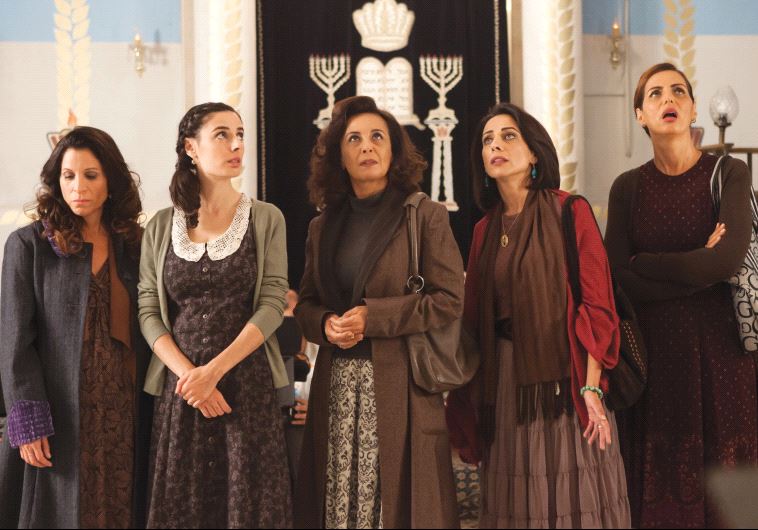
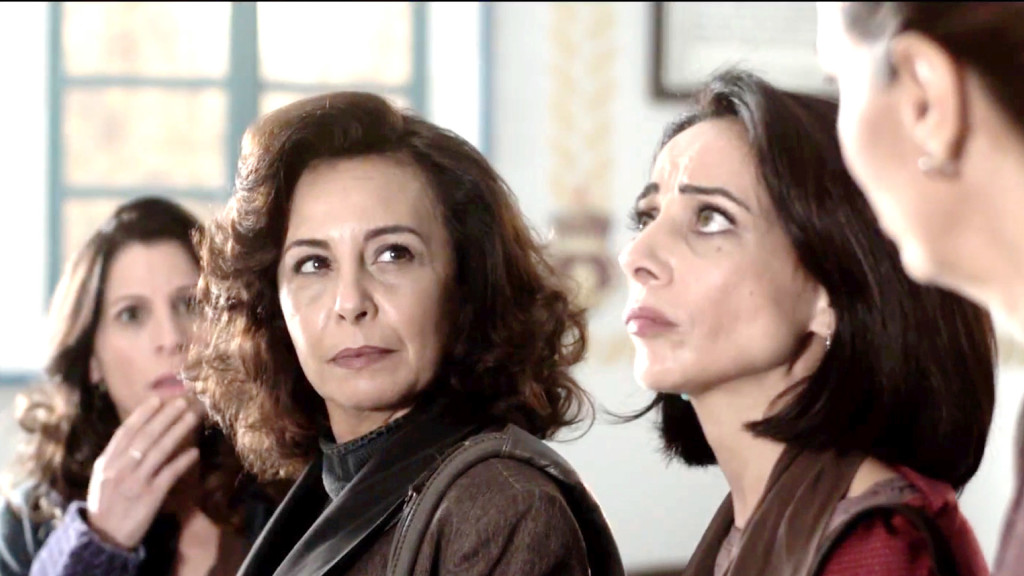
A community of women in a traditional culture revolt in the delightfully smart and funny Israeli comedy The Women’s Balcony.   The balcony in a small Jerusalem synagogue  collapses, and the building is condemned.  The old rabbi’s wife is seriously injured, and he suffers a trauma-induced psychotic breakdown.  Just when it looks like the leaderless congregation will die, a young and charismatic rabbi (Avraham Aviv Alush) appears, enlivens the congregation and repairs the building.  But he rebuilds the synagogue WITHOUT the women’s section.  Profoundly disrespected, the synagogue’s women strike in protest.

The women live in a culture where males have all the power and religious authority trumps all.  The women all have their individually distinct gifts, personalities and rivalries. But they all appreciate the injustice of the situation, and they are really pissed off.  They are very creative in finding way to leverage the power that they do have, and the result is very, very funny.

This could have been a very broad comedy (and a Lysistrata knock-off).  Instead, it’s richly textured, with an examination of ethical behavior and loving relationships.  It’s also dotted with comments on the relations between Israeli Orthodox and Ultra-Orthodox and on the importance of food in this culture.  It’s the first – and very promising – feature for both director Emil Ben-Shimon and writer Shlomit Nehana.

THE WOMEN’S BALCONY

There are plenty LOL moments, including a scene where one of the congregants masquerades as the demented old rabbi to secure the needed psychotropic meds.

We soon understand that the young rabbi has a very unattractive side – grossly sexist and power-hungry. But he has seduced the men and then cows them by manipulating his religious authority. He’s tearing apart a closely bound community braided together by decades of deep friendship and inter-reliance. The movie turns on whether the men can recognize when his supposed righteousness veers into what is really unethical and, in one pivotal scene with the old rabbi, indecent.

Two of the male characters, deeply in love with their women, step up and do the right thing. This overt comedy has a very a romantic core.

Most of all, The Women’s Balcony is about mature relationships. Most of these couples have been married for decades, especially the couple at the core of the story, Ettie (Evein Hagoel) and Zion (Igal Naor). Ben-Shimon and Nehana prove themselves to be keen and insightful observers of long-lasting relationships.

A righteous man must keep his woman happy. This may not be written in the Holy Scriptures, but it’s damn useful advice. (It also helps, we learn, if he can make a mean fruit salad.) The longer you’ve been married, the funnier you’ll find The Women’s Balcony. You can stream it on Amazon, Vudu, YouTube and Google Play.

Stream of the Week: LEVINSKY PARK – refuge for refugees?

LEVINSKY PARK

In honor of the San Francisco Jewish Film Festival, now underway, my this week’s video pick comes from last year’s festival. Israel was created as a home for refugees. What happens when African refugees overwhelm a neglected Tel Aviv neighborhood is the subject of the topical documentary Levinsky Park.

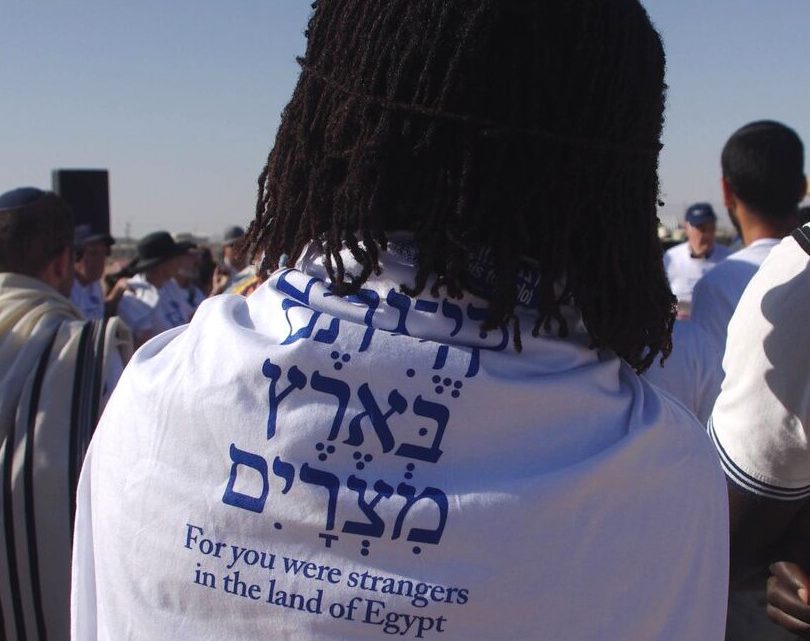
Director Beth Toni Kruvant takes us to Tel Aviv’s hardscrabble Hatikva neighborhood, now burdened with an influx of African refugees from sub-Saharan Africa. The refugees aren’t Jewish, they don’t speak Hebrew and they sure aren’t white. Discouraged from working legally, the refugees encamp on the streets and do what they need to survive. The Israeli government senses a lose-lose media profile on the issue and tries to duck it entirely.

So how do the local Israelis react? There is a wide spectrum. Some welcome and try to help these people fleeing for their lives. Others tag the newcomers with the loaded pejorative “infiltrators” and try to kick them out. We see some ugly, overt racism in Levinsky Park, but nothing unlike what we’ve seen in the US in the Trump Era.

It’s the same question that confronts all countries in the West about political asylum-seekers – who will actually invite them in? What’s different about Levinsky Park, of course, is that this is Israel – the one nation created by and for refugees.

A leader emerges from the refugees, the charismatic and articulate Mutasim Ali. He frames their plight as a movement, and they strive to regain some control over their own futures.

This year’s SFJFF runs from July 19 through August 5 at theaters in San Francisco, Palo Alto, Albany, San Rafael and Oakland. You can peruse the entire program and buy tickets and passes at San Francisco Jewish Film Festival.

Levinsky Park, which originally played in the Bay Area at Cinequest, is available to stream from Amazon, iTunes, YouTube and Google Play.

Stream of the Week: THE WOMEN’S BALCONY – a righteous man must keep his woman happy

THE WOMEN'S BALCONY
THE WOMEN’S BALCONY

A community of women in a traditional culture revolt in the delightfully smart and funny Israeli comedy The Women’s Balcony. The balcony in a small Jerusalem synagogue collapses, and the building is condemned. The old rabbi’s wife is seriously injured, and he suffers a trauma-induced psychotic breakdown. Just when it looks like the leaderless congregation will die, a young and charismatic rabbi (Avraham Aviv Alush) appears, enlivens the congregation and repairs the building. But he rebuilds the synagogue WITHOUT the women’s section. Profoundly disrespected, the synagogue’s women strike in protest.

The women live in a culture where males have all the power and religious authority trumps all. The women all have their individually distinct gifts, personalities and rivalries. But they all appreciate the injustice of the situation, and they are really pissed off. They are very creative in finding way to leverage the power that they do have, and the result is very, very funny.

This could have been a very broad comedy (and a Lysistrata knock-off). Instead, it’s richly textured, with an examination of ethical behavior and loving relationships. It’s also dotted with comments on the relations between Israeli Orthodox and Ultra-Orthodox and on the importance of food in this culture. It’s the first – and very promising – feature for both director Emil Ben-Shimon and writer Shlomit Nehana.

THE WOMEN'S BALCONY
THE WOMEN’S BALCONY

There are plenty LOL moments, including a scene where one of the congregants masquerades as the demented old rabbi to secure the needed psychotropic meds.

We soon understand that the young rabbi has a very unattractive side – grossly sexist and power-hungry. But he has seduced the men and then cows them by manipulating his religious authority. He’s tearing apart a closely bound community braided together by decades of deep friendship and inter-reliance. The movie turns on whether the men can recognize when his supposed righteousness veers into what is really unethical and, in one pivotal scene with the old rabbi, indecent.

Two of the male characters, deeply in love with their women, step up and do the right thing. This overt comedy has a very a romantic core.

Most of all, The Women’s Balcony is about mature relationships. Most of these couples have been married for decades, especially the couple at the core of the story, Ettie (Evein Hagoel) and Zion (Igal Naor). Ben-Shimon and Nehana prove themselves to be keen and insightful observers of long-lasting relationships.

A righteous man must keep his woman happy. This may not be written in the Holy Scriptures, but it’s damn useful advice. (It also helps, we learn, if he can make a mean fruit salad.) The longer you’ve been married, the funnier you’ll find The Women’s BalconyThe Women’s Balcony is available to stream from Netflix Instant, Amazon, iTunes, Vudu, YouTube and Google Play.

BEN-GURION, EPILOGUE: in his own words, Israel’s founding leader reflects

Ben-Gurion, Epilogue

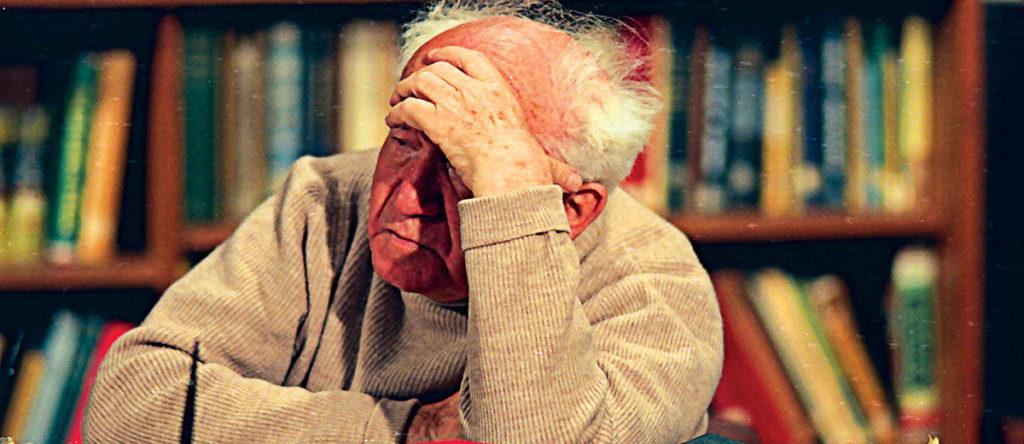
In Ben-Gurion, Epilogue, footage from a recently discovered video interview allows us to hear from Israel’s founding leader in his own words. In 1968, David Ben-Gurion was 82 years old and had been retired from public office for five years. Living on a remote kibbutz in the Negev Desert, he still had a lot to say.

Ben-Gurion was interviewed for seven hours over several days, but the video was lost until recently. First the images were found, which triggered a search for the sound. The result is Ben-Gurion, Epilogue, with the seven hours distilled down to one hour. Director Yariv Moser gets out of the way and lets Ben-Gurion speak for himself. The result is an important document of 20th Century history.

Not a guy who naturally “holds forth”, Ben-Gurion is prodded into revealing his inside view of his controversial acceptance of German reparations.  We also get his take on the Zionist movement (not exactly what you’d expect) and, of course the Big Question: land for peace.  There are also telling insights into his marriage.

You can find a separate 24-minute “making of” documentary on YouTube.

Ben-Gurion, Epilogue will screen at the SFJFF:

  • Cinearts (Palo Alto), Sunday, July 23 Noon
  • Castro (San Francisco), Saturday, July 29 1:45 PM
  • Albany Twin (Albany), Sunday, July 30 Noon.

The SFJFF runs from July 20 through August 6 at theaters in San Francisco, Palo Alto, Albany, San Rafael and Oakland. You can peruse the entire program and buy tickets and passes at San Francisco Jewish Film Festival.

LEVINSKY PARK: refuge for refugees?

LEVINSKY PARK

Israel was created as a home for refugees.  What happens when African refugees overwhelm a neglected Tel Aviv neighborhood is the subject of the topical documentary Levinsky Park.

Director Beth Toni Kruvant takes us to Tel Aviv’s hardscrabble Hatikva neighborhood,  now burdened with an influx of African refugees from sub-Saharan Africa.  The refugees aren’t Jewish, they don’t speak Hebrew and they sure aren’t white.  Discouraged from working legally, the refugees encamp on the streets and do what they need to survive.  The Israeli government senses a lose-lose media profile on the issue and tries to duck it entirely.

So how do the local Israelis react?  There is a wide spectrum. Some welcome and try to help people fleeing for their lives.  Others tag the newcomers with the loaded pejorative “infiltrators” and try to kick them out.  We see some ugly, overt racism in Levinsky Park, but nothing unlike what we’ve seen in the US in the Trump Era.

It’s the same question that confronts all countries in the West about political asylum-seekers – who will actually invite them in?  What’s different about Levinsky Park, of course, is that this is Israel – the one nation  created by and for refugees.

A leader emerges from the refugees, the charismatic and articulate Mutasim Ali.  He frames their plight as a movement, and they strive to regain some control over their own futures.  Levinsky Park is a compelling real-life story and screens at the SFJFF:

  • Castro (San Francisco), Thursday, July 27 11:15 AM
    Albany Twin (Albany), Friday, August 4 4:05 PM.

The SFJFF runs from July 20 through August 6 at theaters in San Francisco, Palo Alto, Albany, San Rafael and Oakland. You can peruse the entire program and buy tickets and passes at San Francisco Jewish Film Festival.