
DVD/Stream of the Week: Undefeated – an Oscar winner you haven’t seen

The extraordinary documentary Undefeated begins with a high school football coach addressing his team:

Let’s see now. Starting right guard shot and no longer in school.  Starting middle linebacker shot and no longer in school. Two players fighting right in front of the coach. Starting center arrested.  Most coaches – that would be pretty much a career’s worth of crap to deal with.  Well, I think that sums up the last two weeks for me.

Undefeated is the story of this coach, Bill Courtney, leading his team through a season.  The kids live in crushing poverty and attend a haplessly under-resourced high school in North Memphis.

Undefeated may be about a football team, but isn’t that much about football.  Instead of the Xs and Os, it shows the emotional energy required of Courtney to keep each kid coming to school, coming to practice and on task.  He gets many of the kids to think about goals for the first time in their lives.  He is tireless, dogged and often frustrated and emotionally spent.

The film wisely focuses on three players, and we get to know them.  Like the rest of the team, all three are from extremely disadvantaged homes.  One is an overachiever both on the field and in the classroom, but surprisingly emotionally vulnerable.   Another has college-level football talent but very little academic preparation.   The third,  recently back from youth prison, is impulsive, immature, selfish and extremely volatile.

Undefeated won the 2012 Oscar for Best Documentary for filmmakers Daniel Lindsay and T.J. Martin – but it didn’t get a wide theatrical release.  It’s available now to stream from Amazon, Vudu, YouTube and redbox.
Mea Maxima Culpa: Silence in the House of God: the blame climbs until it cannot climb higher

In Mea Maxima Culpa: Silence in the House of God, documentarian Alex Gibney explores the Catholic Church’s decades-long cover-up of priest abuse from a Wisconsin parish to the top of the Vatican (and I mean the top).  The film begins with the horrifying and disgusting abuse of the most vulnerable – children at a residential Catholic school for the deaf whose devout parents cannot communicate with them through American Sign Language.

At first it seems like another story of Church leaders suppressing the truth to avoid bad publicity and lawsuits – and it is for the first few years.  But then we learn about an American bishop trying to remove a pedophile from ministry, but being thwarted by superiors across the Atlantic.  As Gibney pulls apart the onion, the focus of the story climbs the Church hierarchy.  The brilliant and prolific Gibney’s work includes Enron: The Smartest Guys in the Room, Client 9: The Rise and Fall of Eliot Spitzer, Casino Jack and the United States of Money and the Oscar-winning Taxi to the Dark Side.

I also recommend another documentary on this difficult subject, Deliver Us From Evil, which made my top ten list for 2006.  That is the story of a serial pedophile priest moved from parish to parish in the Diocese of Stockton, California.  This has become, sadly, a familiar narrative, but what distinguishes Deliver Us From Evil is its breathtaking interviews with the pedophile himself.

Mea Maxima Culpa: Silence in the House of God is now playing on HBO.


Ethel: an interesting woman who has lived an extraordinary life

Ethel is a fine HBO documentary on the life of Ethel Kennedy, Robert F. Kennedy’s widow.   The filmmaker is Ethel’s daughter Rory, her 11th child, born six months after RFK’s assassination.  Rory Kennedy had the advantage of access to a trove of photos and home movies, along with on-camera interviews with her mother and her siblings.  The result is an affectionate and insightful portrait of Ethel, with the view of RFK’s career by his own family.  We are surprised to learn that Ethel was the most competitive member of the family.  We also learn of her impish liveliness, such as dropping “Get a new Director” into the FBI’s basement suggestion box.  Ethel is an interesting woman who has lived an extraordinary life.  Anyone interested in 20th Century American history should see Ethel.

Ethel debuted last week and is being rebroadcast on HBO.

Paul Williams Still Alive: now content in his skin

Here’s a treat – Paul Williams Still Alive, an affecting documentary about the songwriter, omnipresent in the 70s, but not now.  Because Paul Williams’ life story follows the arc of every episode of VH1’s Behind the Music (hits the show biz big time, does too many drugs, career crashes and burns), this film could have been trite.  Instead, it’s fresh and appealing, chiefly because filmmaker Stephen Kessler is such an unabashed  fan boy who glories in following Williams around, uncovering tidbits like Williams love of eating squid.

The documentary’s other cornerstone is that Paul Williams himself – now twenty years sober –  is a very appealing guy.  Williams doesn’t dwell on the time when he was rich, famous and unhappy.  He has an edge, and doesn’t suffer fools, but he lives in the moment and it’s fun to see a guy now so content in his skin.

Paul Williams Still Alive is available now on Video On Demand, including Amazon Instant Video.


Herzog’s most American documentary: God’s Angry Man

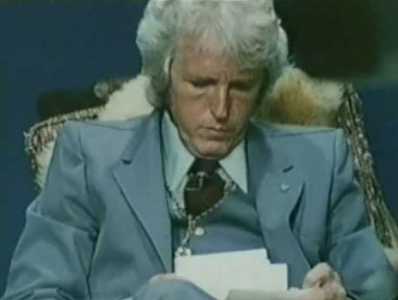
Dr. Gene Scott

I am a huge fan of Werner Herzog’s documentaries (Grizzly Man, Little Dieter Needs to Fly, Cave of Forgotten Dreams).  So I was particularly pleased to come across this 1980 Herzog gem.  It’s a 43 minute made-for-TV documentary called God’s Angry Man.

God’s Angry Man is about the late Dr. Gene Scott, a TV preacher who would rail at his audience until they sent him money.  You would think that people would turn off a television personality who was hectoring them, but Scott tapped into something spooky within his flock.  He was mesmerizing.  I myself watched him for many hours late at night, amazed that his followers would tune in to his hard-edged bellowing and choose to be bullied.

Herzog plays it straight and lets Scott speak for Scott, although Herzog must have been puzzled and bemused by the American phenomenon of the TV preacher.

You can watch the entire movie at this slightly creepy Dr. Gene Scott fan page or here on Google Videos.

The Movie Mitt Romney Doesn’t Want You To See

Mitt Romney has been formally nominated by this week’s Republican Convention in Tampa.  Imagine if Michael Moore directed a profile of Mitt’s career as co-founder of Bain Capital.  Well, the 28-minute short film When Mitt Romney Comes to Town is an even more devastating critique of Romney than a Moore film would be.

The storyline of When Mitt Romney Comes to Town is essentially 1) you are happily living in Middle America, working in a factory and paying your mortgage and your taxes; 2) Mitt Romney’s Bain Capital buys and then loots your company; 3) you lose your job and then your home; and 4) repeat several times.

Amazingly, the film was directed by Jason Killian Meath, a Republican media consultant and culture warrior. During the GOP primary season, it was shilled by a Newt Gingrich-friendly SuperPAC.

Meath’s film is heavy-handed and manipulative (as a Michael Moore film would be). Meath doesn’t have Moore’s sense of humor, but also doesn’t have Moore’s abrasiveness and self-righteousness, which makes his film smoother, more broadly accessible and ultimately more persuasive. In an appeal to Republican primary voters, Meath uses Reaganesque “Morning in America” music and imagery, and I don’t think that it’s an accident that most of Bain Capital’s victims in the film are White.

The oddest thing about When Mitt Romney Comes to Town is that it is not just an attack on Mitt Romney, but against the type of Vulture Capitalism tolerated or even promoted by all recent Republican Congressional leaders and presidential candidates. This is a major thread of the Obama narrative against Romney.

Here’s the entire 28-minute movie.

Searching for Sugar Man: he didn’t know he was a rock star

What a story!  A Detroit construction laborer named Sixto Rodriguez was also a singer-songwriter who cut two albums in 1970 and 1971.  The albums didn’t sell in the US, and he faded back into obscurity.  Yet in South Africa – completely isolated by the sanctions of the apartheid era – the artist known as Rodriguez became huge, and his songs fueled a protest movement.  Rodriguez never knew of his success, and South Africans believed that he had suffered a dramatic rock star death.  The powerful documentary Searching for Sugar Man is the story of some stubborn South African music geeks trying to find out what really happened to Rodriguez, and the startling truths that they uncovered.  (The title comes from Rodriguez’ most iconic anthem, the song Sugar Man.)

I have never seen a biographical documentary of a contemporary figure with less comment from the subject himself.  There is a brief filmed interview with the eccentric Rodriguez, who reveals very little of his perspective on his own story.  His songs can only be written by a reflective person, but Rodriguez is the farthest thing from self-absorbed.  Still, the interviews with his family, friends and fans and his songs help us feel like we know him.

It’s a flabbergasting and unpredictable story and well told.  It’s worth searching out Searching for Sugar Man.

Bill W.: the reluctant founder of a movement

The excellent documentary Bill W. tells the story of Bill Wilson, the founder of Alcoholics Anonymous, and it’s quite a story.  We see Wilson’s own battle with the bottle, including a pivotal moment when he is about to enter a hotel bar in Akron, but instead decides “to call another drunk”.  The story follows his cobbling together what became the 12 step model and his keeping alive the AA movement in its early days.  But the most compelling story – and the heart of the film – is Bill Wilson.

Wilson was a reluctant movement leader.  His primary passion was for business, in which his drinking killed his potential success.  Instead, he achieved fame and historical importance in a field not of his choosing.  As the founder, he could have easily formed AA into a hierarchy with himself at the top – and AA as his personal power base.  But, once AA could stand on its own, he chose to walk away from its leadership.  His decision not to commercialize AA deprived himself of a millionaire’s lifestyle.

Producer and co-director Dan Carracino reminded the audience at my screening that the movie aims to tell the story of Bill Wilson, not to be an exhaustive history of AA.

Because Bill W. primarily uses historical film footage and photos for visuals, and the recorded voice of Wilson himself, along with talking heads who knew him, the audience gets a solid sense of his personality.  There are some visual re-enactments (of Wilson’s drinking days  and early AA meetings) that are successful because they are narrated by the real Bill W. himself.

I was fortunate to see the film in an audience that contained over 200 AA members, and they responded especially favorably to the film.  At its core, Bill W. tells a fascinating story, and I would recommend it for anyone.  Bill W. is being self-distributed with both special screenings and theater runs in various cities.

DVD/Stream of the Week: The Man Nobody Knew: In Search of My Father, CIA Spymaster William Colby

William Colby was a daring saboteur in World War II, an effective espionage agent in the Cold War, an architect of an especially brutal aspect of the Vietnam War and, in the post-Watergate 70s, the nation’s top spy and the Director of Intelligence who made public the CIA’s historic misdeeds.  His son, Carl Colby, explores the man who lived that life in The Man Nobody Knew: In Search of My Father, CIA Spymaster William Colby (2011).

Carl Colby makes use of family photos and filmed interviews with Colby’s colleagues, rivals and observers beginning with his secret missions in WW II.  Chief of these is Barbara Colby, William’s wife of 39 years and Carl’s mother.  The talking heads also include the likes of James Schlesinger, Robert McFarland, Brent Scowcroft, Bob Woodward, Seymour Hersh and even Oleg Kalugin (the KGB’s chief spy in the US).  We also hear the White House audio of Colby, along with JFK, RFK and Averell Harriman, discussing the upcoming overthrow of Vietnam’s Diem government.

Carl Colby admires his father’s smarts, toughness, principles, physical bravery and compulsion to serve.  He also recognizes the impact that such devotion to duty has on family responsibilities.  “It’s a terrible thing to say, but sometimes I think I would have rather worked for him than be his son,” Carl said. “I would have been closer to him.”

Carl Colby interviewed his father’s second wife but did not use the footage in the film, and he did not interview his siblings.  As discussed in this Washington Post article, those family members disagree with the film’s portrayal of Colby as an absentee parent and a suicide victim.

But those are comparatively minor parts of the story. The most historically significant (and interesting) segments are:

  • Colby’s successful secret support of Italy’s Christian Democratic Party, resulting in election victories over the Italian Communist Party.
  • His inside view of the November 1963 anti-Diem coup in Vietnam (which Colby opposed).
  • His decision to resist the Ford Administration and lay bare the CIA’s “Family Jewels”, the past illegal activities, including assassination attempts and domestic surveillance.  Not surprisingly, the always smirking Don Rumsfeld, Henry Kissinger and Dick Cheney are the bad guys in this episode.

The Man Nobody Knew is available on DVD and on Netflix streaming.  Incidentally, it now #6 on my list of Longest Movie Titles, between Can Heironymus Merkin Ever Forget Mercy Humppe and Find True Happiness? (1969) and Don’t Be a Menace to South Central While Drinking Your Juice in the Hood (1996).

DVD/Stream of the Week: Woody Allen: A Documentary

Woody Allen’s To Rome with Love is a pleasant enough trifle, but I’d rather focus on Woody’s masterpieces like Annie Hall, Manhattan, Hannah and Her Sisters, Crimes and Misdemeanors and last year’s Midnight in Paris.  In fact, combining his great films with his really good ones reveals an astounding track record: Play It Again Sam (1972), Annie Hall (1977), Manhattan (1979), Hannah and Her Sisters (1986), Another Woman (1988), Crimes and Misdemeanors (1989) , Husbands and Wives (1992), Mighty Aphrodite (1995), Deconstructing Harry (1997), Match Point (2005), Vicky Christina Barcelona (2008) and Midnight in Paris (2011).

What American filmmaker has created twelve films of this quality?  Woody is up there in Billy Wilder and John Ford territory.  The fact that Woody is so prolific may work against him – cranking out a movie each year means that there are some stinkers (Small Time Crooks, Curse of the Jade Scorpion) that dilute his reputation.  And then there was the scandal…

Cinephiles and Woody’s fans will appreciate Woody Allen: A Documentary, which traces Woody’s life and work, providing key insights into his creative process.  Robert Weide followed Woody for eighteen months and filmed interviews with over thirty associates and critics – many from Woody’s earliest days.  These include Woody himself, his mother (in footage shot by Woody in the 80s)), his sister and producer Letty Aronson and his longtime casting director Juliet Taylor.  We also hear from ex-wife and co-star Louise Lasser and ex-girlfriend and co-star Diane Keaton.

Weide uncovers slew of nuggets.  We see how Woody keeps ideas for potential movies on scraps of paper, which he revisits when he needs to think up another movie.  We see how he uses an old typewriter and lo tech cut-and-staple to construct his screenplays.  We hear how his screenwriting experience on What’s New Pussycat taught him to insist on total artistic control of his films.   He explains how he learned a woman’s point of view from Diane Keaton, which changed his perspective for Hannah and Her Sisters.

The documentary also addresses, but does not dwell on, the Soon-Yi scandal that blew up as he and Mia Farrow were finishing the shooting of Husbands and Wives.

Woody Allen: A Documentary has two parts – the whole thing clocks in a shade under 3 1/2 hours.  It’s available on DVD and on Netflix streaming.