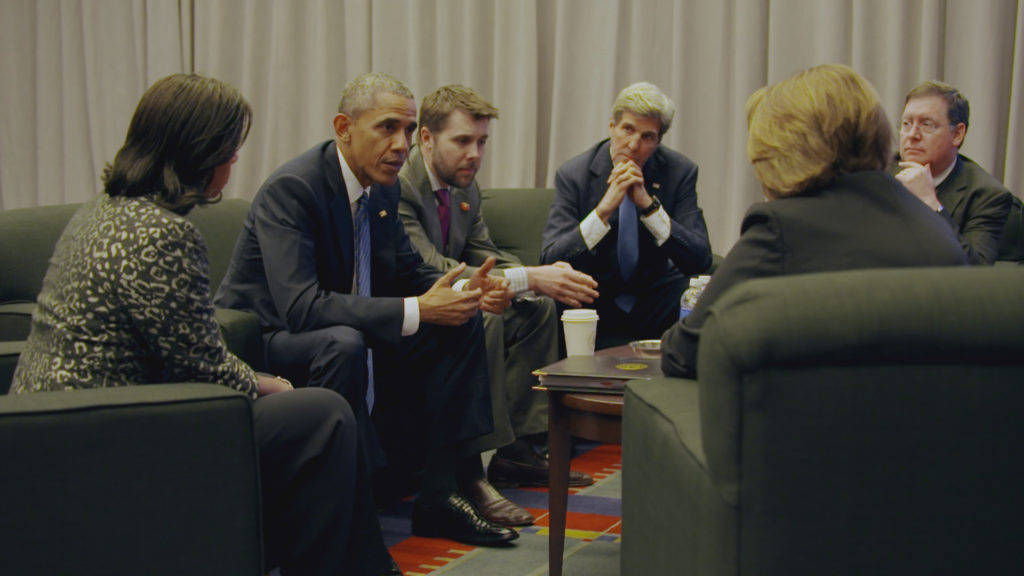
A scene from THE FINAL YEAR, a Magnolia Pictures release. Photo courtesy of Magnolia Pictures.
In the documentary The Final Year, we get to peek inside the last year of the Obama foreign policy. Director Greg Barker’s cameras go behind the scenes to follow Secretary of State John Kerry, UN Ambassador Samantha Power and Deputy National Security Advisor Ben Rhodes as they travel the globe to keep the peace and mitigate conflict.
We see a lot of movies about the military and the intelligence services, so it’s a rare and welcome treat to watch diplomacy in action.
The Final Year primarily depicts and references the Obama Administration’s signature accomplishments – the Iran nuclear deal, avoiding catastrophe in North Korea, the Paris climate accords – along with the challenges of Syria.
We tend to see these folks as talking heads on television, so it’s humanizing to see them in candid moments. However, this is hardly a warts-and-all expose, and sometimes the tone even reaches reverent or fawning. Rhodes even gets the chance to evade responsibility for a basic political mistake – letting a reporter exploit his words.
It’s impossible to watch The Final Year in early 2018 without comparing these folks with the current administration. Whatever their imperfections, Kerry, Power and Rhodes are serious, competent people trying to implement a coherent foreign policy in our national interest and, in the process, earning the respect of other nations. The juxtaposition with the clown show of the current Administration is alarming and profoundly sad.
[SPOILER: In the final shot before the closing credits, the very-soon-to-be-former President Obama says, “Are we done here? Okay, see you later.” and turns down a White House corridor with his security detail for perhaps the last time. It’s heartbreakingly wistful.]
Bombshell: The Hedy Lamarr Storyis the riveting biopic of a glamorous movie star who invented and patented the precursor to wireless technology; that’s amazing enough, but Bombshell delves deeply into how Lamarr’s stunning face, her Jewish heritage, and mid-century gender roles shaped her career, marriages and parenting. Top notch.
In the last few years, one totally unexpected aspect of Lamarr’s life has become more well-known. She was a tinkerer/inventor who co-invented a radio guidance system for submarine torpedos, which she donated to the US military. The US Navy used this technology in WW II. Modern blue tooth technology stems directly from her innovation. Today her patent would be worth billions.
Bombshell adds layer upon layer to this tale of beauty and brains, as it traces Lamarr’s remarkable life. Hedy Lamarr had no control over being born a woman, being born to Jewish parents and being born to be a beauty. These three accidents of birth set the parameters of her journey – granting her access to some professional opportunities and stunting others, even threatening her life.
She burst into celebrity – and notoriety – at age 19, as the star of the film Ecstasy. Not only was Hedy the first actress filmed in full frontal nudity, she was the first screen actress to portray female orgasms. She was soon the young trophy wife of an Austrian industrialist, a formidable and fearsome supplier of munitions to Hitler. Hedy’s life seemed headed along the Bimbo Track, but she realized that her husband was powerful enough to keep her trapped in the marriage, but not powerful enough to protect her from the Nazis. At this point, she orchestrated an international escape that is the stuff of thrillers.
At age 24, often nominated as the most beautiful woman in the world, she launched a Hollywood career. Professional ups and downs, marriages and affairs and children followed, along with her work in technology.
Her beauty was often a blessing and sometimes a curse, but always affected her trajectory. Someone that beautiful is just different – the rest of us can’t help our reactions to her. But how many times can you be a trophy wife?
She was a person who survived troubling times, which left scars on her. How Hedy handled her Jewishness, how she raised her kids and how she was treated by the military are unsettling. Documentarian Alexandra Dean, Bombshell’s writer-director brings us witnesses, including Hedy’s children, to deliver an inside peek at a real life that would not be believable as a work of fiction.
I saw Bombshell: The Hedy Lamarr Story this summer at the San Francisco Jewish Film Festival (SJFF). It’s coming to theaters this week.
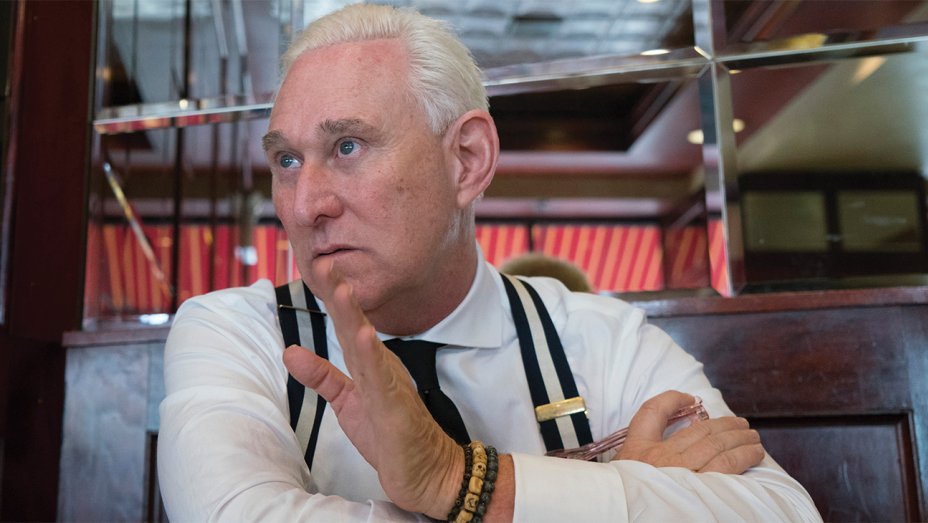
Roger Stone in GET ME ROGER STONESo this week’s biggest news has been the indictment of former Trump campaign chief Paul Manafort. The indictment comes out of special prosecutor Robert Mueller’s probe of the Russian hacking of last year’s presidential campaign. Earlier this year, Netflix released the documentary Get Me Roger Stone, and IMDb bills Paul Manafort third in the “cast”, right behind Roger Stone and Donald Trump.
Get Me Roger Stone is an insightful look at the career of political consultant/provocateur Roger Stone, one of the most outrageous characters on the American political scene. What’s especially relevant today is that Roger Stone and Paul Manafort together invented a new model of lobbying – where the political consultants who help get a candidate elected to high office, then sell their influence over said elected official.
Even without the Manafort angle, Get Me Roger Stone is an entertaining watch, although you might find Roger Stone himself too loathsome to watch. Stone will do anything – no matter how duplicitous – to win a political campaign. He will do anything to bring public attention (i.e., notoriety) upon himself. And he is utterly unapologetic about both. Stone is the political world’s version of a pro wrestling villain.
Roger Stone is the unmatched master of high jacking a news cycle with a preposterous smear. The man has a tattoo of Richard Nixon’s face on his back, which tells you a whole lot about him.
Get Me Roger Stone also chronicles Stone’s decades-long quest to get Trump to run for president, and then Stone’s role as an unofficial/official/unofficial Trump strategist. The documentary also touches on a Roger Stone sex scandal.
Anyway, it’s ripped from the headlines, and you can stream it from Netflix Instant.
When there’s a movie that is supposed to be good for you, but you really don’t enjoy it, I call it an “eat your broccoli” movie, and the documentary Dawson City: Frozen Time is an example.
An estimated 75% of all silent movies have been lost. Dawson City: Frozen Time is about the discovery of hundreds of silent films. It turns out that Dawson City, a mining hamlet in the Canadian Yukon, was the last stop on a movie distribution circuit. When a movie played Dawson City, it was already two years after the initial release, so the distributors didn’t find it worthwhile to pay for the return of the film. Accordingly, many movies from the silent era were stored or disposed of in Dawson City, where they were uncovered by a construction bulldozer in 1978.
That’s all interesting enough, and 5-10 minutes would be enough to tell this story, and then we could focus on the most compelling of the actual Lost Films, and that could make a fine documentary. But the two hours of Dawson City: Frozen Time is a loooong two hours.
There are some interesting documentary nuggets. One example is an illustration of how hand grenades were manufactured for WW I.
Baseball fans will treasure clips from the 1919 World Series, which is infamously known for the “Black Sox” scandal. Some Chicago White Sox stars took money from gamblers to throw the series. In Dawson City, we actually get to see some of the suspiciously inept plays by the heavily favored Sox.
The best part is about two-thirds through – a montage of found films. The images are compelling, and the performances have a surprising magnetism.
By far the worst part of Dawson City is its off-putting score. The drone of discordant chords (is that an oxymoron or just impossible?) played on various keyboard instruments is distracting and then finally unbearable. I was annoyed enough, but then The Wife, from another room in the house, called out, “That music is TERRIBLE”.
I need to tell you that I’m outside the critical mainstream on Dawson City: Frozen Time, which has an impressive Metacritic score of 85. Major critics that I highly respect have described it as “instantaneously recognizable masterpiece”, “thrilling”, “hypnotic” and even “elevates…to the level of poetry”. But not for me.
Dawson City: Frozen Time can be streamed from Amazon, Vudu, YouTube and Google Play.
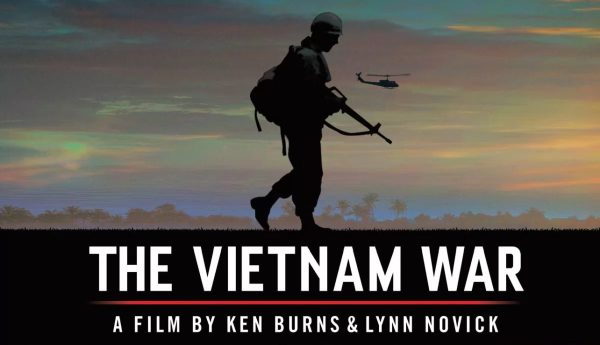
The new PBS documentary by Ken Burns and Lynn Novick, The Vietnam War, is one of the best documentaries of the century and a superb history lesson, crucial to understand the America of today. It’s a Must See for Baby Boomers. For different reasons, it’s a Must See for Americans of later generations. The ten episodes of The Vietnam War can be streamed from PBS through October 15.
It’s impossible to overstate the effect of the Vietnam War upon Americans of my generation. I was watching TV at nine years old when I viewed a Buddhist monk setting himself on fire. Vietnam got my attention on that day and held it throughout my youth. I remember watching the television news, with the weekly “body count” scorecards for dead Americans, Army of the Republic of Vietnam (ARVN), Viet Cong and North Vietnamese Army (NVA). I was almost 15 when, overnight, the Tet Offensive changed the appraisal of the war by the mainstream American public. I was almost 19 when I got my draft lottery number. I was 22 and about to graduate from college when Saigon fell.
Last week, a carpenter about my age did some work at my house. When he arrived, he commented that he heard through the door that I was watching The Vietnam War. It took us about two sentences to get to the draft. Each of us instantly remembered our lottery numbers (mine was 65, his was 322). Both of us remembered where we were on February 2, 1972, the night of that lottery drawing.
For Baby Boomers, The Vietnam War provides context for our experience, along with some new revelations. Younger Americans who watch The Vietnam War will now understand what happened then and how it affects our culture and our politics to this day.
Burns and Novick tell their story mostly through first person accounts, from real people recounting their experiences 40-60 years ago. The American talking heads aren’t big shots, but people who were soldiers, protesters, POWs, journalists and family members who lost loved ones. But Burns and Novick also bring us Vietnamese witnesses – soldiers and civilians from the ARVN, Viet Cong and NVA. Including the Vietnamese points of view – as disparate as the American ones – works to complete the picture.
The Vietnam War also brings us new information about the era’s most iconic photos. We all remember the shocking still photo of the summary pistol-to-the-temple execution of a Viet Cong by a South Vietnamese police official; The Vietnam War brings us the original network TV film clip that was shot and shown only once on the TV news. There’s the unforgettable photo of the Kent State coed, with hands outstretched over the corpse of a fellow student; we also see a never-before-shown home movie clip shot of the scene by another student. Finally, we hear from the journalist who photographed the running Vietnamese girl burned by napalm, and we see film from that scene, too.
Who remembers that “light at the end of the tunnel” was coined by a French general in Vietnam, and later adopted by American brass (a bad choice, given the French experience)? We hear the phrase used again in a very grim joke in late April 1975.
The Vietnam War shows us that Le Duan had shouldered Ho Chi Minh aside and ran the North Vietnamese side of the war for its last eight years. Study of Le Duan provides us with some important lessons. First, never get in a war of attrition with a fanatic. Second, never let a fanatic run your postwar economy or foreign relations.
The Vietnam War is unmatched in tracing the evolution in the American public’s attitude during the long, long war. There was some public opposition to the War almost from the beginning, but the Tet Offensive in early 1968 convinced the great majority that the US could never win and needed to find a way out. But many Americans despised the anti-war protests. It was the protests that divided the American nation. Oddly, at the same time there was both a policy consensus (get out of Vietnam) and a cultural civil war.
And The Vietnam War, through his own words on White House tapes, exposes Henry Kissinger (the favorite of the American press) as the cynical sycophant that he was, ever flattering Nixon and conspiring to delay peace to favor Nixon’s political fortunes.
There is no more evocative aspect of The Vietnam War than its soundtrack, with 120 songs from the era from Jimi Hendrix, Bob Dylan, The Beatles, The Rolling Stones, Buffalo Springfield, Nina Simone, Simon and Garfunkel, Cream, Janis Joplin, Pete Seeger and even the Zombies, Procol Harum, Vanilla Fudge and Link Wray. One episode ends with my choice as the anthem for 1971 in America – Marvin Gaye’s What’s Going On. The songs are absolutely perfectly matched with the usual and spoken content, perhaps the most masterful use of popular music on a soundtrack that I have seen (and heard). You can even review the episode playlists .
Through October 15, you can stream, The Vietnam Warhere.
On September 21, Turner Classic Movies presents five movies with some of the most unforgettable rock concert footage:
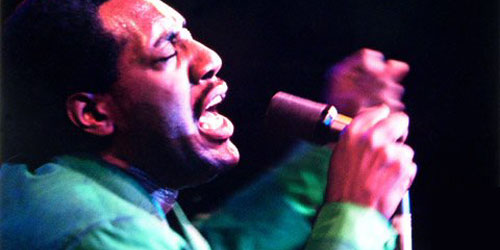
Monterey Pop (1968): This is one of the few DVDs that I still own, for the performances by Mamas and the Papas, Jimi Hendrix, Janis Joplin, Otis Redding, Canned Heat, Simon and Garfunkle, Jefferson Airplane, Eric Burdon and the Animals, Country Joe and the Fish and The Who. It’s okay with me if you fast forward over Ravi Shankar. Pete Townsend and Jimi Hendrix had a guitar-destroying competition, which Hendrix, aided by lighter fluid, undeniably won. The Otis Redding set is epic.
Woodstock (1970): TCM is airing the director’s cut of the film chronicling the most iconic rock concert ever, also a pivotal social and cultural phenomenon. Performers include: Joan Baez, Crosby Still & Nash, Arlo Guthrie, The Who, Sha Na Na, Richie Havens, Joe Cocker, Country Joe and the Fish, Jimi Hendrix, Sly and the Family Stone, Santana and (wait for it…) Ten Years After.
Gimme Shelter (1970): The anti-Woodstock – the ill-fated Rolling Stones concert at Altamont, showing what happened when someone tried to put on a major free concert without Bill Graham or any other adult supervision, depending on the (literally) murderous Hell’s Angels for security. Includes some footage of that notorious publicity grabber, attorney Melvin Belli in real-time negotiations. What’s unforgettable, of course, is watching Mick Jagger dealing with a murder at the foot of his stage.
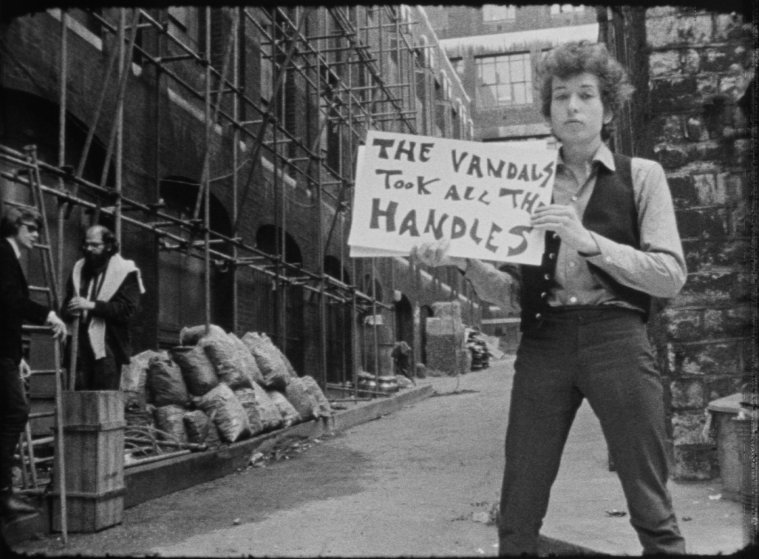
Bob Dylan: Don’t Look Back (1967): The story of Bob Dylan’s 1965 tour of England, when he was transitioning from an acoustic to an electric artist. This film opens with what must be the first music video, as Dylan holds up cards with the lyrics for Subterranean Homesick Blues. The pump don’t work ‘Cause the vandals took the handles
Jimi Hendrix (1973): I haven’t seen this movie, which contains 1967-70 concert footage and interviews with his contemporaries. Here’s a tip for Hendrix fans – the Hendrix display in his hometown’s Seattle Rock and Roll Museum (now Museum of Pop Culture) is superb.
D.A. Pennebaker directed both Monterey Pop and Don’t Look Back. Pennebaker also excels in political documentaries; he was the cinematographer for Primary and the director of The War Room.
I would argue that the Janis Joplin and Otis Redding sets in Monterey Pop are the best live performances ever filmed. Watch for Mama Cass in the audience reacting to Janis with a “Wow”.
Great music and lots of stoned people. Set that DVR.
D.A. Pennebaker invents the music video in BOB DYAN: DON’T LOOK BACK
Stories We Tell is the third film from brilliant Canadian director Sarah Polley (Away From Her, Take This Waltz), a documentary in which she interviews members of her own family about her mother, who died when Sarah was 11. It doesn’t take long before Sarah uncovers a major surprise about her own life. And then she steps into an even bigger surprise about the first surprise. And then there’s a completely unexpected reaction by Polley’s father Michael.
There are surprises aplenty in the Polley family saga, but how folks react to the discoveries is just as interesting. It helps that everyone in the Polley family has a deliciously wicked sense of humor.
The family story is compelling enough, but Polley also explores story telling itself. Everyone who knew Polley’s mother tells her story from a different perspective. But we can weave together the often conflicting versions into what seems like a pretty complete portrait of a complicated person.
Polley adds more layers of meaning and ties the material together by filming herself recording her father reading his version of the story – his memoir serves as the unifying narration.
To take us back to the 1960s, Polley uses one-third actual home movies and two-thirds re-creations (with actors) shot on Super 8 film. Polley hired cinematographer Iris Ng after seeing Ng’s 5 minute Super 8 short. The most haunting clip is a real one, a video of the actress Mom’s audition for a 60s Canadian TV show.
Make sure that you watch all of the end credits – there’s one more surprise, and it’s hilarious.
You can rent Stories We Tell on DVD from Netflix and Redbox and stream it from Amazon, iTunes, Vudu, YouTube and Google Play.
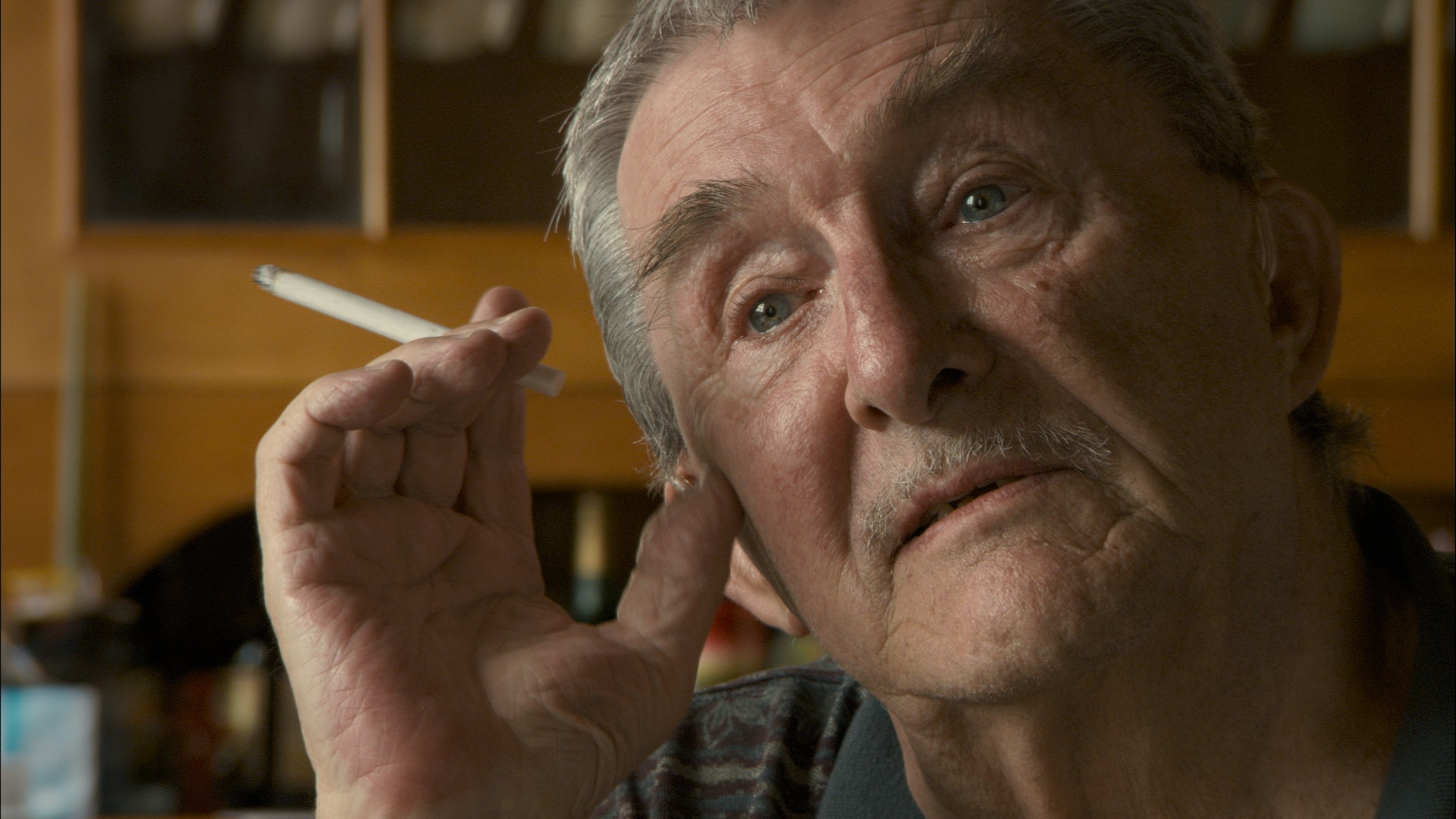
The one absolutely essential requisite for a fine documentary film is a fascinating subject, and Obit proves that an insightful filmmaker can find the fascination in the most unlikely place. It’s about the writing of New York Times obituaries. Director Vanessa Gould chose the subject when the NYT published the obit of an acquaintance whom she feared would become overlooked; the story in her own words is here (scroll down).
The writers in Obit explain something counter-intuitive – good obituaries are very little about a person’s death. Sure, they are published upon a death, but the key to an obit is to explain the person’s life. It helps that the NYT obits eschew the old-fashioned and hypocritical canonization of the dead, instead pseudo-resurrecting them by finding what was most interesting about their lives.
Obit is a superb study on writing. We sit on the writers’ shoulders and observe their process in real-time. Obit lives up to its tagline: Life on a Deadline.
Obit was released briefly earlier this year and is now available to stream on Amazon, iTunes, Vudu, YouTube and Google Play.
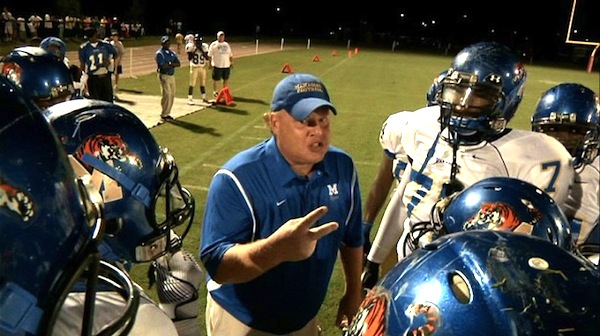
With football season (finally) approaching, it’s time for a Feel Good, Oscar-winning story set on the gridiron. The extraordinary documentary Undefeated begins with a high school football coach addressing his team:
Let’s see now. Starting right guard shot and no longer in school. Starting middle linebacker shot and no longer in school. Two players fighting right in front of the coach. Starting center arrested. Most coaches – that would be pretty much a career’s worth of crap to deal with. Well, I think that sums up the last two weeks for me.
Undefeated is the story of this coach, Bill Courtney, leading his team through a season. The kids live in crushing poverty and attend a haplessly under-resourced high school in North Memphis.
Undefeated may be about a football team, but isn’t that much about football. Instead of the Xs and Os, it shows the emotional energy required of Courtney to keep each kid coming to school, coming to practice and on task. He gets many of the kids to think about goals for the first time in their lives. He is tireless, dogged and often frustrated and emotionally spent.
The film wisely focuses on three players, and we get to know them. Like the rest of the team, all three are from extremely disadvantaged homes. One is an overachiever both on the field and in the classroom, but surprisingly emotionally vulnerable. Another has college-level football talent but very little academic preparation. The third, recently back from youth prison, is impulsive, immature, selfish and extremely volatile.
Undefeated won the 2012 Oscar for Best Documentary for filmmakers Daniel Lindsay and T.J. Martin – but it didn’t get a wide theatrical release. It’s available now to stream from Amazon, Vudu, YouTube and redbox.
The documentary Ella Brennan: Commanding the Table tells the story of the New Orleans powerhouse restaurateur – and it’s one compelling story.
Ella Brennan is a woman who, before she was thirty, started running restaurants in the pre-feminist 1950s. Ella Brennan started as the little sister and became the matriarch of the famous New Orleans restaurant family. She launched Brennan’s and Commander’s Palace, the latter still the greatest of New Orleans Creole restaurants. On her journey, she had to overcome Mad Men-era sexism, a slew of business cycles and hurricanes – and even family betrayal.
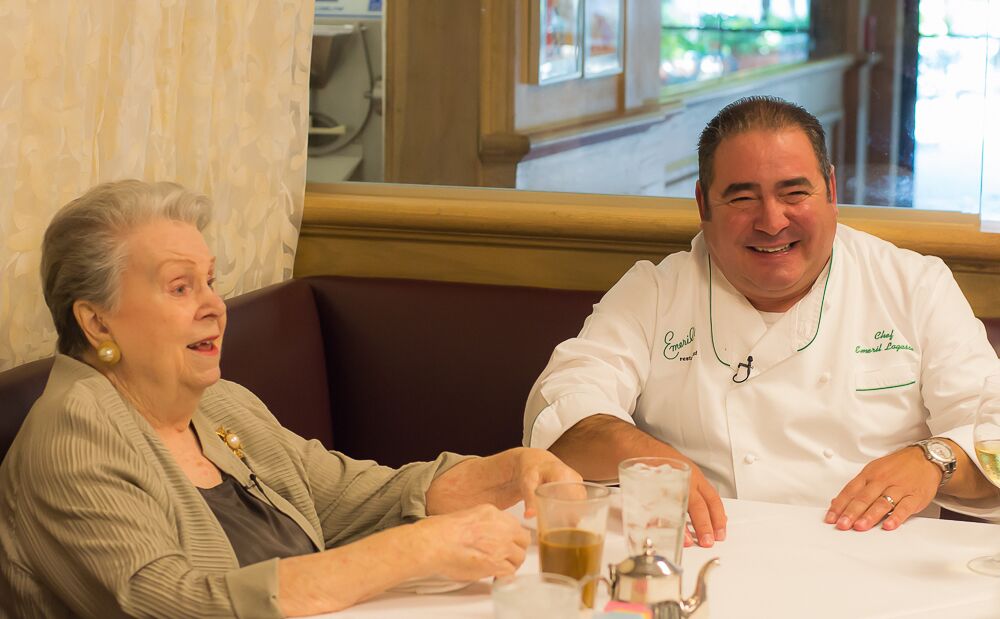
We see a woman with old-fashioned obsession with detail and very high standards. We also see culinary and marketing creativity that can only be described as genius. Ella Brennan is responsible for Bananas Foster, the Jazz Brunch and a host of food trends. Along the way, she mentored the celebrity chefs Paul Prudhomme, Emeril Lagasse and Jamie Shannon. Here’s a New York Times profile of Ella Brennan that mentions this film.
I saw Ella Brennan last fall at the Mill Valley Film Festival. Ella Brennan: Commanding the Table can be streamed from Netflix Instant.