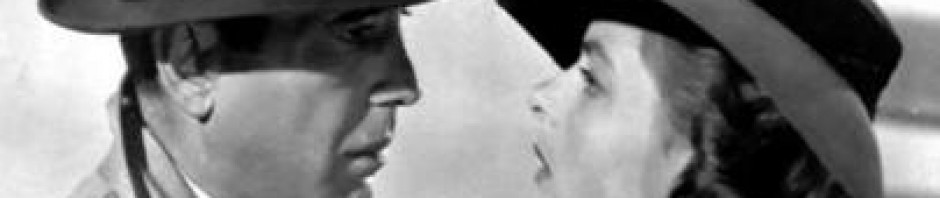
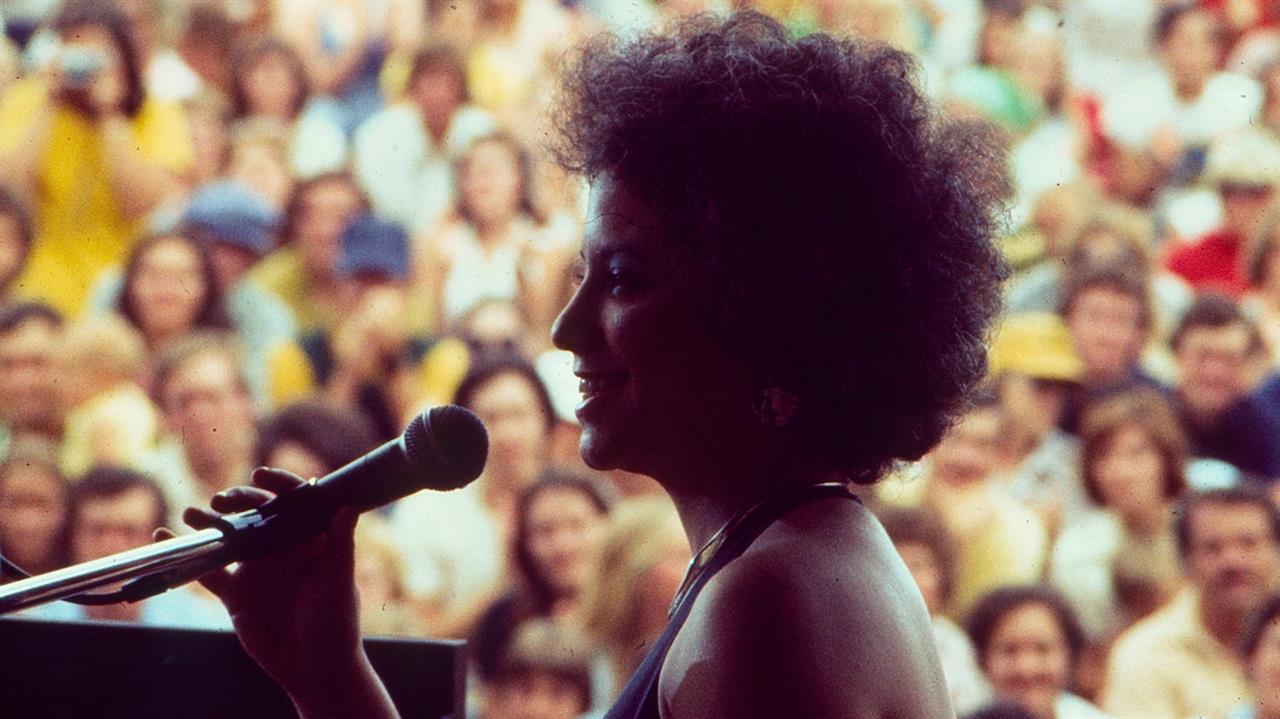
Photo caption: Janis Ian in JANIS IAN: BREAKING SILENCE. Courtesy of Greenwich Entertainment.
In Janis Ian, Breaking Silence, the biodoc of the earnest pop-folk singer-songwriter, a teen prodigy steps onto the roller coaster of the music industry at a tender age and experiences the highest highs and the lowest lows. And, it turns out that there’s more to Janis Ian than Society’s Child and At Seventeen.
The word prodigy is overused, but accurately describes Ian, who was doing professional-level song-writing at age 14. Her dad answers a booking request on the home phone with with, “You know she’s only 15, right?“
We’re not surprised that Ian experiences the shock of instant national stardom, the vicissitudes of record companies, the proverbial crooked business managers, (but not as MANY drugs as in most music biodocs). But it’s insightful to hear from Ian herself about how all this seemed and felt as it happened. Ian recounts her relationships while touring, with both men and women, and the impact of being outed involuntarily.
When Ian is unexpectedly confronted by someone who broke her heart years before, she blurts out the perfect last laugh.
Janis Ian: Breaking Silence was made with Janis Ian’s cooperation, and takes a very sympathetic point of view; that’s okay because Ian herself is clear-eyed, self-deprecating and maintains a solid, often wry, perspective on her experience. Janis Ian herself testifies, along with others close to her (including old pals Arlo Guthrie and Joan Baez).
This is the third feature for director Varda Bar-Kar, who is aided by excellent editing from Ryan Larkin in his first feature.
I originally reviewed Janis Ian: Breaking Silence for its brief thetricl release earlier this year. It’s now playing on PBS American Masters; you can find American Masters on your PBS channel or watch the film on the American Masters website.
Photo caption: Paul Reubens in PEE-WEE AS HIMSELF. Courtesy of HBP Max.
The delightfully wacky character Pee-Wee Herman sprang on the scene, seemingly from nowhere, sweetly celebrating his own weirdness. Pee-Wee was the creation of actor Paul Reubens. Reubens, of course, had a life before Pee-Wee, and he had a very private personal life distinct from his invented persona. Sadly, Reubens lost his privacy in, not one, but two career-killing tabloid scandals.
HBO Max is airing the bio-doc Pee-Wee as Himself, from the acclaimed Silicon Valley native, New York-based documentarian Matt Wolf. Wolf has an uncanny gift for finding compelling stories that everyone else has overlooked: Teenage, Recorder: The Marion Stokes Project, Spaceship Earth and Rustin. Here, Wolf reveals three stories, each in itself worthy of a documentary.
The first is Paul Reubens’ origin story – his childhood, his self-confidence as an avant garde art student and his comfort in an out gay lifestyle. Reubens was failing as an actor, and his overweening drive to be successful as an actor led him to leave his partner and go back in the closet.
The second is Pee-Wee’s creation story – how Reubens joined the famed The Groundlings improv group, working with the likes of Laraine Newman, Phil Hartman and Elvira, and originated several characters, one of which was Pee-Wee. Amazingly, Reubens, as Pee-Wee, was a winning contestant on The Gong Show and even The Dating Game. When Reubens failed to be selected for Saturday Night Live, he determined to produce his own TV show – and the sui generis Pee-Wee’s Playhouse was born. Another helluva story.
Finally, we come to the tabloid scandal, an unexpected comeback and then a second scandal. As Reubens himself ruefully notes, by the time he realized the privacy tradeoffs that come with fame, “the ink had dried on my pact with the devil”.
Wolf had elicited permission from Reubens to make a film about Reubens’ life, and secured 40 hours of on-camera interview footage. But the mercurial Reubens, highly ambivalent to sharing his personal story, kept pulling the plug on the project. In the interviews, Reubens often brings up that ambivalence and repeatedly jerks Wolf’s chain. When Reubens fell ill, Wolf was in a race against mortality to get Reubens back on board. Fortunately, Wolf succeeded.
We also hear from Reubens’ sister and his longtime personal assistant, along with old pals like Laraine Newman, Elvira and Natasha Lyonne. We see an archival interview of Phil Hartman, reflecting on what he saw as a betrayal by Reubens.
I’m not sure that I’ve seen another biodoc where the subject himself, so wounded and humbled, stiffens his dignity to reflect on his own brilliance and his suffering from both injustices and his own mistakes. Pee-Wee as Himself runs three hours and twenty-five minutes and is airing on two parts on HBO Max.
Photo caption: Paul Reubens in PEE-WEE AS HIMSELF. Courtesy of HBP Max.
Tomorrow, HBO Max begins airing the bio-doc Pee-Wee as Himself, from the acclaimed Silicon Valley native, New York-based documentarian Matt Wolf. Wolf has an uncanny gift for finding compelling stories that everyone else has overlooked: Teenage, Recorder: The Marion Stokes Project, Spaceship Earth and Rustin.
The delightfully wacky character Pee-Wee Herman sprang on the scene, seemingly from nowhere, sweetly celebrating his own weirdness. Pee-Wee was the creation of actor Paul Reubens. Reubens, of course, had a life before Pee-Wee, and he had a very private personal life distinct from his invented persona. Sadly, Reubens lost his privacy in a career-killing tabloid scandal.
Wolf had elicited permission from Reubens to make a film about Reubens’ life, and secured hours of on-camera interview footage. But the mercurial Reubens, highly ambivalent to sharing his personal story, kept pulling the plug on the project. When Reubens fell ill, Wolf was in a race against mortality to get Reubens back on board. Fortunately, Wolf succeeded.
Pee-Wee as Himself runs three hours and twenty-five minutes and will be aired in two parts on HBO Max, beginning tomorrow.
Photo caption. Isa and Veronica Garcia-Hayes in MATTER OF MIND: MY PARKINSON. Courtesy of PBS Independent Lens.
The surprisingly uplifting documentary Matter of Mind: My Parkinson’s shines a light on Parkinson’s disease, and what we need to know about it. An estimated one million Americans are living with Parkinson’s, and the key to Matter of Mind’s success is in introducing us to three of them – a Brooklyn optician, a San Francisco fitness trainer and an Alaskan cartoonist – and their families. On April 8, Matter of Mind: My Parkinson’s becomes available on PBS’ Independent Lens and the PBS App..
Parkinson’s is incurable and degenerative, and attacks motor abilities. Matter of Mind does not sugar coat the symptoms, ranging from from tremors, falling and speech impairment to dementia and depression. Nevertheless, there are now medicines and surgeries ((including deep brain stimulation)) that can impact the symptoms.
We watch the three subjects and their families, all engaging and relatable, explore the medical treatments, with their risks and tradeoffs, and adapt to getting the most out of their lives, even with Parkinson’s. Matter of Mind emphasizes the impacts on family members and the importance of family in supporting each sufferer’s response.
The 54-minute format of Independent Lens fits this subject matter exceptionally well – long enough to explain the science without becoming an eat-your-broccoli slog.
This is the second in a series of three documentaries on neurodegenerative diseases from co-writers and co-directors Anna Moot-Levin and Laura Green; all three films in the Matter of Mind trilogy, including My ALS and My Alzheimer’s will be available to stream between May 15 to June 3, 2025.I’m usually not keen on disease movies, but Matter of Mind: My Parkinson’s is so good, and Parkinson’s so prevalent and inadequately understood, that this is essential viewing.
Fortunately, the insightful documentary John Singer Sargent: Fashion and Swagger spends much of its running time staring at the subjects of the painter’s portraits, who gaze back at us is if they were alive.
The doc traces Sargent’s life, and talking heads try to explain how his brushwork results in such compelling art, but I didn’t find that stuff as compelling as when the camera zooms in and lingers on the face of a subject. Sargent really had a gift for making it seem as if the subject is alert to your walking into the room and then engaging with you. They seem in mid-conversation instead of mid-pose.
We get to spend so much time unhurriedly locking eyes with these folks, mostly rich women from 150 years ago, that it’s like being inside a John Sargent Singer coffee table book.
The title refers to “swagger portraits” (which I didn’t know was a thing) – vanity portraits commissioned by the rich and famous to depict their subjects as grand, important and fashionable. Sargent excelled at these.
John Singer Sargent: Fashion and Swagger is streaming free on kanopy.
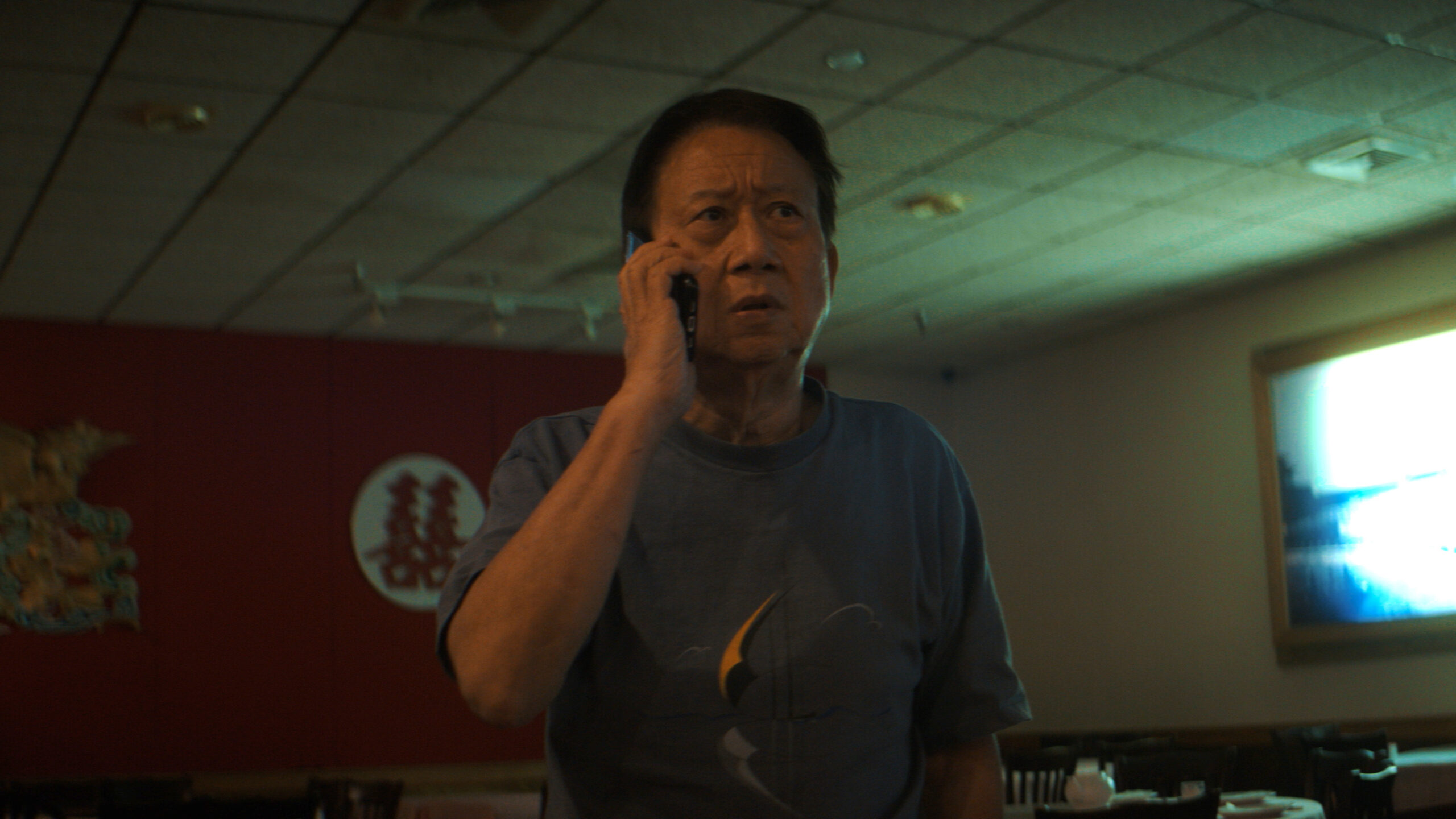
In the documentary Starring Jerry as Himself, a Florida senior sees himself recruited as an operative by Chinese police. The story is told in a re-enactment with the subject playing himself. We later learn why the filmmakers chose re-enactment, and what could have been a conventional true crime exposé or a weeper, is illuminated by the subject family’s humanity.
Starring Jerry as Himself is the first feature for director Law Chen, who also edited, co-produced and shot some of the footage. Law Chen and his co-producer and subject Jonathan Hsu were responsible for the decision on how to structure the film. That decision turned what could have been a heartbreaking downer into an engaging and satisfying family story, albeit a cautionary one.
I highlighted Starring Jerry as Himself as a MUST SEE in my Slamdance: discovering new filmmakers, and it won Slamdance’s Documentary Feature Grand Jury Prize. It’s now available to stream at home from Amazon, AppleTV and YouTube.
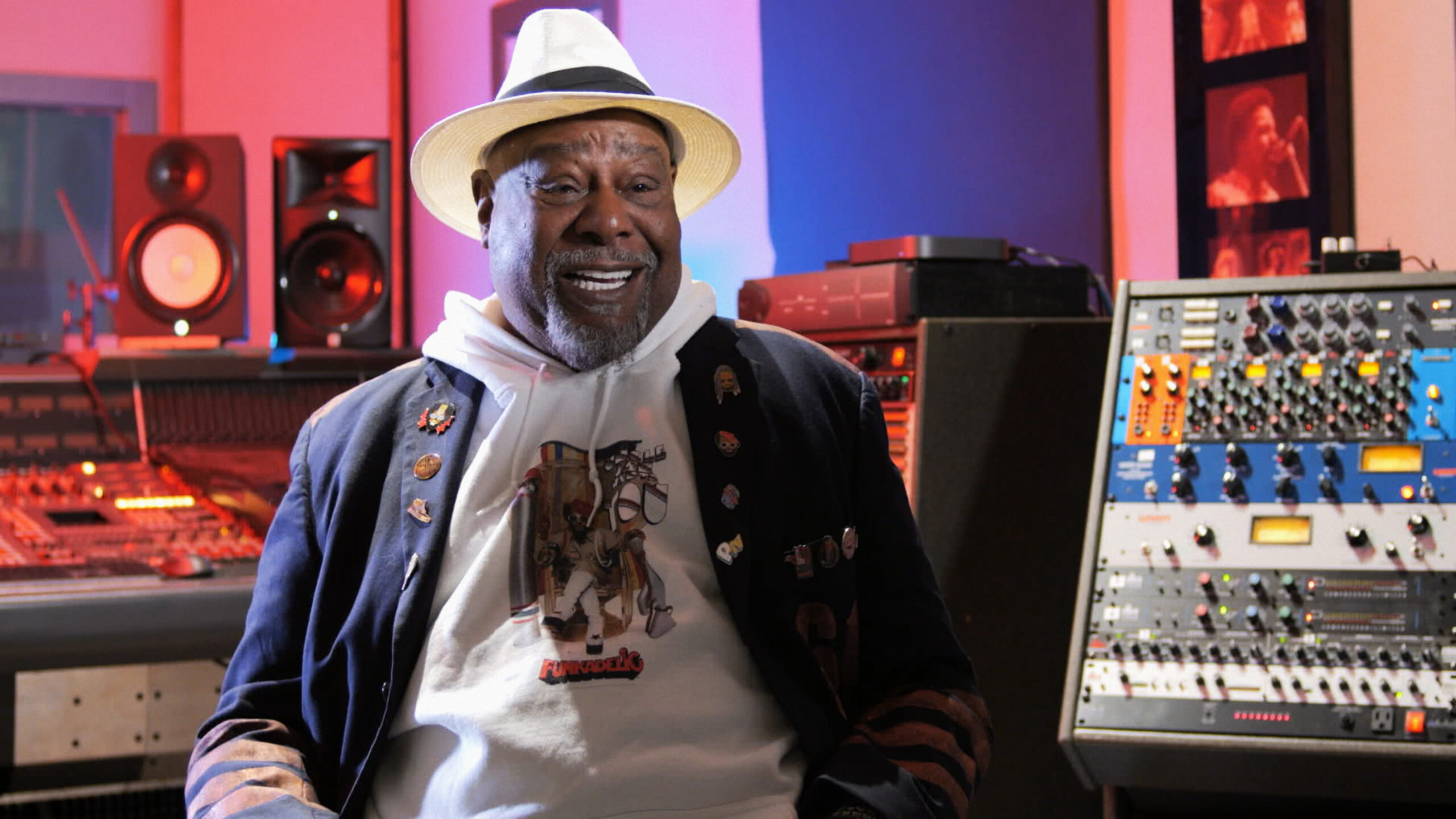
Photo caption: George Clinton in WE WANT THE FUNK. Courtesy of Firelight Films.
The delightful We Want the Funk is as far from an eat-your-broccoli documentary a you can get. Directors/producers Stanley Nelson and Nicole London explain the musical essence, history, and socio-political context of Funk without taking any of the fun out of it. Because the very raison d’être of Funk is to make you want to move your body, this is an especially enjoyable watching experience.
We see the evolution of Funk, beginning with James Brown, Sly and the Family Stone and Parliament/Funkadelic. We Want the Funk traces influence from the Black church and Funk’s legacy impacts on Afrobeat and Hip-hop.
We hear from musicians, like the always playful George Clinton, and scholars, including my favorite musicologist and cultural historian, Questlove. We Want the Funk drills deep to explain James Brown’s weaponization of the one-beat and Sly and the Family Stone bassist Larry Graham’s innovative slap. And how elements of Funk were absorbed by Brits like Elton John, who was stunned when Bennie and the Jets topped the US R&B charts.
We Want the Funk emphasizes the moment when Black music mirrored Black attitudes and sensibilities, as the Civil Rights Era morphed into Black Power. There was a political subtext to Dance to the Music. Motown acts had made sure that their appearance and behavior appealed to mainstream (i.e., White) audiences. Adopting a newly Afro-confident starting point, Funk music didn’t care how Whites reacted (although Whites, being humans, have embraced it, too).
Thank You Falettinme Be Mice Elf Agin. PBS begins airing We Want the Funk April 8 on Independent Lens. It will become available on the PBS app and PBS YouTube beginning April 9th.
Photo caption: Janis Ian in JANIS IAN: BREAKING SILENCE. Courtesy of Greenwich Entertainment.
In Janis Ian, Breaking Silence, the biodoc of the earnest pop-folk singer-songwriter, a teen prodigy steps onto the roller coaster of the music industry at a tender age and experiences the highest highs and the lowest lows. And, it turns out that there’s more to Janis Ian than Society’s Child and At Seventeen.
The word prodigy is overused, but accurately describes Ian, who was doing professional-level song-writing at age 14. Her dad answers a booking request on the home phone with with, “You know she’s only 15, right?“
We’re not surprised that Ian experiences the shock of instant national stardom, the vicissitudes of record companies, the proverbial crooked business managers, (but not as MANY drugs as in most music biodocs). But it’s insightful to hear from Ian herself about how all this seemed and felt as it happened. Ian recounts her relationships while touring, with both men and women, and the impact of being outed involuntarily.
When Ian is unexpectedly confronted by someone who broke her heart years before, she blurts out the perfect last laugh.
Janis Ian: Breaking Silence was made with Janis Ian’s cooperation, and takes a very sympathetic point of view; that’s okay because Ian herself is clear-eyed, self-deprecating and maintains a solid, often wry, perspective on her experience. Janis Ian herself testifies, along with others close to her (including old pals Arlo Guthrie and Joan Baez).
This is the third feature for director Varda Bar-Kar, who is aided by excellent editing from Ryan Larkin in his first feature.
The theatrical release of Janis Ian: Breaking Silence is rolling out, including California cinemas: Laemmle NoHo, Laemmle Monica, SBIFF Film Center, SBIFF Riviera, Smith Rafael Film Center, Rialto Cinemas Elmwood and Rialto Cinemas Sebastopol.
Photo caption: Thomas Kinkade in ART FOR EVERYBODY. Courtesy of Tremolo Productions.
Art for Everybody, the absorbing and revelatory biodoc of painter-entrepreneur Thomas Kinkade, begins with an audio recording of a 16-year-old Kinkade, aspiring to become a famous painter when he grew up – but not a poor one. He succeeded beyond his wildest dreams, harvesting great wealth by creating demand where none had existed and filling it with what he, controversially, called art. After trading on his conservative Christianity, his business model became unsustainable, and Kinkade, living apart from his family, drank himself to death.
That’s a hell of a rise-and-fall story arc, but it gets better. After his death, his family finally saw the other 90% of Kinkade’s work, secreted away in a room they had called “the vault”. Those paintings, so shockingly different than his commercial ones, revealed a Kinkade that he had hidden from everyone. I like documentaries that are jaw-droppers, and this is one. In her first feature, director Miranda Yousef, who also edited, unspools Kinkade’s story flawlessly.
Kinkade, an astonishingly fast and prolific painter, built his empire on sentimental and comforting landscapes with exaggerated light features, such as warm light glowing from the windows of a forest cabin at night. That signature became the Kinkade brand, and he even trademarked the self-given moniker, “Painter of Light”. Because they don’t evoke anything but passive contentedness, I wouldn’t even describe these paintings as art, but rather as decoration or collectibles.
Their themes are more fantasy than nostalgia. For example Art for Everybody shows a Kinkade street scene of busy San Francisco, filled only with all-white, heterosexual families; as a lifelong Northern Californian (like me), Kinkade would surely have known that this was a San Francisco that has never existed.
Kinkade’s open religiosity attracted customers and investors. He exploited the culture wars and even advocated the censorship of other artists like Robert Mapplethorpe and Andres Serrano.
Kinkade, busy opening galleries in shopping malls, was already the painter who had sold the most canvases and prints in history before many in the fine art world had ever heard of him. In 2001, when Susan Orlean profiled him in The New Yorker, pointing out that ten million people owned Kinkade products, the traditional art critics seemed to howl in unison, “how DARE he?“
Art for Everybody is impeccably sourced with testimony from Kinkade’s wife and kids, his siblings, the co-founder of his company, along with Orlean and a bevy of experts in the fine arts world. I can’t remember a documentary where the subject’s family was more clear-eyed about their deceased loved one. They clearly love the guy, but pull no punches about his quirks and flaws.
In one revelatory moment, Yousef shows us a home movie of Kinkade taking his family back to see the modest house where his single mom raised Thomas and his siblings. As a kid, Kinkade was deeply ashamed of this home, and vowed to live more comfortably as an adult. As Kinkade shows his wife and kids around, it’s clear that he saw it as hell hole. Placerville, however, is not a bougie place, and Kinkade doesn’t report that he was spurned or teased because of his home, nor do his siblings seemed to be scarred by it. Clearly, the shame he felt was internally driven. Kinkade’s brother spells out what appealed to Kinkade about painting cozy cottages.
This was a a very complicated man – fun-loving dad and workaholic, a talented fine artist who aimed for the lowest common denominator. Once we’ve seen him as a proudly philistine huckster, it’s breathtaking to discover what he painted for himself and hid away. Might Kinkade have destroyed himself by not working out his demons through his art?
After premiering at the 2023 SXSW and a strong festival run, Art for Everybody is rolling out in theaters.
Photo caption: CHAOS: THE MANSON MURDERS. Courtesy of Netflix.
Master documentarian Erroll Morris revisits and updates the Manson Murders in Chaos: The Manson Murders. After over a half-century, it’s still a chilling, unforgettable story – human behavior so bizarre and transgressive that it’s almost incredible.
Morris introduces us to writer Tom O’Neill, who adds a conspiracy theory. .O’Neill accepts that the Manson Family perpetrated the murders at Charlie Manson’s direction,, but he also sees a connection between Manson and a CIA-funded experiment in mind control, although he doesn’t prove a link. It’s clear that Morris doesn’t buy the conspiracy.
What does Chaos: The Manson Murders add to to our understanding, besides the probably bogus conspiracy theory? The passage of time has added sources and perspective that Morris uses to retell the story more completely than in the past. One dispassionate and ultra-credible source is one of the prosecution team, Stephen Kay, an eyewitness to and participant in the trials. Morris has also found archival footage of interviews with members of the Manson Family and, yes, of Charlie himself.
That allows Morris to unspool a chronological narrative that begins with Manson’s release from prison, his assembling his family of misfits in San Francisco and moving them all to LA so he could dabble in the music industry – just enough to develop a grudge. Morris tells the lesser-known stories of the prequel crimes, the murder of Gary Hinman and the attempted murder of Bernard Crowe, who Manson mistook for a Black Panther because of his Afro. And then finally, the horrors on Cielo Drive and Waverly Drive.
For 46 years, Erroll Morris has been one of the greatest documentarians, with a body of work that ranges from the hilarious (Gates of Heaven, Vernon Florida, Fast Cheap and Out of Control, Tabloid) to the unflinching (The Thin Blue Line, Mr. Death, The Fog of War, Standard Operating Procedure),
(BTW a friend of mine on a prison tour was actually introduced to Charlie Manson in the prison yard. He reported that, indeed, Manson creeped him out with a very scary vibe.)
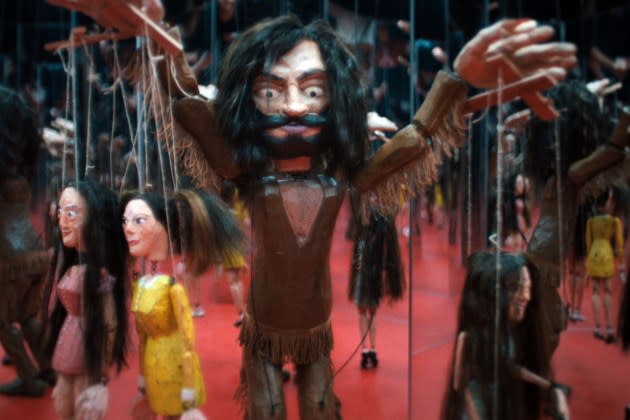
Chaos: The Manson Murders, the ultimate true crime doc, is streaming on Netflix.