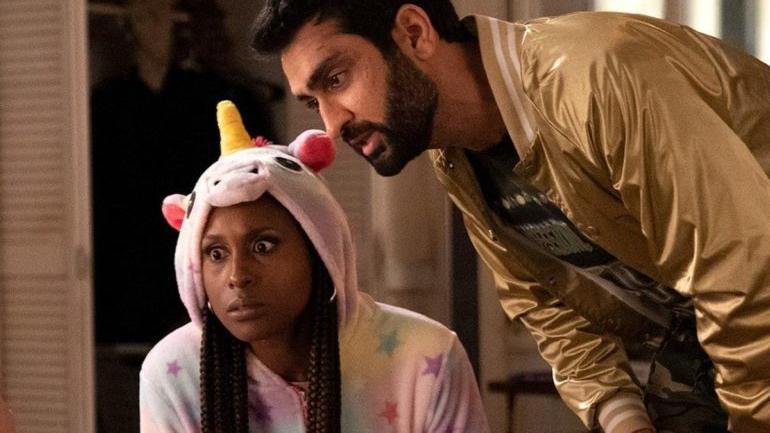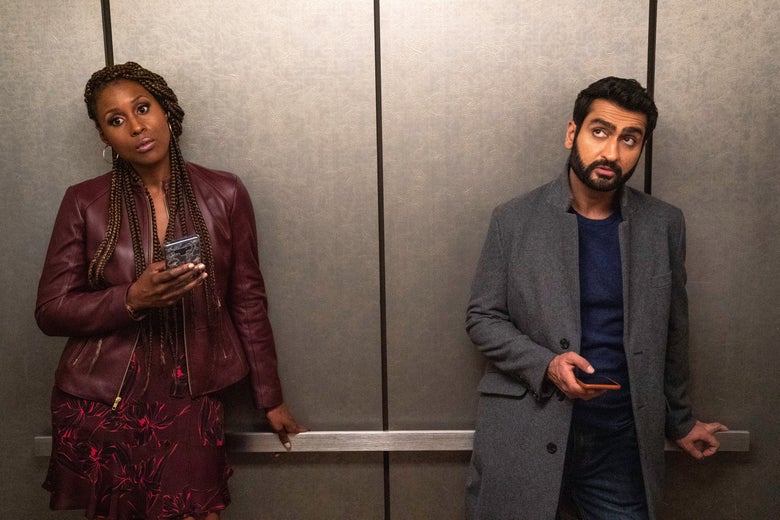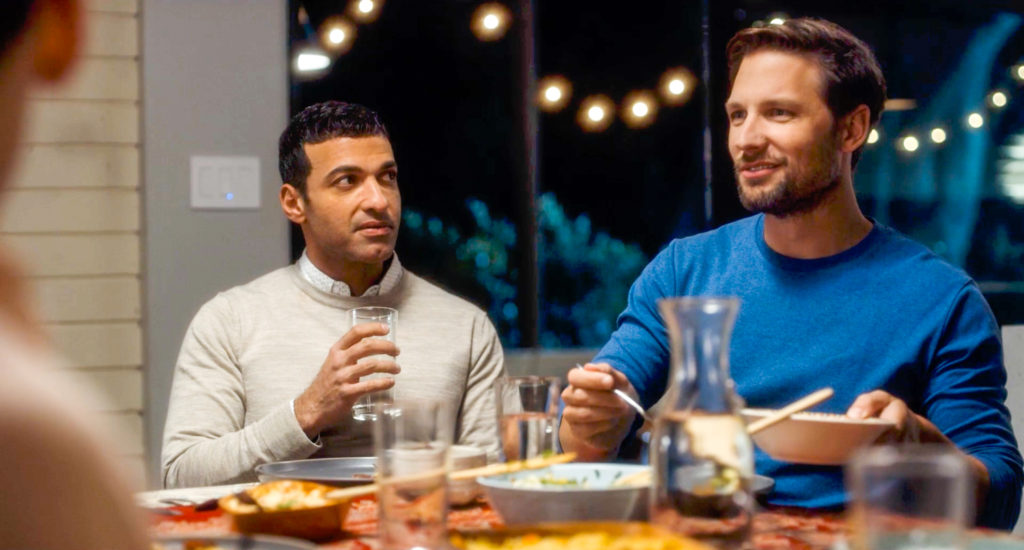
In the Netflix comedy The Lovebirds, Issa Rae and Kumail Nanjiani star as a couple, once passionately in love, who have reached the breaking point. At the very moment that they call it quits, they are plunged into a dire situation – to clear themselves of a murder, they must evade the cops and find The Real Killer.
This is a rom com where the characters have ALREADY met cute. As they endure ever more outrageous indignities, they remember why they fell in love in the first place, despite the other’s foibles. The plot is playful, but the relationship is very truthful.
Rae (Insecure) and Nanjiani (Silicon Valley, The Big Sick), both so appealing, are pitch perfect.
The Lovebirds is successful as a light diversion with plenty of LOL moments, and it’s streaming on Netflix. Here’s the trailer.
This year’s SXSW Film Festival, set to play in March, was cancelled due to COVID-19, but SXSW and Amazon are teaming to showcase over thirty of the films through this Wednesday, May 6. I’ve seen six of them (five shorts and a feature) that I can recommend.
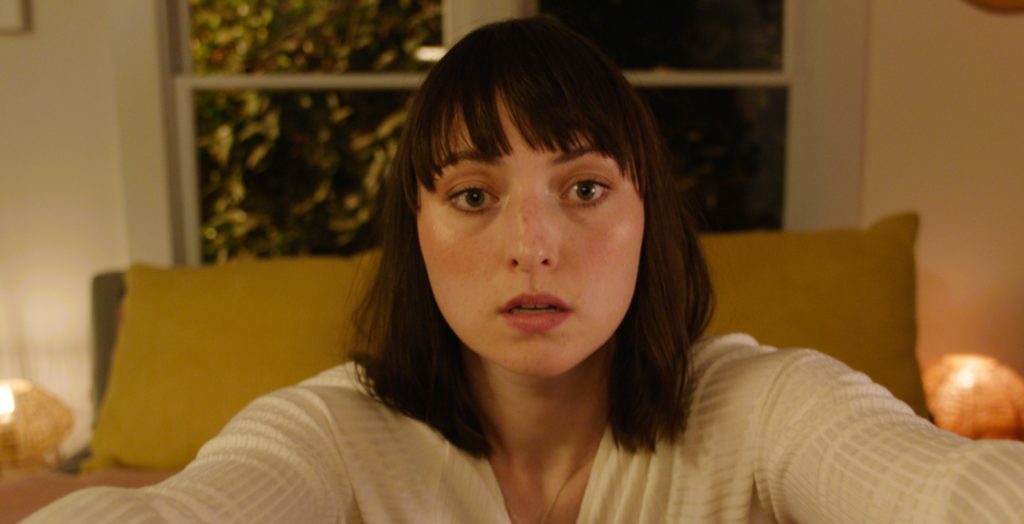
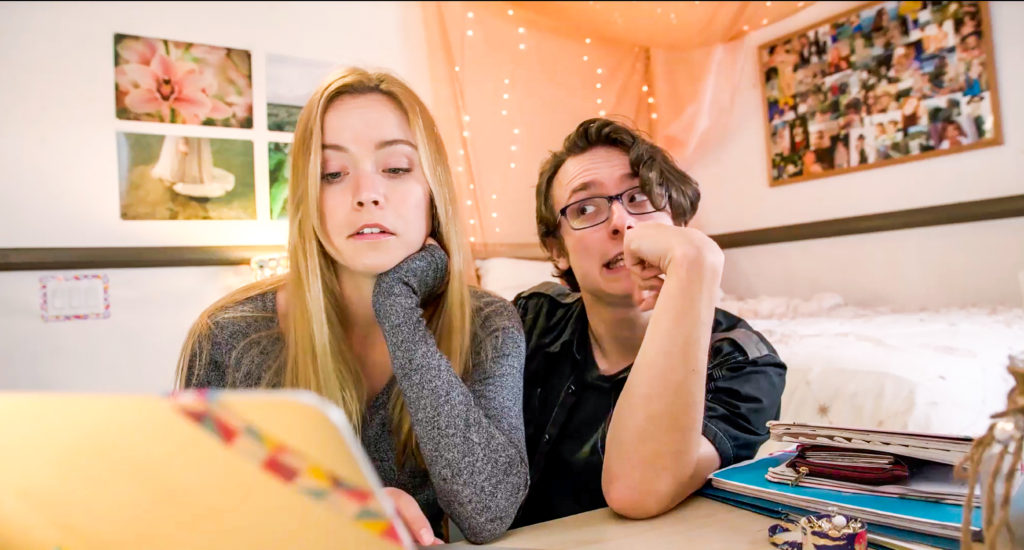
Fate to Face Time is a 7-minute comedy about how any date can lead to misadventure, even a remote one. She’s gone out with him twice and is looking to accelerate things with a surprise FaceTime call, but he may not be that much into her…
We’ve all over-invested in a certain date (and, since teenage years, we’ve all known better, but have done it anyway). Face to Face Time begins as a cringe comedy, but the finale is a howler.
Face to Face Time is written and directed by (and stars) Izzy Shill. As Shill herself notes in the intro, this short is especially timely while we are all sheltering at home and many are dating remotely.
Here are some some more recommendations from Prime’s SXSW 2020 Film Festival Collection:
Quilt Fever – an affectionate documentary abou the Olympics of quilting, held annually in Paducah, Kentucky (who knew? And who knew that there was a Quilting Channel?) (16 minutes.)
No Crying at the Dinner Table – Filmmaker Carol Nguyen recorded separate interviews with her mom, dad and adult sister about losses they have suffered but never talked about, and then shared all three interviews with all three family members. It’s authentic, and it’s a weeper. (16 minutes)
The Voice Inside Your Head – a bizarre comedy is which the inner voice that is stripping you of confidence and self worth is personified in a guy who follows you around all day. (12 minutes).
Daddio – Casey Wilson of SNL wrote, directed and stars in this comic short about how she and her zany dad (Michael McKean) navigated their grief after the death of her mom. (18 minutes.)
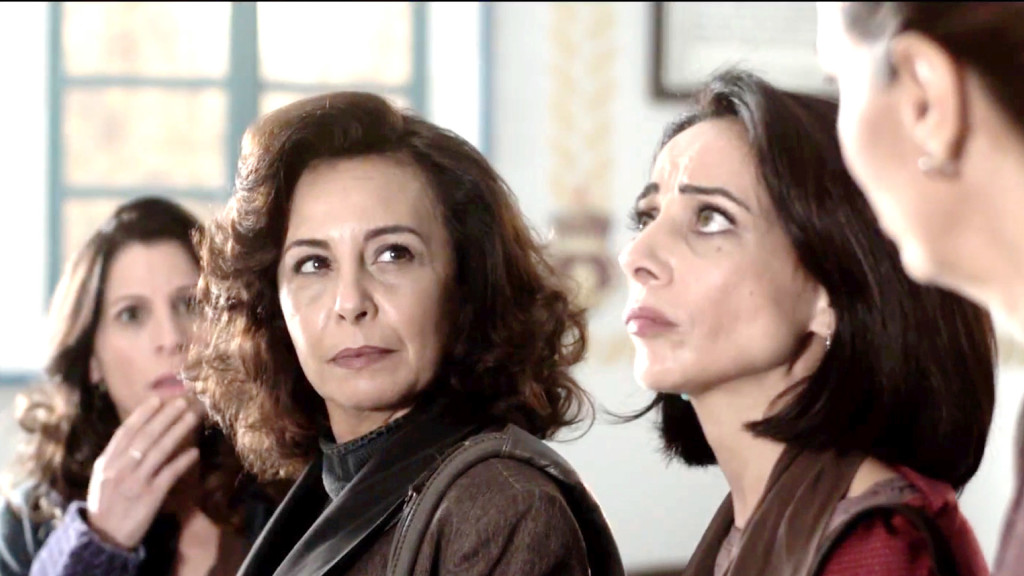
Selfie – This French feature film is a collection of astute parodies that comment on digital online culture, from obsession with view/likes on social media to Internet dating to security breaches. Some of the vignettes are smarter and funnier than others. I especially enjoyed the guy who is bragging about how his life is made better by targeted ads (the algorithms really get him!) until he receives a targeted ad for Viagra. (1 hour 48 minutes.)
Search on Amazon for the title of the film – or “SXSW” for the entire menu of 2020 SXSW films on Amazon Prime thru May 6. If you have Amazon Prime, they’re free.
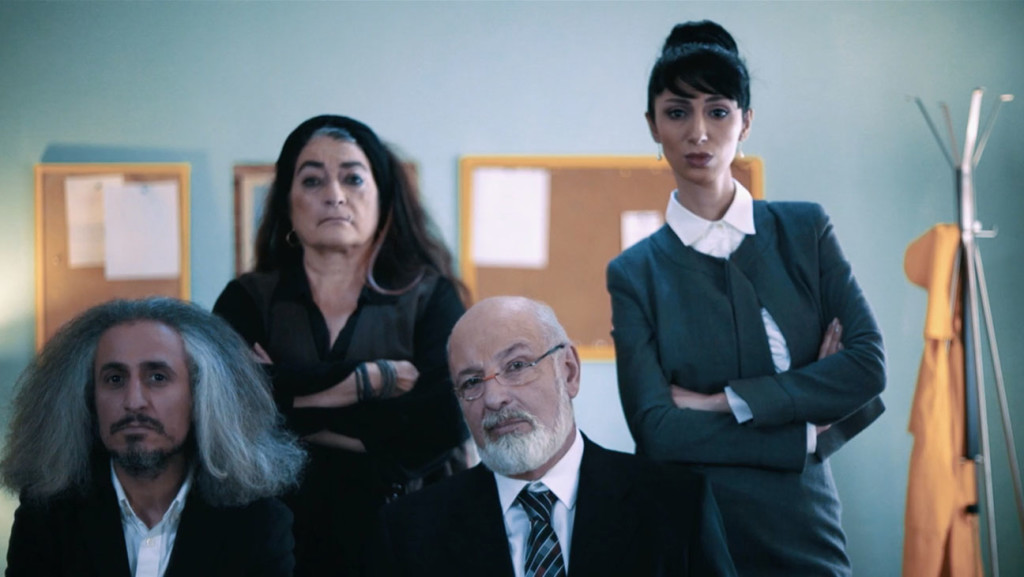
The droll dark comedy Radio Dreams explores the ambivalence of the immigrant experience through the portrait of a flamboyant misfit, a man who rides the roller coaster of megalomania and despair. That misfit is Hamid Royani (Mohsen Namjoo), the director of programming at an Iranian radio station in the San Francisco Bay Area.
Hamid, an author in Iran, is a man of great certainty, with an unwavering sense of intellectual superiority He assumes that everyone should – and will – buy in to his idiosyncratic taste. This results in extremely random radio programming, and Hamid tries to sabotage everything that he finds vulgar (which is everything that might bring more listeners and revenue to the station.)
With his wild mane and indulgent programming, we first think that Hamid is simply batty. But immigrants to the US generally forge new identities, and we come to understand that Hamid has not, perhaps will not, forge that new identity. His despair is real but it’s hard to empathize with – he might be a legitimate literary figure in Iran, but he’s probably a pompous ass over there, too.
The highlight of Radio Dreams is Hamid’s reaction when he is surprised that Miss Iran USA, whom he has dismissed as a bimbo, might have literary chops that rivaling his.
Hamid has concocted a plan to have Afghanistan’s first rock band visit with the members of Metallica on air, and that’s the movie’s MacGuffin. As we wait to see if Metallica will really show up, the foibles of the radio station crew dot Radio Dreams with moments of absurdity. There are the cheesy commercials about unwanted body hair, Hamid’s obsession with hand sanitizer, a radio jungle played live on keyboards EVERY time, a new employee orientation that focuses on international time zones, along with a station intern compelled to take wrestling lessons.
Writer-director Babak Jalali is an adept storyteller. As the movie
opens, we are wondering, why do these guys have musical instruments? Why
are they talking about Metallica? What’s with the ON AIR sign? Much of
the movie unfolds before Hamid Royani emerges as the centerpiece
character.
Hamid is played by the well-known Iranian singer-songwriter Mohsen Namjoo, “Iran’s Bob Dylan”. This is only Namjoo’s second feature film as an actor. He’s a compelling figure, and this is a very fine performance.
Except for Namjoo, the cast is made up of Bay Area actors. Masters of the implacable and the stone face, all of the actors do deadpan really, really well.
As befits the mix of reality and absurdism, here’s a podcast by the characters in Radio Dreams. I saw Radio Dreams at the Cinema Club Silicon Valley, and Babak Jalali took Q&A after the screening by phone from Belgium. Radio Dreams is available to stream from Amazon, iTunes and kanopy.
TWELVE DAYS OF CHRISTMAS. Photo courtesy of Cinequest.
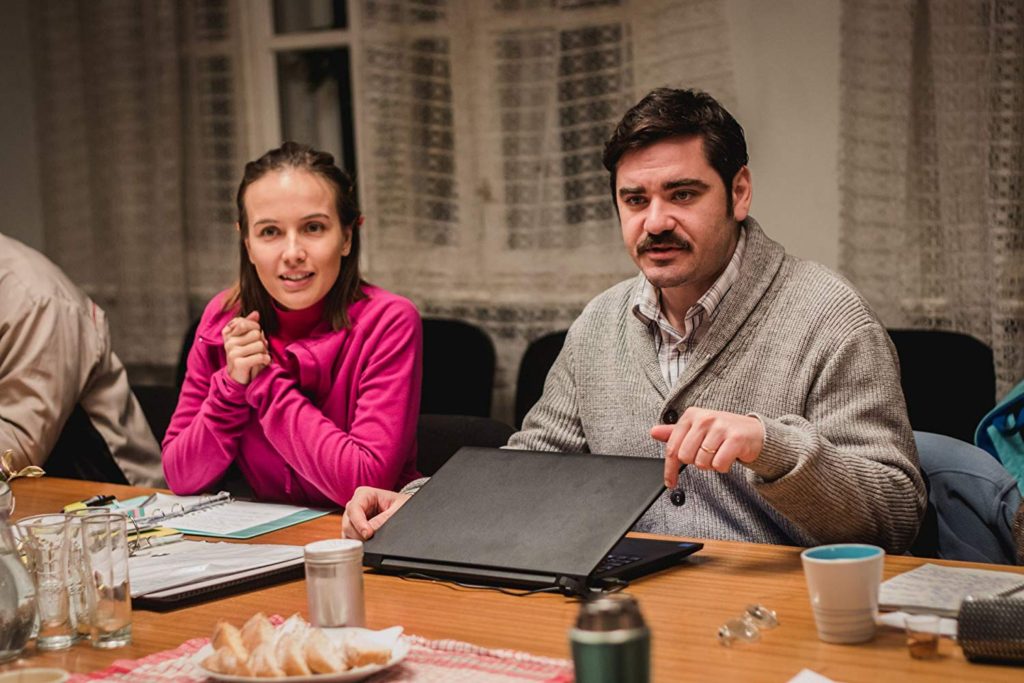
In the comedy Twelve Days of Christmas, high school friends reunite when they’re home for their first college Christmas break. They all get down to some serious partying, but two of them must deal with a serious issue.
These characters act like they are refugees from some mythical colleges that are devoid of booze and drugs. The partying is so purposeful, it brought to my mind the Joe Ely song Everybody Got Hammered. The one blow-out party is very impressive, especially compared to my own first-college-break experience: Round Table pizza, cans of beers and a bottle of rum.
The core of the story is the angst of unrequited love; one character has obviously been in love with his best friend, who hasn’t noticed his yearning for her. And that’s the weakness of Twelve Days of Christmas. Although this guy is fun, witty, loyal and dependable, she knows that he is kinda weak-willed, so it’s evident that she could never see him has a partner.
Most of the cast is very good, although I never got away from being distracted by all the actors seeming at least 4-5 years older than the 19-year-old characters.
Director Michael Boyle and editor Carter Feuerhelm have enough faith in their audience and skill to drop in some split-second gags, all the more effective without lingering on them.
Cinequest hosted the world premiere of Twelve Days of Christmas.
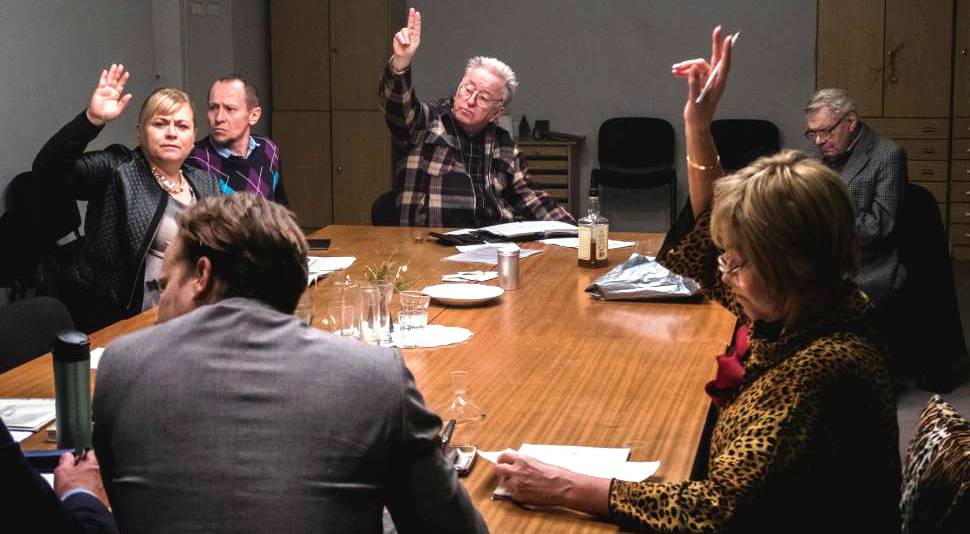
The very dark Czech comedy Owners sharply observes the foibles of the human personality. It’s the regular business meeting of the apartment owners association – but their deliberations about building improvements are anything but mundane, and things quickly get personal.
It’s a rich cast of characters, including:
the insufferable auditor who finds every nit and insists on picking it;
the couple that are self-selected officers, but are too disorganized to ever make a meeting on time; (this time their excuse is that the babysitter was late – yet they come in with their kids!) ; and
two slickster smoothies who are back in the Czech Republic after having made their way in the swashbuckling world of American finance.
It’s all a vortex of past neighborly grievances and self-interest. From the outset, one owner offers his services (I have a little company“) for everything from locksmithing to boiler repair – but his game is only the most naked. Everyone, it turns out, has an agenda. But most hold their cards close to their vests in this poker game of a negotiation.
It all results in multiple epic meltdowns.
OWNERS
It’s unexpected that this comes to mind from an Eastern European film, but Owners’ jaundiced view of human nature matches that of America’s greatest author – Mark Twain. As if Twain were time-traveled to the modern Czech Republic. One of the owner sagely avers that a “conflict of Pinterest” exists.
One element of human nature seems to be that it is easier to accept and trust the unfamiliar than it is the same folks you’ve been squabbling with for years.
Owners also comments on the post-Communist Czech Republic, with the gripes of the old commie holdovers and the onslaught of the new American-style capitalists. The old system didn’t work for everybody, and neither does the new one.
Owners is adapted from a play, and kinda like a funny 12 Angry Men, has a claustrophobic feeling from its containment in the conference room.
Owners has been recognized at this year’s best Czech film. Cinequest hosts the North American premiere of Owners. Make sure that you stay through the closing credits.
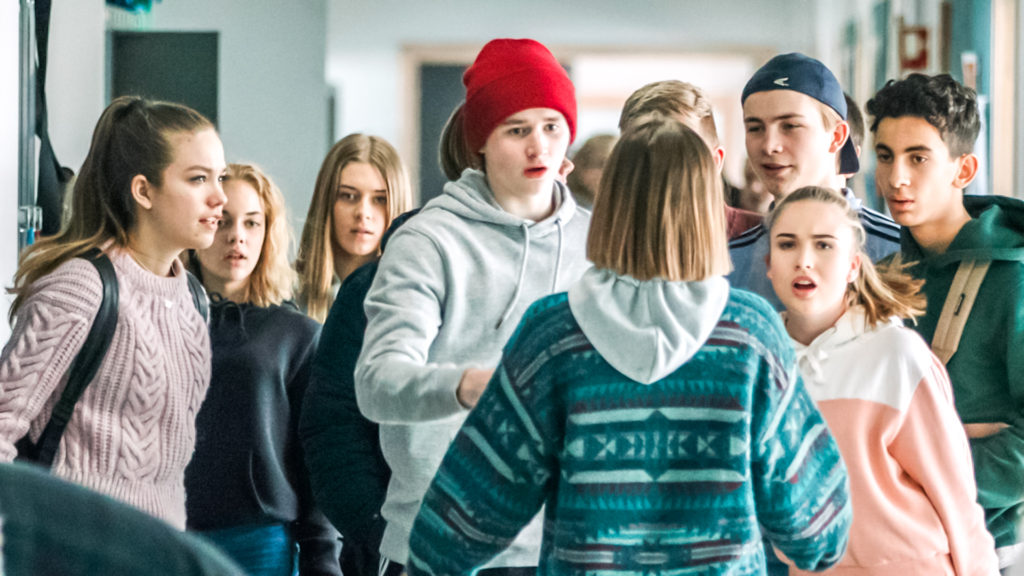
In the Norwegian teen coming of age film Psychobitch, Marius (Jonas Tidemann) is his high school’s high achiever. Frida (Elli Rhiannon Müller Osbourne), on the other hand, is emotionally troubled and always on the verge of flaming out. To help Frida, a well-meaning teacher pairs the odd couple on a group project. Odd couple humor ensues.
Frida is more than just a misfit, a high school outcast. She is battling a serious psychiatric disorder, and she often thinks suicidal thoughts and pushes away those who could help. “Psychobitch“, the best movie title in this year’s Cinequest, is Marius’ initial assessment of Frida.
Marius is devoutly conventional, and there is nothing that Frida rejects more enthusiastically than conventionality. But both of these kids are smart and fun-loving, and being with Frida reveals a funnier and more spirited Marius than had been apparent. Frida is a bundle of vitality, and her constant defiance turns out to be a mask.
Marius learns that there’s something about himself, an aspect of his personality, that is not working out for him. For Marius to be happy and to become his own man, there’s a change he needs to make.
Of course, all of this plays out in a high school, with its classes and detentions, cliques and proms. Cinequest Director of Programming Mike Rabehl noted that it has the air of a 1980s John Hughes film. If you squint, you can almost see Pretty in Pink with a bipolar Molly Ringwald.
This an audience-pleaser. Cinequest hosts the North American premiere of Psychobitch.
Haaz Sleiman and Michael Cassidy in BREAKING FAST. Photo courtesy of Cinequest.
In Breaking Fast, successful physician Dr. Mo (Haaz Sleiman) is a practicing Muslim who is out to his family, friends and work colleagues; although he lives in West Hollywood, he’s not part of the gay club scene. He has a longtime boyfriend Hassan (Patrick Sabongui), and Mo’s most flamboyant behavior is scoring the best desserts from the local Middle Eastern bakery for family gatherings.
Hassan’s family is not so tolerant, and Hassan – buried deep in the closet – believes that he must enter a sham heterosexual marriage, which Mo cannot stomach, and they split. Then, Mo meets meets Kal (Michael Cassidy), sparks fly, and the audience recognizes that Kal is perfect for Mo. But Kal is neither Arab nor Muslim, and Mo is still obsessed with losing Hassan. A romantic dramedy ensues.
The term “Gay-rab” pops up. And there is a stereotypical Gay Best Friend, Sam (Amin El Gamal), who is so gay that his party features a gospel choir singing Happy Birthday.
Sleiman is an adorable lead, and the flawless main characters must navigate a straightforward conflict.
This is a first feature by writer-director Mike Mosallam. He delivers solid entertainment here, elevated with insights into the quandaries faced by LGBTQ Muslim-Americans. Authentic-seeming cultural glimpses in the lives of Arab-Americans, Muslim-Americans and LGBTQ LA are a bonus.
There’s even an effective cameo by Veronica Cartwright. BTW it’s good to see these Arab-American actors getting chance to play something other than terrorists on episodic TV.
Although the most striking aspect of Breaking Fast is its breaking ground on the topic of LGBTQ Muslims, we should note that it’s a romantic comedy about someone on his forties, which isn’t all that that common, either.
So, this is just another gay Muslim romantic comedy…I predict that Breaking Fast will become the Feel Good hit of the 2020 Cinequest. And I wouldn’t bet against Breaking Fast getting a shot at theatrical distribution. Cinequest hosts the world premiere of Breaking Fast.
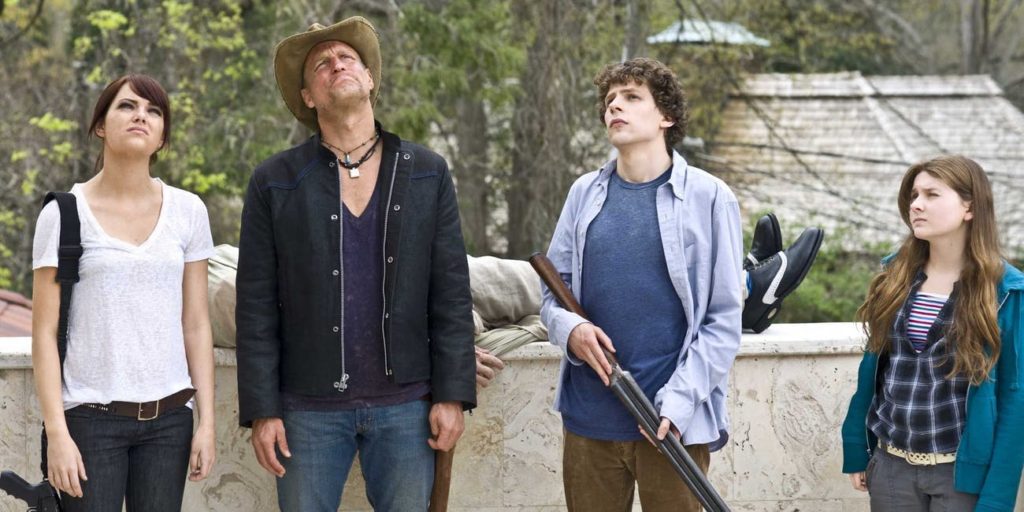
Zombieland brings several nice touches. Our young heroes (Jesse Eisenberg, Emma Stone and Abigail Breslin – very early in their careers) band together with the a master zombie killer (Woody Harrelson). The zombie killer’s astonishing skills and unwholesome enthusiasm are very funny. After many close calls, the group finds shelter in Bill Murray’s LA mansion where Bill Murray (playing himself) is surviving by impersonating a zombie. The climax is a showdown in an amusement park where the zombies have cornered the heroes.
Zombieland is also on my list of Woody Harrelson’s Overlooked Gems. It’s available on DVD from Netflix and streaming from Amazon, iTunes, Vudu, YouTube and Google Play.
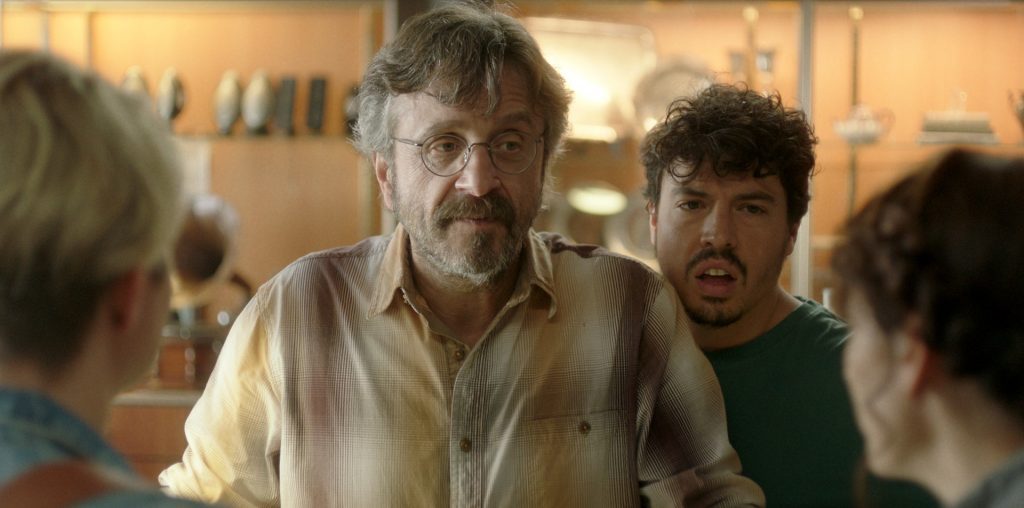
In Lynn Shelton’s brilliant comedy Sword of Trust, Mel (Marc Maron) runs a Birmingham, Alabama, pawnshop with his worthless Millennial assistant Nathaniel (Jon Bass – very funny). Cynthia (Jillian Bell) has returned to Alabama, with her partner Mary (Michaela Watkins), to claim an inheritance that disappointingly turns out to be a single antique sword. But the grandfather’s incoherent letter about the sword fits the Internet ravings of a White supremacist cult called the “Provers” (like “Truthers”), who are hunting for artifacts that “prove” that the Conderacy really won the Civil War. The four resolve to cash in an a windfall by dealing the sword to the scary underground racist cult. Comic situations, naturally, ensue.
There’s plenty of grist for comedy here, and Shelton bores in on the widespread absence of critical thinking that meshes with the Internet to give platforms to crackpot conspiracy theories. From Anti-vaxxers to Truthers, folks are now somehow comfortable with denying scientific or historical fact to fit a narrative that they prefer. In Sword of Trust, that idiocy ranges to denying the Union victory in the Civil War and even the roundness of the Earth.
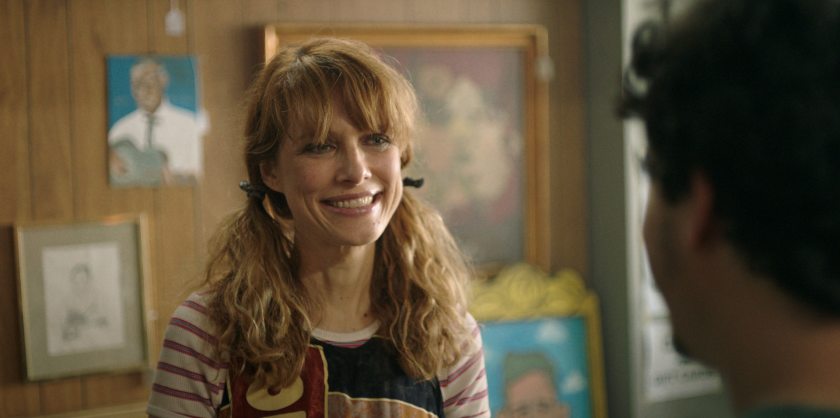
Sword of Trust is very successful as a comedy, but there’s another, very emotionally powerful story in here. Mel’s ex Deirdre drops by the shop in an attempt to extract some cash for a modest ring. It’s clear that Deidre has had a toxic and near-ruinous impact on Mel’s life that he can’t – and perhaps won’t – escape. This story takes up less than ten minutes, essentially book-ending the sword comedy, but it’s the meat of Maron’s performance and the heartfelt core of the film.
Maron’s performance as Mel is a tour de force. When Mel first sees Diedre, he silently freezes for an instant and takes the long way around the shop to gather himself before reaching the counter. He listens to Deidre’s story with a knowing weariness in his eyes. When Deidre says “I’m good for it” and Mel replies, “No, you’re not”, it is with the quiet certainty of a man scarred. Later, Maron’s Mel relates his own back story, and it’s all the more heartbreaking because of his matter-of-factness. This is one of the best performances of the year.
Lynn Shelton in SWORD OF TRUST
And, Deidre, what a mess! The fidgety desperation just underneath her sad story du jour just nails the manipulative addict. I made a note to look up the actress playing Deidre with such compelling authenticity – and it is Lynn Shelton herself.
The entire cast is good, especially Dan Bakkedahl (Life in Pieces) as the White supremacist kingpin and prolific character actor Toby Huss as his henchman.
Sword of Trust is a very smart and funny comedy with a bonus – a rich and moving character study.
In Mindy Kaling’s very smart comedy Late Night, Emma Thompson plays Katherine Newberry, the host of late night television talk show that has become, along with Katherine herself, an institution; the problem is that institutions tend to get stale, and networks eventually dump stale shows.
A woman in an almost all-male niche, Katherine has achieved by being brusque and exacting (and Emma Thompson nails the part). But is she still genuine? And is she still even trying? Katherine brings the inexperienced striver Molly Patel (Kaling) into her writers’ room as a diversity hire – and Molly can tell her the truths that others fear to tell Katherine.
Late Night skewers male privilege and affluent class privilege, and takes on slut shaming, too. Kaling has spent time as the only woman or only POC in writers’ rooms, and she clearly knows of what she writes. Kaling doesn’t pull any punches, but the wit makes it an easy, and perhaps instructive, watch for any audience.
It’s also worth watching Late Night for a secondary thread – the relationship between Katherine and her husband (John Lithgow). It’s such an authentic portrayal of a longtime partnership, based on affection and trust – the only venue in which Katherine allows herself to be vulnerable. Lithgow’s performance is powerful and heartbreaking.
The best joke involves Katherine Newberry coining the word, “catharticissistic”, a witticism that convulsed The Wife, but totally escaped the Millennial woman seated next to her.
Amy Ryan plays the network CEO, and at first we think it’s going to be a stereotypical the-suits-trample-the-creatives character. But Ryan’s CEO is the age and gender peer who calls Katherine on her shit. Ryan’s performance sparkles.
Ike Barinholz is ickily superb as the shallow, gross-out comic pegged to replace Katherine. Denis O’Hare is also excellent as Katherine’s loyal but enabling producer.
I haven’t been a big fan of Kaling’s performances, but Late Night is her triumph as a writer. This is a comedy with laughs and social criticism. And the supporting turns by John Lithgow and Amy Ryan are special,