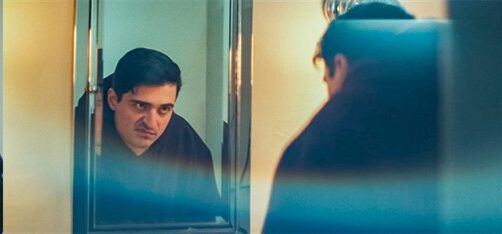
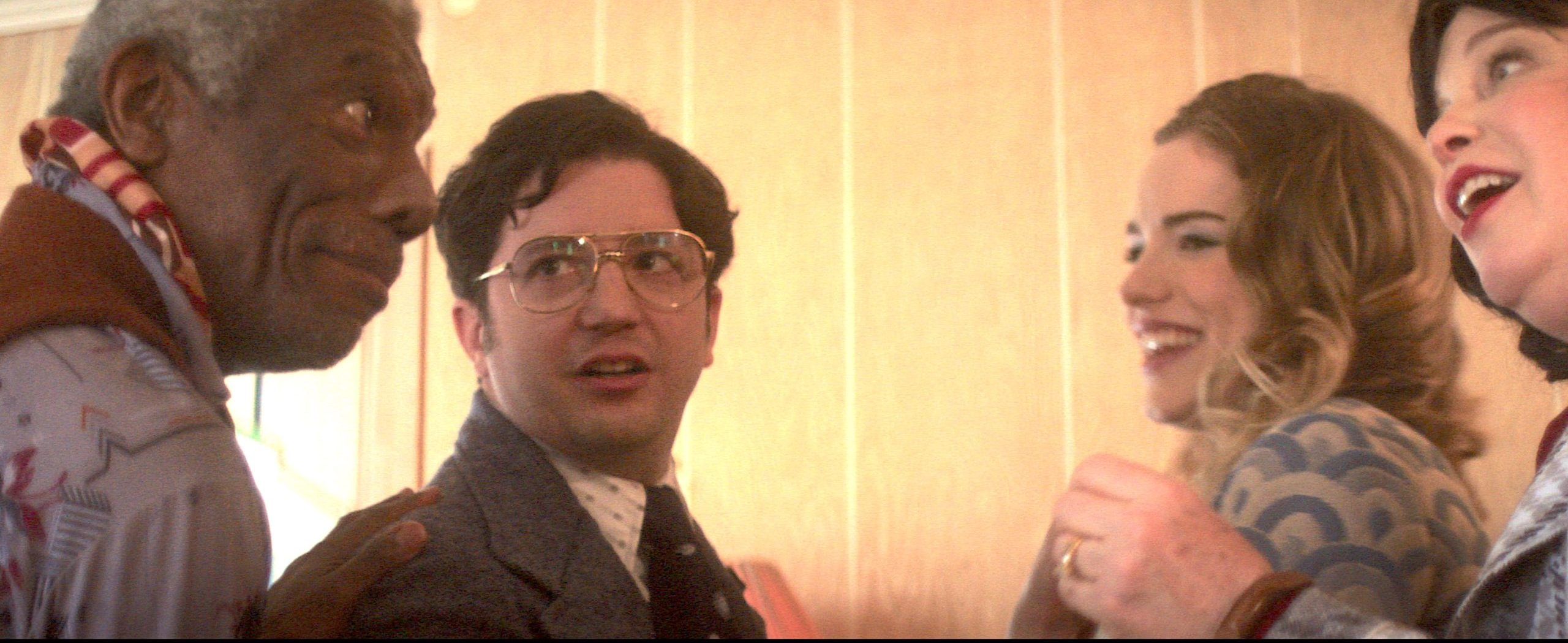
The dark sci fi comedy Daddy: is set in a future where only a limited number of men are approved by the government to father children. Four guys apply for the privilege and are isolated in a mountain lodge to wait for the expert evaluator, who doesn’t immediately show up. As they try to figure out what’s going on and what they should do, they succeed only in demonstrating how unfit they would be as parents – until things get all Lord of the Rings. It’s a very funny skewering of both male overconfidence and male angst.
Finally, the guys get an unexpected visitor, who may or may not be the evaluator that they expect. What’s impressive about this episode is how each man’s instinctual reaction, different from each other’s, can be so profoundly wrongheaded.
The mountain lodge is equipped with an artificial baby model (a doll). Co-writers Neal Kelley and Jono Sherman refrain from overusing this prop in slapstick. It’s far funnier to glimpse the doll as it seems to silently rebuke the foolhardiness around it.
Daddy is the second feature and first feature, respectively, for for co-directors/co-writers Kelley and Sherman, who also play two of the guys. Cinequest’s online festival Cinejoy hosts the world premiere of Daddy.
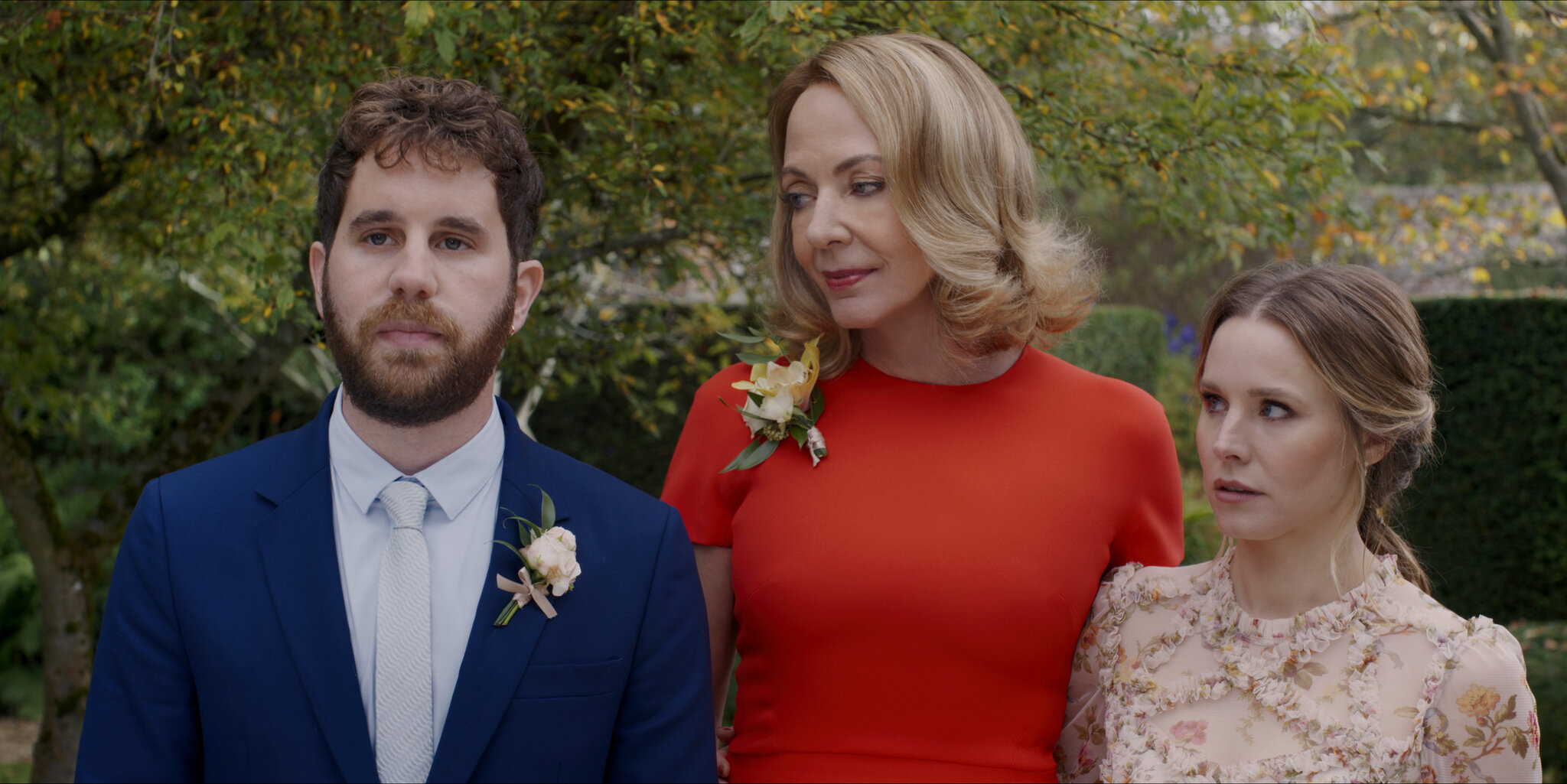
Ben Platt, Allison Janney and Kristen Bell in THE PEOPLE WE HATE AT THE WEDDING. Courtesy of Amazon.
The purported comedy The People We Hate at the Wedding feels like an agency deal that attached the talent and was sold to Amazon before there was any story to justify the film. The story, if you chose to call it that, is a compendium of rom com tropes – the anxious bride, the Bridezilla, the bride keeping a Big Secret from the groom, the brides’ estranged parents, the mom not comfortable with her out gay son and his partner, and some more. The tropes are there, but there just isn’t a single moment of authenticity. Nor any reason to care about the characters. Nor laughs.
I’ll watch just about anything with Allison Janney and/or Kristin Bell, but they’re hopelessly wasted in this stinker. The usuallycompelling French actor Isaach De Bankole is surprisingly wooden (perhaps because his lines are in English?).
If you must, The People We Hate at the Wedding is streaming on Amazon (included with Prime).
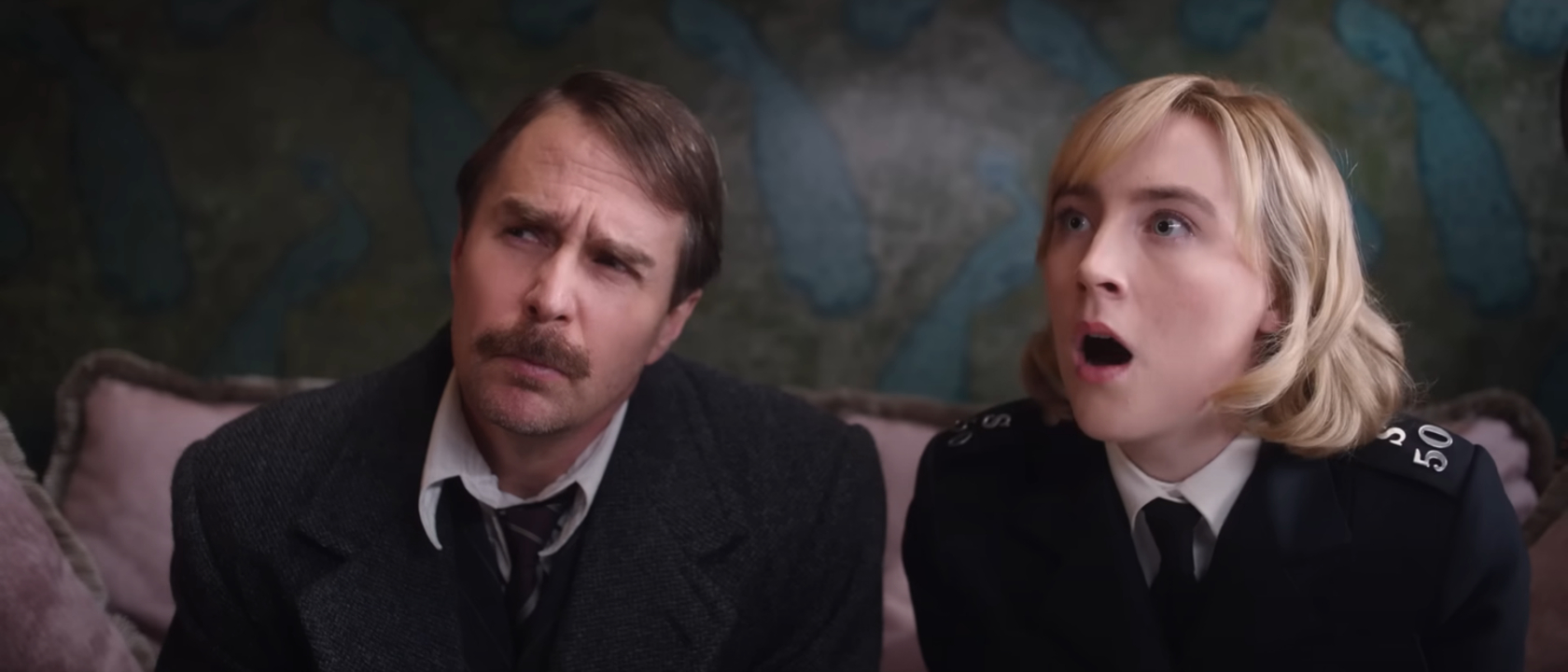
Photo caption: Sam Rockwell and Saiorse Ronan in SEE HOW THEY RUN. Courtesy of Searchlight Pictures.
“Is this supposed to be funny?”, asked The Wife about 20 minutes into the purported comedy See How They Run, which is a send up of the drawing room mystery and its tropes. There’s a murder at a theater running an Agatha Christie play, and everyone involved with the play is a suspect for detectives played by Sam Rockwell and Saoirse Ronan.
But what’s the point of parodying a form that doesn’t take itself seriously? Can one even parody the drawing room murder mystery? Agatha Christie was a smart cookie who never thought that the Miss Marple books were great literature; she knew that she wrote popular entertainment and that she was exceptionally good at it.
There’s also supposed to be some humor from the Odd Couple pairing of the jaded veteran cop (Rockwell) and the eager rookie (Ronan). However, the script doesn’t provide any freshness to this time-honored comedy situation, and the normally excellent actors don’t develop any chemistry. Other fine actors are similarly wasted: David Oyewolo, Ruth Wilson, Harris Dickinson. Only Adrien Brody gets the benefit of a flamboyant role and makes the most of it.
See How They Run was written by Tom Chappell and directed by Tom George, and this misfire is their fault.
The trailer promises a funny film, but it’s misleading. See How They Run is streaming on HBO. Skip it.
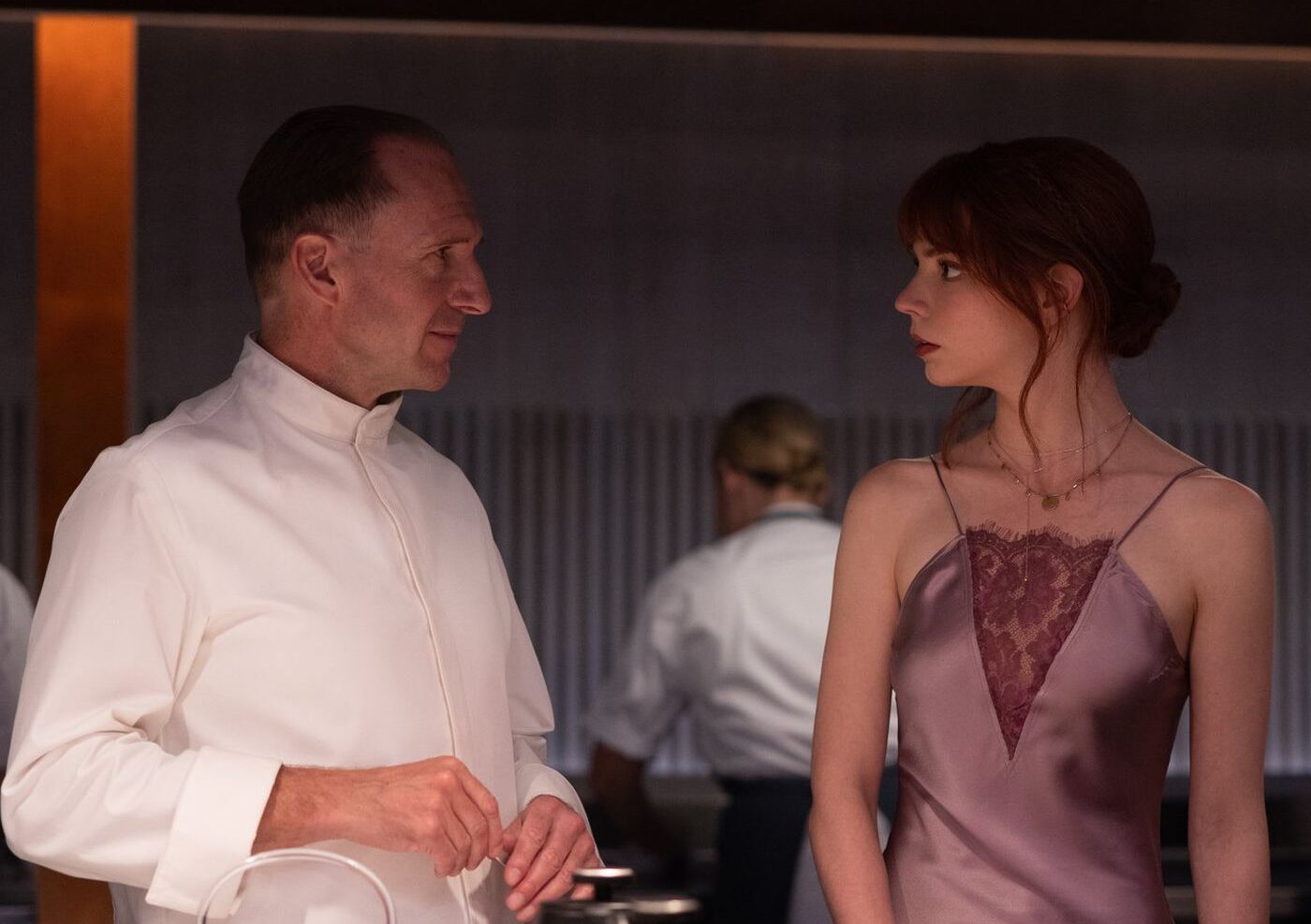
Photo caption: Ralph Fiennes and Ana Taylor-Joy in THE MENU. Courtesy of Searchlight Pictures.
The darkly funny horror film The Menu is a battle of wits set in absurd foodieism. This isn’t the kind of horror film with a lot of jump scares, although one sudden event shocks and disgusts the diners (though some think that it’s all part of the show). The Menu builds a sense of dread, a situation where it looks like survival is impossible.
Chef Slowik (Ralph Fiennes) presides over a restaurant on its own island in the Pacific Northwest, with its own carefully curated gardens and aquaculture and a staff as cultish as The People’s Temple. The restaurant has 12 seats and each evening’s prix fixe goes for $1250.
Slowik seems like a self-important and officious kitchen tyrant, but unsettlingly high strung. That signals, and this is really not a significant spoiler, that he’s a balls out psycho intending to slaughter all his guests.
Creepily, it is revealed that tonight’s customers have been carefully selected by Slowik. The one exception is Margot (Ana Taylor-Joy), the last minute substitute date of Tyler (Nicholas Hoult) an obsequious celebrity chef groupie.
I’m a foodie myself; after all, I named my blog The Movie Gourmet. But, as much as I enjoy fine dining experiences and my own amateur cooking, I look askance on a $60 small plate of foam. The Menu is a wicked, The-Emperor-Has-No-Clothes sendup of that kind of culinary silliness. Each of the courses of Chef Slowik’s meal (and each wine pairing) is its own very funny comment on food fads. The best is the “breadless bread”, which I guess is not a “deconstructed” dish, but an “unconstructed” one. The Tyler character gets funnier as he ignores the escalating horrors to laser in on the avant-garde flavor combinations.
The key to the story is that Margot is immune to pretension. Margot never buys into the extreme food scene, and she has street smarts, which equip her for an epic psychological showdown with Slowik.
Ana Taylor-Joy is one of my very favorite actors, endlessly watchable with as she projects her unique blend of intelligence and danger, I first discovered her in Thoroughbreds, and have enjoyed her in The Queen’s Gambit, Last Night in Soho and even the blah Amsterdam.
Ralph Fiennes is really cast perfectly as an ego monster with a telling insecurity or two. Hoult is a hoot, and Hong Chau, is a master of deadpan as Slowik’s henchwoman.
The Menu is only the fourth feature for veteran television director Mark Mylod (Game of Thrones, Succession). The screenplay – and it;s a damn good one – is by Seth Weiss and Will Tracy, who come out of The Onion. These guys, with Ana Taylor-Joy and Ralph Fiennes, have made a pointedly acid and entertaining movie.
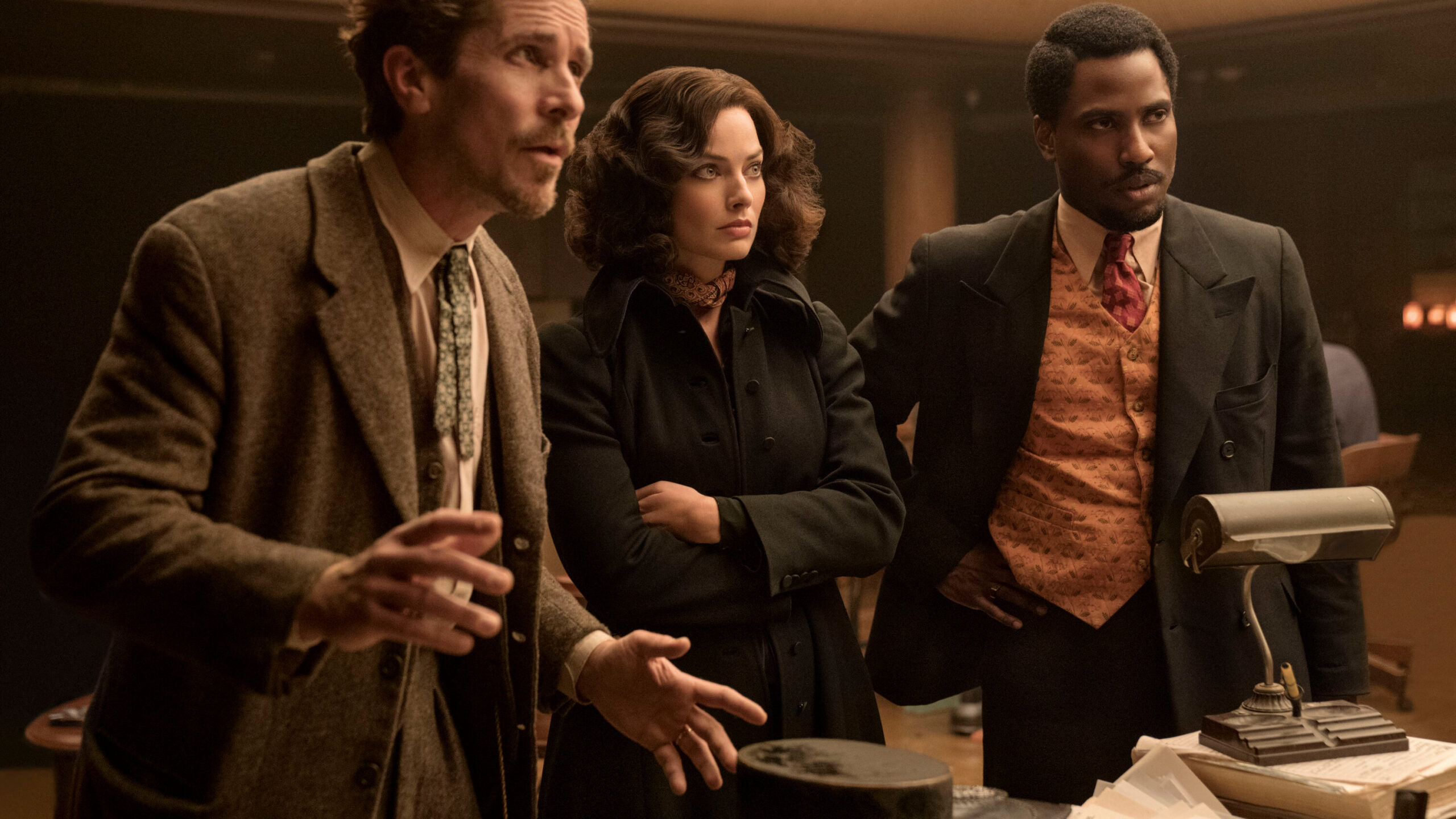
Christian Bale, Margot Robbie and John David Washington in AMSTERDAM. Courtesy of 20th Century Studios
Amsterdam, which wants to be a star-studded paranoid thriller, is only star-studded.
Burt (Christian Bale) and Harold (John David Washington) met as American soldiers in WWI, and stay in Europe after the war, sharing an Amsterdam apartment and a bohemian lifestyle with another spirited American expat, Valerie (Margot Robbie). As Amsterdam the movie opens, Burt, now a shady physician, and Harold, now a lawyer, have returned to New York City, and the two share a commitment to helping other WWI veterans. The two are called to investigate a suspicious death, which they determine to have been a murder, and then there’s another murder, for which they are framed. Off they go to find the real murderers and clear themselves, becoming entangled in a convoluted conspiracy and re-encountering Valerie in the process.
Despite Bale, Washington and Robbie delivering solid performances, the story never pops. That’s the fault of a remarkably disappointing screenplay by director David O. Russell (Silver Linings Playbook, American Hustle). We’re never surprised, never waiting for the next page to be turned, and not particularly invested in the characters.
The movie’s stars aside, Russell also wastes the talents of a ridiculously deep cast: Robert De Niro, Rami Malek, Andrea Riseborough, Ana-Taylor-Joy, Chris Rock, Michael Shannon, Zoe Saldana, Mike Myers, Timothy Olyphant, Taylor Swift, Matthias Schoenaert, Alessandro Nivola. There’s not a bad performance in the lot, but they just don’t get much to do. Michael Shannon and Mike Myer bring some laughs, but Schoenaert and Nivola have roles that could have been played by cardboard cutouts. Two weeks later, I can’t even remember Olyphant’s character. After winning an Oscar for wearing horse teeth and NOT singing like Freddie Mercury, Rami Malek seems to have settled into a career playing reptilian villains.
Here’s an example of bad storytelling . [SPOILER ALERT] The movie’s climax is an attempted assassination in an auditorium, like in The Manchurian Candidate. Burt is staggered by a bullet in the torso. Then there’s a fracas in which the shooter is apprehended. There’s a melee with uniformed Nazi sympathizers. Malek and Taylor-Joy’s characters are exposed, and the conspiracy is explained. Ten minutes later, as everyone leaves the auditorium, Burt removes his jacket and reveals that the bullet had only struck his back brace, and he doesn’t have a gunshot wound after all. By this time, I had FORGOTTEN THAT HE HAD BEEN SHOT.
An allusion to a real historical conspiracy is only a half-hearted political statement because this movie’s plot is just like that of every fictional paranoid conspiracy.
I recommend skipping Amsterdam and watching American Hustle again.
Photo caption: Charlbi Dean and Harris Dickinson in in TRIANGLE OF SADNESS. Courtesy of NEON.
The biting satire Triangle of Sadness is very funny and is at its best in the first, most subtle moments. Yaya (Charlbi Dean) and Carl (Harris Dickinson) are a couple, both professional models. Because of Yaya’s status as an influencer, they are comped a cruise on a luxury yacht. This puts them amidst a boatful of superrich fellow passengers, and Triangle of Sadness, like Parasite and Knives Out is Eat-The-Rich cinema. It’s fun to laugh at the rich, with their entitlement, tone deafness and absurd customer requests.
The cruise starts going horribly awry, even before the formal captain’s dinner is scheduled during a ship-tossing storm. Eventually, things get all Lord of the Flies. The tone of Triangle of Sadness evolves from pointedly witty to all-out comic mayhem, a la the Marx Brothers, I Love Lucy or The Hangover. As the humor gets broader, there are belly laughs, but the humor is no longer as smart. And Triangle of Sadness would be more watchable if it were shorter than 2 1/2 hours, too.
The sly beginning of the film is brilliant, with a memorable and telling scene about picking up the check in a restaurant. And funny little Easter Eggs abound, like the first names of an elderly British couple and the dramatic express delivery of a mysterious case that we learn contains jars of Nutella.
Triangle of Sadness was written and directed by Ruben Ostlund. His first notable film, Force Majeure, was a masterpiece of subtle humor. Having lessened the subtlety, his next two inferior satires, The Squareand Triangle of Sadness have each won the Palme d’Or at the Cannes Film Festival. Go figure. Anyway, I recommend that you watch Force Majeure on Amazon, AppleTV, Vudu or YouTube.
The cast is very good. Charlbi Dean is excellent as the vivacious, frivolous and admittedly manipulative Yaya; (Dean died suddenly of a viral infection before the film’s theatrical release). I really admired Harris Dickinson’s performance as the dim and spineless Carl. Vicki Berlin is very good as the put-upon head steward. Zlatko Buric soars as a Russian fertilizer magnate, the self-described “King of Shit”. Woody Harrelson is very funny as the yacht’s alcoholic, Marxist captain, who does not suffer fools.
The most memorable performance is by Dolly DeLeon, who plays a character almost invisible until the final act, when she becomes pivotal and gives DeLeon the movie’s best opportunity for a killer line reading. She nails it.
I enjoyed most of Triangle of Sadness, less so as it became broader (and longer). It’s always fun to kick the rich, and Ruben Ostlund is a caustic observer of their frailties.
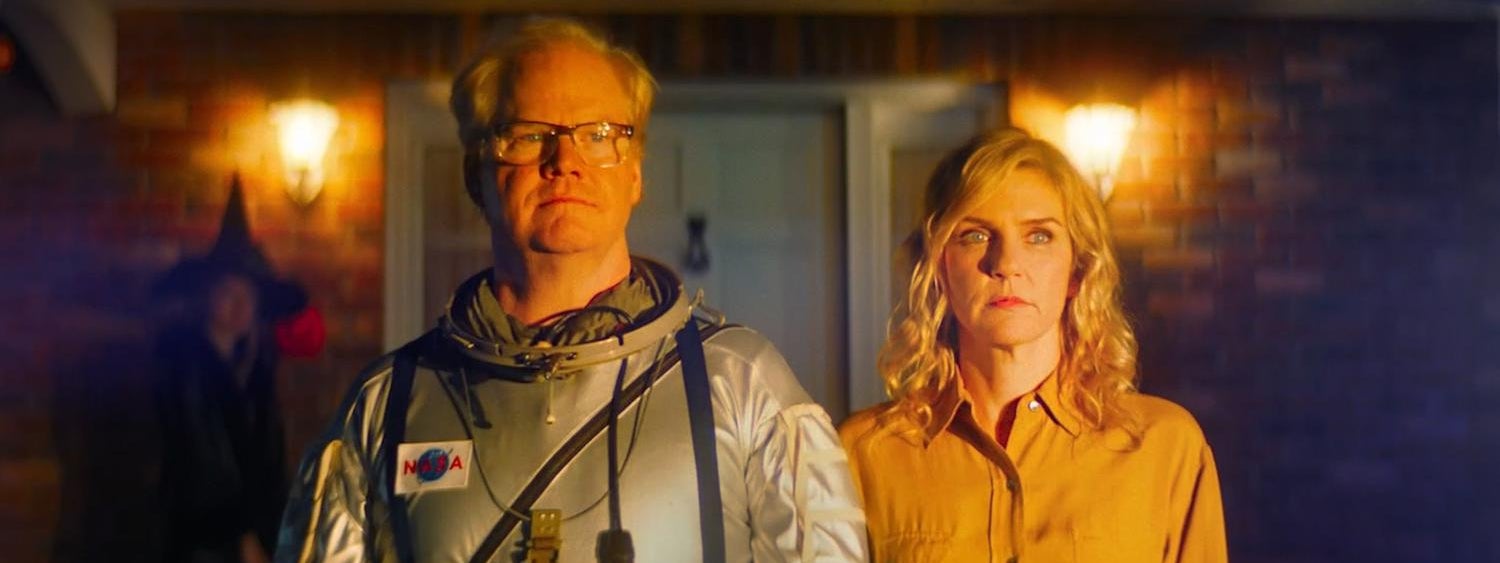
Jim Gaffigan and Rhea Seehorn in LINOLEUM. Courtesy of Blue Fox Entertainment.
Colin West’s Linoleum, a gentle story of a lovable loser with a nose-diving kid’s science TV show, is superficially about the guy’s eccentric attempt to build a real rocket in his garage; but it’s really three love stories – or are they one love story? Although West peppers some clues throughout, it’s not until the final act that the audience connects the dots about what is going on. Linoleum is hard to review – or even describe – without spoilers, but let’s just say that it is a highly original and sweet film.
Our TV host Cameron (Jim Gaffigan) is an astronomer who seems overqualified for his charmingly corny children’s show. He takes the science seriously, but not himself. Cameron is the kind of affable guy who always gets run over by the more self-interested among us.
Cameron is married to Erin (Rhea Seehorn) a smarty pants aeronautical engineer who is direcying programs at a provicial air and space museum. Like Cameron, she started out as a whiz kid and is wondering. Unlike Cameron, who is placidly content, she is wondering how she got stuck in the bush leagues. Erin’s dissatisfaction with her career, and with Cameron’s lack of ambition, is threatening their marriage.
The teenage girl in the story meets the new boy in high school, and they tentatively stumble into a guileless friendship. This thread in Linoleum is especially charming.
The comedian Jim Gaffigan has shown that he’s also a fine actor (Light from Light), and Rhea Seehorn (Better Call Saul, Veep) is one of our finest TV actors. Both are very good in Linoleum.
The first two acts of Linoleum are fairly easy-to-follow, with a couple small mysteries that could be imagined or hallucinated. The third act, which I will not spoil, becomes more confusing until West connects the threads of the story and we understand what we’ve been watching ll along. Viewers who need linear stories may be frustrated, but the payoff is splendid.
I saw Linoleum at the opening night of Cinequest, with Gaffigan and West in attendance.
Aubrey Plaza and Alison Brie in SPIN ME ROUND, Courtesy of IFC Films.
In the unpretentious and delightful comedy Spin Me Round, Alison Brie plays the assistant manager of an Italian chain restaurant who wins a corporate junket – a week at the CEO’s villa in Tuscany. She arrives in Italy with a cadre of peers, misfits all, to discover that they aren’t exactly at the villa and the corporate retreat isn’t exactly what it seems. The charismatic zillionaire CEO (Alessandro Nivola) seems to be grooming them – but not for corporate advancement. Many laughs ensue.
Alison Brie, so good as Trudy Campbell in Mad Men, has proven to have a wonderful gift for comedy. She ably works her Girl Next Door quality to reflect the more overtly zany characters around her. Brie co-wrote Spin Me Round’s screenplay with director Jeff Baena. Baena and Brie had worked together on The Little Hours and Horse Girl (which they also co-wrote).
Spin Me Round is a showcase for comic actors:
If you can’t get enough of Zach Woods’s Silicon Valley character, he returns with his naive, overly nice, worshipful devotee – with the capacity for a massive meltdown.
Aubrey Plaza (director Baena’s wife) plays archly cynical and dangerously edgy better than anyone.
Molly Shannon can convincingly play a deranged, over-the-top character because she just commits so entirely.
Fred Armisen is as we rarely, if ever, see him – as a macho, oily Silvio Berlusconi type.
Ego Nwodin, in the tiniest of roles as Brie’s Skypeing roommate, is just perfect.
One of the funniest threads in Spin Me Round is the send-up of The Olive Garden, the restaurant chain so obviously parodied here, The chain’s managers know shockingly little about Italian cuisine. And you may never eat alfredo sauce again.
In real life, wild pigs are not funny; here, they are very, very funny.
I saw Spin Me Round, before its release, at a well-attended screening at Cinequest, where the crowd loved it. It opens this weekend in LA, but I haven’t located a screen in the Bay Area.
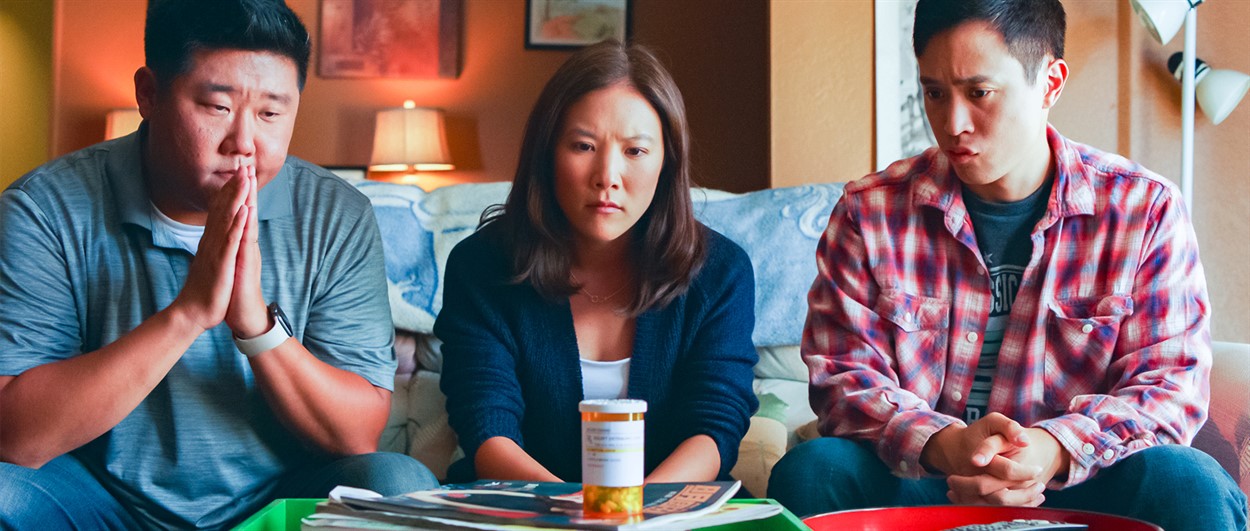
Peter S. Kim, Ally Maki and Hayden Szeto in DEALING WITH DAD. Courtesy of Cinequest.
Comedies abound at this year’s Cinequest. Here are four:
Dealing with Dad is a topical family comedy with an Asian-American cast. Three adult siblings – the super-achiever oldest sister, the passive middle brother and the infantilized youngest brother, a gaming slacker – meet at their parents’ home. The dad, whose harsh and never-bending expectations battered them as kids, has become paralyzed (and defanged) by severe depression. Their differences spawn lots of laughs, but Dealing with Dad addresses both depression and the issues that many second-generation Asian-Americans face because of their immigrant parents’ parenting styles. Cinequest audiences will appreciate that Dealing with Dad is set in MILPITAS.
18 1/2is a dark comedy that sends up the paranoid thriller genre. A low-level government clerical worker (an excellent Willa Fitzgerald) finds herself in possession of the infamous 18 1/2 minute gap in the Watergate Tapes. Of course, co-writers Daniel Moya and Dan Mirvish had to devise a way to get this MacGuffin in her hands; given the paranoia, deviousness and clumsiness of the Nixon White House, their solution is surprisingly plausible. Double crosses and red herrings escalate, as does the dark, dark humor. Richard Kind and Vondie Curtis-Hall sparkle in supporting roles.
Sweet Disaster, from Germany, is driven by the protagonist’s ever-unleashed impulsiveness and utter lack of boundaries. Frida (Friederike Kempter) encounters and falls for an airline pilot and audaciously charms him into a relationship; their affair lasts just long enough for her to become impregnated and for him to abandon her for his ex. Consumed by the urge to win him back, Frida throws propriety to the winds. Frida’s zany roller coaster is tempered by sweet relationships with her apartment neighbors, a precocious teenage neighbor and a Greek Chorus of card-playing older women.
Alpha Male, from Poland, is another dark comedy. A feckless young man has been dispatched by his girlfriend to a smoking cessation self-help group. Given the chaos of the community center, he ends up in the wrong room, among a men’s support group headed by a charismatic instructor. He hangs around anyway – and even returns – because this group has better food. The group focuses on their resentment of women, which seems silly and harmless at first, but descends into a paranoid fixation on an imagined organization of women seeking to emasculate them. Both the misogyny and their submissiveness to their bullying leader are taken to absurd levels.
A scene from Teppo Airaksinen’s film SUPERCOOL, which played at SFFILM. Photo courtesy of SFFILM.
Supercool has the familiar arc of a teen comedy – until it doesn’t. We get the high school cafeteria lunch period, the adolescent social awkwardness, the bullies and the parents-away teen house party. And then there are some unexpected sparkles.
Our protagonists, Neil (Jake Short) and Gilbert (Miles J. Harvey) have a commonplace obsession for teen boys: they aspire to get SOME sexual experience with another person. And Neil worships a girl whom he is afraid to even talk to,
There’s a funny scene (glimpsed in the trailer below) where the guys fantasize a situation where girls would be attracted to them, unaware that Neil’s parents are hearing every word.
The guys also have two misadventures that put them in hilariously uncomfortable sexual situations.
Neil has a helluva imagination and creates graphic novels that picture how he hopes to eventually woo his beloved. Fortunately, he is sweet on a girl who turns out to have an awesome sense of humor.
I must note that Supercool does contain the best-ever movie use of the (only?) Haddaway song What Is Love.
I screened Supercool for its world premiere at SFFILM in April 2021. Supercool can now be streamed from Amazon, Vudu, YouTube and redbox.