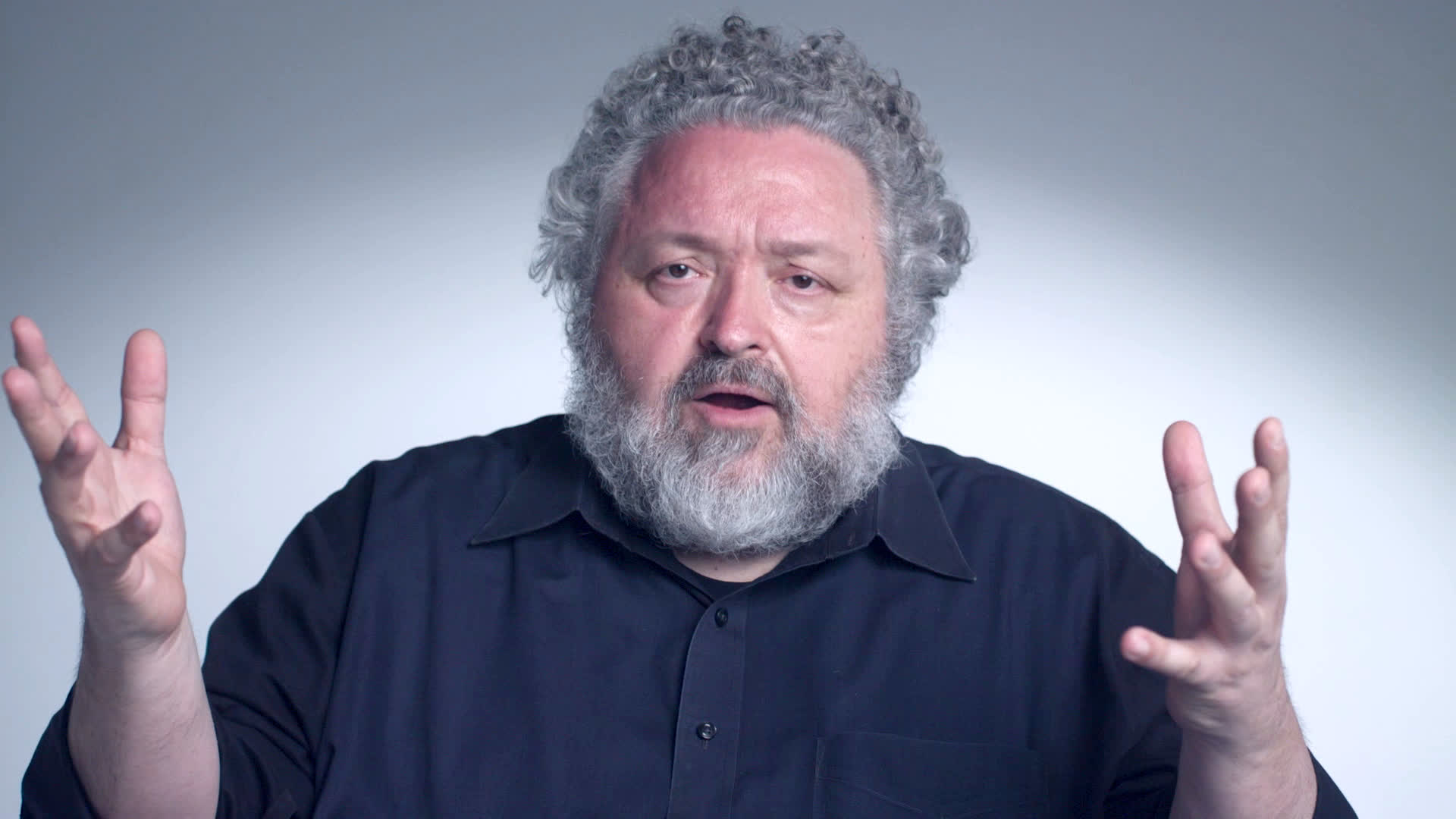
Photo caption: Bruce Mau in MAU. Courtesy of BABKA.
The term visionary is overused, but it surely fits Canadian designer Bruce Mau, the subject of the documentary Mau.
I generally think of design as the means to make objects more pleasing and useful and attractive to consumers. But Mau observes that almost everything we experience is not natural – and therefore DESIGNED. And if designed, it can be RE-DESIGNED to be more beautiful, more sustainable, more intelligent and more humane.
Bruce Mau thinks big. He has been retained to redesign Coca-Cola. And to redesign the millennium-old pilgrimage experience of Mecca. And to redesign the nation of Guatemala.
Mau’s upbringing and his work is somewhat interesting, as is his aspirational exhibition project Massive Action. But the most compelling aspect of Mau is the exposure to how Bruce Mau THINKS. Mau essentially becomes the world’s best TED Talk.
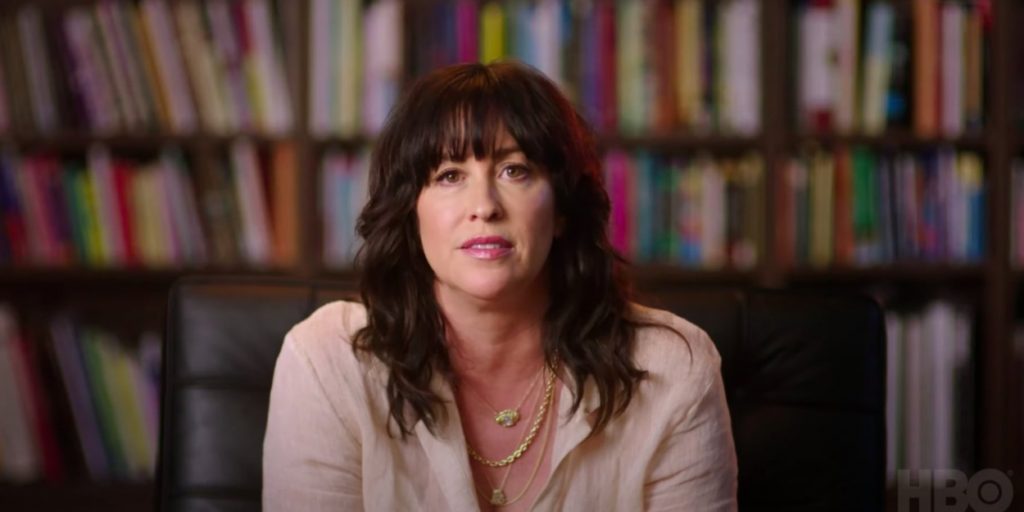
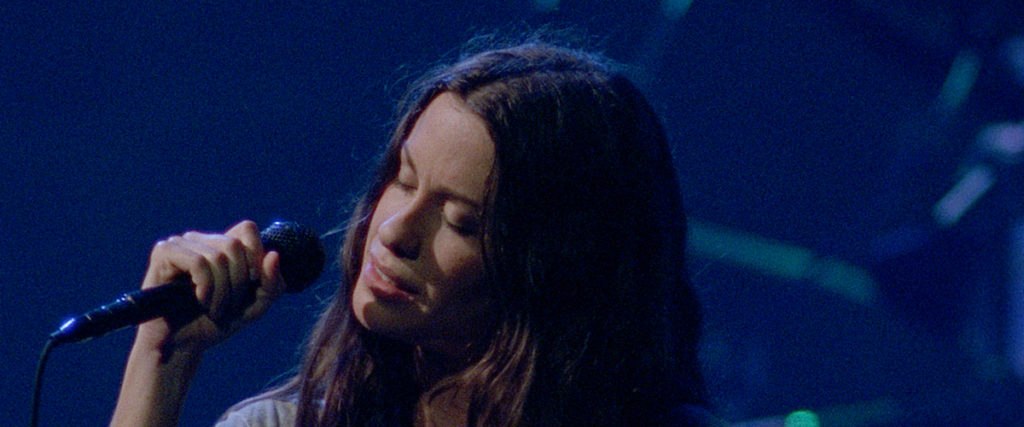
Photo caption: Alanis Morissette in JAGGED. Courtesy of HBO.
Jagged is a surprisingly addictive biodoc of singer-songwriter Alanis Morissette, packed with Morissette’s own reflections. Jagged traces Morissette’s beginnings as a child prodigy and teen pop princess (big hair and all) to the point where she matured into an innovative songwriter and groundbreaking stadium act.
The deepest dive is appropriately on Morissette’s debut album Jagged Little Pill and the 18-month concert tour to support it. With sales of over 33 million, Jagged Little Pill is still the number one selling album by a woman. It’s amazing to reflect that Morissette was only 19-20 when writing the songs and only 20-21 on the tour.
Alanis Morissette in JAGGED. Courtesy of HBO.
Of course, Morissette’s breakthrough came with one of the bitterest of all breakup songs, You Oughta Know, raising the question of just how angry is she? Not at all, says Morissette, who notes that she released her anger in the writing of You Oughta Know and moved on.
Director Alison Klayman (Ai Weiwei: Never Sorry) takes us back to the 1994 media coverage, by male music writers, of Morissette as Angry Young Woman. Jagged takes advantage of lots of candid backstage/tour bus footage from the tour; and that Morissette is an even-tempered and playful person, not even temperamental, let alone raging.
In her years a teen pop singer, Morissette was allowed to tour the world without parental protection, which predictably made her vulnerable to exploitation by older men. It’s really worth watching Jagged to hear Morissette’s framing of how women publicly discuss sexual abuse years afterwards: “They weren’t silent. The culture wasn’t listening.”
Oddly, Morissette herself is unhappy with the documentary, calling it “salacious”. I thought that Klayton handled Morissette’s own words about her sexual abuse in a way that was the opposite of salacious. Klayton has Morissette present herself as insightful and well-grounded, which adds up to a flattering impression.
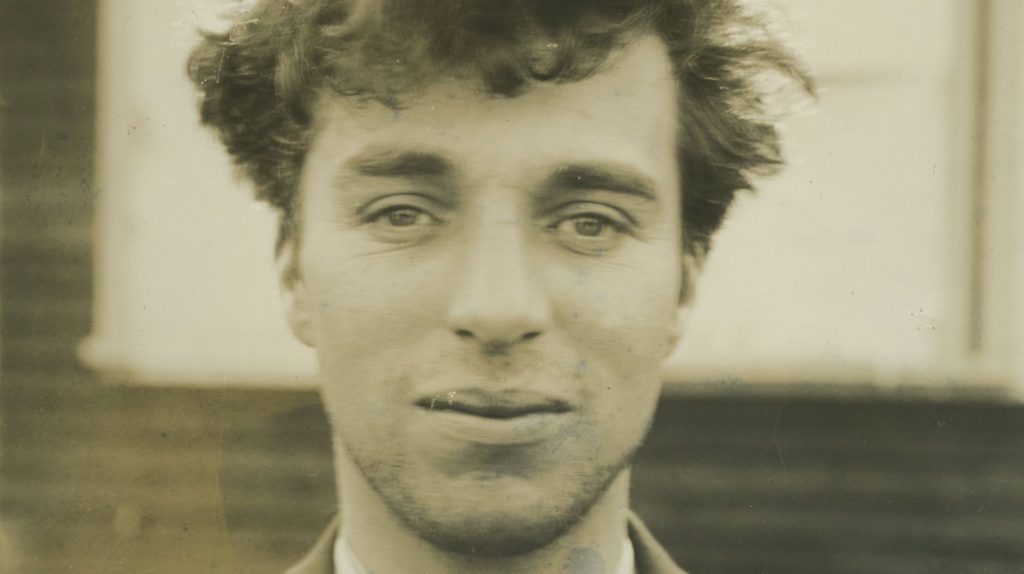
Photo caption: Charles Chaplin in THE REAL CHARLIE CHAPLIN. Courtesy of Showtime.
The biodocumentary The Real Charlie Chaplin has some insights, as far as it goes. The film aspires to cover these elements of Charlie Chaplin’s life and does a pretty good job:
the crushing poverty of his childhood,
his quick rise to world-wide celebrity,
his exploitation of his very young wives, and
his blacklisting.
The highlights are video interviews with Chaplin’s school mate and childhood neighbor Effie, an absolutely delightful old gal. Unusual for a celebrity biodoc, the filmmakers also do a good job in giving voice to Chaplin’s wives.
Of course, you have to pick and choose, and the filmmakers only reference Chaplin’s pioneering filmmaking as it pertains to his personal life. If you’re looking for insights into Chaplin’s artistic genius and innovations, look elsewhere.
The Real Charlie Chaplin is streaming on Showtime.
Photo caption: ROADRUNNER: A FILM ABOUT ANTHONY BOURDAIN. Courtesy of HBO Max.
2021 has been an unusually strong year for biodocs. With the notable exceptions of Dean Martin and Kenny G, most of the subjects have been disruptors: Anthony Bourdain, Julia Child, Kurt Vonnegut, Brian Wilson, Guy Clark, John Belushi, Truman Capote and Tennessee Williams.
Along with Penny Lane’s surprisingly revelatory Listening to Kenny G, a good watch even if you never ever think of Kenny G, here are the best from 2021:
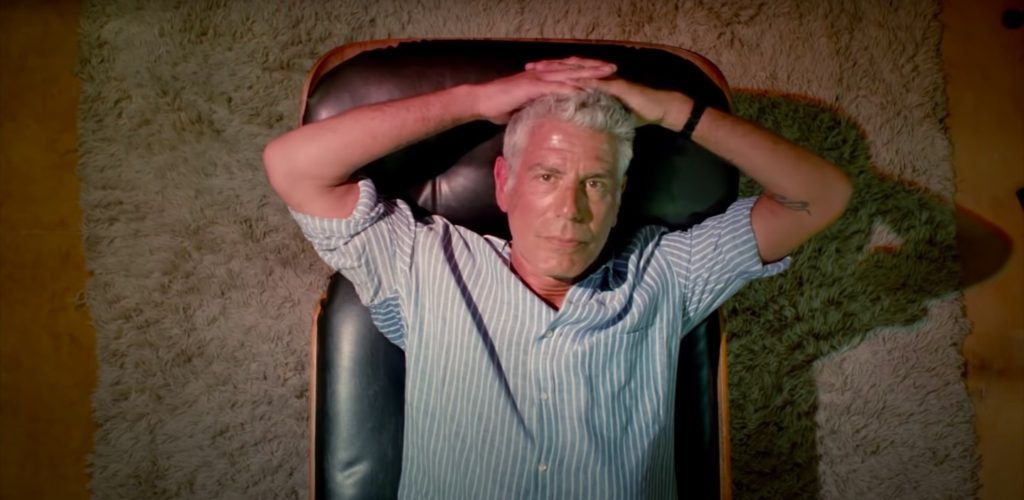
Roadrunner: A Film About Anthony Bourdain: An unusually profound, revealing and unsentimental biodoc of a complicated man – a shy bad ass, an outwardly cynical romantic, a brooding humorist. A triumph for director Morgan Neville, Oscar-winner for 20 Feet from Stardom.
Brian Wilson: Long Promised Road: An unusual documentary about an unusual man. Brian Wilson, The Beach Boys’ songwriting and arranging genius weighs in on his life and work. Wilson’s old and trusted friend drove him around important places in his life – in the format of Comedians in Cars Drinking Coffee – and it paid off with oft emotional revelations from the usually monosyllabic Wilson.
Without Getting Killed or Caught: This lyrical documentary traces the lives of singer-songwriter Guy Clark and his painter-songwriter wife Susanna. Their roommate was troubled songwriter Townes Van Zandt, Guy’s best friend and Susanna’s soulmate. This is a film about an unusual web of relationships amidst the creative process.
Julia: This charming documentary, affectionate and clear-eyed, tells the unlikely story of how Julia Child broke through every expectation of her gender, class and upbringing to become an icon in her fifties.
Kurt Vonnegut: Unstuck in Time: This uncommonly rich biodoc of the social critic/humorist/philosopher benefits from having been paused and restarted several times, resulting in hours of filmed interviews with Vonnegut in different decades. Very entertaining because Vonnegut was so damn funny.
King of Cool: King of Cool is filled with insight into an icon who was extremely successful at being unknowable. Dean Martin used his charm to mask his detachment. Universally beloved, his internal life was still never understood by his closest friends and colleagues – and even by his family. The filmmakers turned to the device from Citizen Kane – what was the “Rosebud” that drove and explained Dean Martin?
Truman and Tennessee: An Intimate Conversation: Truman Capote and Tennessee Williams were both gay men from the Deep South, who attained fame and descended into addiction. They also knew each other. Truman and Tennessee tells their stories from their own letters and from being interviewed on TV by the likes of David Frost and Dick Cavett. There is no third-party “narration”. It’s an effective and increasingly popular documentary technique, used in, for example, I Am Not Your Negro.
Belushi: We all know the story of John Belushi – a career soaring like Icarus, propelled by comic genius and then death by drug overdose at age 33. The new biodoc Belushi brings us more texture because of unprecedented access to Belushi’s friends and widow and to Belushi’s own letters, notes and journals.
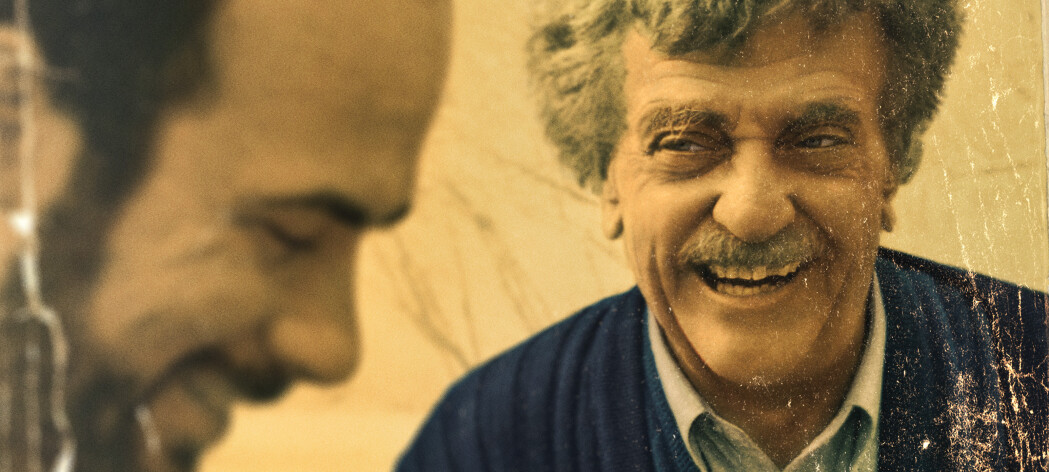
Photo caption: Filmmaker Robert Weide and Kurt Vonnegut in KURT VONNEGUT: UNSTUCK IN TIME. Courtesy of IFC Films.
Kurt Vonnegut: Unstuck in Time is an uncommonly rich biodoc of the social critic/humorist/philosopher Kurt Vonnegut. Most importantly, there’s a heavy dose of Vonnegut himself, which is very entertaining because Vonnegut was so damn funny.
All of the Vonnegut is because filmmaker Robert Weide, early in his career, began to make this documentary of his literary hero, with Vonnegut’s participation. The film had to be paused and restarted several times, mostly due to the usual indie film obstacle of funding. Finally, Weide became very successful as the producer and director of Larry David’s Curb Your Enthusiasm and didn’t have the time to finish. As a result, Weide collected hours of filmed interviews with Vonnegut in different decades.
Over the years, Weide and Vonnegut developed a personal friendship that facilitated even more access and allowed Vonnegut to be even more forthcoming.. Weide filmed Vonnegut in visits to the homes in which he had pivotal experiences (including the one where he found his mother after her suicide on Mother’s Day).
In Unstuck in Time, Weide adds lots of file footage and interviews with all of Vonnegut’s kids (he sired three and raised his sister’s four sons).
(Incidentally, Vonnegut’s hometown is Indianapolis, which has embraced him posthumously to the extent there is a multi-story Vonnegut mural in downtown Indy.)
Vonnegut’s anti-war attitude came out of his especially horrific experiences in WWII, and he had his share of peacetime family tragedies. But I need to emphasize that Unstuck in Time is anything but grim because of Vonnegut’s humor. Kurt Vonnegut: Unstuck in Time is in some art house theaters and streaming on Amazon and AppleTV.
Listening to Kenny G is director Penny Lane’s surprisingly revelatory biodoc of smooth jazz icon Kenny G. Lane chose Kenny G as a subject to focus on the dramatic and passionate conflict of opinion about his music. Kenny G has sold over 75 million albums and has millions of fans, many of whom have gotten married to his music. The consensus of music critics and academics, however, is that his music is insipid, shallow, commercial crap.
It turns out that Kenny G and his critics may disagree about whether it is Good Music or Bad Music, but not on the underlying facts that Kenny G isn’t trying to challenge listeners, to express ideas or to engage in any cultural conversation. He is just trying to be very technically proficient and to make people feel good, especially relaxed and romantic.
We spend a lot of time with Kenny G, a nice guy who is very comfortable in his skin. He doesn’t show the least bit of bitterness toward those who spew torrents of bile at his work. Kenny G, who comes from the any publicity is good publicity school of public relations, is the perfect subject for a documentary film, very accessible, open and transparent. What you see is what you get. And he gladly points out the moments that he got lucky.
Listening to Kenny G works – even if you have zero interest in Kenny G – because of the Penny Lane’s imaginative approach. Lane (Our Nixon,Hail Satan?, NUTS!) has become one our funniest and most trenchant documentarians. Just watch the faces of the critics as they try to express, in a socially acceptable way, their views of Kenny G’s music.
Near the beginning, Lane asks Kenny G what he loves about music and gets this UNEXPECTED answer: “I don’t know if I love music that much. When I listen to music, I think about the musicians and I just think about what it takes to make that music and how much they had to practice.”
What Kenny G DOES love is doing something very well. His need to be the very best, without a bit of self-consciousness, drives him to work relentlessly at his skill on the saxophone – and at golf and aviation.
And here’s something I didn’t know: Kenny G’s Going Home from the Kenny G Live album has become the unofficial national closing song for businesses in China; every day, the song is looped over and over for the final half hour or so that businesses are open.
Listening to Kenny G is streaming on HBO. I highly recommend the 32-minute interview with director Penny Lane in HBO’s Extra Features.
Photo caption: Julia Child in JULIA. Courtesy of Sony Pictures Classics.
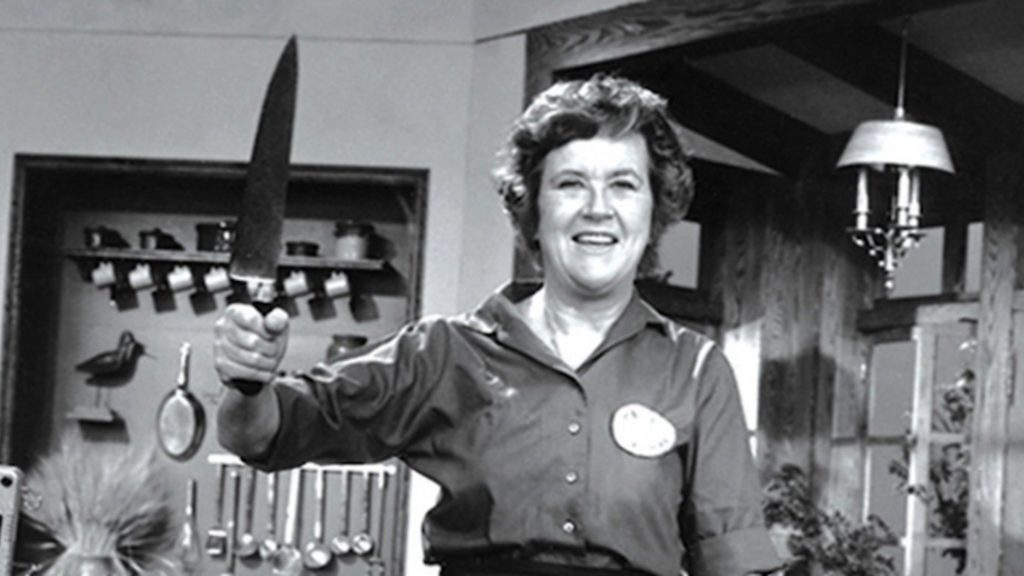
The charming documentary Julia is an affectionate but clear-eyed portrait of the iconic Julia Child. Child became a best-selling author and TV star in her fifties; besides outlining her importance, Julia tells the unlikely story of how she got to that point.
Indeed, one of the most remarkable aspects to Julia Child was how she broke through every expectation of her gender, class and upbringing. She was liberated by WW II, which gave her the chance to reject the societal limitations of her background.
To mark her impact, Julia shows us both pre-Julia educational TV and pre-Julia American cuisine (think TV dinners and jello salad).
Julia is very well-sourced and based on no fewer than THREE books. We get to hear from some of Julia’s family and friends, and a slew of celebrity chefs.
Julia highlights Julia Child’s life-changing first French meal – sole meunière at La Couronne in Rouen. Through TripAdvisor, I found the restaurant online, and it still offers the dish on a Julia Child menu.
Julia was directed by Julia Cohen and Betsy West, the team behind the excellent Ruth Bader Ginsberg biodoc RBG. Julia is now playing in theaters.
Photo caption: Dean Martin in KING OF COOL. Courtesy of Turner Classic Movies.
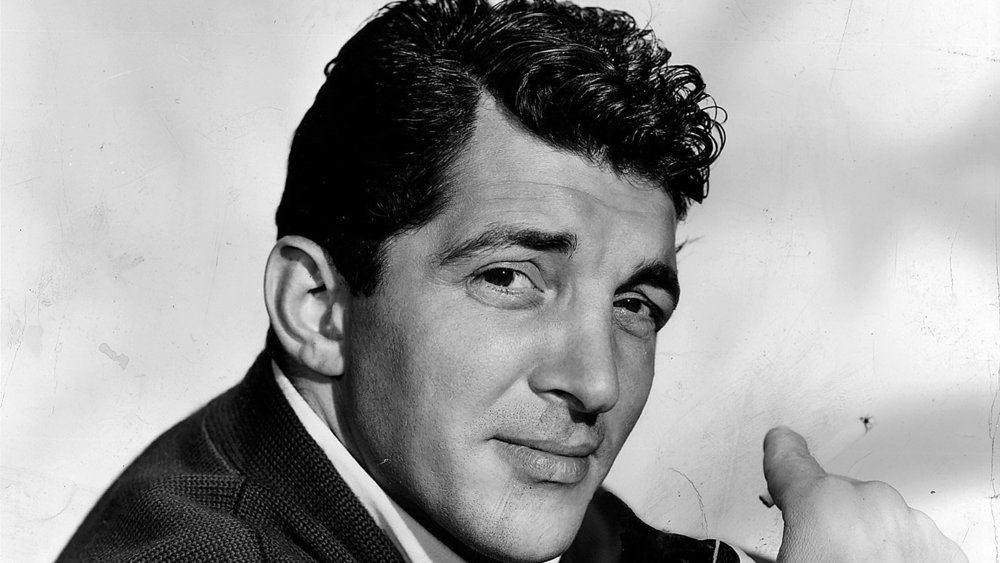
Turner Classic Movies has premiered the Dean Martin documentary King of Cool, and it’s coming back to TCM on November 26. King of Cool is filled with insight into an icon who was extremely successful at being unknowable.
Dean Martin used his charm to mask his detachment. Universally beloved, his internal life was still never understood by his closest friends and colleagues – and even by his family.
Director Tom Donohoe and producer Ilan Arboleda, who had teamed for the essential filmmaking doc Casting By, faced this challenge – how does one create a biodoc on an enigma? Donohoe and Arboleda turned to the device from Citizen Kane – what was the “Rosebud” that drove and explained Dean Martin? (There’s one very fitting answer to that question in King of Cool.)
Superbly sourced, we get to hear from Martin’s closest associates, plus friends and co-workers like Bob Newhart, Angie Dickinson, Norman Lear, Carol Burnett, Barbara Rush, Florence Henderson, Lainie Kazan, Tommy Tune, Frankie Avalon and Dick Cavett,. The clearest – and most poignant – testimonies come from Martin’s daughter Deana Martin and Jerry Lewis’ son Scotty Lewis.
Despite Martin’s unknowability, King of Cool reveals a lot, including what Dino was really drinking on stage in his nightclub act, his close friendship with Montgomery Clift, and his rebuke of the JFK inauguration. There’s a wonderful firsthand account of his hosting big Hollywood parties and sneaking out to watch TV. We also get reading from Mark Rudman’s 2002 poem about Martin, The Secretary of Alcohol and hear how no less than Elvis Presley described Martin as “King of Cool”.
On a personal note, Dean Martin is on my own very short list of the most perpetually cool humans to ever walk the planet, along with Ben Gazzara, Joan Jett, Jean Gabin, Dr. John and Barack Obama.
TCM will replay King of Cool on November 26. Set your DVR.
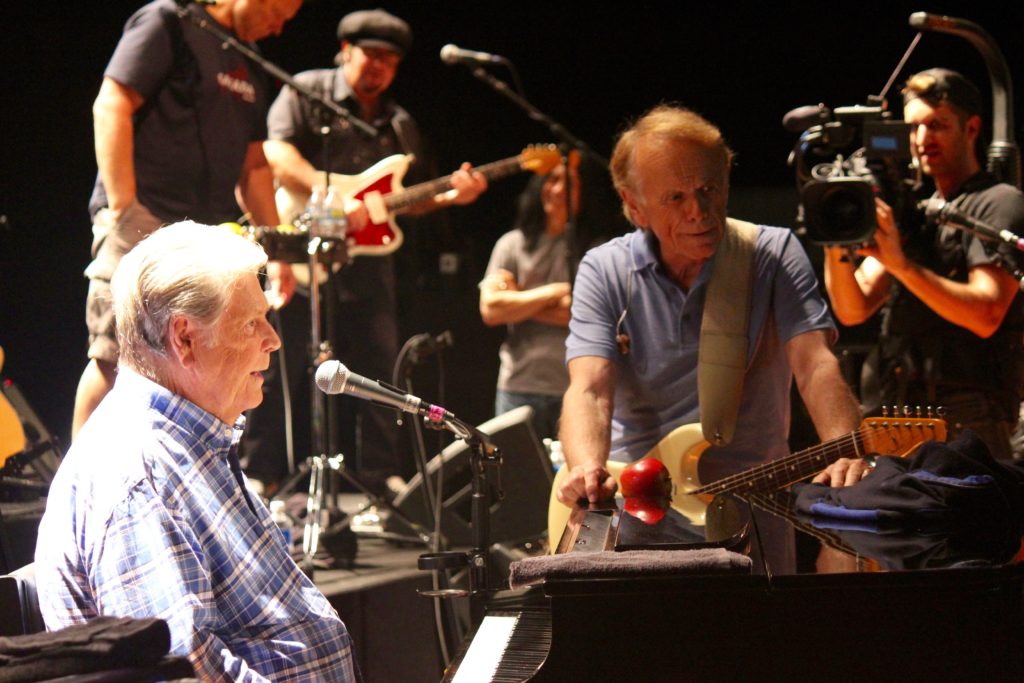
Photo caption: Brian Wilson (seated left) in BRIAN WILSON: LONG PROMISED ROAD. Courtesy of Nashville Film Festival.
A musical genius opens up in Brian Wilson: Long Promised Road, an unusual documentary about an unusual man. Brian Wilson. The Beach Boys’ songwriting and arranging master weighs in on his life and work.
As depicted in the film Love & Mercy, Wilson was afflicted with auditory hallucinations at 21, triggering painful years of what was essentially captivity at the hands of a quack doctor. Because Wilson’s affect is oddly flat and he he favors the briefest of answers, he would not be the ideal subject of a conventional interview documentary.
Instead, the filmmakers have Wilson’s old and trusted friend, rock journalist Jason Fine, drive him around important places in Wilson’s life; it’s the format of Comedians in Cars Drinking Coffee, and it pays off with oft emotional revelations. It turns out that Wilson is remarkably open about his travails and his creative process.
Completely at ease cruising Southern California with with Fine, Wilson matter-of-factly replies to very personal questions and even blurts some revelations of his own – as how he detoxed from alcohol, cocaine and cigarettes simultaneously (giving up cigarettes was the toughest).
Remarkably, some of the places in the Beach Boys origin story are now actually adorned with civic historical monuments, including the site of the Wilson family homeplace and the spot of the band’s photo shoot for their Surfer Girl album cover.
We get to see which of his songs that Brian himself listens to when he is feeling grief or nostalgia. And there are indelible moments of great feeling when Brian listens to his own music.
The film also brings in assessments of Brian’s work from master songwriters that include Elton John, Bruce Springsteen and Linda Perry; Perry says, “Brian Wilson is still trying to beat God Only Knows. Can you imagine?”
I saw Brian Wilson: Long Promised Road when it opened theNashville Film Festival. It’s opening this weekend, including at the Landmark Shattuck in Berkeley.
An American Story: Norman Mineta and His Legacy traces the life and times of Norman Mineta, who amassed a startling number of “firsts” and other distinctions in America history:
The first Asian-American mayor of a major U.S. city.
The first Japanese American member of Congress elected from the 48 Continental states.
A Cabinet Secretary in both Democratic and Republican Administrations.
The nation’s longest-serving Transportation Secretary.
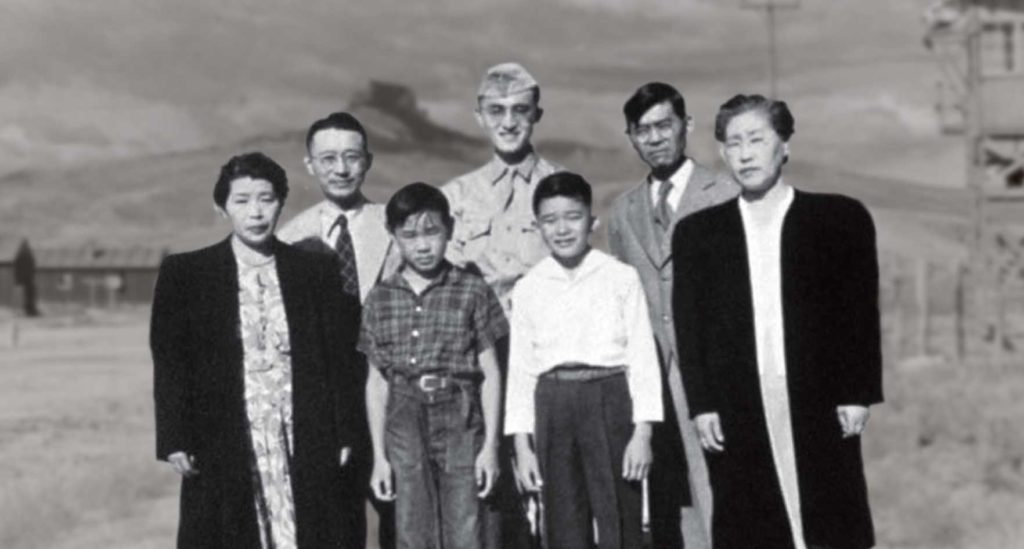
The achievements were even more remarkable given that, as a child, Mineta was imprisoned by his own US government in a WW II internment camp. And given that his political base had, during his career, an Asian-American population of far less than ten percent.
This didn’t happen by accident. Norm Mineta is a driven man. At the same time, his ambition and will is tempered by his buoyancy and ebullience.
Documentarians Dianne Fukumi (director and co-producer) and Debra Nakatomi (co-producer) embed the story of Japanese-Americans, from immigration through internment, and on to reparations.
AN AMERICAN STORY: NORMAN MINETA AND HIS LEGACY
The defining event for Mineta’s Nissei generation was the WW II internment of 120,000 Americans by their own government. The central thread in the Mineta story is that the injustice of Mineta’s internment informed George W. Bush’s resistance to treating American Muslims that same way in the aftermath of the 9/11 attacks.
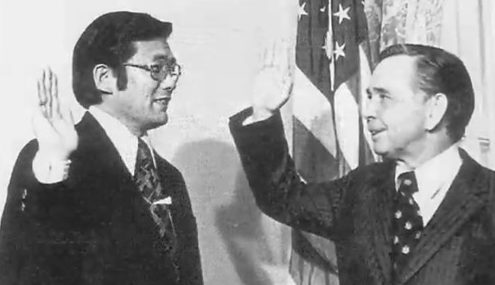
Mineta being sworn into the US House of Representatives by House Speaker Carl Albert in AN AMERICAN STORY: NORMAN MINETA AND HIS LEGACY
The film’s most delightful moment may be the octogenarian Mineta sunnily taking his luggage through security at Norman Y. Mineta San Jose International Airport.
[Full disclosure: I have known Norm since I served in his 1974 primary campaign and interned for him on Capitol Hill in the mid 70s. I saw An American Story: Norman Mineta and His Legacy at an October 2018 special screening with Norm Mineta, Fukumi and Nakatomi in San Jose.]