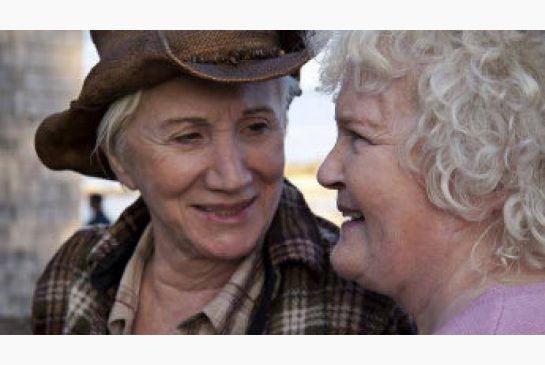
The funny and sentimental Canadian dramedy Cloudburst pairs Oscar-winning actresses Olympia Dukakis (Moonstruck) and Brenda Fricker (My Left Foot) as lesbian life partners of many decades. Because they live in Maine before the legalization of same-sex marriage there, their union is not legally recognized. The sweet-tempered Dotty (Fricker) is visually-impaired and becoming more and more infirm. Her partner Stella (Dukakis) is irascible and enjoys a startlingly vulgar vocabulary. The pair is separated when Dotty’s granddaughter moves Dotty into a convalescent home over Stella’s objection. Stella rescues Dotty and spirits the two of them off to get legally married in Nova Scotia. On the run from Maine authorities, they pick up a feckless young guy (Ryan Doucette) and head off on a very funny, and sometimes dangerous, road trip.
Cloudburst is directed and written by Thom Fitzgerald from his own play. Fitzgerald has written wonderful characters for Dukakis and Fricker to play, and their performances are superb. Surprisingly, this is the first lead role for the 68-year-old Fricker.
Cloudburst was an indie hit in Canadian theaters, but was purchased by Lifetime and didn’t get a theatrical release in the US. That’s a shame, because I think that Cloudburst could have become an art house hit like The Best Exotic Marigold Hotel. It’s a crowd pleaser.
Cloudburst is available on DVD from Netflix and streaming from Amazon, iTunes, Vudu and other VOD providers.
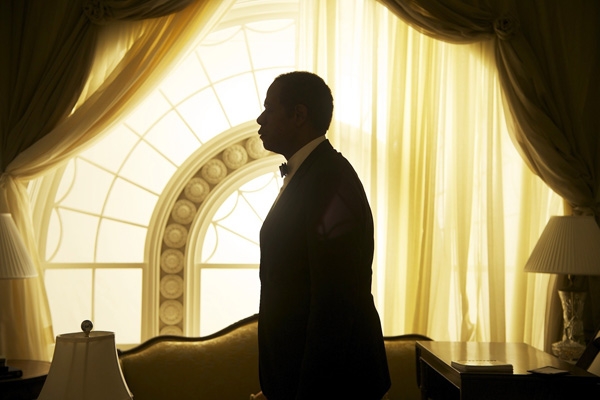
Lee Daniels’ The Butler is an entertaining and satisfying epic that explores the issue of race in America as reflected in the experiences of two men – a man who escaped a Southern cotton farm to become a butler at the White House (Forest Whitaker) and his son (David Oyelowo), who becomes engaged with the racial justice movement from the 60s through the 90s.
What The Butler gets right is the overall sweep of history, and it shines as an accessible history lesson. We get a taste of American race relations from the 1920s onward, and we glimpse the key moments in Civil Rights history: Little Rock school desegregation, lunch counter sit-ins, Freedom Rides, the JFK and LBJ civil rights speeches and legislation, the King assassination, urban riots, Black Power and anti-apartheid activism. The perspectives of the two main characters mirror those of Booker T Washington and W.E.B. DuBois.
Most importantly, The Butler reveals the African-American community as not monolithic, but with different (and conflicting) personality types, political views and generational perspectives. This is not accomplished very often in popular culture. Indeed, The Butler is strongest in the family moments – breakfasts, parties, arguments, sending the kid off to college – that allow the cast to bring out the textures of their characters. (And The Butler is dead-on perfect with all the periods, including the unfortunate fashions of the 1970s.)
That being said, the implausibility of the protagonists’ Zelig-like personal presence at every key historical moment is distracting. Every time Whitaker’s character brings a cup of coffee into the Oval Office, the President du moment is deciding on sending federal troops into the South, sending a Civil Rights bill to the Hill or some-such. Oyelowo’s character is a lunch counter sitter, a Freedom Rider, a Selma marcher, a MLK aide at the Lorraine Motel, a Black Panther, a Congressional candidate and an anti-apartheid leader. The coincidences are so improbable that it’s too much of the audience to suspend disbelief.
Forest Whitaker is a great actor. Here he perfectly plays a man who has strong feelings that he expresses among Blacks and that he conceals (sometimes stoically, sometimes charmingly) among Whites. We’ve been watching Whitaker since 1982’s Fast Times at Ridgemont High and his searing Charlie Parker in 1986’s Bird, right through to his Oscar win for The Last King of Scotland. My personal favorite Forest Whitaker performances are in The Crying Game and Ghost Dog: The Way of the Samurai.
Oyelowo is an actor who has come on strong in the past two years (The Help,The Paperboy, Lincoln), and here delivers a perfect performance of a man with youthful strong-headedness, self-possessed whether on the right side of history or not. He’s that brave man who does dangerous things without impetuosity.
The African-American cast is a marvel. Oprah Winfrey is outstanding as the wife/mom, and an Oscar nod is likely. Terence Howard is marvelous as the shady neighbor. Clarence Williams III (yes, from The Mod Squad) is superb as the butler’s first mentor. Cuba Gooding Jr and Lenny Kravitz are excellent as White House co-workers with very different personalities. Mariah Carey, who was unbelievably good as the social worker in Daniel’s Precious, is equally good here as the butler’s tortured mother.
The cast playing the White House’s upstairs residents do not fare so well. In the movie’s funniest turn, Liev Schreiber captures LBJ’s frenetic energy but not his imposing and sinister physicality. John Cusack has Nixon’s creepiness but not his painful social awkwardness. Robin Williams plays Ike without any military bearing or snap. James Marsden plays a pretty, but wimpy JFK. And is that Alan Rickman as Ronnie? The one impeccable performance in this category (and Daniels’ sly joke on the Reagans) is Jane Fonda as Nancy.
Overall, it’s an important, if imperfect work by director Lee Daniels (Precious, The Paperboy). (BTW – the title is not because of his ego – but because of the silly refusal by another movie studio to grant the title rights.) At times profound and at times ridiculously improbable, The Butler gets the basic truths profoundly right.
The droll indie comedy Prince Avalanche opens today (and is also streaming on VOD). I haven’t yet seen Lee Daniels’ The Butler, a major release which also opens today. You can read descriptions and view trailers of it and other upcoming films atMovies I’m Looking Forward To.
The jaw-dropping documentary The Act of Killing, an exploration of Indonesian genocide from the perpetrators’ point of view, is the most uniquely original film of the year.
Woody Allen’s very funny Blue Jasmine centers on an Oscar-worthy performance by Cate Blanchett.
Another rock doc, A Band Called Death with the story of three African-American brothers in Detroit inventing punk rock before The Ramones and The Sex Pistols – and then dropping out of sight for decades.
The Irish horror comedyGrabbers, which fails to deliver on a great premise.
My DVD/Stream of the Week is the intelligent drama The Place Beyond the Pines with Ryan Gosling and Bradley Cooper. The Place Beyond the Pines is available on DVD from Netflix and streaming from Amazon, iTunes, Vudu, GooglePlay and other VOD providers.
On August 21, Turner Classic Movies will air the iconic Sam Peckinpah Western The Wild Bunch, with stellar performances by William Holden, Robert Ryan and Ernest Borgnine. Watch for two of my favorite character actors – Warren Oates and Ben Johnson – as the Gorch brothers. Other beloved members of Peckinpah’s repertory company in The Wild Bunch include L.Q. Jones, Dub Taylor and Strother Martin.
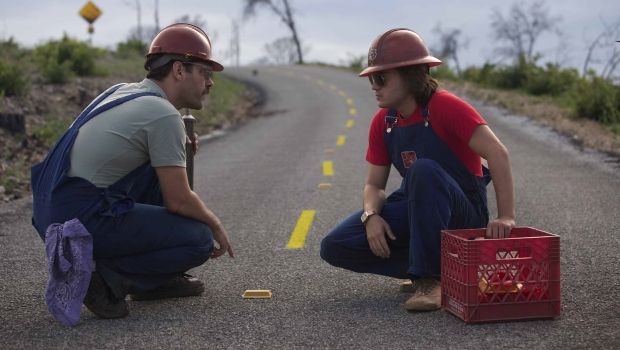
In the comedy Prince Avalanche, Paul Rudd and Emile Hirsch play two guys working a lonely job – painting the yellow line in the middle of a forlorn road through a wildfire-decimated Texas landscape. Neither guy is what you would call smart, but Rudd’s Alvin is brighter than Hirsch’s Lance. Alvin is quirky and more than a bit anal. Lance’s horizon isn’t much farther than his next sexual encounter. It’s funny when Alvin tries to keep Lance on task. As each faces some personal bad news, all semblance of order crumbles. Along the way, they meet a hilariously gonzo trucker (Lance LeGault). It’s all very funny in a droll kind of way.
Rudd, of course, is a solid comic actor, but Hirsch is the surprise. Hirsch has been very strong in dramatic roles (especially in Into the Wild), but he was the weak link in last year’s darkly funny Killer Joe. Here, he plays his dunderhead entirely straight, and the result is very funny. Who knew?
Green is now a successful director for hire (Pineapple Express and a load of commercials). But all of the indies that he’s written and directed have been really excellent: George Washington, Undertow, All the Real Girls and Snow Angels (which made my Best Movies of 2008).
I saw Prince Avalanche at a San Francisco International Film Festival screening introduced by Green. He said that, after filming Snow Angels’ suicide in frozen Nova Scotia, he was ready for something lighter. A member of the band Explosions in the Sky (his frequent collaborator) told him about the burned-out landscape around Bastrop, Texas. Having found a location, he needed a two-actor story, and so he adapted the Icelandic movie Either Way. Fueled by lots of coffee, he whipped out the screenplay in two days, with two more days for a rewrite.
One of the real pleasures of Prince Avalanche is the performance of Lance LeGault, who died just before he could have seen the movie, as the truck driver. LeGault was a veteran character actor who started off as Elvis’ stunt double and played scads of nasty military guys; Green discovered him working as an extra while shooting an auto commercial in Tehachapi. Now we can remember LeGault for stealing all his scenes in Prince Avalanche.
Prince Avalanche is in theaters, and is also streaming on Amazon, iTunes, DirecTV, Comcast, Vudu, GooglePlay and other VOD outlets.
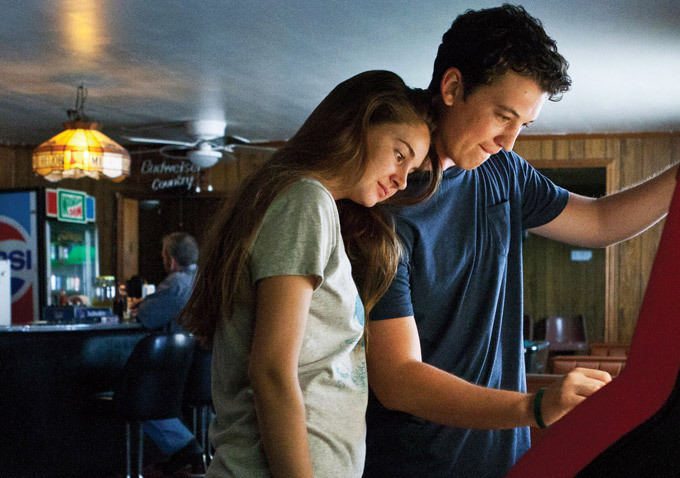
The Spectacular Now is a spectacularly authentic and insightful character-driven story of teen self-discovery. It’s the best teen coming of age story since…I can’t remember.
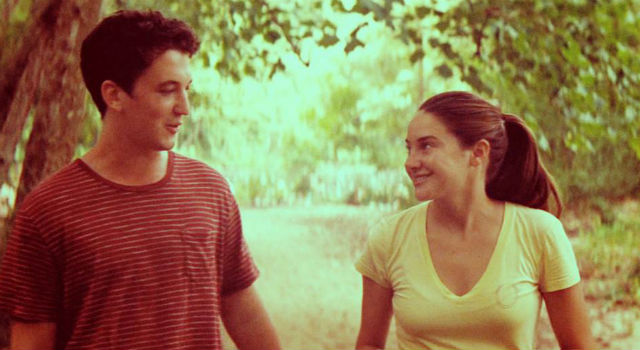
Sutter (Miles Teller – so good in Rabbit Hole) is the high school’s gregarious party guy. Everybody loves being charmed by Sutter, but it becomes apparent that his compulsive sociability is masking some family related emotional damage. It’s also clear that he will soon face some consequences from his out-of-control and escalating drinking.
When his popular girlfriend dumps him for a guy who is less fun, but a better long-term bet, he is in the market for a rebound relationship and meets Aimee (Shailene Woodley, glammed down from the foxy brat in The Descendants). Aimee is focused, responsible, capable and smart, but has no self-esteem; she has family issues, too. Sutter becomes her first love. At first, it’s a lark for Sutter – until he assesses himself and his potential effect on her.
That’s the crux of the movie. Sutter isn’t just a shallow party guy. He’s smart – and too smart to keep from seeing where he is headed.
The Spectacular Now is directed by indie filmmaker Joe Ponsoldt (director and co-writer of Smashed), who is moving toward Hollywood’s A list. The screenplay is adapted by Scott Neustadter and Michael H. Weber from the novel by Tim Tharp.
Smashed is a remarkably realistic depiction of alcohol abuse, and so is The Spectacular Now. Miles Teller is great in the role. And there’s a second great alcoholic performance – that of Kyle Chandler (Friday Night Lights, Argo) as Sutter’s long-estranged dad; Chandler’s turn is Oscar worthy. Woodley is just as outstanding as she was in The Descendants. The rest of the cast is uniformly excellent, especially Brie Larson and Jennifer Jason Leigh.
If you see The Spectacular Now with your teen, there will be plenty to talk about afterward – teen drinking, addiction, dating, partying, picking your friends, making choices and what a damn good movie this is.
Every teenager should see this movie, which brings me to this bit of insanity – The Spectacular Now has an R rating because teenagers are DRINKING ALCOHOL in the movie. It doesn’t matter that the movie is ABOUT teen alcoholism. It doesn’t matter that The Spectacular Now is the 2013 movie most likely to help teenagers in their real lives (by sparking discussion of the issues therein). Of course, just last year, the MPAA similarly assigned the R Rating to Bully. Just leave it to the pompous asses at the MPAA to keep those 14- to 16-year-olds out (unless they show the good taste and resourcefulness to sneak in).
I saw The Spectacular Now at the San Francisco International Film Festival in a screening with director Ponsoldt. It’s on my Best Movies of 2013 – So Far.
Okay, here’s a jaw dropper. In the chilling documentary The Act of Killing, perpetrators of genocide in Indonesia are asked to re-enact their murders – and they are pleased as punch to do so. We meet unapologetic mass murderers face-to-face. Filmmaker Joshua Oppenheimer has created the year’s most startling documentary.
After the 1965 military coup, death squads sympathetic to the military labeling opponents of the regime, landless farmers and ethnic Chinese as “communists” – and killed 2-3 million fellow Indonesians. The killers were mostly Indonesian paramilitary groups and gangsters. The Act of Killing introduces us to several of these murderers, who don’t try to evade or spin their deeds, but instead look proudly and nostalgically at their murders as the highlight of their lives.
The film primarily focuses on two self-described gangsters, Anwars and Herman. The two enthusiastically embrace the film project so they can document their murders for history. Anwars is said to have killed a thousand by himself. Because beating them to death produced too much messy blood, he devised a method of strangling them with wire. The corpulent Herman chooses spends about a third of movie dressed in flamboyant drag, which is ridiculous, but the film is so disturbing that the audience just can’t laugh. Besides acting out interrogation torture murders and a village massacre, the two come up with a Bollywood-like musical number of Born Free, complete with dancing-girls in front of a waterfall, in which the garotted dead reappear to thank Anwars for sending them on to the afterlife. It is beyond bizarre.
In the film’s most riveting scene, a guy who has been recruited to play a torture victim in the film-within-a-film, recounts the death squad murder of his step-father to Anwars and Herman. To keep his composure, he awkwardly laughs as he describes the abduction – but his eyes are clearly blaming the old gangsters. Then he acts out his torture for the camera.
The Act of Killing is hypnotically compelling – you can’t believe what’s on the screen, can’t believe that you’re still watching it and can’t stop watching.
The Act of Killing is directed by Oppenheimer and co-directed by someone credited as “Anonymous” and Christine Cynn. Oddly, there is no writing credit. The great documentarians Errol Morris and Werner Herzog are among the executive producers.
[We don’t often explore genocide from the perpetrator’s point of view, although two excellent documentaries come to mind: Shoah and Blind Spot: Hitler’s Secretary, both on my 5 Essential Holocaust Films. The current film Hannah Arendt is about the academic theorist who coined the term “banality of evil”, but that story’s duel of letters between hand-wringing intellectuals makes for a stale discussion.]
The Act of Killing is a very uncomfortable movie, and I suspect that it wouldn’t be not a great choice for most of my readers. But it pushes the envelope of cinema and is the most uniquely original film of the year (or millennium so far?). I’m really glad that I watched it.
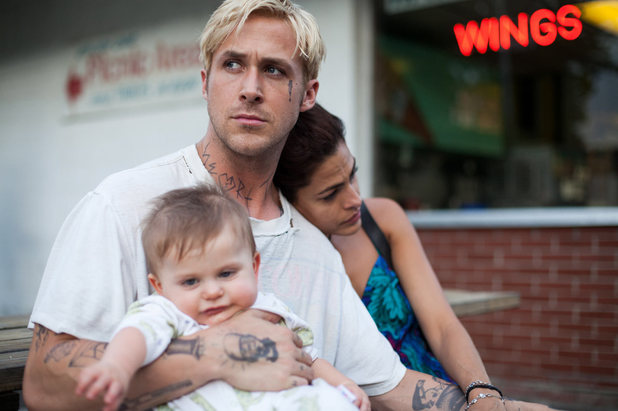
Ryan Gosling and Eva Mendes in THE PLACE BEYOND THE PINES
According to the Old Testament, “the iniquity of the fathers shall be visited upon the sons”. Indeed, the successes and flaws of fathers, and the choices they make, impact their sons. And sons are often driven to be like or unlike their fathers, to match them or to surpass them. That is the territory explored in writer-director Derek Cianfrance’s intelligent drama The Place Beyond the Pines. (The story is set in Schenectady, New York, and the title refers to the Mohawk origin of the town’s name.)
At first, the story follows a familiar path for a crime drama – a motorcycle trick rider (Ryan Gosling) turns to bank robbery and has an encounter with a cop on patrol (Bradley Cooper). But the screenplay embeds nuggets about how both men feel about their fathers and how those feelings drive their actions. Both men have infant sons, and the father-son theme becomes more apparent as the story resumes fifteen years later with a focus on their own sons as teenagers.
I can’t remember a recent performance by Ryan Gosling that hasn’t been compelling, and he’s outstanding here, too. But the unexpected gem is Bradley Cooper, who shows us acting depth and range that we haven’t seen in his earlier work. Especially in scenes with a police psychiatrist and when forced to ask his father for advice, Cooper exposes the naked vulnerability of his character.
The Place Beyond the Pines is replete with excellent performances. Eva Mendes plays the mother of Gosling’s baby, and her performance stands up to Gosling’s – no small feat. Harris Yulin is superb as Cooper’s canny father. The wonderful Australian actor Ben Mendelsohn (Animal Kingdom,Killing Them Softly) plays Gosling’s crime partner. Ray Liotta, who often plays shady characters, has never been so menacing.
I found the character of Cooper’s son to be very unsympathetic; he is supposed to be a kid messed up by his parents’ divorce and father’s inattention, and I think that the story would have worked better if it were easier to look past his obnoxiousness to appreciate his damaged nature. Still, it’s a film that I’m still pondering a day later. Cianfrance made Blue Valentine, the hard-to-watch but starkly authentic story of an unraveled relationship, an acting showcase for Gosling and Michele Williams. The Place Beyond the Pines is just as thoughtful and more accessible than Blue Valentine. Pines is an ambitious and mostly successful film.
The Place Beyond the Pines is available on DVD from Netflix and streaming from Amazon, iTunes, Vudu, GooglePlay and other VOD providers.
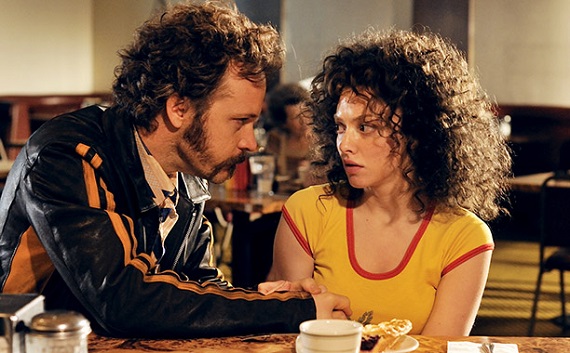
Lovelace is a soap opera about a nice girl who meets the Wrong Guy and, before she knows it, she’s in a porn movie. The movie is cleverly constructed. First, it outlines the true story of the naive and troubled young woman soon-to-become porn star Linda Lovelace, culminating in the 70s porn megahit Deep Throat. Doing so, it captures both the polyester period and the appeal of the then-novel campy humor in Deep Throat. Then it fills in the blanks, completing the flashbacks of earlier scenes (and inserting new ones) so we see the relentless abuse of Lovelace by her Wrong Guy husband. His abuse of her – even pimping her out – is horrific.
It’s generally a well-acted film. The appealing Amanda Seyfried works as Lovelace. The most welcome aspect of the film is the goofy team of Hank Azaria, Bobby Cannavale and Chris Noth as the pornographers – they’re very funny and lighten the film.
As we would expect, Peter Sarsgaard makes for the most despicable movie husband since Lawrence Fishburne’s Ike Turner in What’s Love Got to Do With It. His sadistic sociopath is both smarmy and sadistic.
An unrecognizable Sharon Stone is excellent as the rigidly devout Catholic mother who insists that Lovelace return to her physically abusive husband and obey him (although, to be fair, the mom can’t imagine the depth of the abuse).
Robert Patrick is excellent as her terse father, especially in one particularly heartbreaking scene. So many of Patrick’s roles are in action movies, so I’m glad that he got a chance to play a rigidly unemotional guy that is having deep emotions.
Some of the other casting is pretty random. James Franco is completely wrong as Hugh Hefner. Hef is cool only because of the Playboy Empire. Franco is cool because he’s Franco. Here Franco doesn’t swap out his own personal magnetism for the real Hef’s stiff reserve. Less would have been more. And, oddly, Chloe Sevigny receives a credit for what may be less than five seconds on-screen.
The real Linda Lovelace wasn’t particularly deep, and neither is Lovelace. As well-crafted as it is – and with the superb performances of Skarsgaard, Stone, Patrick, Azaria, Cannavale and Noth – the central cautionary tale of Lovelace – the fall and redemption of a sympathetic character – nonetheless remains a not very profound soap opera.
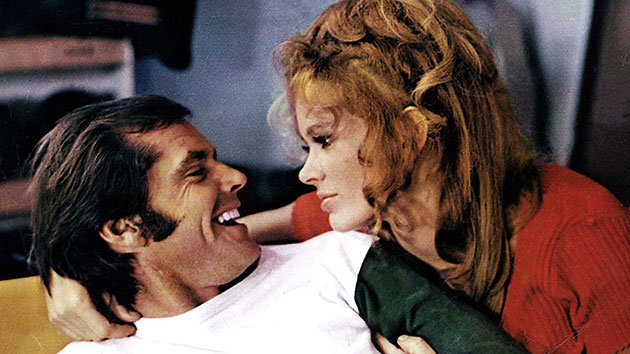
Jack Nicholson and Karen Black in FIVE EASY PIECES
Karen Black, one of the icons of 1970s American cinema, has died. From 1969 through 1976 she starred in Easy Rider, Five Easy Pieces, Drive He Said, the Kris Kristofferson vehicle Cisco Pike, Portnoy’s Complaint, The Outfit (with Robert Duvall), The Great Gatsby, Robert Altman’s Nashville and Alfred Hitchcock’s Family Plot. She excelled at playing sexually liberated and kooky women, generally downscale and down on their luck. Her New York Times obit quoted this 1975 appraisal from Time magazine:
“Black brings to all her roles a freewheeling combination of raunch and winsomeness. Sometimes she is kittenish. At other times she has an overripe quality that makes her look like the kind of woman who gets her name tattooed on sailors.”
My favorite Karen Black performance was her Oscar-nominated turn in Five Easy Pieces (1970) as Rayette, the girlfriend of Bobby Dupea (Jack Nicholson). Brimming with alienation, Bobby is working as an oil field roughneck, and the diner waitress Rayette falls in love with him. However, he comes from a highbrow family of classical musicians, and when he must revisit their world, it’s heartbreakingly clear that Rayette isn’t going to fit in.
Here’s the most famous scene in Five Easy Pieces from my Most Memorable Movie Food Scenes. Karen doesn’t have much to do in this scene (besides reacting to Jack), but it’s nice to see her again.
This week’s MUST SEES are The Hunt – the best movie of 2013 so far – and the emotionally powerful Fruitvale Station. The Huntis likely out for only one more week.
Woody Allen’s very funny Blue Jasmine centers on an Oscar-worthy performance by Cate Blanchett.
I haven’t yet seen Amanda Seyfried and Peter Sarsgaard in the porn star biopic Lovelace. You can read descriptions and view trailers of it and other upcoming films atMovies I’m Looking Forward To.
Another rock doc, A Band Called Death with the story of three African-American brothers in Detroit inventing punk rock before The Ramones and The Sex Pistols – and then dropping out of sight for decades.
A stale intellectual argument from 1961 in Hannah Arendt.
The Irish horror comedyGrabbers, which fails to deliver on a great premise.
the wretched crime thriller Only God Forgives is in the running for the year’s worst film.
This week, there’s no DVD/Stream of the Week – get out to see The Hunt and Fruitvale Station!
On August 11, Turner Classic Movies is featuring Henry Fonda movies, including his iconic performances in Mister Roberts and The Grapes of Wrath. But I also like the oft overlooked comedy A Big Hand for a Little Lady, where Fonda plays a pioneer who has lost almost everything in a poker game and then becomes ill just when he is dealt a very promising hand; his wife (Joanne Woodward) must decide whether to hold ’em or fold ’em.