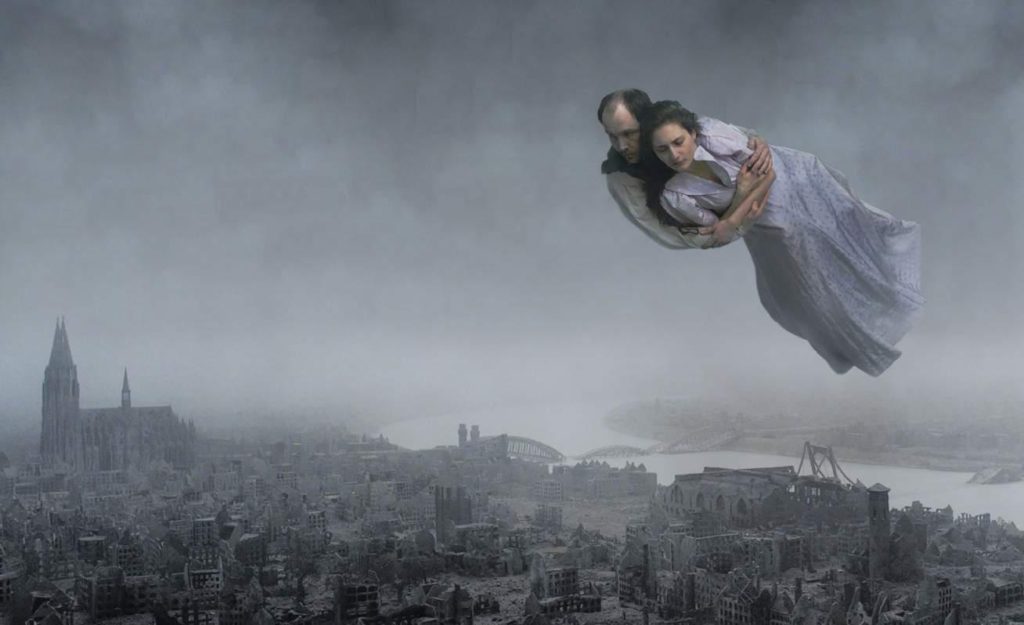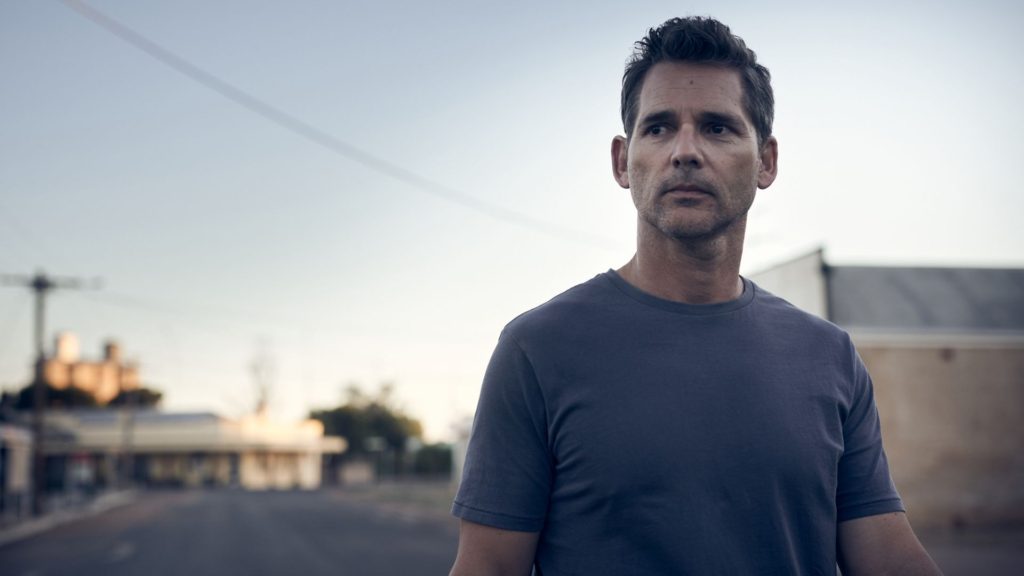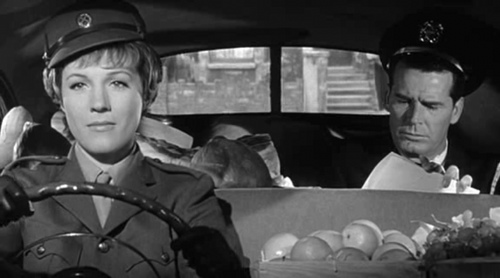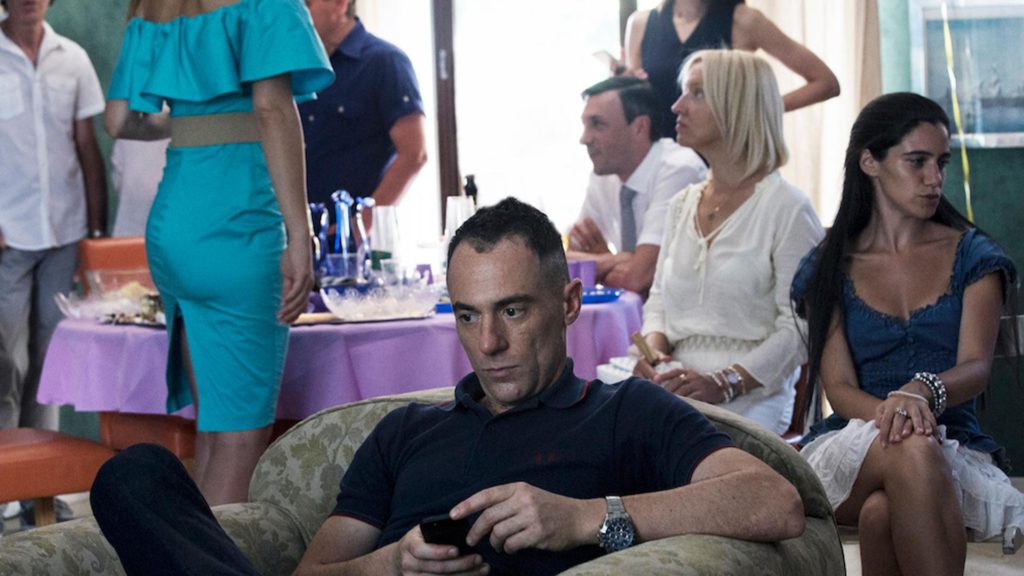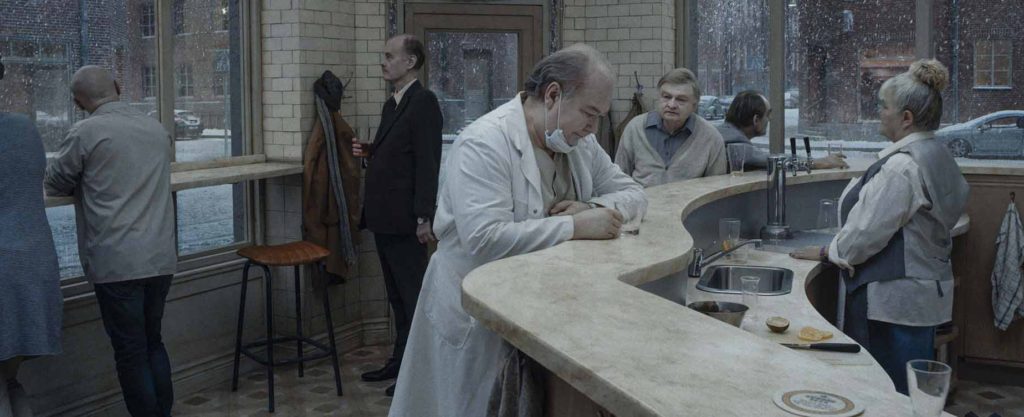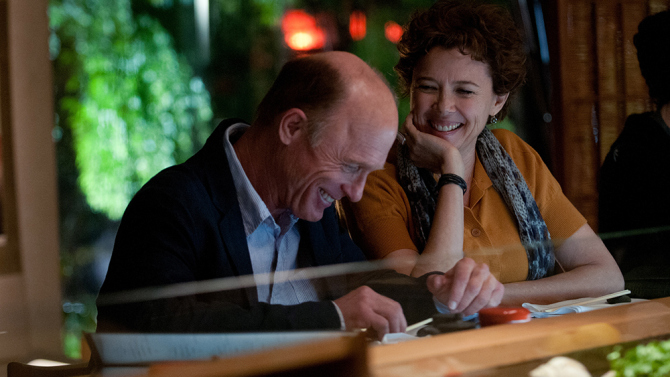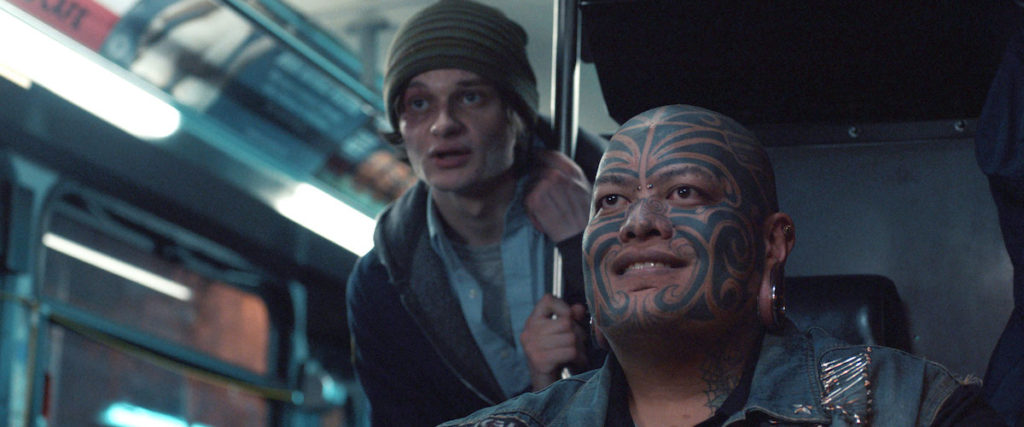
Here’s an underrated 2014 romance that most of us didn’t get to see in theaters: The Face of Love.
Annette Bening plays a woman whose husband suddenly dies, and she is plunged into an immediate and harsh sense of loss. She goes on with her life and then is surprised to meet a man who is attracted to her. They begin to date and fast develop a serious bond. Here’s the kicker – the new boyfriend looks EXACTLY like her late husband (both are played by Ed Harris). You know that eventually he is going to find out, and that eventually her kids and friends are going to find out, and that people are going to think this is very weird. Those characters – and the audience – will wonder whether she is in love with this new man – or in love with the image of her late husband.
As one would expect, Bening and Harris both give compelling performances. The scene where the new guy asks her out on a date is especially fun. The Face of Love is a worthwhile watch.
The Face of Love is available to stream from Amazon.
This week, we can finally stop chasing the Oscar movies and watch some overlooked gems.
ON VIDEO
Augustine: obsession, passion and the birth of a science. Amazon (included with Prime), AppleTV, Vudu, YouTube and Google Play.
The Brainwashing of My Dad: Filmmaker Jan Senko expores how right-wing media impacts the mood and personality of its consumers as well as their political outlook – and she uses her own dad as a case study. Amazon, AppleTV, Vudu, YouTube and Google Play.
ON TV
Linda Hunt and Mel Gibson in THE YEAR OF LIVING DANGEROUSLY
On May 2, Turner Classic Movies presents Peter Weir’s 1982 political thriller The Year of Living Dangerously, starring Mel Gibson and Sigourney Weaver. In the exotic setting of Sukarno’s Indonesia, this film has gripping intrigue, romance and a neo-noir ending.
The stars were each coming off their first major feature, Weaver’s Eyewitness with William Hurt and Gibson with the original Mad Max. The Year of Living Dangerously made them both solid A-list movie stars. Linda Hunt won an Oscar for her gender- and race-crossing performance as the local fixer.
Weir had made the fine Australian films Picnic at Hanging Rock, The Last Wave and Gallipoli. This major MGM release brought him success in his first Hollywood picture and empowered Weir to follow with Witness, Dead Poets Society, The Truman Show and Master and Commander.
Sigourney Weaver and Mel Gibson in THE YEAR OF LIVING DANGEROUSLY
Filmmaker Jan Senko’s dad Frank in THE BRAINWASHING OF MY DAD
How the hell did we get here – a moment when millions of Americans believe stuff that demonstrably isn’t true – and have this misconceptions drive them into unrighteous rage? For insight, let’s look at the prescient 2016 documentary The Brainwashing of My Dad, which saw some of this nightmare coming.
In 2016, I wrote, “Ever notice how people who watch a lot of Fox News or listen to talk radio become bitter, angry and, most telling, fact-resistant?” Then I couldn’t imagine an assault on a the US Capitol by propaganda-intoxicated hillbilly barbarians. In The Brainwashing of My Dad, filmmaker Jan Senko explores how right-wing media impacts the mood and personality of its consumers as well as their political outlook. Senko uses her own father Frank as a case study.
We see Frank Senko become continually mad and, well, mean. And we hear testimony about many, many others with the identical experience. Experts explain the existence of a biological addiction to anger.
Senko traces the history of right-wing media from the mid-1960s, with the contributions of Lewis Powell, Richard Nixon, Rush Limbaugh, Roger Ailes and Rupert Murdoch. Senko even gets right-wing wordsmith Frank Luntz on camera to explain the power of buzz words. If you don’t know this story (Hillary was right about the “vast, right-wing conspiracy”) , Senko spins the tale very comprehensively. If you do know the material (and my day job is in politics), it is methodical.
This topic is usually explored for its impact on political opinion. Senko’s focus on mood and personality is original and The Brainwashing of My Dad contributes an important addition to the conversation. One last thing about the brainwashing of Senko’s dad – it may not be irreversible…
I first reviewed The Brainwashing of My Dad for its U.S. Premiere at Cinequest 2016. The Brainwashing of My Dad is available streaming on Amazon, AppleTV, Vudu, YouTube and Google Play.
Vincent Lindon (left) and xxxxx (center) AUGUSTINE
The absorbing French drama Augustine is based on the real work of 19th century medical research pioneer Jean-Martin Charcot, known as the father of neurology. A young kitchen maid begins suffering wild seizures and is brought to Charcot’s research hospital. He ascertains the triggers for the seizures, and begins to close in on cure. Needing funding for his research, he triggers her seizures before groups of his peers; he is showing off his research, but it’s clear that his affluent male audience is titillated by the comely girl’s orgasmic thrashes.
She is drawn to this man whose kindness to her belies their class difference and whose brilliance is the key to her recovery. The good doctor intends to cure her – but not until she has performed for his potential funders. She is unexpectedly cured just before Charcot’s most important demonstration, and she gets to decide whether to continue her exploitation. In the stunning conclusion, she gets the upper hand and her simmering feelings erupt.
The fine French actor Vincent Lindon (Mademoiselle Chambon) excels at playing very contained and reserved characters, and here he nails Charcot’s clash of decency and professional ambition.
The French pop singer Soko is captivating as his patient. I noted the feral fierceness and simmering intensity of Soko in The Stopover, a film that I saw at the San Francisco International Film Festival (SFFILM).
It’s an auspicious first feature film for writer-director Alice Winocour. She has constructed a story that about two sympathetic characters whose interests converge, then diverge and then… Since Augustine, Winocur has co-written the wonderful Mustang and directed Disorder.
Augustine is available to stream from Amazon (included with Prime), AppleTV, Vudu, YouTube and Google Play.
Caption: Watching the Oscars in The Movie Gourmet’s screening room
Oddly, watching the Oscars seemed so comfortable in such a bizarre year. Less was more. The no-host format, the Union Station set, the incorporation of the remote locations and subbing Questlove for the orchestra, each improved the show. Steven Soderbergh and the other producers finally off-loaded the Best Song category to the pre-show – a huge help. And I sure didn’t expect the most powerful moment to come from Tyler Perry and the funniest from Glenn Close.
The awards, for once, pretty much all went to deserving winners. My only quibble was the atrocious Documentary Feature win for the good but not great My Octopus Teacher, an opinion shared by critics such as Christy Lemire and Jason Gorber. (I did like the octopus in the movie, just not the human.)
In each of The Movie Gourmet’s ten years of blogging, The Wife and I watch the Oscars while enjoying a meal inspired by the Best Picture nominees. For example, we had sushi for Lost in Translation, cowboy campfire beans for Brokeback Mountain and Grandma Ethel’s Brisket for A Serious Man – you get the idea. The high point has been the Severed Hands Ice Sculpture (below) in 2011 for 127 Hours and Winter’s Bone. Here is the 2019 version.
The Movie Gourmet’s culinary tribute to 127 HOURS and WINTER’S BONE
The characters in Nomadland, Sound of Metal, The Father and Minari all spent time in kitchens, so we could have come up with an Oscar menu. But it didn’t seem right this year. I, for one, haven’t been inside a movie theater in 417 days. To honor the movie theater experience, we chose movie popcorn and movie candy (Hot Tamales for me, DOTS for The Wife) and settled in for the telecast.
The Wife and her father indulging in The Movie Gourmet’s 2021 Oscar dinner
Caption: A scene from Marilyn Agrelo’s film STREET GANG: HOW WE GOT TO SESAME STREET. Courtesy of SFFILM
There’s a lot to like about Street Gang: How We Got to Sesame Street, a documentary as charming as the beloved TV series. As groundbreaking as it was, Sesame Street is now a 51-year-old institution, and its origin saga has not been well-known. Most of the key players survive, allowing director Marilyn Agrelo to present the first-hand back story.
We take the concept for granted today, based on the recognition that kids voraciously learn from commercial television – they learn to consume commercially marketed products. Sesame Street’s founders aimed to find out what kids like to watch and what is good for them to watch and put the two together.
Refreshingly. the pioneering producer Joan Ganz Cooney, the visionary Lloyd Morrisette of the Carnegie Foundation and the inventive director/head writer Jon Stone, each gives the credit to the others. If you add Mister Rogers to these folks, you have the Mount Rushmore of children’s television.
Everything in Sesame Street was intentional – like the street setting itself. Noting that most kid shows had fantasy settings, the creators chose a gritty urban neighborhood street to be relatable to disadvantaged urban kids. The same is true for the integrated cast.
Of course, Street Gang highlights the role of the Muppets. At first, the Muppets had their own set, but the creators learned that kids were so entertained by the Muppets that they found the street boring. So, they pivoted and brought the Muppets on to the street.
Jim Henson founded the Muppets as a late night satirical act and brought that adult sensibility to Sesame Street. The jokes embedded for adults encouraged parents to watch Sesame Street with their kids (which the educators thought was important).
There is also the astounding story of Sesame Street in Mississippi, where state government-controlled public television refused to air a show with an integrated cast. Those stations had to reverse themselves when private Mississippi stations put the show on the air.
This had not occurred to me, but Sesame Street requires creation of original music for 100 episodes per year – an enormous body of work. Street Gang takes us into the songwriting craft, with witty gems like Letter B (from Let It Be).
I screened Street Gang: How We Got to Sesame Street at SFFILM. It opens today in select San Francisco theaters and will release on VOD on May 6.
The Oscars will presented Sunday night, and I expect deserving Oscars for Nomadland (Best Picture), Chloe Zhao (Director), Chadwick Boseman (Actor), Another Round (International Feature) and Sound of Metal (Sound). I’ll generally be happy with any wins by Nomadland, Sound of Metal and Ma Rainey’s Black Bottom Blues.
Zhao is also nominated for Original Screenplay and Editing. I’m annoyed that IMDb and some other sources describe Chloé Zhao as a “Chinese director”. Although she was born in Beijing, I consider Zhao a Chinese-born American filmmaker. As a child, she left China for a London boarding school and finished high school in LA; she graduated from college and film school in the US, and has made all of her movies in America. Besides, what other filmmaker has set her last three movies in South Dakota, for chrissakes?
This Oscar week, I’ve also highlighted what I think is the Most Overlooked Movie of 2020: Driveways.
And here’s my remembrance of cult director Monte Hellman.
ON VIDEO
See the Oscar-nominated films (IN THIS ORDER).
Nomadland: refusing to be defeated. THE YEAR’S BEST MOVIE. Hulu.
Sound of Metal: Seeking anything but stillness. Amazon (included with Prime).
Minari: who gets to decide on a family’s dream? Amazon, AppleTV, Vudu, YouTube, Google Play.
ON TV
Janet Gaynor, Fredric March and Adolphe Menjou in A STAR IS BORN
Compare and contrast. On April 26, Turner Classic Movies is showing the 1937, 1954 and 1976 versions of A Star Is Born. In all three, the story is about an entertainment superstar self destructing from narcissism and addiction, with a sinking career eclipsed by that of a lover-protege. Each version features with A-list talent, but some are much better than others.
The 1937 original stars Janet Gaynor and Fredric March, with the screenplay adapted by Dorothy Parker and others from a story co-written by director William Wyler. The 1954 screenplay was adapted by Moss Hart, and the movie, starring Judy Garland and James Mason, was directed by George Cukor. The 1976 re-remake stars Barbra Streisand and Kris Kristoffersson (at his hunkiest) with a script by Joan Didion and John Gregory Dunne.
The 1976 film launched the producing career of Jon Peters, Streisand’s hairdresser boyfriend. Despite a terrible personal reputation, he went on to produce 52 more films before his career was extinguished by a #MeToo scandal.
My favorites are the 1937 original and the 2018 version (which TCM is not airing) with Bradley Cooper and Lady Gaga. Cooper also co-adapted the screenplay and directed; Lady Gaga shared the Oscar for Best Original Song for Shallow. The Streisand-Kristoffersson version is not good.
The real life basis of the story is said to be Barbara Stanwyck and her contemptible and obnoxious first husband Frank Fay. 16 years younger than Fay, Stanwyck married him when she was 21 and transitioning from chorus girl to movie ingenue. Within seven years, she had become a major movie star and had had enough of the fading vaudevillian Fay. By all accounts, Fay was a drunken, anti-Semitic, pro-fascist, wife-beater with a massive ego: Fred Allen said of Fay, “The last time I saw him he was walking down Lover’s Lane, holding his own hand.“
Harry Dean Stanton and Warren Oates in Monte Hellman’s COCKFIGHTER
My favorite cult director, Monte Hellman, has died at age 91. TheNew York Timescalled him a “hero of the American independent film movement“.
Hellman worked in low-budget genre movies, collaborating with Roger Corman, Jack Nicholson and Hellman’s great muse, Warren Oates. Hellman could elevate the sparest of scripts and the most minuscule of budgets into film classics.
Hellman showcased Oates’ gift for playing a tough, bottom-feeding grasper who needs a little too much luck in Two-Lane Blacktop (1971) and Cockfighter (1974). Cockfighter, a movie that even Hellman couldn’t make today, is probably his masterpiece.
Road to Nowhere, in 2010, was the first film in twenty years from the then 79-year-old Hellman. It’s a multi-layered riddle that challenges the audience. Road to Nowhere is far more stylish and ambitious than Hellman’s 1970s films, but far more baffling.
I can’t find Two-Lane Blacktop available to stream, but the Blu-Ray DVD is available from The Criterion Collection. Cockfighter can be streamed from Amazon (included with Prime) and a few other outlets. Road to Nowhere is available to stream from Amazon, AppleTV, YouTube and Google Play.
The Oscars are coming up on Sunday night, so here’s a plug for The Most Overlooked Movie of the Year. I can’t think of a more authentic movie about intergenerational relationships than the charming, character-driven Driveways. I saw this modest little indie at Cinequest, and it’s one of the Best Movies of 2020.
Kathy (Hong Chau) and her nine-year-old Cody (Lucas Jaye) arrive in a small town to clean out and flip the house of Kathy’s late sister. Kathy and her much older sister had lost touch,and Kathy is surprised and disheartened to discover that the sister had become a hoarder, making the clean-up job monumental. The octogenarian next-door neigbor Del (Brian Dennehy) watches from his porch.
All three are facing life challenges. Kathy is a single mom trying to navigate a career change; now she has an unwanted chore and some guilt from not reviving the relationship with her sister. Cody is a sensitive kid who isn’t comfortable in many situations and who has an embarrassing reaction to anxiety. Del is grieving the loss of his wife and facing the loss of his independence. Things do not go as the audience expects.
Hong Chau in DRIVEWAYS
Director Andrew Ahn, by dropping subtle clues, lets the audience connect the dots about the characters and their back stories. We learn about the mom-son relationship when she discards a cigarette on the ground and he wordlessly grinds it out with his shoe. We learn about Del’s fears about his independence when he glances at an increasingly forgetful buddy.
Driveways is a three-hander and all three actors, Hong Chau, Lucas Jaye and Brian Dennehy are superb. 91-year-old character actor Jerry Adler is brilliant in a few very brief scenes.
This was the final performance for Brian Dennehy (scroll down to bottom for my remembrance). His performance – so remarkably genuine and subtle – in Driveways is award-worthy. Dennehy’s facial expression, in one fleeting moment, conveys Del’s profound regret about a mistake that he made with his own daughter.
Brian Dennehy and Lucas Jaye in DRIVEWAYS
Driveways played at Cinequest 2020 with an in-person appearance by Hong Chau, which I skipped because I sized it up as too sappy. I was wrong.
You know how children are drawn to some kids and not to others? Driveways perfectly captures the joy of making friends when a kid discovers another kid with common interests.
That authenticity is exactly what keeps Driveways from being corny. There’s not a hint of manipulation from Ahn. That’s why Driveways is that rarity, a recommendation from The Movie Gourmet that can be described as”heartfelt”.
Cody is as much the lead character as are the mom and the old guy. The Wife thinks that the movie is too slow for kids. But I’d give it a try and challenge the kids. It’s only 83 minutes, and I think kids will be drawn to the portrayal of a kid that is so real-world and unlike the stock characters spoon fed them by the likes of the Disney Channel.
Driveways is available to stream on all the major platforms.
Minari: who gets to decide on a family’s dream? Amazon, AppleTV, Vudu, YouTube, Google Play.
ON TV
Jack “Dragnet” Webb and Peggy Lee in PETE KELLY’S BLUES
On April 21, TCM brings us something COMPLETELY different, the 1955 Pete Kelly’s Blues, directed by and starring Jack Webb, who we all know from TV’s Dragnet. Made at the downturn of the Big Band Era, Pete Kelly’s Blues is set at during Prohibition in the infancy of Big Bands.
It’s a fairly routine drama about a small time bandleader on the outs with a dangerous crime boss, but Jack Webb loved jazz and worked hard to get the music in the movie right, resulting in quite the period document. Peggy Lee received a Supporting Actress Oscar nomination for portraying an alcoholic vocalist. There’s an unforgettable cameo performance by Ella Fitzgerald at the top of her game. The house band includes many real-life musicians who played with Benny Goodman, Bing Crosby and the like, including Matty Matlock, Eddie Miller and Jud De Naut.
Webb never had much range as an actor, but the rest of the cast is excellent: Janet Leigh, Edmond O’Brien, Lee Marvin, Andy Devine, Jayne Mansfield and Harry Morgan. Not a great flick, but worth a look for the music.