
Cinequest: ALL THE BEAUTY

ALL THE BEAUTY
ALL THE BEAUTY

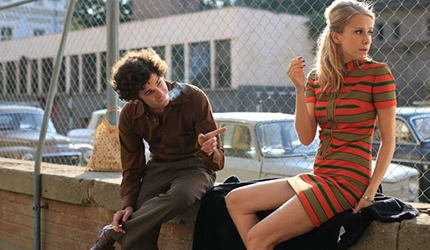
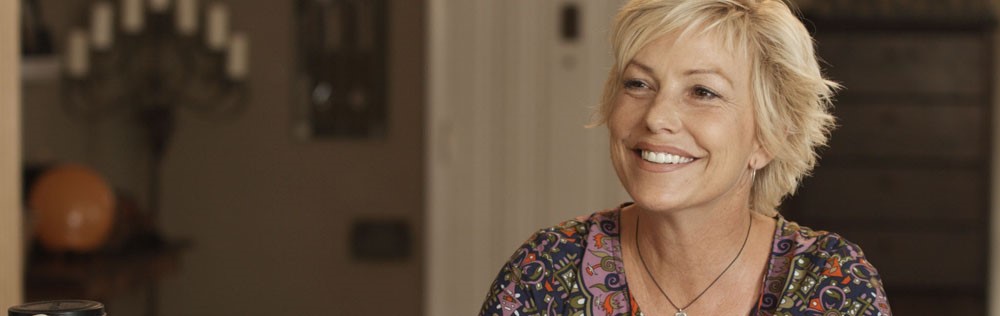
In the Norwegian drama All the Beauty, David, a successful Swedish writer, has invited his old girlfriend, the Danish gynecologist Sarah, to help him finish his new play, which is about their decades-long, off-and-on relationship. Given that David’s biggest bestseller was a tell-all that revealed Sarah’s sex life in every intimate detail, Sarah is understandably wary.

As Sarah reads each act of David’s play, we see the two in vignettes at the ages of 23, 33 and 43. At 23, they meet and jump in bed in the full flush of a new romance – and Sarah sets a pivotal ground rule for their relationship. At 33, there is another defining moment when they have the chance for a reset. At 43, the two face another crossroad. And we are our choices (and the choices of those we love).

ALL THE BEAUTY
ALL THE BEAUTY

Different sets of actors play David and Sarah at the ages of 23, 33, 43 and 53. Cinequest fans will recognize the 43-year-old David – Kristoffer Joner, who starred in The Wave at last year’s festival.

It’s not all Scandinavian darkness. Some very funny jokes about yoga, of all things, get the audience engaged right away. And then there’s the awkwardly naked jogger, too.

All the Beauty is the first feature director and co-writer Aasne Vaa Greibrokk and her co-writer Hilde Susan Jægtnes. The two have crafted an insightful exploration of female sexuality and the power within relationships – all with a very novel story structure. The Wife enjoyed it, too, at Cinequest. Recommended.
Cinequest: REVENGE

REVENGE
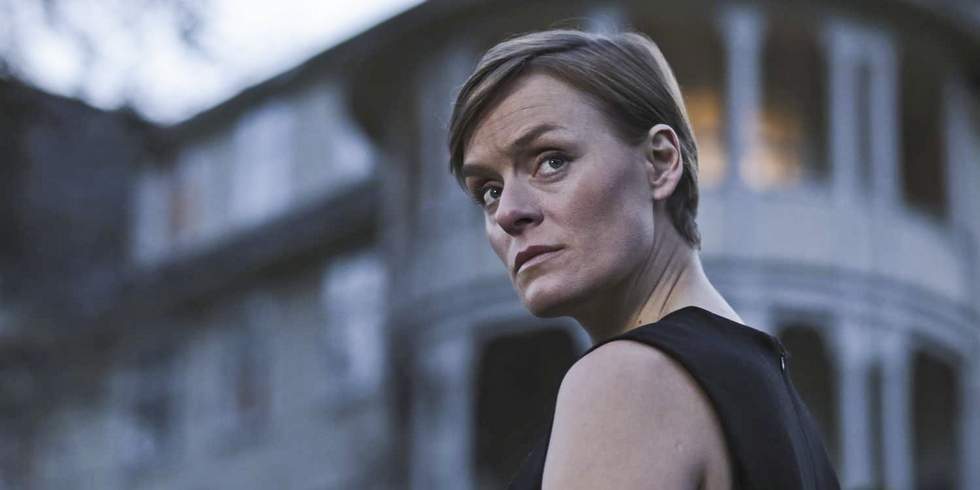
Siren Jørgensen in REVENGE

In the Norwegian suspense thriller Revenge, the slightly creepy Rebekka (Siren Jørgensen) appears at a hotel on a remote fjord under the false pretense that she is a travel writer.  The hotel is otherwise empty because it is off-season (think The Shining).  She ingratiates herself with the hotel’s owner Morten, the most economically and socially significant person in town, and his wife (Maria Bock).  It turns out that twenty years before, Morten date-raped Rebekka’s little sister, leading to her suicide.  Now Rebekka wants to exact vengeance.

Revenge becomes a tick-tock suspenser as Rebekka deliberately lays her trap.  We’re able to see some, but not all, of the web that she spins, which will put in jeopardy Morten’s reputation, marriage, business and his very health and survival.  Can she pull it off?  And how lethal will her revenge be?

It’s the first feature for Kjersti Steinsbø, who adapted the screenplay and directed.  She has created a real page-turner here.  In one very effective touch, it turns out that one of the characters knows FAR more than we initially suspect.

REVENGE
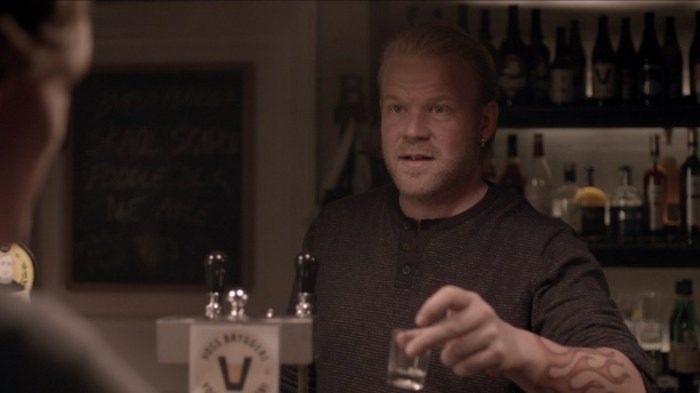
Anders Baasmo Christian in REVENGE

Revenge is uniformly well-acted, but Anders Baasmo Christian, as Bimbo the bartender, is exceptionally good.  Just keep your focus on Bimbo.  There’s more there than initially meets the eye.  And Bimbo’s relationships with both Rebekka and Morten are very conflicted and complicated.

The ending is satisfying, and Morten’s ultimate fate is unexpected.  Revenge is one of the world cinema high points at Cinequest.

Cinequest: THE LAST WORD

THE LAST WORD
THE LAST WORD

In the comedy The Last Word, Shirley MacLaine plays a control freak of absolutely unstoppable will. This is a person who is obsessed with getting her own way on even the most inconsequential detail. She is living a wealthy retirement, having been forced out of the company she founded when her behavior becomes too unbearable for everyone else. Facing her mortality, she decides to employ an obituary writer (Amanda Seyfried) to favorably pre-write her obit. The challenge, of course, is that no one – family members, former co-workers, anyone – has anything nice to say. This sets up an Odd Couple comedy until it becomes an Odd Trio when Harriet seeks to improve her obit profile by mentoring a disadvantaged nine-year-old (AnnJewel Lee Dixon).

Often contrived, The Last Word isn’t a masterpiece, but it has three things going for it:

  • Shirley MacLaine is in full willful grandeur, and her performance is tour de force.
  • Supporting players: Anne Heche is priceless in a “she is your daughter” scene. AnnJewel Lee Dixon is a force of nature herself, kind of a Shirley Mini-Me. Philip Baker Hall is a wonderful match for Maclaine. Thomas Sodoski is always appealing.
  • The remarkably smart soundtrack, which almost becomes a character of its own.

I did also appreciate the brief homage to Reservoir Dogs, the slo-mo power stride with sunglasses (pictured above).

I saw The Last Word at Cinequest at a screening with director Mark Pellington, who noted that The Last Word took 25 days to film. Crediting his music supervisor for finding obscure and affordable songs, he said, “the music works on an infectious level”. Describing the scene where the three actresses take a moonlit dip in a pond, he said, “I love that their laugh deflates the symbolism of it”. His favorite scene was the obne when Philip Baker Hall tells Shirley MacLaine, “I knew what I was getting when I married you”, which inspired Pellington’s next movie Nostalgia (now in post-production).

Cinequest: THE TWINNING REACTION

THE TWINNING REACTION

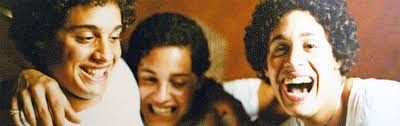
The startling and moving documentary The Twinning Reaction tells the story of a Mad Men-era research project and its profound human impact. To perform a longitudinal study of nurture vs. nature, researchers INTENTIONALLY separated identical twins and placed them with families that the researchers kept in the dark.  The placements occurred AFTER the twin babies had bonded together in the crib for many months.  Legally and ethically sketchy at the time, this is monstrous by today’s standards, and, in fact, caused harm to the adoptees.

Somehow, some of these twins learned the truth as adults and located their birth siblings.
In The Twinning Reaction, we meet three sets of separated identical siblings.  Because we meet the subjects of the study, the effects of separation are clearly apparent and highly personalized.

Writer-director Lori Shinseki has found an amazing story and source material to match.  She weaves it into a coherent and compelling story.  Only 52 gripping minutes long, The Twinning Reaction’s world premiere is at Cinequest.

Cinequest: THAT TRIP WE TOOK WITH DAD

THAT TRIP WE TOOK WITH DAD

The German dramedy That Trip We Took with Dad reminds the American audience that Iron Curtain-style communism was NOT monolithic.  The story takes place during a significant historical moment, when the Prague Spring was slammed shut by the Soviet invasion in August, 1968.  Two Romanian brothers are taking their dad to a surgical procedure, which necessitates a road trip from Romania through Hungary, Czechoslovakia and into East Germany.

The primary point of view is from one of the brothers, a young doctor.   Feeling responsibility beyond his years, the  doctor is very, very practical.  He will do what it takes to protect his father and brother, even if it means the distasteful task of informing to the secret police.

His younger brother is a naive artist who keeps criticizing OTHER Eastern European commie regimes in the knuckle-headed belief that the Romanian commies will leave him alone.  The father is a once-true believer who now blames communism for the death of his wife.

Since the brother and the father are likely to blurt out the most provocative thing at any moment, each border crossing becomes dreadfully tense for the doctor – and for the audience.  As with any Odd Couple (or Odd Trio) road trip, there is also humor.

That Trip We Took with Dad is a social and political satire of Iron Curtain communist societies.  Our doctor also encounters some West German lefties who naively reject Western capitalism for its exploitation and inequality, ignoring or apologizing or minimizing the lack of free expression behind the Iron Curtain.

The family in the movie is Romanian of German ethnicity, and the story stems from writer-director Anca Miruna Lazarescu’s own family. Her introduction of the film for Cinequest is on this post just below the trailer.

Cinequest: THE TEACHER

THE TEACHER
THE TEACHER

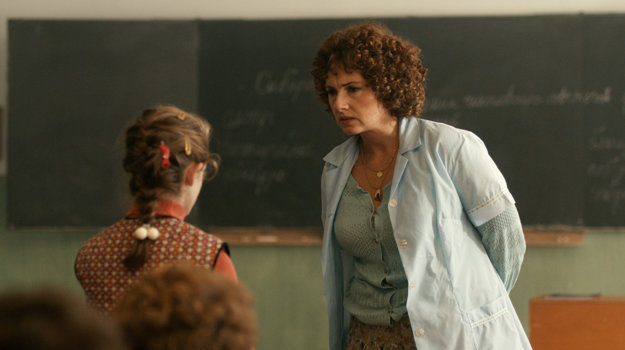
In the superb drama The Teacher, it’s the mid-1980s and the Iron Curtain is still defining Czechoslovakia; (The Teacher is a Czech movie in the Slovak language). The title character’s position as a high school teacher makes her a gatekeeper to the children’s futures, and she’s unaccountable because she’s a minor Communist Party functionary. Wielding blatant academic favoritism and even overt blackmail, she uses the advantage of her political status for her own petty benefit – coercing shopping errands, car rides, pastries and other favors from the parents of her students.  Finally, she causes so much harm to one student that some of the parents rebel and seek her ouster.

Will the other parents support them?  What of the parents who benefit from the regime?  And what of the majority of the parents who must decide whether to risk their own futures?  The risk is real: the regime has already reassigned one parent, a scientist, to a menial job after his wife had defected.

The Teacher benefits from a brilliant, award-winning performance from Zuzana Mauréry in the title role.  What makes this character especially loathsome is that she’s not just heavy-handed, but grossly manipulative. Mauréry is a master at delivering reasonable words with both sweet civility and the unmistakable menace of the unspoken “or else”.

The acting from the entire company is exceptional, especially from Csongor Kassai, Martin Havelka and the Slovak director Peter Bebjak as aggrieved parents. Writer Petr Jarchovský has created textured, authentic characters. Director Jan Hrebejk not only keeps the story alive but adds some clever filmmaking fluorishes as he moves the story between flashbacks and the present.

The Teacher is one of the highlights of Cinequest 2017.

Cinequest: SWEET GIRLS

SWEET GIRLS
SWEET GIRLS

In the dark, dark Swiss comedy Sweet Girls, the two teenage besties are lazy and unmotivated – even by teenage standards.  They will do ANYTHING to avoid an entry-level job that might plunge them into the adult workaday drudgery that they despise.  Left to their own devices with a deadline looming, the two  take unseemly advantage when an elderly woman dies in their apartment building.  Absurdly self-involved, the two start harvesting all the apartment building’s elderly in an absurdly harsh scheme.  Think Arsenic and Old Lace and Sweeney Todd.

Both girls are brats of the first order, but Elodie, the ringleader, also has an experience in her past which has scarred her feelings about the geriatric set.  Neither is a sympathetic character.  The humor here comes from the absurdist plot and from the social satire, which is probably more accessible to a Western European audience.

Cinequest: PRODIGY

PRODIGY
PRODIGY

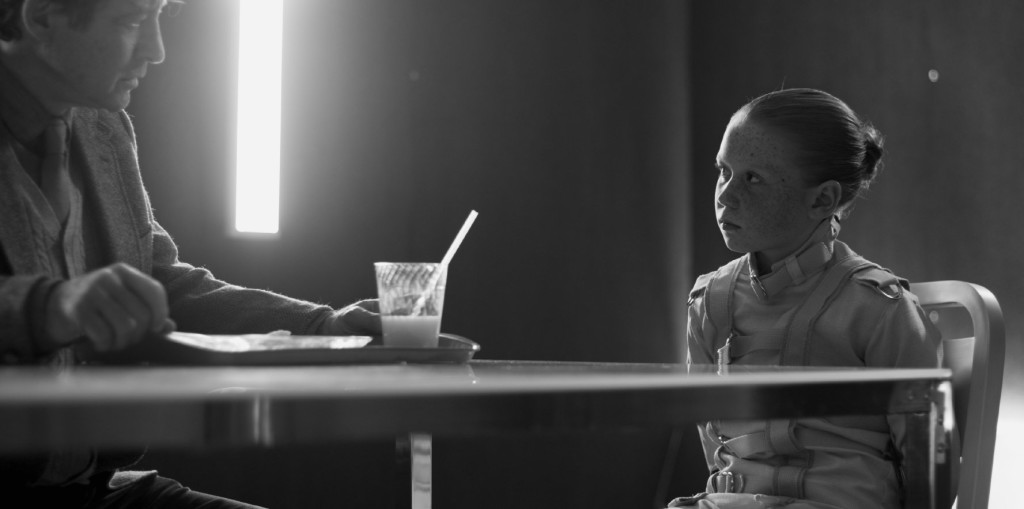
The psychological thriller Prodigy begins with a psychologist (Richard Neil) being brought to a secret government “black site” to interview a dangerous prisoner.  When he receives an orientation, he and we expect to see a superhuman sociopath like Hannibal Lector.  But he enters the secure room to face a freckled-face nine-year-old girl (Savannah Liles).  Her arms are pinned to her chair with restraints.  We learn that there is an understandable reason for this.

She is abnormal in every way – in her super intelligence, in her telekinetic powers and in her capacity for performing monstrous and lethal acts.  The two embark on a game of wits with very high stakes.  There’s a deadline (literally) so the game is also a race against the clock.

It’s the first feature for writer-directors Alex Haughey and Brian Vidal, and Cinequest hosts Prodigy’s world premiere. Haughey and Vidal have bet their movie, in large part, on the performance of a nine-year-old actor.  Savannah Liles is exceptional as she ranges between a very smart little girl and a monstrous psychopath and between a vulnerable child and a person who has made herself invulnerable.  It’s a very promising performance.

In the Cinequest program notes, Pia Chamberlain describes Prodigy as “reminiscent of a cerebral episode of the Twilight Zone, which is pretty apt.  Just like the best of Rod Serling, Prodigy’s compact story-telling takes us to an environment that we can recognize, but which has different natural laws than the ones under which we operate.

Filmmakers have shocked us before with the juxtaposition of innocent looking children and their heinous deeds  Sometimes those children have been created fundamentally evil (The Bad Seed, Rosemary’s Baby, The Omen) and sometimes possessed by evil (The Exorcist).  Prodigy takes a different tack – exploring how a trauma can produce monstrous behavior and whether evil behavior is reversible.

Prodigy is a thinking person’s edge-of-the-seat thrill ride.  I’m looking forward to the next work from Haughey and Vidal.  Note that this trailer is in color, but the version of the movie that I screened is in black and white.

Cinequest: PAINLESS

painless1

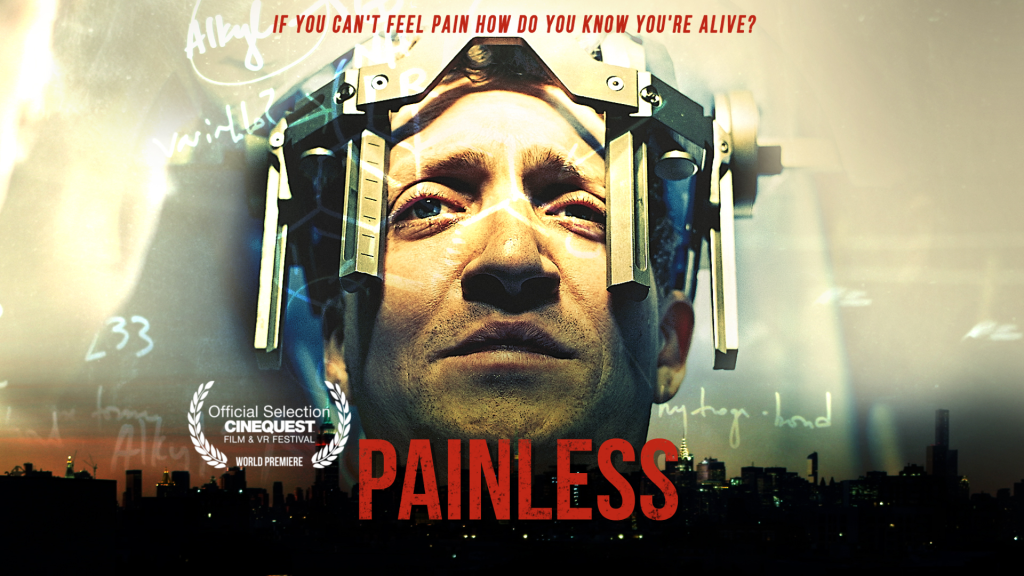
In writer-director Jordan Horowitz’ first narrative feature, Painless, he brings us a wholly original premise – a man who cannot experience physical pain. And here’s another twist – freedom from pain is a BAD thing. Pain does serve an important purpose by alerting us to our own injury and illness. The protagonist, Henry (Joey Klein) is obsessed with finding a solution to his condition.

Henry lives a solitary existence as an underground scientist, who makes his living by manufacturing recreational designer drugs. Self-taught, he has become a genius at diagnostics, and the audience will enjoy the Sherlock Holmes moments when he surprises someone by correctly nailing their medical condition. His obsession drives him to traffic with a disgraced medical researcher, and risk a sketchy drug trial. Along the way, he meets a very appealing free spirit (Evalena Marie) who seeks to distract him from the totality of his obsession.

Of course, the idea of a character obsessed with finding a cure for NO pain, when the global pharmaceutical industry is basically built on the quest for the opposite, is brilliantly absurdist. But Horowitz, as the director, gets the audience to buy in right away.

Joey Klein superbly brings alive both Henry’s eccentricities and the drive that masks his loneliness. It’s an excellent performance.

Desperation leads to obsession and, finally, to self discovery. Cinequest hosts the world premiere of Painless.

Cinequest: QUALITY PROBLEMS

QUALITY PROBLEMS
QUALITY PROBLEMS

The remarkably successful dramedy Quality Problems plunges us into a contemporary world that most of us in the sandwich generation recognize – a life so busy that  the relative importance of our stress-inducers can blur.   Something like the cake for your kid’s birthday party can seem as important as paying the bills or dealing with an aging parent.   Until cancer reshuffles the deck.  Quality Problems‘ insights in navigating modern life are accessible because it’s so damn funny.

Bailey (Brooke Purdy) and Drew (Doug Purdy) are a couple in their early forties with two school-age kids. Each is  comfortable taking on one child-rearing or domestic task while handing off a competing responsibility to their partner.  Each knows – and accepts – what the partner is – or is NOT – good at.  Both have wicked senses of humor, and they are affectionate and even playful.  Their relationship has weathered the usual financial and parental challenges, along with an episode where Bailey beat back breast cancer.

Brooke Purdy wrote the screenplay and also co-directed with Doug Purdy.  The breezy banter between characters  is often flat-out hilarious.  This is not sitcom-grade humor, it’s much closer to a Hawksian screwball comedy.  The characters deal with cancer and parental dementia with a dark humor that is realistic and funny.

Bailey’s single neighbor and bestie Paula (Jenica Bergere) is an essential member of the family’s support structure, but Paula and Drew loathe each other.  Chained together because of their attachment to Bailey and the kids, every interaction sparks a new round of insults.  This isn’t good-natured teasing –  the jibes, in particular about his job and her reproductive health, are aimed to hurt.  The Paula-Drew relationship adds some edginess to the mix and contributes to the film’s authenticity.

Watch for an uncredited cameo by the prolific and versatile character actor Alfred Molina (Raiders of the Lost Ark, Love Is Strange). Veteran Chris Mulkey is excellent as Bailey’s dad, who is sinking into dementia.

Quality Problems is the directing debut for Brooke and Doug Purdy, and its world premiere is at Cinequest, where  I expect it to be an audience favorite.