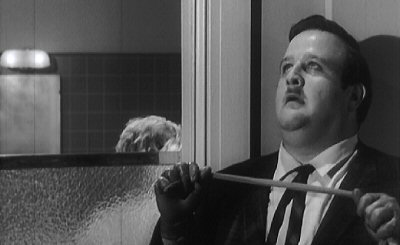
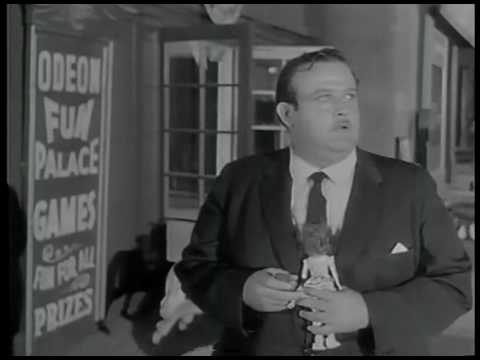
This Friday night, Turner Classic Movies will air the 1964 serial killer movie The Strangler, the masterpiece of director Burt Topper, who specialized in low-budget exploitation movies. It’s on my list of Overlooked Noir.
First, we see that lonely lab tech Otto Kroll (Victor Buono) is twisted enough to murder random women and then return to his lair to fondle his doll collection. Then we learn his motivation – he dutifully visits his hateful mother (Ellen Corby – later to play Grandma Walton) in her room at the convalescent home; she heaps abuse on him in every interaction. Pretty soon, even the audience wants to kill Mrs. Kroll, but Otto sneaks around taking out his hatred for his mom by strangling other women.
Because Otto is outwardly genial to a fault, it takes a loooong time to fall under the suspicion of the cops. The character of Otto and Buono’s especially brilliant and eccentric performance elevate The Strangler above its budget and launches it into the top rank of serial killer movies.
Victor Buono and Ellen Corby in THE STRANGLER
The Strangler, which plays occasionally on Turner Classic Movies, is NOT available for rent from Netflix or streaming providers. You can buy the DVD from Amazon or find a VHS on eBay.
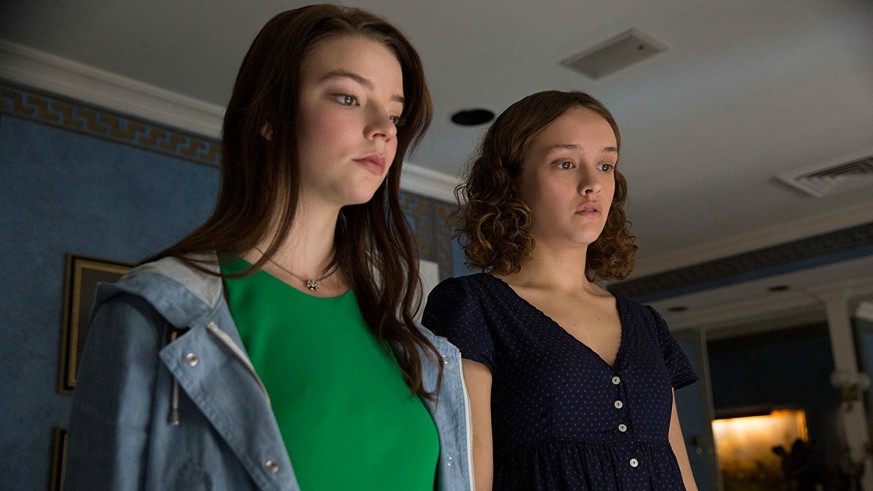
The psychological thriller Thoroughbreds is a witty and novel exploration of sociopathy. The story is about two teen daughters of the Connecticut super-rich: Amanda (Olivia Cooke – so good in Me and Earl and the Dying Girl) and Lily (Anya Taylor-Joy). Although the girls have known each other since early childhood, it turns out that Amanda’s mom, at her wit’s end, has paid for a “play date” with Lily. This seems like a mismatch, but the two bond and then scheme to murder Lily’s odious step-father, Mark.
Amanda admits that she doesn’t feel emotions. That being said, she is very perceptive and self-aware about her lack of feelings. Although she has an Asberger’s affect, she has learned to mimic emotional behavior. Amanda has shocked the community with a disturbing act and has been socially ostracized.
Lily, on the other hand, is at first glance a normal teen – normal for the over-privileged, that is. It turns out that she has her issues, too. In the film’s biggest understatement, one girl says to the other, “empathy not your strong suit”.
Thoroughbreds is the writing and directing feature debut for Cory Finley. Although it has its obvious similarities to psychological thrillers in the vein of Strangers on a Train, this film is not so much about the plot as an exploration of these two personalities Finley has taken two types of sociopaths and combined them into a very original match-up. For example, one of the girls is definitely a very high-functioning borderline personality – but she’s not the one who has been diagnosed as such.
As we are immersed in the story, we focus less about whether they’re going to kill Mark and more on which girl is more disturbed.
Both Cooke and Taylor-Joy deliver fine performances. The late Anton Yechin appears in a very funny role as the Connecticut suburbs’ bumbling bottom-feeder.
Paul Sparks is excellent as the repellent step-dad Mark. In Mark, Finley has crafted a character who excels in business and his many hobbies (riding, tennis, kendo), each of which he pursues obsessively. He is the only character who has a very clear and accurate analysis of Lily’s personality. Mark is the guy who outsiders would see as a high-achiever in many fields, even though he’s gone beyond the pale with his mega-rowing machine and monthly juice purges. But once we see his domination and control of Lily’s mom and the creepy sexual undertones of his relationship with Lily, we want him to go.
I had been eager to see Thoroughbreds since I first watched this deliciously noirish trailer. It was worth the wait. Thoroughbreds is a very promising calling card by Cory Finley.
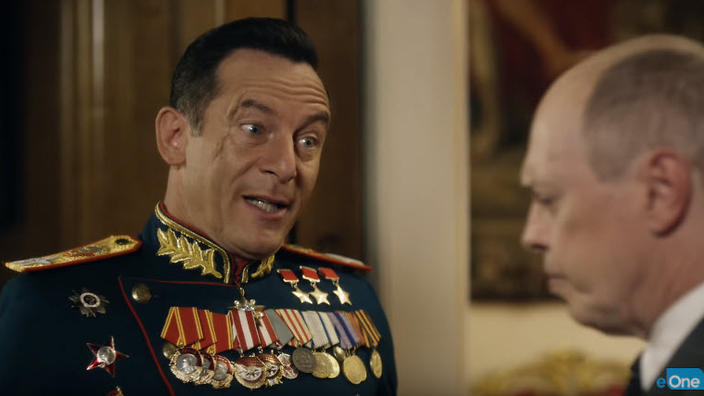
Jason Isaacs and Steve Buscemi in THE DEATH OF STALIN
One might not expect the death of Josef Stalin and the subsequent maneuvering of his cronies to make for a savagely funny movie, but that is exactly what writer-director Armando Ianucci has accomplished in in The Death of Stalin. In his Veep and In the Loop, Ianucci has proved himself an expert in mocking the ambition, venality and flattery of those reaching for power. In The Death of Stalin, he adds terror to his quiver of motivations, and the result is darkly hilarious.
Serving Stalin was a high-wire act. By the end of Stalin’s Great Terror, everyone still standing in the Soviet leadership had survived by flattering Stalin and by loyally carrying out every Stalin command, no matter how misguided and/or murderous. Given that the slightest misstep – or even a wholly imagined fragment of Stalin’s paranoia – could lead to a summary bullet-in-the-head, this was no small achievement. These may have been the most powerful men at the very top of a superpower, but they have all been traumatized into extreme caution by years of fear.
For example, when Stalin suffers a cerebral hemorrhage and falls to the floor, his guards are afraid to burst into his room. When Stalin is discovered on the floor by his housekeeper, the regime’s top leaders gather around him and decide on next steps. The first question is whether to call a doctor, because they fear that if Stalin wakes up and finds that someone else has made a decision, he will have them executed. (Once they get past that, they must work around the fact that Stalin has already killed or exiled all the competent doctors in Moscow.)
Of course, it would be absurd for Stalin’s inner circle to refrain from calling a doctor for hours and hours. But it really happened. So did all of the other key occurrences in the movie, although the events were compressed from the real six months into a three-day movie plot.
This cast is brilliant. Steve Buscemi is cast as Nikita Kruschev and proves to be an inspired choice. Jason Isaacs, with a ridiculously broad (but historically accurate) chest full of medals, is especially delightful as Field Marshal Zhukov. Michael Palin, as Molotov, has one of the best bits as he deadpans political correctness while figuring out whether he can admit that the sudden release of his imprisoned wife is really good news. Each one of the actors – Simon Russell Beale, Olga Kuryenko, Paddy Considine, Jeffrey Tambor, Andrea Riseborough – gets to shine with Ianucci’s dialogue.
This is gallows humor from the highest of scaffolds. The Death of Stalin is an insightful exploration of terror – and hilarious, too.
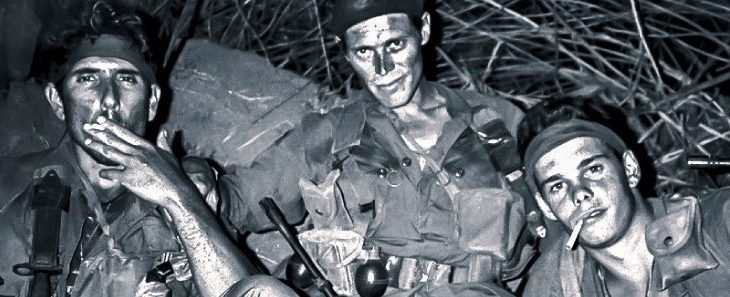
Brothers in Arms is a documentary on the making of Platoon, directed by Paul Sanchez, who played Doc. Platoon, of course, won the Best Picture Oscar and launched the careers of many actors in its young cast. Except for Tom Berenger, this was the first movie job for most of them. including Charlie Sheen, Johnny Depp and Willem Dafoe.
Director Oliver Stone, a Vietnam vet himself, assembled the cast two weeks before filming and put them through basic military training in the Philippine jungle under real military trainers. The cast developed an usual bond during that process, as well as in coping with the mercurial Stone.
In Brothers in Arms, we get to hear from the actors (except for Dafoe, who was making a movie in South Africa) and the military advisers (but not from Oliver Stone). There plenty of entertaining anecdotes and some insights into the filmmaking.
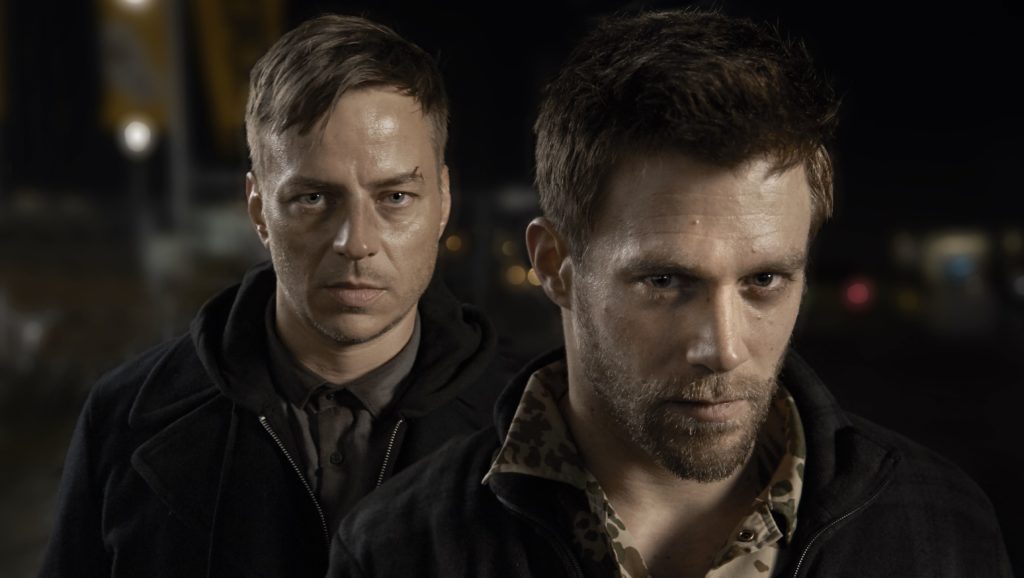
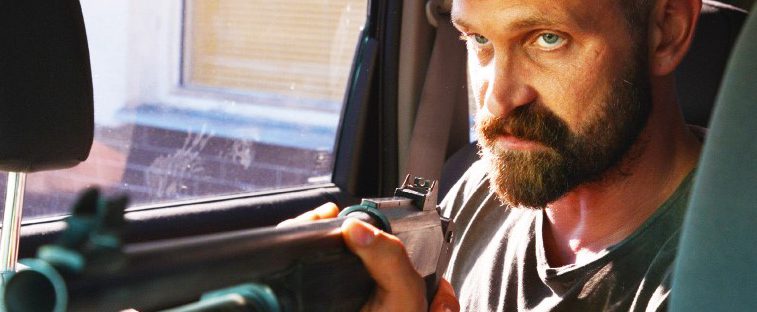
In the intense German thriller Berlin Falling, Frank (Ken Duken) is a troubled vet hoping to reunite at Christmas with his estranged wife and kid. But he picks up the hitchhiker Andreas (Tom Wlaschiha of Game of Thrones), who turns out to be any contemporary European’s worst nightmare (exactly what kind of nightmare is revealed at the end). Andreas subdues Frank with a highly personalized threat and forces him him to engage in a horrific terrorist attack, complete with its own chilling Isis video. It looks like there is no way out for Frank, and Berlin Falling ticks on like a time bomb to its uncompromising and violent conclusion.
With its comments on terrorism, immigration and xenophobia, Berlin Falling covers much of the same ground as this year’s German Oscar submission, In the Fade, but with a huge plot twist. It’s the writing-directing feature debut for actor Ken Duken, who plays Frank. It all works as a nail-biter, but it’s a bit exhausting. I saw Berlin Falling at Cinequest.
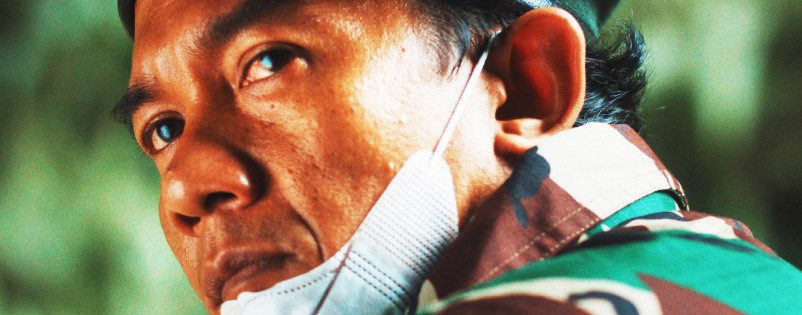
Skull, an absolutely bizarre film, is intended to be Indonesia’s first sci-fi film. Opening with a beautiful drone shot, Skull lurches forward with bits of mystery, romance, chases and shootouts until its “science unleashes the end of the world” finish.
The discovery of a giant skull threatens the underpinnings of many scientific theories and results in an international secret research project and a coverup by the Indonesian government. Ani ( Eka Nusa Pertiwi), a young woman at the research project is about to become a victim of the coverup when her killer-to-be is whacked by Yos (played by writer-director Yusran Fuadi), and the two escape on a motorcycle roadtrip through the Indonesian hinterlands, ending up with Yos’ mentor in a watchtower high above the jungle.
The frenetic pacing screeches to an abrupt halt while the three banter in front of a static camera for maybe ten minutes – it’s not at all a bad scene, just jarringly different than the pace of the rest of the film. The mentor gets in a couple sniffs of Ani’s hand, then rest of the assassins arrive and there’s a shootout. Afterwards, there’s a visit to a philosopher who might have the key to the mystery.
Along the way, we have a SWAT team wearing skull masks, an exercise in mass voting by text (but is it hacked?) and a character exclaiming, “Dried Shit!”. This paranoid thriller finally concludes with a Pandora’s box ending with odd, but very effective special effects. Skull is also notable for its vivid colors and terrible translation in the English subtitles.
I saw Skull at a Cinequest screening with the cast and crew. Yusran Fuadi made the film in 128 days of shooting over more than three years on 40 different locations in Java. Each time he could save up $180 from his paycheck as a lecturer, he would gather the crew and shoot some more of the movie. He said his major direction to leading lady Eka Nusa Pertiwi was a plea not to get pregnant in the next three years.
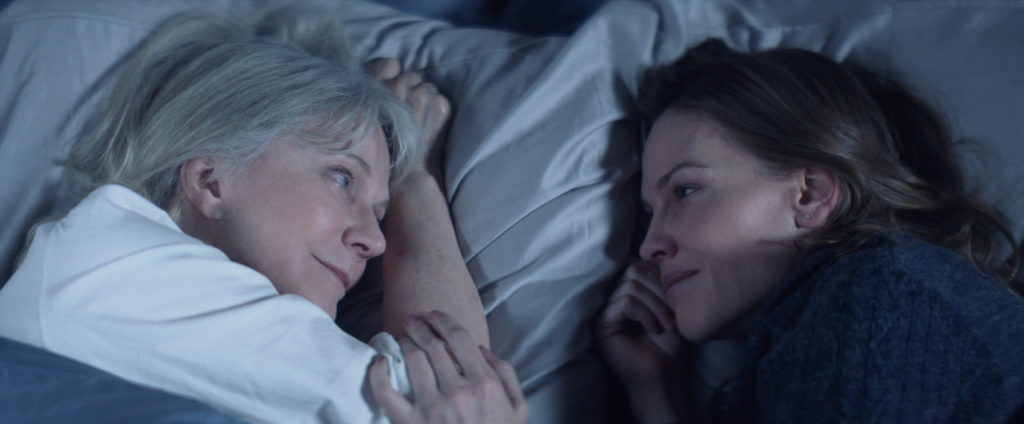
WHAT THEY HAD Blythe Danner and Hilary Swank star as Ruth and Bridget Keller in WHAT THEY HAD, a Bleecker Street release. Photo courtesy of Bleecker Street
In the family drama What They Had, two siblings (Hilary Swank and Michael Shannon) face their mom (Blythe Danner) sinking into Alzheimer’s, and their father (Robert Forster) refusing to take action. To heighten the pressure, the out-of-town daughter wants to give the old folks more slack than does the local son. He’s been dealing with this situation up close, and he’s fed up. The dad is used to always being in charge, and he doesn’t cope well with needing help.
Despite the subject, What They Had is not a depressing movie, mostly because of the sunniness of Danner’s character. This is a character-driven story that benefits from this stellar cast. This is the first feature for writer/director Elizabeth Chomko, and she delivers an authentic and well-crafted story.
I saw What They Had at Cinequest. An October 18, 2018 release is planned. Here’s a clip.
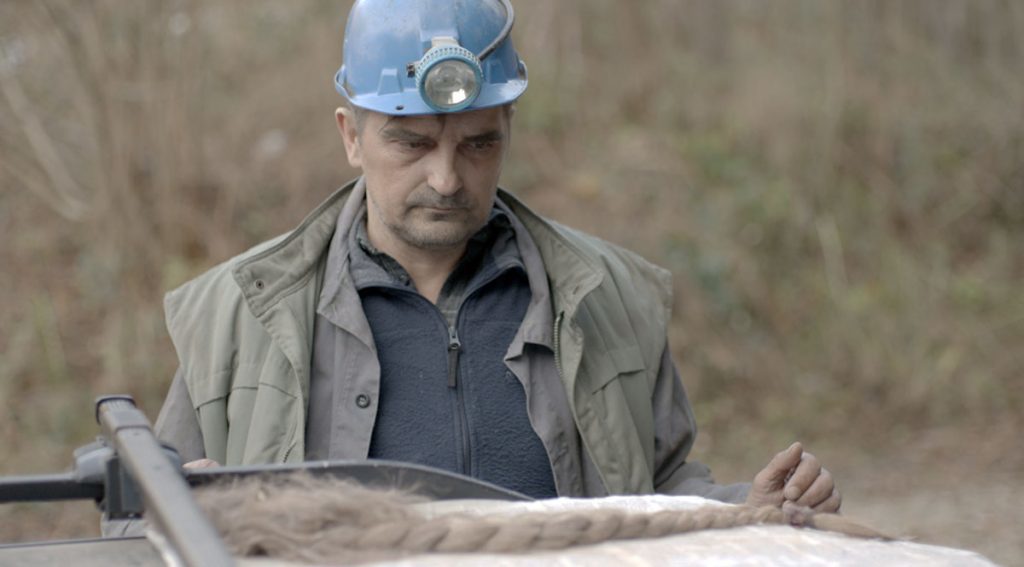
In the gripping Slovene drama The Miner (Rudar), the experienced miner Alija (Leon Lucev) is tasked with checking out an abandoned mine before it is permanently sealed. No one wants anything found in the old shaft, let alone anything controversial. But Alijah is a man burdened by a great sense of duty. As a Bosnian immigrant, he has also been seared by the Bosnian genocide.
The movie starts out as a mystery and urns into a psychological thriller. Indeed, [MINOR SPOILER] the mine that has been closed since 1945 is revealed to contain a mass grave. Embued with the Bosnian resolve to “find them all”, Alijah is not about to cooperate in the coverup that his employer and the Slovenian government desire. Alijah is a man of few words, but he is eloquent when he relates the family story to his adult daughter. The Miner is based on a true story.
The writer-director is Hannah Antonina Wojcik Slak, and The Miner is her third feature.
I saw The Miner at Cinequest. Cinequest’s international film scout Charlie Cockey specializes in Eastern European cinema and brought this gem to the festival. Slak won Best Director and Lucev won Best Actor at the Slovene Film Festival, and The Miner was Slovenia’s submission to the Oscars.
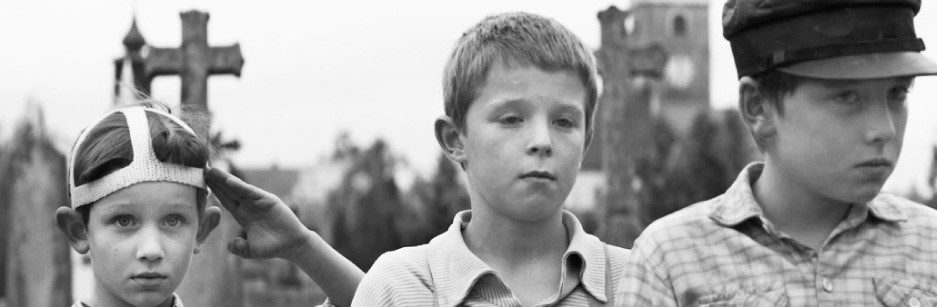
The excellent Czech historical drama Barefoot is from director Jan Sverák, who won an Oscar for Kolya. It’s the coming of age story of a small boy named Eda and is set during World War II. The local puppets collaborating with the Nazis make it impossible for Eda’s father to stay in the city, so he moves his family to his rural home village.
In the countryside, Eda develops a gang of buddies and meets his mysterious uncle Wolf. In the city, Eda’s father had been courageous – even risking his life – to undermine the Nazis; but, in the village, the father is completely submissive to his own father and the rural extended family.
The war is in the background, occasionally protruding into the forefront. The Germans are on their heels and a Russian victory is inevitable, but the Germans are still in control and dangerous.
We follow the story through the boy’s lens, and there’s an effective balance of humor and drama. Whether in wartime or peacetime, a boy must grow and learn life lessons and form his character.
I saw Barefoot at Cinequest, where Director of Programming Mike Rabehl secured the rare black-and-white director’s cut. The black-and-white is splendid, and there’s a sleigh ride scene that is magical.
Barefoot, which is way better than the Oscar winner Kolya, is another gem from Cinequest’s international film scout Charlie Cockey. It doesn’t yet have distribution in the US, but I’ll let you know when it’s available to US audiences.
In the neo-noir Slovak thriller The Line (Ciara), Adam’s (Tomas Mastalir) life is about to be changed by history. The Schengen agreement, which opens the borders between the European nations, is about to be implemented. That’s a problem for Adam, who leads a crew of smugglers who sneak Ukrainian cigarettes through Slovakia to Austria and other European markets. First, there’s no longer going to be any market for smuggling anything out of Slovakia. Second, the border between Slovakia and the Ukraine is going to be hardened, so he’s no longer going to be able to source anything from the Ukraine. What was going to be his last big job goes awry, leaving him in hopeless hock to a ruthless Ukrainian gangster. So he’s going to have to take a chance on a very dangerous job.
We see Adam’s crew equipping vehicles with hidden compartments and making bribes at the border. One crew member sends off a load of bootleg cigarettes with “Cancer is headed to Austria”.
Adam is one tough mother, a guy who is exceptionally tough even by the standards of movie crime bosses. But he’s under increasing pressure, and that same pressure is incentivizing people he relies on to go sideways on him. At its heart, The Line is a film about betrayal.
It turns out that Adam runs a business started by his mother (Emília Vásáryová), who is herself the most formidable and lethal granny since Livia Soprano or Lillian Gish in The Night of the Hunter. There’s a great scene near the end where Adam and mom experience a shared memory of what happened to his father.
Adam’s wife (Zuzana Fialová) knows him very well. She also knows when to hold her cards and when to fold them.
The Line keeps getting darker – and then even darker – until a major veer at the end. It’s an effective character-driven thriller.
The Line was directed by Peter Bebjak, who acted in the best foreign film at the 2017 Cinequest, The Teacher. The Line was Slovenia’s submission to this year’s Oscars.